



Community hub
Recent from talks
Knowledge base stats:
Talk channels stats:
Members stats:
Tessar
The Tessar is a photographic lens design conceived by the German physicist Dr. Paul Rudolph in 1902 while he worked at the Zeiss optical company and patented by Zeiss in Germany; the lens type is usually known as the Zeiss Tessar. Since its introduction, millions of Tessar and Tessar-derived lenses have been manufactured by Zeiss and other manufacturers, and are still produced as excellent intermediate aperture lenses.
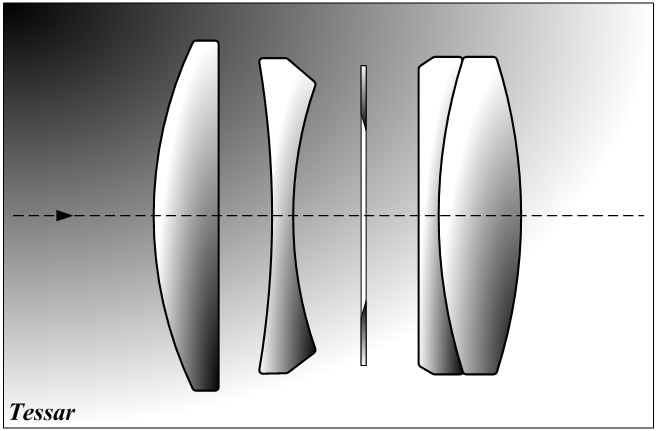
The Tessar design uses four spherical lens elements in three groups, one positive crown glass element at the front, one negative flint glass element at the center and a negative concave flint glass element cemented with a positive convex crown glass element at the rear.
Despite common belief, the Tessar was not developed from the 1893 Cooke triplet design, although it appears the Tessar replaces the single rear element of the Cooke triplet with a cemented achromatic doublet. Instead, the Tessar underwent a parallel evolution from Paul Rudolph's 1890 Anastigmat lens, which had four elements in two cemented groups. Hugh L. Aldis patented the Stigmatic lens line for Dallmeyer in 1895; in one implementation, the front group from the Anastigmat design was modified by adding a narrow air gap, which acted as a positive element and improved zonal correction. Later, Rudolph adopted the same device to modify the Anastigmat design, resulting in the Unar of 1899. In addition, this allowed the photographers to have greater freedom when choosing the lenses. In one implementation, the Unar has four air-spaced elements in four groups, which replaced the two cemented interfaces of the earlier Anastigmat design.
In 1902, Rudolph realized the two cemented interfaces had many virtues, so he reinserted them in the back of his Anastigmat, maintaining the "air gap" of the previous part of the Unar, thus creating the Tessar design (from the Greek word τέσσερα (téssera, four) to indicate a design of four elements) of 1902. The frontal element of the Tessar, like that of the Anastigmat, had little power since its only function was to correct the few aberrations produced by the powerful posterior element. The set of interfaces cemented in the posterior element had 3 functions: to reduce the spherical aberration; reduce the overcorrected spherical-oblique aberration; and reduce the gap found between astigmatic foci.
The first Tessar appeared with a maximum aperture of f/6.3, but by 1917, the maximum aperture had been increased to f/4.5. In 1930, Ernst Wandersleb and Willy Merté from Zeiss developed Tessar lenses with apertures of f/3.5 and f/2.8.
In 1925, E. Wandersleb and W. Merté of Zeiss created the Biotessar consisting of two elements cemented in the front, a single negative element in the center, and three cemented in the rear.
After World War II and the partitioning of Germany, the Zeiss factory at Eisfeld ended up in East Germany; Zeiss Jena developed a popular camera line named the 'Werra', after the Werra river which runs through the town. Many models were equipped with Tessar lenses, which were marked as "Zeiss-Tessar", resulting in legal action from the Zeiss company in Western Germany. For a while the Werra Tessar lenses were marked simply as "T", but eventually they were allowed to market the lenses as "Carl Zeiss Jena Tessar".
Zeiss had strong control over the Tessar design, because Rudolph's patent was very general. In the corresponding U.S. Patent, he claimed:
Hub AI
Tessar AI simulator
(@Tessar_simulator)
Tessar
The Tessar is a photographic lens design conceived by the German physicist Dr. Paul Rudolph in 1902 while he worked at the Zeiss optical company and patented by Zeiss in Germany; the lens type is usually known as the Zeiss Tessar. Since its introduction, millions of Tessar and Tessar-derived lenses have been manufactured by Zeiss and other manufacturers, and are still produced as excellent intermediate aperture lenses.
The Tessar design uses four spherical lens elements in three groups, one positive crown glass element at the front, one negative flint glass element at the center and a negative concave flint glass element cemented with a positive convex crown glass element at the rear.
Despite common belief, the Tessar was not developed from the 1893 Cooke triplet design, although it appears the Tessar replaces the single rear element of the Cooke triplet with a cemented achromatic doublet. Instead, the Tessar underwent a parallel evolution from Paul Rudolph's 1890 Anastigmat lens, which had four elements in two cemented groups. Hugh L. Aldis patented the Stigmatic lens line for Dallmeyer in 1895; in one implementation, the front group from the Anastigmat design was modified by adding a narrow air gap, which acted as a positive element and improved zonal correction. Later, Rudolph adopted the same device to modify the Anastigmat design, resulting in the Unar of 1899. In addition, this allowed the photographers to have greater freedom when choosing the lenses. In one implementation, the Unar has four air-spaced elements in four groups, which replaced the two cemented interfaces of the earlier Anastigmat design.
In 1902, Rudolph realized the two cemented interfaces had many virtues, so he reinserted them in the back of his Anastigmat, maintaining the "air gap" of the previous part of the Unar, thus creating the Tessar design (from the Greek word τέσσερα (téssera, four) to indicate a design of four elements) of 1902. The frontal element of the Tessar, like that of the Anastigmat, had little power since its only function was to correct the few aberrations produced by the powerful posterior element. The set of interfaces cemented in the posterior element had 3 functions: to reduce the spherical aberration; reduce the overcorrected spherical-oblique aberration; and reduce the gap found between astigmatic foci.
The first Tessar appeared with a maximum aperture of f/6.3, but by 1917, the maximum aperture had been increased to f/4.5. In 1930, Ernst Wandersleb and Willy Merté from Zeiss developed Tessar lenses with apertures of f/3.5 and f/2.8.
In 1925, E. Wandersleb and W. Merté of Zeiss created the Biotessar consisting of two elements cemented in the front, a single negative element in the center, and three cemented in the rear.
After World War II and the partitioning of Germany, the Zeiss factory at Eisfeld ended up in East Germany; Zeiss Jena developed a popular camera line named the 'Werra', after the Werra river which runs through the town. Many models were equipped with Tessar lenses, which were marked as "Zeiss-Tessar", resulting in legal action from the Zeiss company in Western Germany. For a while the Werra Tessar lenses were marked simply as "T", but eventually they were allowed to market the lenses as "Carl Zeiss Jena Tessar".
Zeiss had strong control over the Tessar design, because Rudolph's patent was very general. In the corresponding U.S. Patent, he claimed: