
Recent from talks
Mk VII Tetrarch light tank
Knowledge base stats:
Talk channels stats:
Members stats:
Mk VII Tetrarch light tank
The light tank Mk VII (A17), also known as the Tetrarch, was a British light tank produced by Vickers-Armstrongs in the late 1930s and used during the Second World War. The Tetrarch was the latest in the line of light tanks built by the company for the British Army. It improved upon its predecessor, the Light Tank Mk VIC, by introducing the extra firepower of a 2-pounder gun. The War Office ordered 70 tanks, an order that eventually increased to 220. Production was delayed by several factors and only 100 to 177 of the tanks were produced.
The design flaws of the tank, combined with the decision by the War Office not to use light tanks in British armoured divisions, ruled out the use of Tetrarchs in the North African Campaign. The majority of the tanks remained in Britain, although twenty were sent to the USSR as part of Lend-Lease. In early 1941, the Royal Armoured Corps formed three squadrons for use in overseas amphibious operations, one of which was equipped with Tetrarchs. In May 1942, a small number of Tetrarchs formed part of the British force which participated in Operation Ironclad, the invasion of Madagascar. In June 1942, Tetrarchs were attached to the 1st Airborne Division after it was decided that the design allowed its use as an air-portable light tank to support British airborne forces. The Tetrarchs were transported and landed in specially designed General Aircraft Hamilcar gliders. A lack of gliders prevented their participation in the Allied invasion of Sicily in 1943; instead they were attached to the new 6th Airborne Division and became part of the 6th Airborne Armoured Reconnaissance Regiment.
The division used approximately twenty Tetrarchs during Operation Tonga, the British airborne landings in Normandy in June 1944. The tanks were landed by glider, where their appearance caused the Germans to cancel a counter-attack at a key moment in the battle but individually, they did not perform well. Several were lost in accidents and those that did see action proved to be inferior in firepower and armour to the armoured vehicles of the German forces. A few days after the beginning of the operation, the tanks were removed from direct engagement with German armour and used only to provide fire support. By August 1944, most of the Tetrarchs in action were replaced with Cromwell tanks and the remainder were replaced by the M22 Locust in December 1944.
Tetrarchs did not see any further combat and were deemed obsolete by 1946; the last was retired in 1950. There were several variations on the Tetrarch design, including the Alecto self-propelled gun and the Light Tank Mk VIII but none of these were used operationally by the British Army.
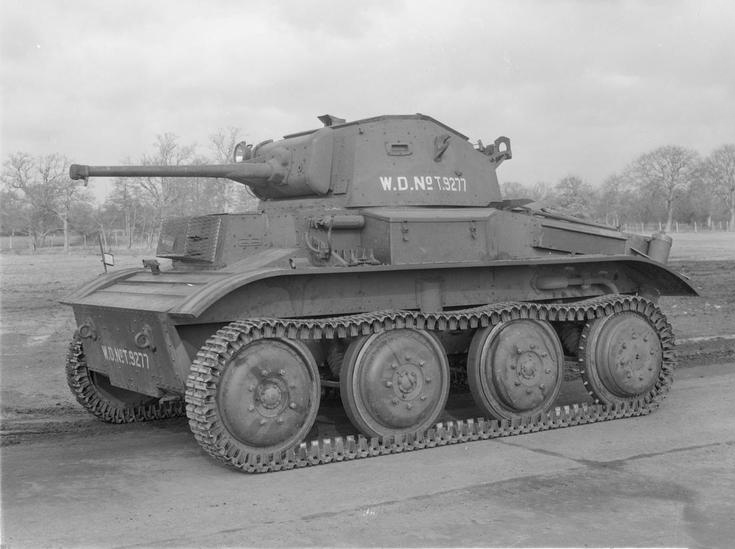
The prototype of the Light Tank Mk VII (A17), nicknamed 'Purdah', was first developed in 1937 by Vickers-Armstrongs as a private venture, and was intended to be sold either to the British Army or to foreign militaries. It was to be the latest in a series of light tanks produced by the company. The tank was designed to overcome the shortcomings of insufficient armament in earlier light tanks that were fitted only with machine guns. Vickers-Armstrong installed on the Mk VIIs a 40 mm (1.6 in) QF 2-pounder main gun paired with a 7.92 mm (0.312 in) Besa machine gun, and mounted the two guns in a two-man turret. The tank had a maximum of 14 millimetres (0.55 in) of armour. The prototype weighed approximately 16,800 lb (7,600 kg) and was powered by a 165-horsepower (123 kW) Meadows engine. Suspension was on eight road wheels, four per side, with no separate driver or idler wheels and it was capable of a 40 miles per hour (64 km/h) top speed. The Mk VII design relied on an unusual steering method and a mechanical system incorporated into earlier Vickers models. The front wheels could be steered to allow for gentle turns by bending the tracks. For sharper turns, the system returned to the conventional method of braking one track to turn the tank; the dual system of turning was designed to lessen mechanical strain on the Mk VII and reduce its power wastage. The suspension system was also a new design that relied on struts with pockets of air for springing and cushions of oil for damping, and each of the wheels was independently sprung.
The War Office examined the design and put the prototype through a series of trials during May and June 1938; the model was tested as a possible "light cruiser" since War Office light tank needs were already met by its predecessor, the Mark VI. The War Office then took the view that the tank was not acceptable as a light cruiser because the Nuffield A13 design offered better speed and obstacle crossing performance. Despite this, it was decided that it was essential for some Tetrarchs to be produced, and it was suggested that they be brought in at the end of the light tank program. Accordingly, the War Office gave the Tetrarch the official General Staff specification number A17, and, in November 1938, accepted it for limited production after requesting a few minor changes which included the fitting of an external fuel tank to increase the tank's range.
The number to be produced was subject to fluctuation as the War Office vacillated in their demand; in July 1938, it requested that 70 of the tanks be produced, then increased the request to 120 after a three-day conference in November. Production was to begin in July 1940, but meanwhile the War Office temporarily returned to its original order of 70 before increasing the number to 100. The number further increased to 220 after Metropolitan Cammell Carriage & Wagon, a company part owned by Vickers-Armstrong that would be producing the tanks, indicated it had already ordered armour plating for that many tanks.
Production of the tank was delayed by a number of factors. The War Office put their order on hold in a post-Battle of France decision to focus military production on infantry and cruiser tanks, due to the poor performance of British light tanks during that battle. Due to the shortage of more suitable tanks, light tanks that were not designed for use against German armour, were nevertheless deployed against them; the resulting high casualties led the War Office to re-evaluate the suitability of the light tank design. The pre-war role of the light tank, that of reconnaissance, meanwhile had been found to be better suited to scout cars that used smaller crews and had better road abilities. Further delays were caused by the bombing raids of the Luftwaffe during May 1941 against the factories where the tanks were assembled.
Hub AI
Mk VII Tetrarch light tank AI simulator
(@Mk VII Tetrarch light tank_simulator)
Mk VII Tetrarch light tank
The light tank Mk VII (A17), also known as the Tetrarch, was a British light tank produced by Vickers-Armstrongs in the late 1930s and used during the Second World War. The Tetrarch was the latest in the line of light tanks built by the company for the British Army. It improved upon its predecessor, the Light Tank Mk VIC, by introducing the extra firepower of a 2-pounder gun. The War Office ordered 70 tanks, an order that eventually increased to 220. Production was delayed by several factors and only 100 to 177 of the tanks were produced.
The design flaws of the tank, combined with the decision by the War Office not to use light tanks in British armoured divisions, ruled out the use of Tetrarchs in the North African Campaign. The majority of the tanks remained in Britain, although twenty were sent to the USSR as part of Lend-Lease. In early 1941, the Royal Armoured Corps formed three squadrons for use in overseas amphibious operations, one of which was equipped with Tetrarchs. In May 1942, a small number of Tetrarchs formed part of the British force which participated in Operation Ironclad, the invasion of Madagascar. In June 1942, Tetrarchs were attached to the 1st Airborne Division after it was decided that the design allowed its use as an air-portable light tank to support British airborne forces. The Tetrarchs were transported and landed in specially designed General Aircraft Hamilcar gliders. A lack of gliders prevented their participation in the Allied invasion of Sicily in 1943; instead they were attached to the new 6th Airborne Division and became part of the 6th Airborne Armoured Reconnaissance Regiment.
The division used approximately twenty Tetrarchs during Operation Tonga, the British airborne landings in Normandy in June 1944. The tanks were landed by glider, where their appearance caused the Germans to cancel a counter-attack at a key moment in the battle but individually, they did not perform well. Several were lost in accidents and those that did see action proved to be inferior in firepower and armour to the armoured vehicles of the German forces. A few days after the beginning of the operation, the tanks were removed from direct engagement with German armour and used only to provide fire support. By August 1944, most of the Tetrarchs in action were replaced with Cromwell tanks and the remainder were replaced by the M22 Locust in December 1944.
Tetrarchs did not see any further combat and were deemed obsolete by 1946; the last was retired in 1950. There were several variations on the Tetrarch design, including the Alecto self-propelled gun and the Light Tank Mk VIII but none of these were used operationally by the British Army.
The prototype of the Light Tank Mk VII (A17), nicknamed 'Purdah', was first developed in 1937 by Vickers-Armstrongs as a private venture, and was intended to be sold either to the British Army or to foreign militaries. It was to be the latest in a series of light tanks produced by the company. The tank was designed to overcome the shortcomings of insufficient armament in earlier light tanks that were fitted only with machine guns. Vickers-Armstrong installed on the Mk VIIs a 40 mm (1.6 in) QF 2-pounder main gun paired with a 7.92 mm (0.312 in) Besa machine gun, and mounted the two guns in a two-man turret. The tank had a maximum of 14 millimetres (0.55 in) of armour. The prototype weighed approximately 16,800 lb (7,600 kg) and was powered by a 165-horsepower (123 kW) Meadows engine. Suspension was on eight road wheels, four per side, with no separate driver or idler wheels and it was capable of a 40 miles per hour (64 km/h) top speed. The Mk VII design relied on an unusual steering method and a mechanical system incorporated into earlier Vickers models. The front wheels could be steered to allow for gentle turns by bending the tracks. For sharper turns, the system returned to the conventional method of braking one track to turn the tank; the dual system of turning was designed to lessen mechanical strain on the Mk VII and reduce its power wastage. The suspension system was also a new design that relied on struts with pockets of air for springing and cushions of oil for damping, and each of the wheels was independently sprung.
The War Office examined the design and put the prototype through a series of trials during May and June 1938; the model was tested as a possible "light cruiser" since War Office light tank needs were already met by its predecessor, the Mark VI. The War Office then took the view that the tank was not acceptable as a light cruiser because the Nuffield A13 design offered better speed and obstacle crossing performance. Despite this, it was decided that it was essential for some Tetrarchs to be produced, and it was suggested that they be brought in at the end of the light tank program. Accordingly, the War Office gave the Tetrarch the official General Staff specification number A17, and, in November 1938, accepted it for limited production after requesting a few minor changes which included the fitting of an external fuel tank to increase the tank's range.
The number to be produced was subject to fluctuation as the War Office vacillated in their demand; in July 1938, it requested that 70 of the tanks be produced, then increased the request to 120 after a three-day conference in November. Production was to begin in July 1940, but meanwhile the War Office temporarily returned to its original order of 70 before increasing the number to 100. The number further increased to 220 after Metropolitan Cammell Carriage & Wagon, a company part owned by Vickers-Armstrong that would be producing the tanks, indicated it had already ordered armour plating for that many tanks.
Production of the tank was delayed by a number of factors. The War Office put their order on hold in a post-Battle of France decision to focus military production on infantry and cruiser tanks, due to the poor performance of British light tanks during that battle. Due to the shortage of more suitable tanks, light tanks that were not designed for use against German armour, were nevertheless deployed against them; the resulting high casualties led the War Office to re-evaluate the suitability of the light tank design. The pre-war role of the light tank, that of reconnaissance, meanwhile had been found to be better suited to scout cars that used smaller crews and had better road abilities. Further delays were caused by the bombing raids of the Luftwaffe during May 1941 against the factories where the tanks were assembled.
Recent media