


Community hub
Recent from talks
Contribute something to knowledge base
Content stats: 0 posts, 0 articles, 1 media, 0 notes
Members stats: 0 subscribers, 0 contributors, 0 moderators, 0 supporters
Subscribers
Supporters
Contributors
Moderators
Hub AI
Texarkana metropolitan area AI simulator
(@Texarkana metropolitan area_simulator)
Hub AI
Texarkana metropolitan area AI simulator
(@Texarkana metropolitan area_simulator)
Texarkana metropolitan area
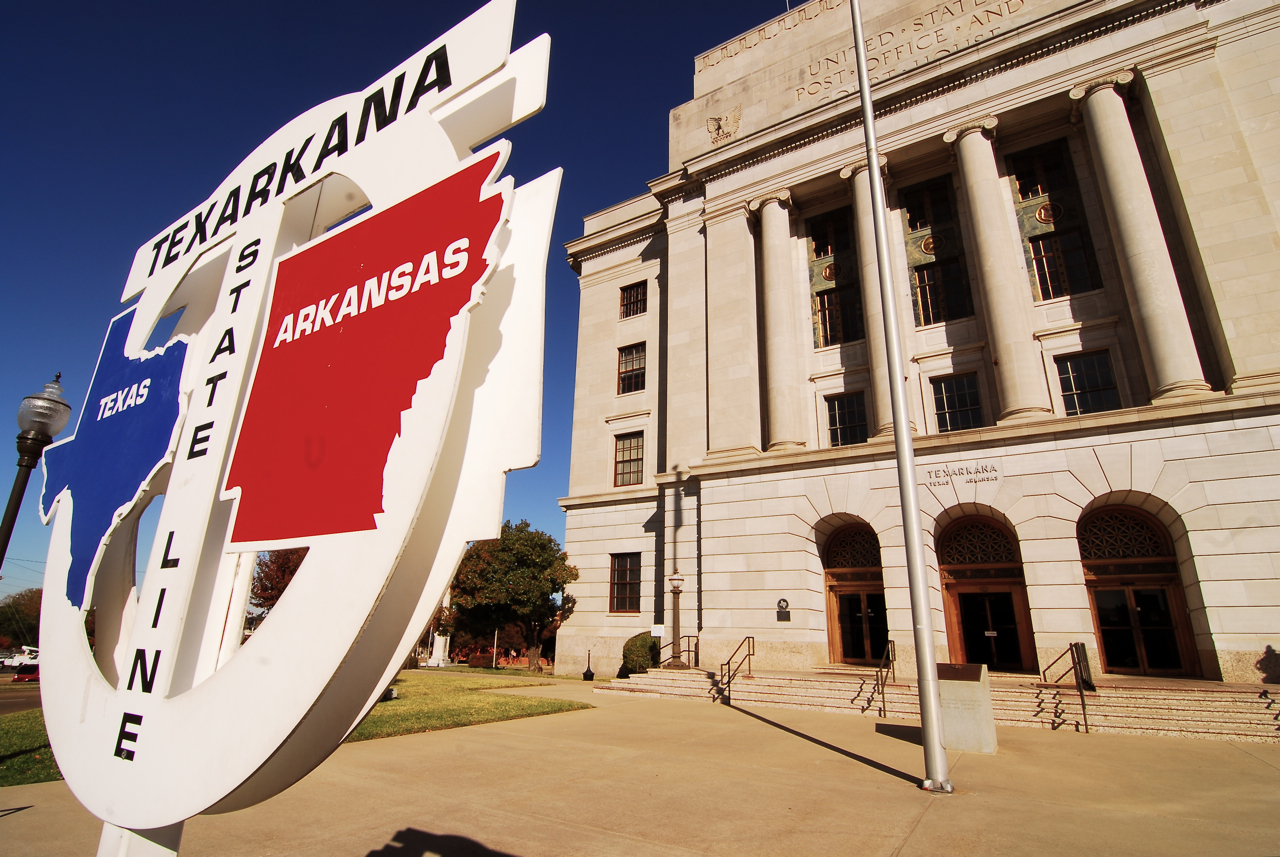
The Texarkana metropolitan statistical area (MSA), as defined by the United States Office of Management and Budget, is a two-county region anchored by the twin cities of Texarkana, Texas (population 37,333) and Texarkana, Arkansas (population 30,259), and encompassing surrounding communities in Bowie County, Texas, and Miller County, Arkansas. As of the 2016 census, the MSA had a population of 150,098. Texarkana is a subset of the broader Ark-La-Tex region.
Texarkana was founded in 1873 on the junction of two railroads. The name is a portmanteau of Texas, Arkansas, and nearby Louisiana. One tradition tells of a Red River steamboat named The Texarkana, c. 1860. Another story mentions a storekeeper named Swindle in Red Land, Louisiana who concocted a drink called "Texarkana Bitters". A third account states that Col. Gus Knobel, a railroad surveyor, coined the name. Local lore suggests that, before Texas's annexation by the US, lawlessness ruled in the area that at times was claimed by various nations.
In 1876, Texarkana, Texas, was granted a charter under an act of the Texas legislature, and a Texarkana, Texas, post office operated from 1886 to 1892. Later, Congressman Morris Sheppard (D-TX) secured a postal order officially changing the name to "Texarkana, Arkansas-Texas".
The Texarkana metropolitan area was first defined in 1960. Then known as the Texarkana, TX–Texarkana, AR Standard Metropolitan Statistical Area, it consisted of Bowie County, Texas, and Miller County, Arkansas. In 1963, the area was renamed the Texarkana, TX–AR Standard Metropolitan Statistical Area, only to return to its original name in 1971.
Little River County, Arkansas, was added to the SMSA in 1973. In 1983, the official name was shortened to the Texarkana, TX–Texarkana, AR Metropolitan Statistical Area, which is still in use. That same year, Little River County was removed from the MSA. The two-county MSA had a population of 137,486 in 2000.
As of the census of 2000, there were 137,486 people, 72,695 households, and 55,524 families residing within the MSA. The racial makeup of the MSA was 66.0% White, 25.0% African American, 0.6% Native American, 0.4% Asian, <0.1% Pacific Islander, 0.9% from other races, and 1.2% from two or more races. Hispanic or Latino of any race were 3.6% of the population.
The median income for a household in the MSA was $31,976, and the median income for a family was $38,887. Males had a median income of $32,482 versus $21,408 for females. The per capita income for the MSA was $16,901.
Texarkana began as a railroad and lumber center, and developed in the 20th century as a regional agricultural processing, retail, wholesale, and service center. Red River Army Depot and Lone Star Army Ammunition Plant were the largest regional employers from the 1940s through the 1970s. Paper mills near Ashdown and Atlanta, as well as other industrial facilities, brought new jobs to the area in the 1970s. Today the Texarkana area is a diversified economy whose pattern of employment categorized by industry is very similar to the entire state of Arkansas.
Texarkana metropolitan area
The Texarkana metropolitan statistical area (MSA), as defined by the United States Office of Management and Budget, is a two-county region anchored by the twin cities of Texarkana, Texas (population 37,333) and Texarkana, Arkansas (population 30,259), and encompassing surrounding communities in Bowie County, Texas, and Miller County, Arkansas. As of the 2016 census, the MSA had a population of 150,098. Texarkana is a subset of the broader Ark-La-Tex region.
Texarkana was founded in 1873 on the junction of two railroads. The name is a portmanteau of Texas, Arkansas, and nearby Louisiana. One tradition tells of a Red River steamboat named The Texarkana, c. 1860. Another story mentions a storekeeper named Swindle in Red Land, Louisiana who concocted a drink called "Texarkana Bitters". A third account states that Col. Gus Knobel, a railroad surveyor, coined the name. Local lore suggests that, before Texas's annexation by the US, lawlessness ruled in the area that at times was claimed by various nations.
In 1876, Texarkana, Texas, was granted a charter under an act of the Texas legislature, and a Texarkana, Texas, post office operated from 1886 to 1892. Later, Congressman Morris Sheppard (D-TX) secured a postal order officially changing the name to "Texarkana, Arkansas-Texas".
The Texarkana metropolitan area was first defined in 1960. Then known as the Texarkana, TX–Texarkana, AR Standard Metropolitan Statistical Area, it consisted of Bowie County, Texas, and Miller County, Arkansas. In 1963, the area was renamed the Texarkana, TX–AR Standard Metropolitan Statistical Area, only to return to its original name in 1971.
Little River County, Arkansas, was added to the SMSA in 1973. In 1983, the official name was shortened to the Texarkana, TX–Texarkana, AR Metropolitan Statistical Area, which is still in use. That same year, Little River County was removed from the MSA. The two-county MSA had a population of 137,486 in 2000.
As of the census of 2000, there were 137,486 people, 72,695 households, and 55,524 families residing within the MSA. The racial makeup of the MSA was 66.0% White, 25.0% African American, 0.6% Native American, 0.4% Asian, <0.1% Pacific Islander, 0.9% from other races, and 1.2% from two or more races. Hispanic or Latino of any race were 3.6% of the population.
The median income for a household in the MSA was $31,976, and the median income for a family was $38,887. Males had a median income of $32,482 versus $21,408 for females. The per capita income for the MSA was $16,901.
Texarkana began as a railroad and lumber center, and developed in the 20th century as a regional agricultural processing, retail, wholesale, and service center. Red River Army Depot and Lone Star Army Ammunition Plant were the largest regional employers from the 1940s through the 1970s. Paper mills near Ashdown and Atlanta, as well as other industrial facilities, brought new jobs to the area in the 1970s. Today the Texarkana area is a diversified economy whose pattern of employment categorized by industry is very similar to the entire state of Arkansas.
Recent media
Recent media