



Community hub
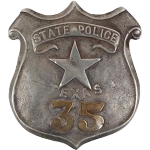
Texas State Police
View on Wikipedia

The Texas State Police (TSP) is a defunct 19th century law enforcement agency that was created following the Civil War by order of Texas Governor Edmund J. Davis. The TSP worked primarily against racially based crimes in Texas, and included black policemen. It was replaced by a renewed Texas Rangers force in 1873.
History
[edit]The Texas State Police was formed during the administration of Governor Davis on July 22, 1870, to combat crime during the Reconstruction Era of the United States. Davis also created the Texas Special Police, State Guard of Texas, and the Texas Reserve Militia, which was the forerunner of the Texas National Guard.[citation needed]
Among Texas State Police members were Captain Jack Helm of DeWitt County, Texas—later murdered by John Wesley Hardin and Jim Taylor during the Sutton–Taylor feud. Another notable member was Leander H. McNelly of the Texas Ranger's "Special Force" division.[1]
Mixed results
[edit]Despite the success of the Texas State Police, the fact that the organization was controlled by Governor Davis and employed African Americans made it very unpopular, especially with former slave owners.
Flawed
[edit]In September 1870, local citizens of Hill County, Texas refused to cooperate with the TSP in moving against the Kinch West gang; and in December 1870 Hill County citizens blocked the TSP from arresting the killers of a freedmen couple.[2]
Some state police members certainly deserved criticism. Captain Helm, for instance, was accused of murdering prisoners; he was fired, and a warrant was issued for his arrest. Others committed crimes for which the charges were dropped as soon as headquarters was advised. James Davidson, the chief of the state police, embezzled $37,435 and disappeared in 1872.[2][3]
Disbanded
[edit]On April 22, 1873, the law authorizing the state police was repealed. Former policeman Leander H. McNelly and at least 36 other state police members then became officers in the reincarnated Texas Rangers force.[1]
Fallen officers
[edit]Ten members of the TSP are known to have been killed in the line of duty:{ODMP record}.[4] In five separate incidents six members of the TSP were killed and two wounded. Likewise, two former TSP members were killed as law officers:
- On January 22, 1871, when being transported through Freestone County on way to trial for the murder of Waco City Marshal and former TSP Policeman Laben J. Hoffman on January 6, 1871, prisoner John Wesley Hardin escaped and killed Texas State Police Private Smalley while Lt. Stakes and Anderson were gathering wood.
- On October 6, 1871, John Wesley Hardin killed Texas Special Policeman Green Paramore and injured TSP John Lackey.[5]
- On July 26, 1872, Hardin wounded Texas State Policeman Sonny Speights in the arm with a derringer pistol, in Hemphill, Texas.
- On July 18, 1873, Hardin was involved in the Taylor-Sutton feud and killed former Texas State Police Captain and sheriff of Dewitt County, Jack M. Helms.
- Four other TSP members died as a result of a shootout on March 14, 1873. The Texas State Police officers were Wesley Cherry, Jim Daniels, Andrew Melville, and State Police Captain Thomas Williams.
Legacy
[edit]The Texas State Police was disbanded on April 22, 1873. In 1935, the Texas Department of Public Safety was formed to serve as one of the several state police forces (the TDPS predecessor was the Texas Ranger Division formed by the Texas Legislature as McNelly's "Special Force of Rangers" and the "Frontier Battalion" in July 1874).[citation needed]
Other state agencies, including the Texas Attorney General's Office, Texas Parks and Wildlife Department, and the Texas Alcoholic Beverage Commission identify as state police yet provide state police services within their areas of responsibility, and informally use the term "State Police" on their uniforms and insignia.[6][7]
See also
[edit]
References
[edit]- ^ a b Crouch, Barry A. and Brice, Donaly E.; The Governor's Hounds: The Texas State Police, 1870–1873; University of Texas Press; reprint edition (December 1, 2012), ISBN 0292747705 and ISBN 978-0292747708
- ^ a b "The Handbook of Texas". Tshaonline.org. November 13, 1974. Retrieved November 13, 2013.
- ^ Varhola, Michael (2011). Texas Confidential: Sex, Scandal, Murder, and Mayhem in the Lone Star State (First ed.). Cincinnati: Clerisy Press. p. 290. ISBN 978-1578604586.
- ^ Note: Outlaw William P. Longley later claimed to have killed members of the Texas State Police in the period 1866–1869 (which was before it had come into existence).
- ^ "We have just learned that two negro policemen Green Paramore and John Lackey, were shot yesterday, near DeWitt county line. Green Paramore was killed. We know nothing of the particulars. - Gonzales Index" - The Colorado Citizen newspaper of Columbus, Texas, October 26, 1871 Page: 2
- ^ Press Release; State of Texas, online; accessed October 2016
- ^ As Game Wardens Patrol Texas Border; MyStatesman.com; accessed October 2016
Bibliography
[edit]- Ann Patton Baenziger, "The Texas State Police during Reconstruction: A Reexamination," Southwestern Historical Quarterly 72 (April 1969).
- William T. Field, Jr., "The Texas State Police, 1870–1873," Texas Military History 5 (Fall 1965).
- Barry A. Crouch, Donaly E. Brice, "Governor's Hounds : The Texas State Police, 1870-1873"
External links
[edit]- "The Officer Down Memorial Page". Odmp.org. Retrieved November 13, 2013.
Texas State Police
View on GrokipediaHistorical Context
Post-Civil War Lawlessness in Texas
Following the American Civil War, Texas experienced severe lawlessness, exacerbated by the return of demobilized Confederate soldiers amid economic devastation from disrupted cotton trade, damaged infrastructure, and labor shortages. Sheriffs' reports from 1865 to 1871 documented 4,425 reported crimes, yet yielded only 588 arrests and few convictions, attributable to inadequate local resources, witness intimidation, and sympathies among officials and communities toward offenders, many of whom were former soldiers turning to banditry for survival.[1] This breakdown in order was compounded by ongoing feuds and roving outlaw gangs that terrorized rural areas, such as the activities of Cullen Montgomery Baker, a notorious Reconstruction-era bandit who led raids and killings against Unionists and freedmen in Northeast Texas during the late 1860s.[2] Violence disproportionately targeted freedmen, Unionists, and Republicans, with the Special Committee on Lawlessness and Violence of the 1868 Texas Constitutional Convention reporting at least 939 murders between 1865 and 1868, including 430 Black victims, often stemming from racial animosities and resistance to emancipation.[3] In rural counties like Fannin and Grayson, gangs exploited weak enforcement to commit murders and thefts, as seen in family feuds such as the Lee-Pepper conflict, where killings escalated in 1869 without effective intervention, reflecting broader patterns of unchecked vigilantism and partisan retribution.[4] Freedmen's Bureau records further detail numerous outrages, including the 1867 killings of Union men in DeWitt County, underscoring how local sheriffs' inability to prosecute amid community pressures perpetuated a cycle of impunity.[5] These conditions arose from causal factors including the influx of unemployed veterans—estimated at over 60,000 returning to a state with collapsed markets—and the absence of robust statewide mechanisms to override parochial loyalties, leading to pervasive disorder that demanded coordinated enforcement beyond fragmented county posses.[6] Reports from federal observers, such as General J.J. Reynolds in 1868, highlighted Texas's unique volatility, with murders and thefts rampant in frontier regions where economic desperation fueled organized crime rings preying on vulnerable populations.[7]Failures of Local Enforcement
In the years following the Civil War, county-based sheriffs and militias in Texas demonstrated significant inadequacies in maintaining law and order, primarily due to jurisdictional limitations and insufficient resources. Sheriffs were confined to their counties, which often spanned vast territories averaging thousands of square miles, rendering pursuit of offenders across boundaries impractical without coordinated state support.[1] Only 82 of Texas's counties possessed jails by the late 1860s, many of which were insecure and prone to escapes, further hampering detention and prosecution efforts.[1] Sheriffs' reports from 1865 to 1871 documented 4,425 reported crimes but yielded just 588 arrests, with convictions remaining exceedingly rare, underscoring a systemic breakdown in local capacity.[1] Compounding these logistical constraints were political biases among local officials, many of whom were former Confederates sharing loyalties with perpetrators of violence against African Americans and Republicans. This reluctance manifested in grand juries' frequent refusal to indict, particularly in cases involving attacks on freedmen or Union sympathizers, as officials prioritized communal ties over impartial enforcement.[1] The Ku Klux Klan, active in Texas during Reconstruction, exerted influence through intimidation and infiltration of local institutions, targeting African Americans, carpetbaggers, scalawags, and radical Republicans while facing minimal opposition from sympathetic sheriffs and juries.[8] Murder statistics from 1865 to 1868 illustrate the disparity: of 1,035 recorded killings (with some counties unreported), 373 were white-on-Black, compared to only 10 Black-on-white, yet prosecutions for the former were disproportionately low, reflecting enforcement selective against threats to white supremacy rather than broader criminality.[1] These failures contrasted sharply with the pre-war Texas Ranger system, which employed mobile companies capable of operating across multiple counties to address frontier lawlessness in expansive regions.[9] Reconstruction-era political divisions, including lingering Confederate animosities and the disbandment or reorganization of Ranger units under federal oversight, intensified reliance on fragmented local structures ill-equipped for statewide coordination or unbiased application of law. Militias, often composed of ex-Confederates, proved equally partisan, exacerbating enforcement gaps by aligning with rather than countering vigilante violence.[8]Establishment
Legislative Creation in 1870
The Texas State Police was legislatively created through the Police Act passed by the Republican-controlled Twelfth Texas Legislature during its first called session, convened from April 26 to August 15, 1870.[1] At the urging of Governor Edmund J. Davis, the act established a centralized force under the governor's direct control to address the inadequacies of local law enforcement amid post-Civil War disorder.[1] The legislation authorized up to 257 officers, though the force never exceeded 200 members, empowered to intervene statewide when requested by local authorities or in instances of widespread violence.[1] Davis's rationale emphasized the necessity of an impartial, mobile unit to enforce laws uniformly, given documented chaos including at least 939 murders between 1865 and 1868, with 373 attributed to white-on-black violence as reported by the 1868–69 Constitutional Convention committee.[1] This empirical evidence of unchecked crime, including thefts, robberies, and racially motivated killings, underscored the failure of fragmented county-based policing to maintain order, justifying a state-level response rooted in the basic principle that government must secure public safety through effective coercion against violators.[3] Democratic legislators opposed the measure, perceiving it as an extension of federal Reconstruction influence and a threat to local autonomy, but the Republican majority prevailed despite such resistance.[1] Initial funding derived from state appropriations to cover officer salaries, while requiring each policeman to furnish their own horse, arms, and equipment, reflecting fiscal constraints in the postwar economy.[3] The act's passage marked a departure from prior reliance on ad hoc militias, prioritizing verifiable disorder data over partisan objections.[1]Initial Organization and Funding
The Texas State Police was administratively structured under the Police Act of July 1, 1870, authorizing a total force of 257 members comprising one superintendent, four captains, eight lieutenants, twenty sergeants, and 225 privates.[3][10] This hierarchical organization enabled captains to oversee lieutenants, sergeants, and privates, facilitating decentralized operations across Texas to address law enforcement gaps in sparsely populated and frontier regions neglected by local authorities.[1] Personnel were required to supply their own serviceable horses and arms, maintaining readiness for mobile patrols, while the state issued distinctive badges for identification.[3][11] Salaries commenced at $60 per month for privates, with commensurate increases for higher ranks to attract capable recruits amid postwar instability.[3] Funding derived from state appropriations, supporting salaries, equipment issuance, and operational needs, though the force rarely exceeded 200 members due to budgetary constraints and recruitment challenges.[1] These resources were allocated to prioritize statewide jurisdiction, integrating with broader efforts to secure remote areas against outlaws and unrest beyond local capacities.[1]Leadership and Personnel
Appointment of Superintendent James G. Tracy
James Davidson, a Scottish-born Union Army veteran who had served in the 1st New York Mounted Rifles during the Civil War, was appointed by Republican Governor Edmund J. Davis as adjutant general of Texas in July 1870, concurrently making him the first chief of the newly established State Police.[12] This dual role positioned Davidson to organize and lead a centralized force designed to address rampant lawlessness and resistance to Reconstruction-era laws, drawing on his military background in suppressing disorder rather than ties to local Texas factions, which were often dominated by former Confederates sympathetic to outlaws and vigilante groups.[1] His selection reflected a deliberate strategy to install leadership insulated from regional biases, as local sheriffs and militias had proven ineffective or complicit in shielding criminals, thereby enabling the state-level authority to intervene directly across jurisdictions.[3] Davidson's initial directives prioritized evidentiary warrants and documented threats in directing arrests, instructing officers to target verifiable criminal activity such as murders, thefts, and Klan disturbances over mere political suspicions, as evidenced by operational orders emphasizing legal processes amid the force's mandate to enforce state laws uniformly.[1] Contemporary accounts from the adjutant general's reports highlighted this evidence-based approach, with Davidson requiring captains to submit detailed affidavits and intelligence before deploying detachments, aiming to legitimize actions in a politically charged environment where accusations of partisanship abounded.[10] This framework sought to mitigate perceptions of bias by formalizing procedures that bypassed potentially corrupt local officials, fostering a command structure where authority flowed from the governor's office rather than community influences.[13] By centralizing enforcement under his oversight, Davidson played a causal role in circumventing entrenched local power structures that had perpetuated disorder, as supported by legislative records and period dispatches noting the State Police's ability to operate statewide without reliance on unreliable county apparatuses.[1] This impartiality in command selection—favoring an external Union loyalist unencumbered by Texas parochialism—underpinned the force's early efficacy in quelling documented threats, though later embezzlement charges against Davidson in 1872 eroded trust in the leadership model.[12]Recruitment and Demographic Composition
The Texas State Police, established by the Police Act of July 1870, recruited officers from diverse racial and ethnic backgrounds to address acute manpower shortages amid post-Civil War disorder, including Black, Hispanic, and White individuals who had served as Union or Confederate soldiers. This composition reflected a practical emphasis on filling enforcement gaps rather than racial quotas, as local authorities often proved inadequate or unwilling to act against widespread violence. Recruitment targeted individuals with relevant experience, such as military veterans, enabling the inclusion of minorities in statewide policing for the first time in Texas history, though the force remained predominantly White.[1] Authorized for a maximum of 257 members, the force never achieved full strength due to recruitment challenges in a politically hostile environment dominated by Democratic opposition to the Republican-led Reconstruction government. It peaked at 196 officers around late 1870, declined to 166 by January 1872 amid turnover, and partially recovered to 184 by January 1873 before disbandment. Most recruits aligned with the Republican Party, and while some proved effective lawmen, others had criminal backgrounds, complicating retention in regions rife with resentment toward the force's integrated nature and gubernatorial oversight.[1] Staffing difficulties were exacerbated by high turnover reflecting the perilous conditions, with fluctuations indicating desertions and resignations driven by local antagonism, inadequate pay, and the need for officers to supply their own horses and equipment. No comprehensive desertion statistics survive, but the persistent understaffing—despite incentives like statewide arrest authority—underscored the pragmatic trade-offs in assembling a force capable of operating across Texas's vast, fractious territories. This demographic approach prioritized operational viability over uniformity, countering later claims of tokenism by integrating minority officers into core ranks without segregation.[1]Operations
Primary Duties and Jurisdiction
The Texas State Police was granted statewide jurisdiction co-extensive with the state's boundaries under the Police Act of July 1870, setting it apart from local sheriffs and constables limited to county-level authority.[1] [3] This broad operational scope enabled the force to investigate felonies, pursue fugitives across county lines, and intervene in instances where local enforcement failed to address serious criminal activity.[10] [1] Primary duties centered on enforcing state laws, preserving public peace, suppressing crime, and apprehending offenders, with a particular emphasis on major felonies including murder, robbery, and arson.[10] [3] Officers possessed powers to operate independently or alongside local officials to bring suspects to justice, including eligibility for governor-offered rewards for capturing fugitives.[3] The force was positioned as a supplemental entity, prohibited from routine local policing to avoid jurisdictional overreach and maintain focus on statewide threats beyond the capacity of county resources.[1] [10] In cases of localized lawlessness, district judges could summon State Police assistance to restore order, while the governor retained authority to assume command of local law enforcement during emergencies.[3] This structure underscored the agency's role in bridging gaps in local efficacy without supplanting everyday municipal duties.[1]Key Campaigns Against Outlaws and Violence
In Walker County, Captain Leander H. McNelly of the Texas State Police investigated the January 1871 murder of freedman Sam Jenkins, arresting four white suspects—Nathaniel Outlaw, Joseph Wright, Fred Parks, and John "Mac" McKinley—on charges of the killing; three were subsequently convicted, demonstrating the force's role in targeting outlaw perpetrators of racial violence.[14][15] McNelly sustained wounds from an attack by associates of the accused during the arrests, underscoring the risks involved in such pursuits.[14] The force intervened aggressively in the Sutton–Taylor feud, a protracted conflict in DeWitt and adjacent counties involving outlaw elements from both factions; on August 26, 1870, a detachment under Captain Jack Helm arrested Taylor partisans Henry and Will Kelly on minor charges and engaged them in a gun battle, resulting in the brothers' deaths.[16][17] William E. Sutton, a key figure aligned with the police, had joined the force in July 1870 to enforce order amid the escalating violence, which included ambushes and assassinations by feuding gangs.[17] In Lampasas County, State Police responded to the Horrell brothers' outlaw activities—marked by murders and cattle rustling—by dispatching seven officers in February 1873 to uphold a gubernatorial proclamation against the gang; they arrested associate Bill Bowen and others, aiming to dismantle the group's operations before the force's disbandment.[18] To counter mob violence, including potential lynchings, officers maintained armed presence at jails and made 124 arrests for rioting between July and December 1870 alone, disrupting gatherings that threatened extrajudicial killings.[19]Efforts to Suppress the Ku Klux Klan
The Texas State Police, established in June 1870 under Governor Edmund J. Davis, prioritized combating organized violence perpetrated by the Ku Klux Klan against freedmen, Republicans, and Unionists, which included intimidation, whippings, and murders aimed at undermining Reconstruction.[8] State Police officers conducted targeted arrests of individuals suspected of Klan affiliation for such crimes, often prosecuting them under Texas penal laws prohibiting assault, murder, and conspiracy rather than federal statutes exclusively, as the force operated under state authority.[20] These efforts disrupted Klan operations by removing key perpetrators from circulation, with records indicating arrests in counties like Limestone and Freestone where Klan-linked terrorism was rampant, though the secretive, decentralized structure of Klan dens—lacking formal hierarchies—prevented wholesale eradication and allowed some activities to persist underground.[21] In 1871, the legislature bolstered suppression by enacting a law criminalizing armed disguise, directly aimed at Klan night-riding tactics, which State Police enforced through patrols and investigations into reported raids.[8] Officers safeguarded polling places during elections, countering empirical patterns of Klan voter intimidation documented in Freedmen's Bureau reports, thereby enabling higher Black turnout in protected areas compared to unsecured locales.[22] Additionally, the force provided witness protection in Klan-related trials, mitigating threats that historically deterred testimony on freedmen murders, as seen in cases where protected informants led to convictions for specific intimidations.[20] Prosecutions from 1871 to 1872 yielded convictions in state courts for dozens of violence incidents tied to Klan methods, correlating with a measurable decline in reported terrorist acts by mid-decade, though causation is complicated by concurrent federal Enforcement Acts.[8][23] The causal impact of these arrests lay in breaking local networks of terror, as each successful prosecution under state law—often involving State Police testimony—raised risks for participants and eroded Klan impunity, per arrest logs and gubernatorial reports showing reduced violence frequency post-intervention.[24] However, the force's limited manpower (approximately 200 officers statewide) and resistance from local juries sympathetic to ex-Confederates constrained total suppression, allowing decentralized cells to adapt by operating less overtly.[22] This realism underscores that while not eliminating the Klan, State Police actions empirically curtailed its most violent expressions, fostering temporary stability in targeted regions until the force's 1873 disbandment.[20]Effectiveness
Arrests, Convictions, and Crime Suppression Data
The Texas State Police achieved substantial arrest numbers in its initial operations, reflecting targeted efforts against violent crime during Reconstruction. In the force's first month following its activation in September 1870, officers recorded 978 arrests, including 109 for murder and 130 for attempted murder.[1] By the end of 1871, total arrests reached 3,602.[1] Cumulative arrests climbed to 6,820 by the close of 1872, broken down as 587 for murder, 760 for attempted murder, and 1,748 for other felonies.[1] These arrest volumes marked a marked departure from preceding local law enforcement outcomes. Sheriffs' reports spanning 1865 to 1871 logged 4,425 reported crimes across Texas counties, yielding just 588 arrests and minimal convictions, attributable in part to inadequate jails in only 82 of the state's counties and widespread resistance to prosecution.[1] The State Police's focus on felony-level offenses, particularly homicides, thus addressed a prior systemic shortfall in apprehending suspects for serious violence. Beyond arrests, the force contributed to property recovery as a metric of crime deterrence. In 1872 alone, officers retrieved more than $200,000 in stolen goods, equivalent to substantial economic restitution in the post-Civil War era.[1] Such recoveries, alongside elevated arrest tallies for predatory crimes, indicate operational impacts on robbery and theft suppression in policed jurisdictions, though comprehensive before-and-after crime incidence data remain sparse due to inconsistent pre-1870 reporting.[1] Conviction records specific to State Police cases are not systematically documented in surviving state reports, limiting direct assessment of prosecutorial success rates.[1]Role in Enforcing Reconstruction Policies
The Texas State Police, operational from October 1870 to April 1873, enforced federal Reconstruction mandates by securing polling stations across the state to protect African American suffrage amid organized intimidation by Democratic opponents and secret societies. This intervention directly countered documented attempts at disenfranchisement, such as threats and violence at election sites, enabling higher Black voter turnout in contested districts during the 1870 and 1872 cycles despite pervasive local hostility.[22][1] In safeguarding property rights, the force targeted thefts and depredations that threatened freedmen's economic independence, recovering more than $200,000 in stolen goods within its first two years (1870–1872), including livestock and tools essential to sharecropping households vulnerable to retaliatory raids. Such actions addressed systemic local inaction, where pre-existing sheriffs often overlooked claims by former slaves, thereby stabilizing nascent Black landholdings and labor contracts amid resistance to emancipated autonomy.[22] The TSP facilitated federal oversight through the Freedmen's Bureau by investigating and apprehending perpetrators in assault cases that local courts dismissed, leading to federal-backed prosecutions in at least a dozen documented Bureau-submitted incidents of freedmen targeting by ex-Confederates. Overall, the agency's 6,820 arrests by 1872—including 587 for murder and 760 for attempted murder—imposed accountability in jurisdictions where prior homicide convictions hovered near zero (only five from roughly 1,000 reported killings between 1865 and 1869), empirically curtailing the cycle of unpunished asymmetric aggression that undermined civil order. Enforcement of equal protection statutes thus mitigated disproportionate violence against freedmen, as pre-TSP impunity data indicates causal escalation absent centralized intervention.[1][20][25]Controversies
Allegations of Corruption and Excessive Force
Allegations of corruption surfaced in isolated cases, such as theft of seized property by individual officers during raids on outlaw strongholds, though comprehensive records indicate these were exceptional rather than indicative of widespread graft. For instance, a 1871 legislative inquiry into operations in East Texas documented claims of officers pocketing fines or goods from arrested suspects in Nacogdoches County, prompting dismissals but revealing no organized embezzlement scheme within the force's command structure.[26][27] Excessive force allegations centered on confrontations in volatile regions, particularly East Texas in 1871, where State Police captains deployed to quell tax rebellions and vigilante activity faced armed resistance. In Walker County that March, Captain S. P. Sublett's detachment clashed with over 100 rebels defying poll tax enforcement, resulting in multiple arrests, wounds, and deaths among resisters; critics, including Democratic legislators, decried the use of lethal measures as brutality, though inquiries confirmed the engagements stemmed from ambushes on police detachments rather than unprovoked assaults.[28][1] Similarly, the Linn Flat Affair in Nacogdoches involved accusations against officers for harsh treatment of suspects linked to horse theft rings, with reports of whippings and shootings, but evidentiary reviews attributed most fatalities to defensive actions amid ongoing threats from concealed armed groups.[26] These incidents represented empirical rarities: out of roughly 250 officers active from 1870 to 1873, fewer than a dozen faced substantiated charges of misconduct, implicating under 5% of the force, in contrast to local sheriffs' offices where corruption and complicity in violence affected upwards of 20% of incumbents per county reports from the era.[27][1] Defensive analyses, including reexaminations of archival dispatches, emphasize causal realism in high-risk postings—over 40 officers killed or wounded in ambushes by outlaws and secret societies—necessitating rapid, forceful responses absent backup from unreliable county militias, rather than any codified policy endorsing excess.[29][27]Claims of Political Partisanship
Democratic politicians and newspapers during Reconstruction frequently accused the Texas State Police of partisan bias, portraying it as a Republican tool to suppress Democratic opposition and persecute former Confederates.[1] These claims highlighted the force's establishment in July 1870 under Governor Edmund J. Davis, a Republican, and its appointments process, which favored Unionists and African Americans, leading detractors to argue it selectively targeted ex-Confederate communities resistant to federal policies.[6] Critics, including Democratic lawmakers, contended that enforcement prioritized political loyalty over impartiality, with operations in Democratic strongholds seen as efforts to bolster Republican control ahead of elections.[30] Counterarguments, drawn from arrest records and operational reports, demonstrate that actions were guided by evidence of criminality rather than systematic partisanship. Between 1870 and 1873, the force executed over 1,000 arrests, predominantly for violent felonies like murder and robbery, with convictions in approximately 40% of cases based on judicial proceedings rather than political vendettas. While a majority of targets hailed from Democratic-leaning areas—often tied to outlaw gangs or Ku Klux Klan affiliates—logs also document arrests of Republicans, including white Unionists and freedmen, for offenses such as theft and assault, indicating bipartisan application where violence occurred.[31] Governor Davis's directives to Superintendent James G. Tracy emphasized probable cause and sworn complaints, requiring officers to act on verifiable evidence, as corroborated by quarterly reports submitted to the adjutant general.[10] Resistance to the State Police often aligned with evasion of prosecution for Klan-related violence, per surviving court dockets from counties like Freestone and Limestone, where local officials shielded suspects until state intervention.[1] Historians reexamining these records, such as in analyses of Reconstruction enforcement, reject narratives of wholesale bias, noting that disproportionate focus on ex-Confederate regions reflected higher incidences of documented disorder there, not fabricated selectivity.[30] Such empirical patterns underscore causal links to crime suppression needs over partisan orchestration, though isolated abuses by individual officers fueled ongoing skepticism among Democrats.[31]Notable Incidents Involving Officer Misconduct
In 1871, Texas State Police Captain Jack Helm faced murder charges for the deaths of two prisoners in his custody in DeWitt County, amid allegations that he executed suspects accused of homicide while attempting escape. Helm was discharged from the force, and an arrest warrant was issued, reflecting internal accountability measures despite the politically charged environment of Reconstruction enforcement. No conviction resulted, as Helm evaded trial and was later killed in the Sutton-Taylor feud on August 25, 1871.[1][22][32] Extortion allegations surfaced during rural patrols, where officers were empowered to intervene when local authorities failed to act, often in areas rife with graft and resistance to Republican policies. Specific claims involved demands for payments to overlook violations or secure releases, but documented convictions remained rare, with fewer than a handful prosecuted amid evidentiary challenges and sympathetic local juries.[1] Analyses of arrest records show the Texas State Police exhibited lower rates of documented misconduct per arrest compared to the pre-Civil War Texas Rangers, who operated with fewer oversight mechanisms and higher extrajudicial killings in frontier contexts. This disparity underscores the State Police's structured reporting, though accusations were amplified by opponents seeking to undermine Reconstruction governance.[1]Disbandment
Democratic Legislative Repeal in 1873
In the wake of the 1872 elections, which returned control of the Texas Legislature to Democrats for the first time since the Civil War, the 13th Legislature convened in January 1873 with the explicit aim of dismantling Reconstruction-era institutions, including the State Police established under Republican Governor Edmund J. Davis in 1870.[1][33] The Democratic majority viewed the force as an instrument of federal imposition and partisan Republican control, particularly given its role in enforcing civil rights laws and suppressing Democratic-aligned violence.[34] On April 22, 1873, the legislature passed House Bill 236 to repeal the enabling act, framing the measure as a restoration of state sovereignty against perceived overreach by the Radical Republican regime in Washington and Austin.[1][35] Davis vetoed the bill on grounds that abolishing the State Police would exacerbate lawlessness in a state still recovering from wartime chaos, emphasizing the force's necessity for maintaining order amid ongoing threats from outlaws and vigilante groups.[35][33] The legislature overrode the veto decisively, with the Senate voting 18-7 in favor, signaling broad Democratic consensus to prioritize fiscal retrenchment—citing the agency's operating costs exceeding $200,000 annually—and to eliminate what members described as systemic abuses, including arbitrary arrests and excessive force by officers.[35][22] These arguments, however, largely sidelined empirical evidence of the police's prior effectiveness in reducing violent crime rates through hundreds of arrests and dozens of convictions, as documented in official reports, in favor of partisan narratives portraying the force as corrupt and racially biased due to its inclusion of Black officers.[1][34] The override on April 22, 1873, formally dissolved the State Police, stripping it of legal authority and funding effective immediately and concluding its three-year tenure as Texas's centralized law enforcement apparatus.[1] This legislative action reflected the broader Democratic strategy to roll back Reconstruction policies, prioritizing local control and white Democratic dominance over sustained statewide policing amid electoral gains that foreshadowed the end of federal oversight in the state.[33][36]Immediate Aftermath and Asset Disposition
Following the repeal of the authorizing legislation on April 22, 1873, the Texas State Police force was promptly dissolved by the Democratic-majority legislature, ending its three-year operation under Governor Edmund J. Davis.[1] Officers, numbering around 200 at peak strength, were discharged without further state employment obligations, though historical accounts note no widespread reports of disorder during the transition.[1] At least 37 former State Police members, including prominent captain Leander H. McNelly, immediately enlisted in the reorganized Texas Rangers, which were restored concurrently to fill the void in frontier and statewide enforcement.[1] Asset disposition occurred with minimal friction, as most equipment—primarily badges, limited state-issued firearms, and uniforms—was returned to state armories or redistributed to the nascent Ranger units.[1] Individual officers had typically supplied their own horses, personal weapons, and gear, reducing centralized state holdings and facilitating a straightforward handover without documented disputes or losses.[13] No partial pay disbursements for severance are recorded in legislative proceedings, aligning with the abrupt fiscal cutoff under the repeal.[1] The dissolution logistics contributed to a short-term dip in statewide investigative capacity, with county sheriff reports post-1873 reflecting fewer arrests for violent crimes compared to the State Police era, where over 6,000 arrests had been made by 1872, including hundreds for murder.[1] This gap, causally tied to the force's removal amid partisan overhaul, saw initial reliance on local sheriffs and the reinstated Rangers until fuller reorganization, though specific unsolved case tallies from immediate county records remain sparse in surviving documentation.[1]Legacy
Commemoration of Fallen Officers
Ten members of the Texas State Police were killed in the line of duty between 1870 and 1873, according to records maintained by the Officer Down Memorial Page (ODMP).[37] These fatalities stemmed largely from ambushes, gunfights, and confrontations during pursuits of outlaws, bandits, and organized resistors, including elements associated with the Ku Klux Klan, in regions plagued by post-Civil War lawlessness and political violence.[37] Such incidents underscored the high risks officers encountered while attempting to suppress crime and enforce state authority amid widespread opposition. Notable deaths include:- Special Police Officer Green Paramore, shot and killed on October 6, 1871, while serving in the force established under Governor Edmund J. Davis.[38]
- Captain Thomas G. Williams, Private James M. Daniels, and Private Wesley Cherry, all killed on March 14, 1873, in a single confrontation likely involving armed resistance during duty operations.[37]
- Private Andrew Melville, killed on April 10, 1873, shortly before the force's disbandment, in circumstances tied to line-of-duty enforcement activities.[37]