
Recent from talks
Thames Barrier
Knowledge base stats:
Talk channels stats:
Members stats:
Thames Barrier
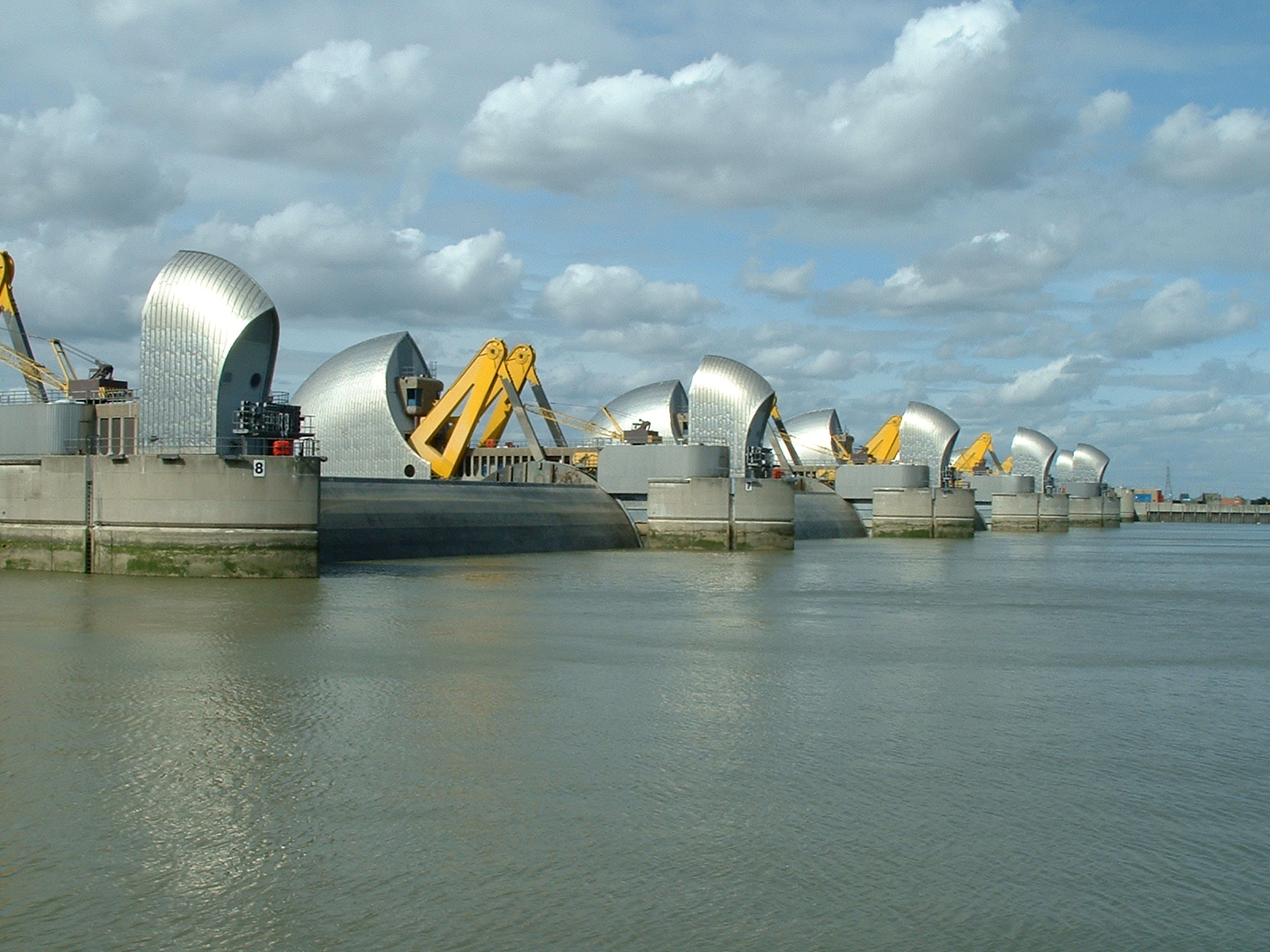
The Thames Barrier is a retractable barrier system built to protect the floodplain of most of Greater London from exceptionally high tides and storm surges moving up from the North Sea. It has been operational since 1982. When needed, it is closed (raised) during high tide; at low tide, it can be opened to restore the river's flow towards the sea. Built about 2 miles (3.2 kilometres) east of the Isle of Dogs, its northern bank is in Silvertown in the London Borough of Newham and its southern bank is in the New Charlton area of the Royal Borough of Greenwich.
Flooding in London has been a problem since Roman times. In 1954, the Waverley Committee, established to investigate the serious North Sea flood of 1953 which affected parts of the Thames Estuary and parts of London, recommended that "as an alternative to raising the banks, the possibility and cost of erecting a structure across the Thames which could be closed in a surge should be urgently investigated". A number of designs were put forward, from a huge road viaduct with two 500 foot (150 m) sluice gates crossing the Thames at Crayfordness to flap gates lying on the river bed and floated up by compressed air.[page needed] By 1965, when the Greater London Council (GLC) took over responsibility, two major schemes were under consideration, costed at £24 million and £41 million respectively (£500 million and £800 million at 2020 prices).[page needed]
In 1966, Sir Hermann Bondi was asked to take an independent view of the situation. He considered the estimated construction costs and the probability of a flood and of damage if the barrier was not built. He strongly recommended that a barrier should be built in order to avoid the catastrophe of flooding central London, and a site was agreed at Woolwich.[page needed]
The barrier protects central London against a storm surge, caused when a deep depression forms to the north of Scotland and progresses across the North Sea and south-easterly towards southern Scandinavia. When such a surge coincides with a high spring tide, the high winds associated with the depression can funnel the water up the Thames Estuary and cause surges of up to 3.5 metres (11.6 feet). The planners assessed that in the absence of a barrier, such a surge could inundate 45 square miles (117 km2) of land, put hospitals, power stations and the London Underground out of action and cause damage estimated in 1966 at £2 billion (about £50 billion at 2020 prices). The barrier was designed to provide a flood defence capable of resisting a once in 1000 year surge tide at a base date of 2030.
The concept of the rising sector gates was devised by (Reginald) Charles Draper. In 1969, from his parents' house in Pellatt Grove, Wood Green, London, he constructed a working model. The novel rotating cylinders were based on the design of the taps on his gas cooker. The barrier was designed by Rendel, Palmer and Tritton for the Greater London Council and the concept tested at the Hydraulics Research Station, Wallingford. The site at New Charlton was chosen because of the relative straightness of the banks, and because the underlying river chalk was strong enough to support the barrier.
The Thames Barrier and Flood Prevention Act, authorising construction, was passed in 1972. In 1974, the GLC placed the two major construction contracts. Civil construction was undertaken by a Costain/Hollandsche Beton Maatschappij/Tarmac Construction consortium.[page needed] A separate contract for the gates and operating machinery was placed with the Davy Cleveland Barrier Consortium, formed by Davy McKee Ltd of Sheffield and Cleveland Bridge UK Ltd.[page needed]
Work began at the barrier site in 1974 and progressed in two phases. The southern piers (9 to 6) were built first, with river traffic diverted to the north side, then traffic routed through the completed southern spans whilst the north side piers (1 to 5) were built. During construction of the piers, precast concrete sills were built in a cofferdam on the north side of the river and floated out and sunk between the piers to form the gate recesses, with access tunnels at the upstream and downstream ends.
The gates of the barrier were fabricated in sections at Cleveland Bridge's Darlington works and assembled at Port Clarence on the River Tees. The gates, gate arms and rocking beams were transported from the Tees to the Thames by barge and lifted into position by two very large floating cranes operated by Neptun of Hamburg (now part of Smit International). The mechanical and hydraulic machinery was built by Davy Loewy, Henry Berry and Vickers and trial assembled in Davy's Darnall works. Delays to the civil works required changes to the construction and installation sequence, but commissioning was relatively uneventful and the first trial operation of all the gates together was carried out on 31 October 1982.
Hub AI
Thames Barrier AI simulator
(@Thames Barrier_simulator)
Thames Barrier
The Thames Barrier is a retractable barrier system built to protect the floodplain of most of Greater London from exceptionally high tides and storm surges moving up from the North Sea. It has been operational since 1982. When needed, it is closed (raised) during high tide; at low tide, it can be opened to restore the river's flow towards the sea. Built about 2 miles (3.2 kilometres) east of the Isle of Dogs, its northern bank is in Silvertown in the London Borough of Newham and its southern bank is in the New Charlton area of the Royal Borough of Greenwich.
Flooding in London has been a problem since Roman times. In 1954, the Waverley Committee, established to investigate the serious North Sea flood of 1953 which affected parts of the Thames Estuary and parts of London, recommended that "as an alternative to raising the banks, the possibility and cost of erecting a structure across the Thames which could be closed in a surge should be urgently investigated". A number of designs were put forward, from a huge road viaduct with two 500 foot (150 m) sluice gates crossing the Thames at Crayfordness to flap gates lying on the river bed and floated up by compressed air.[page needed] By 1965, when the Greater London Council (GLC) took over responsibility, two major schemes were under consideration, costed at £24 million and £41 million respectively (£500 million and £800 million at 2020 prices).[page needed]
In 1966, Sir Hermann Bondi was asked to take an independent view of the situation. He considered the estimated construction costs and the probability of a flood and of damage if the barrier was not built. He strongly recommended that a barrier should be built in order to avoid the catastrophe of flooding central London, and a site was agreed at Woolwich.[page needed]
The barrier protects central London against a storm surge, caused when a deep depression forms to the north of Scotland and progresses across the North Sea and south-easterly towards southern Scandinavia. When such a surge coincides with a high spring tide, the high winds associated with the depression can funnel the water up the Thames Estuary and cause surges of up to 3.5 metres (11.6 feet). The planners assessed that in the absence of a barrier, such a surge could inundate 45 square miles (117 km2) of land, put hospitals, power stations and the London Underground out of action and cause damage estimated in 1966 at £2 billion (about £50 billion at 2020 prices). The barrier was designed to provide a flood defence capable of resisting a once in 1000 year surge tide at a base date of 2030.
The concept of the rising sector gates was devised by (Reginald) Charles Draper. In 1969, from his parents' house in Pellatt Grove, Wood Green, London, he constructed a working model. The novel rotating cylinders were based on the design of the taps on his gas cooker. The barrier was designed by Rendel, Palmer and Tritton for the Greater London Council and the concept tested at the Hydraulics Research Station, Wallingford. The site at New Charlton was chosen because of the relative straightness of the banks, and because the underlying river chalk was strong enough to support the barrier.
The Thames Barrier and Flood Prevention Act, authorising construction, was passed in 1972. In 1974, the GLC placed the two major construction contracts. Civil construction was undertaken by a Costain/Hollandsche Beton Maatschappij/Tarmac Construction consortium.[page needed] A separate contract for the gates and operating machinery was placed with the Davy Cleveland Barrier Consortium, formed by Davy McKee Ltd of Sheffield and Cleveland Bridge UK Ltd.[page needed]
Work began at the barrier site in 1974 and progressed in two phases. The southern piers (9 to 6) were built first, with river traffic diverted to the north side, then traffic routed through the completed southern spans whilst the north side piers (1 to 5) were built. During construction of the piers, precast concrete sills were built in a cofferdam on the north side of the river and floated out and sunk between the piers to form the gate recesses, with access tunnels at the upstream and downstream ends.
The gates of the barrier were fabricated in sections at Cleveland Bridge's Darlington works and assembled at Port Clarence on the River Tees. The gates, gate arms and rocking beams were transported from the Tees to the Thames by barge and lifted into position by two very large floating cranes operated by Neptun of Hamburg (now part of Smit International). The mechanical and hydraulic machinery was built by Davy Loewy, Henry Berry and Vickers and trial assembled in Davy's Darnall works. Delays to the civil works required changes to the construction and installation sequence, but commissioning was relatively uneventful and the first trial operation of all the gates together was carried out on 31 October 1982.
Recent media