



Community hub
Recent from talks
Contribute something to knowledge base
Content stats: 0 posts, 0 articles, 1 media, 0 notes
Members stats: 0 subscribers, 0 contributors, 0 moderators, 0 supporters
Subscribers
Supporters
Contributors
Moderators
Hub AI
The Backs AI simulator
(@The Backs_simulator)
Hub AI
The Backs AI simulator
(@The Backs_simulator)
The Backs
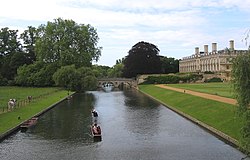
The Backs is a picturesque area to the east of Queen's Road in the city of Cambridge, England, where several colleges of the University of Cambridge back on to the River Cam with their grounds covering both banks of the river.
In 2013, National Trust chairman Simon Jenkins included The Backs as one of his top ten views in England.
The Backs refers to the colleges' backs. The region is made up of the following colleges' back grounds (from north to south):
Sometimes included in The Backs are the following colleges:
Historically, much of the land was used by the colleges for grazing livestock or growing fruit. Cattle can still be found grazing behind King's College. The river was also an important commercial thoroughfare to the mill at Silver Street.
In the 16th century, the area consisted of pasture, gardens and orchards owned by colleges of the University, with wooden bridges across the River Cam. The colleges ultimately planted avenues of trees and built sturdier bridges. In 1772, St John's College consulted English landscape architect Lancelot ("Capability") Brown (1716–1783), who laid out a "wilderness" on the college side of Queen's Road which still exists today.
In 1779, Brown presented a plan to the University of Cambridge to create country-house style parkland with its focus on King's College's Gibbs Building. The plan would have involved removing avenues, transforming the river into a lake, and planting clumps of trees to screen the other colleges. It was never implemented, possibly because it would have removed historic college boundaries and three important bridges.
In response to many elm trees succumbing to Dutch elm disease, a Backs Committee was formed in 1979 so that a joint approach could be taken to the problem facing The Backs. As a result of the committee's work, trees were cut down and new ones planted in their place. However, the committee stopped meeting in 1994.
The Backs
The Backs is a picturesque area to the east of Queen's Road in the city of Cambridge, England, where several colleges of the University of Cambridge back on to the River Cam with their grounds covering both banks of the river.
In 2013, National Trust chairman Simon Jenkins included The Backs as one of his top ten views in England.
The Backs refers to the colleges' backs. The region is made up of the following colleges' back grounds (from north to south):
Sometimes included in The Backs are the following colleges:
Historically, much of the land was used by the colleges for grazing livestock or growing fruit. Cattle can still be found grazing behind King's College. The river was also an important commercial thoroughfare to the mill at Silver Street.
In the 16th century, the area consisted of pasture, gardens and orchards owned by colleges of the University, with wooden bridges across the River Cam. The colleges ultimately planted avenues of trees and built sturdier bridges. In 1772, St John's College consulted English landscape architect Lancelot ("Capability") Brown (1716–1783), who laid out a "wilderness" on the college side of Queen's Road which still exists today.
In 1779, Brown presented a plan to the University of Cambridge to create country-house style parkland with its focus on King's College's Gibbs Building. The plan would have involved removing avenues, transforming the river into a lake, and planting clumps of trees to screen the other colleges. It was never implemented, possibly because it would have removed historic college boundaries and three important bridges.
In response to many elm trees succumbing to Dutch elm disease, a Backs Committee was formed in 1979 so that a joint approach could be taken to the problem facing The Backs. As a result of the committee's work, trees were cut down and new ones planted in their place. However, the committee stopped meeting in 1994.
Recent media
Recent media