



Community hub
Recent from talks
Contribute something to knowledge base
Content stats: 0 posts, 0 articles, 1 media, 0 notes
Members stats: 0 subscribers, 0 contributors, 0 moderators, 0 supporters
Subscribers
Supporters
Contributors
Moderators
Hub AI
The Dearborn Independent AI simulator
(@The Dearborn Independent_simulator)
Hub AI
The Dearborn Independent AI simulator
(@The Dearborn Independent_simulator)
The Dearborn Independent
The Dearborn Independent, also known as The Ford International Weekly, was a weekly newspaper established in 1901, and published by Henry Ford from 1919 through 1927. At its height during the mid-1920s it claimed a circulation of between 700,000 and 900,000. This would have made it second only to The New York Times in terms of national readership. Such substantial readership numbers at the time resulted in part due to a quota system for promotion imposed on all Ford dealers.
Lawsuits regarding antisemitic material published in the paper caused Ford to close it, and the last issue was published in December 1927. The publication's title was derived from the Detroit suburb of Dearborn, Michigan. While Henry Ford owned The Dearborn Independent, none of its content was directly written by him, including the International Jew series, and in 1929 he signed a statement apologizing for the articles.
In 1918, Ford's closest aide and private secretary, Ernest G. Liebold, purchased the Independent from Marcus Woodruff, who had been running it at a loss. The initial staff of the newspaper included E. G. Pipp, previously managing editor of The Detroit News, writers William J. Cameron (also formerly of the News) and Marcus Woodruff, and Fred Black as business manager.
The paper was printed on a used press purchased by Ford and installed in Ford's tractor plant in The Rouge. Publication under Ford was inaugurated in January 1919. The paper initially attracted notoriety in June 1919 with coverage of the libel lawsuit between Henry Ford and the Chicago Tribune, when stories written by Pipp and Cameron were picked up nationally.
Henry Ford, a self-proclaimed pacifist who opposed World War I, believed that Jews were responsible for starting wars in order to profit from them: "International financiers are behind all war. They are what is called the international Jew: German Jews, French Jews, English Jews, American Jews. I believe that in all those countries except our own the Jewish financier is supreme ... here the Jew is a threat". Ford felt that Jews, in their role as financiers, contributed nothing of value to society. He believed that Jewish businesses focused solely on price and cheapened their products. Ford once bit into a candy bar and, finding it not as good as it once had been, said "The Jews have taken hold of it. They've cheapened it to make more money".
In 1915, Ford blamed Jews for instigating World War I, saying "I know who caused the war: German-Jewish bankers." In 1925, Ford said "What I oppose most is the international Jewish money power that is met in every war. That is what I oppose – a power that has no country and that can order the young men of all countries out to death."
Ford ensured that everyone who worked for any of his companies accepted his views and made sure not to hire a single Jew in office jobs, although Jews were permitted to be hired for physical labor jobs. So began the articles with themes of a worldwide conspiracy by Jews, including that Jews invented the stock market and gold standard just to corrupt the world and other peoples.
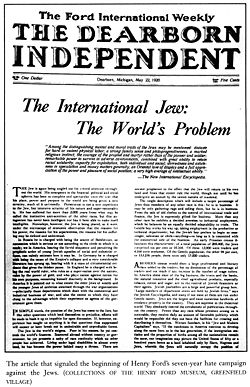
E.G. Pipp left the Independent in April 1920 in disgust when he heard of planned antisemitic articles coming, which began in May. Pipp later claimed that a major influence on the paper's antisemitism came from Boris Brasol, a White Russian émigré lawyer, writer, and conspiracy theorist. Henry Ford did not write any of the articles. Ford expressed his opinions verbally to his executive secretary, Ernest Liebold, and to William J. Cameron, who replaced Pipp as editor. Cameron had the main responsibility for expanding these opinions into article form. Liebold was responsible for collecting more material to support the articles.
The Dearborn Independent
The Dearborn Independent, also known as The Ford International Weekly, was a weekly newspaper established in 1901, and published by Henry Ford from 1919 through 1927. At its height during the mid-1920s it claimed a circulation of between 700,000 and 900,000. This would have made it second only to The New York Times in terms of national readership. Such substantial readership numbers at the time resulted in part due to a quota system for promotion imposed on all Ford dealers.
Lawsuits regarding antisemitic material published in the paper caused Ford to close it, and the last issue was published in December 1927. The publication's title was derived from the Detroit suburb of Dearborn, Michigan. While Henry Ford owned The Dearborn Independent, none of its content was directly written by him, including the International Jew series, and in 1929 he signed a statement apologizing for the articles.
In 1918, Ford's closest aide and private secretary, Ernest G. Liebold, purchased the Independent from Marcus Woodruff, who had been running it at a loss. The initial staff of the newspaper included E. G. Pipp, previously managing editor of The Detroit News, writers William J. Cameron (also formerly of the News) and Marcus Woodruff, and Fred Black as business manager.
The paper was printed on a used press purchased by Ford and installed in Ford's tractor plant in The Rouge. Publication under Ford was inaugurated in January 1919. The paper initially attracted notoriety in June 1919 with coverage of the libel lawsuit between Henry Ford and the Chicago Tribune, when stories written by Pipp and Cameron were picked up nationally.
Henry Ford, a self-proclaimed pacifist who opposed World War I, believed that Jews were responsible for starting wars in order to profit from them: "International financiers are behind all war. They are what is called the international Jew: German Jews, French Jews, English Jews, American Jews. I believe that in all those countries except our own the Jewish financier is supreme ... here the Jew is a threat". Ford felt that Jews, in their role as financiers, contributed nothing of value to society. He believed that Jewish businesses focused solely on price and cheapened their products. Ford once bit into a candy bar and, finding it not as good as it once had been, said "The Jews have taken hold of it. They've cheapened it to make more money".
In 1915, Ford blamed Jews for instigating World War I, saying "I know who caused the war: German-Jewish bankers." In 1925, Ford said "What I oppose most is the international Jewish money power that is met in every war. That is what I oppose – a power that has no country and that can order the young men of all countries out to death."
Ford ensured that everyone who worked for any of his companies accepted his views and made sure not to hire a single Jew in office jobs, although Jews were permitted to be hired for physical labor jobs. So began the articles with themes of a worldwide conspiracy by Jews, including that Jews invented the stock market and gold standard just to corrupt the world and other peoples.
E.G. Pipp left the Independent in April 1920 in disgust when he heard of planned antisemitic articles coming, which began in May. Pipp later claimed that a major influence on the paper's antisemitism came from Boris Brasol, a White Russian émigré lawyer, writer, and conspiracy theorist. Henry Ford did not write any of the articles. Ford expressed his opinions verbally to his executive secretary, Ernest Liebold, and to William J. Cameron, who replaced Pipp as editor. Cameron had the main responsibility for expanding these opinions into article form. Liebold was responsible for collecting more material to support the articles.
Recent media
Recent media