



Community hub
Community hub
Recent from talks
Knowledge base stats:
Talk channels stats:
Members stats:
The Emperor's New Clothes
"The Emperor's New Clothes" (Danish: Kejserens nye klæder [ˈkʰɑjsɐns ˈnyˀə ˈkʰlɛːðə]) is a literary folktale written by the Danish author Hans Christian Andersen, about a vain emperor who gets exposed before his subjects. The tale has been translated into over 100 languages.
"The Emperor's New Clothes" was first published with "The Little Mermaid" in Copenhagen, Denmark, by C. A. Reitzel, on 7 April 1837, as the third and final installment of Andersen's Fairy Tales Told for Children. The tale has been adapted to various media, and the story's title, the phrase "the Emperor has no clothes", and variations thereof have been adopted for use in numerous other works and as idioms.
The tale concerns an emperor who has an obsession with fancy new clothes, and spends lavishly on them at the expense of state matters. One day, two con-men visit the emperor's capital. Posing as weavers, they offer to supply him with magnificent clothes that are invisible to those who are either incompetent or stupid. The gullible emperor hires them, and they set up looms and pretend to go to work. A succession of officials, starting with the emperor's wise and competent minister, and then ending with the emperor himself, visit them to check their progress. Each sees that the looms are empty but pretends otherwise to avoid being thought a fool.
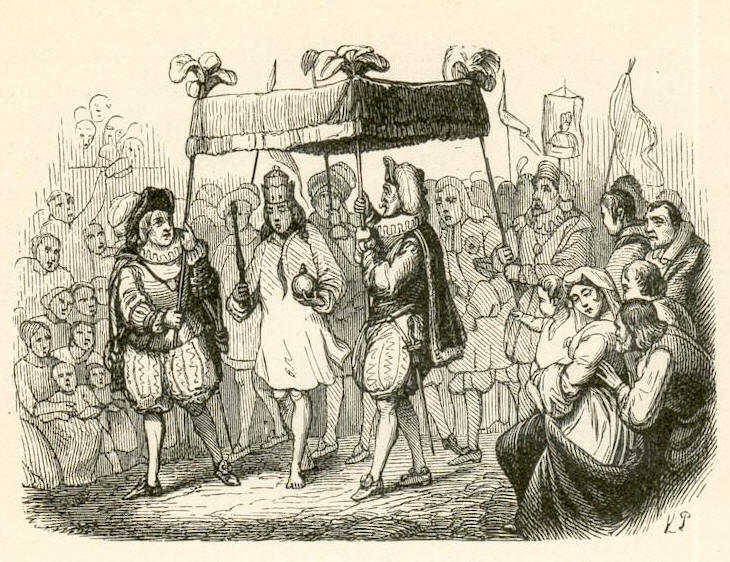
Finally, the "weavers" report that the emperor's suit is finished. They mime dressing him and he sets off in a procession before the whole city. The townsfolk uncomfortably go along with the pretense, not wanting to appear inept or stupid, until a child blurts out that the emperor is wearing nothing at all. The entire town then cries out that the emperor is wearing nothing at all. The emperor is startled, but opts to continue the procession.
Andersen's tale is based on a 1335 story from the Libro de los ejemplos (or El Conde Lucanor), a medieval Spanish collection of fifty-one cautionary tales with various sources such as Aesop and other classical writers and Persian folktales, by Juan Manuel, Prince of Villena (1282–1348). Andersen did not know the Spanish original but read the tale in a German translation titled "So ist der Lauf der Welt" ("That's the way of the world"). In the source tale, a king is hoodwinked by weavers who claim to make a suit of clothes invisible to any man not the son of his presumed father; whereas Andersen altered the source tale to direct the focus on courtly pride and intellectual vanity rather than adulterous paternity.
There is also an Indian version of the story, which appears in the Līlāvatīsāra by Jinaratna (1283), a summary of a now-lost anthology of fables, the Nirvāṇalīlāvatī by Jineśvara (1052). The dishonest merchant Dhana from Hastināpura swindles the king of Śrāvastī by offering to weave a supernatural garment that cannot be seen or touched by any person of illegitimate birth. When the king is supposedly wearing the garment, his whole court pretends to admire it. The king is then paraded about his city to show off the garment; when the common folk ask him if he has become a naked ascetic, he realizes the deception, but the swindler has already fled.
Hollis Robbins, in "The Emperor's New Critique" (2003), argues that the tale is itself so transparent "that there has been little need for critical scrutiny". Robbins argues that Andersen's tale "quite clearly rehearses four contemporary controversies: the institution of a meritocratic civil service, the valuation of labor, the expansion of democratic power, and the appraisal of art". Robbins concludes that the story's appeal lies in its "seductive resolution" of the conflict by the truth-telling boy.
Naomi Wood of Kansas State University challenges Robbins' reading, arguing that before the World Trade Center attacks of 2001, "Robbins's argument might seem merely playful, anti-intuitive, and provocative." Wood concludes: "Perhaps the truth of 'The Emperor's New Clothes' is not that the child's truth is mercifully free of adult corruption, but that it recognizes the terrifying possibility that whatever words we may use to clothe our fears, the fabric cannot protect us from them."
Hub AI
The Emperor's New Clothes AI simulator
(@The Emperor's New Clothes_simulator)
The Emperor's New Clothes
"The Emperor's New Clothes" (Danish: Kejserens nye klæder [ˈkʰɑjsɐns ˈnyˀə ˈkʰlɛːðə]) is a literary folktale written by the Danish author Hans Christian Andersen, about a vain emperor who gets exposed before his subjects. The tale has been translated into over 100 languages.
"The Emperor's New Clothes" was first published with "The Little Mermaid" in Copenhagen, Denmark, by C. A. Reitzel, on 7 April 1837, as the third and final installment of Andersen's Fairy Tales Told for Children. The tale has been adapted to various media, and the story's title, the phrase "the Emperor has no clothes", and variations thereof have been adopted for use in numerous other works and as idioms.
The tale concerns an emperor who has an obsession with fancy new clothes, and spends lavishly on them at the expense of state matters. One day, two con-men visit the emperor's capital. Posing as weavers, they offer to supply him with magnificent clothes that are invisible to those who are either incompetent or stupid. The gullible emperor hires them, and they set up looms and pretend to go to work. A succession of officials, starting with the emperor's wise and competent minister, and then ending with the emperor himself, visit them to check their progress. Each sees that the looms are empty but pretends otherwise to avoid being thought a fool.
Finally, the "weavers" report that the emperor's suit is finished. They mime dressing him and he sets off in a procession before the whole city. The townsfolk uncomfortably go along with the pretense, not wanting to appear inept or stupid, until a child blurts out that the emperor is wearing nothing at all. The entire town then cries out that the emperor is wearing nothing at all. The emperor is startled, but opts to continue the procession.
Andersen's tale is based on a 1335 story from the Libro de los ejemplos (or El Conde Lucanor), a medieval Spanish collection of fifty-one cautionary tales with various sources such as Aesop and other classical writers and Persian folktales, by Juan Manuel, Prince of Villena (1282–1348). Andersen did not know the Spanish original but read the tale in a German translation titled "So ist der Lauf der Welt" ("That's the way of the world"). In the source tale, a king is hoodwinked by weavers who claim to make a suit of clothes invisible to any man not the son of his presumed father; whereas Andersen altered the source tale to direct the focus on courtly pride and intellectual vanity rather than adulterous paternity.
There is also an Indian version of the story, which appears in the Līlāvatīsāra by Jinaratna (1283), a summary of a now-lost anthology of fables, the Nirvāṇalīlāvatī by Jineśvara (1052). The dishonest merchant Dhana from Hastināpura swindles the king of Śrāvastī by offering to weave a supernatural garment that cannot be seen or touched by any person of illegitimate birth. When the king is supposedly wearing the garment, his whole court pretends to admire it. The king is then paraded about his city to show off the garment; when the common folk ask him if he has become a naked ascetic, he realizes the deception, but the swindler has already fled.
Hollis Robbins, in "The Emperor's New Critique" (2003), argues that the tale is itself so transparent "that there has been little need for critical scrutiny". Robbins argues that Andersen's tale "quite clearly rehearses four contemporary controversies: the institution of a meritocratic civil service, the valuation of labor, the expansion of democratic power, and the appraisal of art". Robbins concludes that the story's appeal lies in its "seductive resolution" of the conflict by the truth-telling boy.
Naomi Wood of Kansas State University challenges Robbins' reading, arguing that before the World Trade Center attacks of 2001, "Robbins's argument might seem merely playful, anti-intuitive, and provocative." Wood concludes: "Perhaps the truth of 'The Emperor's New Clothes' is not that the child's truth is mercifully free of adult corruption, but that it recognizes the terrifying possibility that whatever words we may use to clothe our fears, the fabric cannot protect us from them."