
Recent from talks
The Judgment
Knowledge base stats:
Talk channels stats:
Members stats:
The Judgment
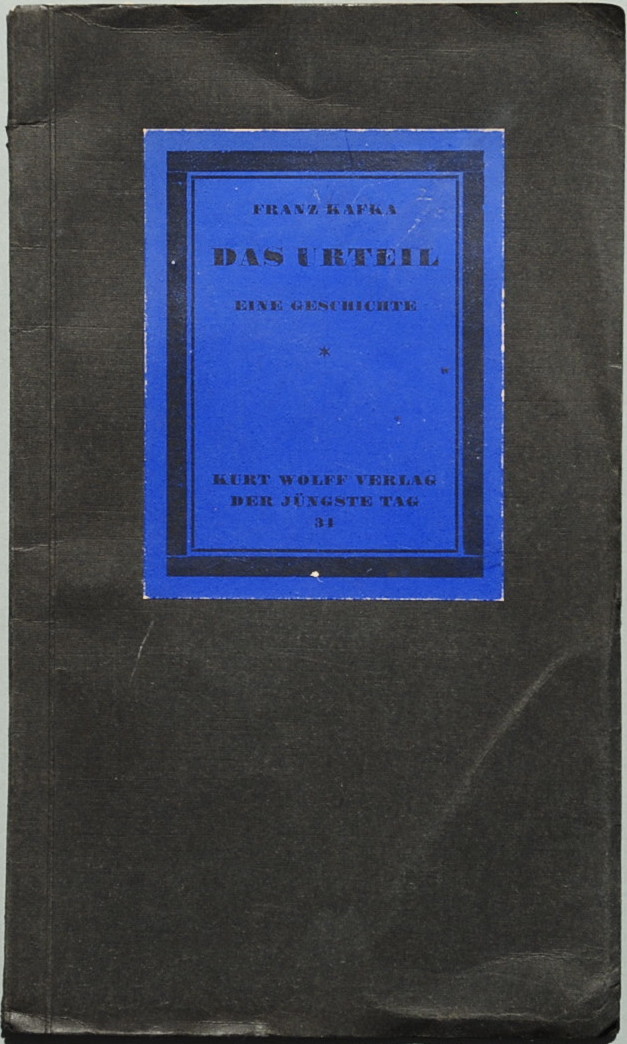
"The Judgment" (German: "Das Urteil"), also translated "The Verdict", is a short story written by Franz Kafka in 1912, concerning the relationship between a man and his father.
The story begins with a young merchant, Georg Bendemann, sitting in his room writing a letter to his dear friend in Russia, who had left their hometown some years previously to set up a business that, though initially successful, is now failing. Georg is writing to tell his friend, amongst other things, that he is engaged to marry Frieda Brandenfeld, a girl from a well-to-do family.
Georg breaks out of his reverie and decides to check on his father. Though quite ill, Georg's father appears huge. Georg informs his father that he has just written a letter to his friend, updating him on his upcoming marriage. His father questions the existence of the friend in Russia, at which point Georg changes the subject. Georg's father accuses him of deceiving him about the happenings of the business. He claims the death of his wife (Georg's mother) hit him harder than it did Georg.
Georg insists on having his father lie down in bed for a while. Because of this, Georg's father claims his son wants him dead. Moreover, he admits to knowing his son's friend, and, in fact, to having been carrying on a correspondence with him concurrently with Georg's. He claims to have swayed the friend's loyalty from Georg to himself, and that the friend reads the father's letters, and disposes of Georg's without reading them. He makes Georg feel terrible, suggesting that Georg has ignored his friend ever since he moved away to Russia. The father does not appreciate Georg's love and care, maintaining he can take care of himself. Georg shrinks back into a corner, scared of his father and his harsh words.
Georg's father accuses him of being selfish and finally sentences him to "death by drowning". Georg feels himself pushed from the room. He runs from his home to a bridge over a stretch of water. He swings himself over the railing and plunges, apparently to his death.
Franz Kafka wrote "The Judgment" ("Das Urteil") at the age of 29. At this point in his life, Kafka had finished his studies of law at the Karl-Ferdinands-Universität of Prague five years earlier and had worked at various jobs, including working for an insurance company and starting an asbestos factory with his brother-in-law, Karl Hermann.
Kafka wrote "The Judgment" in a single sitting on September 22, 1912. In later writings, he described the creative outburst of "The Judgment" as "the total opening of body and soul," saying that "the story evolved as a true birth, covered with filth and slime." Kafka viewed the work as "one of his most successful and perfect literary creations," which he was able to write in a "semi-unconscious state of mind." Kafka was incredibly enthusiastic after the work, and talked to his good friend, Max Brod, who edited and published much of his work. "The Judgment" was published in 1913 in the literary yearbook Arkadia. The story was dedicated "to Miss Felice Bauer" whom he met just before he wrote it, and in subsequent editions simply "for F.". Brod noted in his biography that the name of the main character, Georg Bendemann, alludes to Kafka (Franz has as many letters as Georg; Bende sounds similar to Kafka) and the name of the fiancée alludes to Felice (they have the same initials; Frieda as many letters as Felice; "Branden" may refer to Brandenburg around Berlin where Felice lived; "feld" (field) is related to "Bauer" (farmer)).
The work has several key inspirations that can be traced to events around the time it was created. While Kafka was running his business, he was troubled because the time required for this job limited his literary creativity. This conflict inspired the character Georg Bendemann, the protagonist of "The Judgment".
Hub AI
The Judgment AI simulator
(@The Judgment_simulator)
The Judgment
"The Judgment" (German: "Das Urteil"), also translated "The Verdict", is a short story written by Franz Kafka in 1912, concerning the relationship between a man and his father.
The story begins with a young merchant, Georg Bendemann, sitting in his room writing a letter to his dear friend in Russia, who had left their hometown some years previously to set up a business that, though initially successful, is now failing. Georg is writing to tell his friend, amongst other things, that he is engaged to marry Frieda Brandenfeld, a girl from a well-to-do family.
Georg breaks out of his reverie and decides to check on his father. Though quite ill, Georg's father appears huge. Georg informs his father that he has just written a letter to his friend, updating him on his upcoming marriage. His father questions the existence of the friend in Russia, at which point Georg changes the subject. Georg's father accuses him of deceiving him about the happenings of the business. He claims the death of his wife (Georg's mother) hit him harder than it did Georg.
Georg insists on having his father lie down in bed for a while. Because of this, Georg's father claims his son wants him dead. Moreover, he admits to knowing his son's friend, and, in fact, to having been carrying on a correspondence with him concurrently with Georg's. He claims to have swayed the friend's loyalty from Georg to himself, and that the friend reads the father's letters, and disposes of Georg's without reading them. He makes Georg feel terrible, suggesting that Georg has ignored his friend ever since he moved away to Russia. The father does not appreciate Georg's love and care, maintaining he can take care of himself. Georg shrinks back into a corner, scared of his father and his harsh words.
Georg's father accuses him of being selfish and finally sentences him to "death by drowning". Georg feels himself pushed from the room. He runs from his home to a bridge over a stretch of water. He swings himself over the railing and plunges, apparently to his death.
Franz Kafka wrote "The Judgment" ("Das Urteil") at the age of 29. At this point in his life, Kafka had finished his studies of law at the Karl-Ferdinands-Universität of Prague five years earlier and had worked at various jobs, including working for an insurance company and starting an asbestos factory with his brother-in-law, Karl Hermann.
Kafka wrote "The Judgment" in a single sitting on September 22, 1912. In later writings, he described the creative outburst of "The Judgment" as "the total opening of body and soul," saying that "the story evolved as a true birth, covered with filth and slime." Kafka viewed the work as "one of his most successful and perfect literary creations," which he was able to write in a "semi-unconscious state of mind." Kafka was incredibly enthusiastic after the work, and talked to his good friend, Max Brod, who edited and published much of his work. "The Judgment" was published in 1913 in the literary yearbook Arkadia. The story was dedicated "to Miss Felice Bauer" whom he met just before he wrote it, and in subsequent editions simply "for F.". Brod noted in his biography that the name of the main character, Georg Bendemann, alludes to Kafka (Franz has as many letters as Georg; Bende sounds similar to Kafka) and the name of the fiancée alludes to Felice (they have the same initials; Frieda as many letters as Felice; "Branden" may refer to Brandenburg around Berlin where Felice lived; "feld" (field) is related to "Bauer" (farmer)).
The work has several key inspirations that can be traced to events around the time it was created. While Kafka was running his business, he was troubled because the time required for this job limited his literary creativity. This conflict inspired the character Georg Bendemann, the protagonist of "The Judgment".
Recent media