



Community hub
Recent from talks
Knowledge base stats:
Talk channels stats:
Members stats:
The Marriage of Figaro
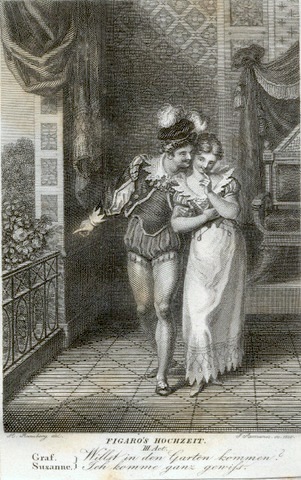
The Marriage of Figaro (Italian: Le nozze di Figaro, pronounced [le ˈnɔttse di ˈfiːɡaro] ⓘ), K. 492, is a commedia per musica (opera buffa) in four acts composed in 1786 by Wolfgang Amadeus Mozart, with an Italian libretto written by Lorenzo Da Ponte. It premiered at the Burgtheater in Vienna on 1 May 1786. The opera's libretto is based on the 1784 stage comedy by Beaumarchais, La folle journée, ou le Mariage de Figaro ("The Mad Day, or The Marriage of Figaro"). It tells how the servants Figaro and Susanna succeed in getting married, foiling the efforts of their philandering employer Count Almaviva to seduce Susanna and teaching him a lesson in fidelity.
Considered one of the greatest operas ever written, it is a cornerstone of the repertoire and appears consistently among the top ten in the Operabase list of most frequently performed operas. In 2017, BBC News Magazine asked 172 opera singers to vote for the best operas ever written. The Marriage of Figaro came in first out of the 20 operas featured, with the magazine describing it as being "one of the supreme masterpieces of operatic comedy, whose rich sense of humanity shines out of Mozart's miraculous score".
Beaumarchais's earlier play The Barber of Seville had already made a successful transition to opera in a version by Paisiello. Beaumarchais's Mariage de Figaro, with its frank treatment of class conflict, was at first banned in Vienna: Emperor Joseph II stated that "since the piece contains much that is objectionable, I therefore expect that the Censor shall either reject it altogether, or at any rate have such alterations made in it that he shall be responsible for the performance of this play and for the impression it may make", after which the Austrian Censor duly forbade performing the German version of the play. Mozart's librettist Lorenzo Da Ponte managed to get official approval from the emperor for an operatic version, which eventually achieved great success.
The opera was the first of three collaborations between Mozart and Da Ponte, followed by Don Giovanni and Così fan tutte. It was Mozart who originally selected Beaumarchais's play and brought it to Da Ponte, who turned it into a libretto in six weeks, rewriting it in poetic Italian and removing all of the original's political references. In particular, Da Ponte replaced Figaro's climactic speech against inherited nobility with an equally angry aria against unfaithful wives. The libretto was approved by the Emperor before any music was written by Mozart.
The Imperial Italian opera company paid Mozart 450 florins for the work; this was three times his meagre yearly salary when he had worked as a court musician in Salzburg. Da Ponte was paid 200 florins.
The voice types that appear in this table are those listed in the critical edition published in the Neue Mozart-Ausgabe. In modern performance practice, Cherubino and Marcellina are usually assigned to mezzo-sopranos, and Figaro to a bass-baritone.
The Marriage of Figaro is scored for two flutes, two oboes, two clarinets, two bassoons, two horns, two clarini, timpani, and strings; the recitativi secchi are accompanied by a keyboard instrument, usually a fortepiano or a harpsichord, often joined by a cello. The instrumentation of the recitativi secchi is not given in the score, so it is up to the conductor and the performers. A typical performance lasts around three hours.
The Marriage of Figaro continues the plot of The Barber of Seville several years later, and recounts a single "day of madness" (la folle journée) in the palace of Count Almaviva near Seville, Spain. Rosina is now the countess. Dr. Bartolo is seeking revenge against Figaro for thwarting his plans to marry Rosina himself, and Count Almaviva has degenerated from the romantic youth of Barber, (a tenor in Paisiello's 1782 opera), into a scheming, bullying, skirt-chasing baritone. Having gratefully given Figaro a job as head of his servant-staff, he is now persistently trying to exercise his droit du seigneur – his right to bed a servant girl on her wedding night – with Figaro's bride-to-be, Susanna, who is the countess's maid. He keeps finding excuses to delay the civil part of the wedding of his two servants, which is arranged for this very day. Figaro, Susanna, and the countess conspire to embarrass the count and expose his scheming. He retaliates by trying to compel Figaro legally to marry a woman old enough to be his mother, but it turns out at the last minute that she really is his mother. Through the clever manipulations of Susanna and the countess, Figaro and Susanna are finally able to marry.
Hub AI
The Marriage of Figaro AI simulator
(@The Marriage of Figaro_simulator)
The Marriage of Figaro
The Marriage of Figaro (Italian: Le nozze di Figaro, pronounced [le ˈnɔttse di ˈfiːɡaro] ⓘ), K. 492, is a commedia per musica (opera buffa) in four acts composed in 1786 by Wolfgang Amadeus Mozart, with an Italian libretto written by Lorenzo Da Ponte. It premiered at the Burgtheater in Vienna on 1 May 1786. The opera's libretto is based on the 1784 stage comedy by Beaumarchais, La folle journée, ou le Mariage de Figaro ("The Mad Day, or The Marriage of Figaro"). It tells how the servants Figaro and Susanna succeed in getting married, foiling the efforts of their philandering employer Count Almaviva to seduce Susanna and teaching him a lesson in fidelity.
Considered one of the greatest operas ever written, it is a cornerstone of the repertoire and appears consistently among the top ten in the Operabase list of most frequently performed operas. In 2017, BBC News Magazine asked 172 opera singers to vote for the best operas ever written. The Marriage of Figaro came in first out of the 20 operas featured, with the magazine describing it as being "one of the supreme masterpieces of operatic comedy, whose rich sense of humanity shines out of Mozart's miraculous score".
Beaumarchais's earlier play The Barber of Seville had already made a successful transition to opera in a version by Paisiello. Beaumarchais's Mariage de Figaro, with its frank treatment of class conflict, was at first banned in Vienna: Emperor Joseph II stated that "since the piece contains much that is objectionable, I therefore expect that the Censor shall either reject it altogether, or at any rate have such alterations made in it that he shall be responsible for the performance of this play and for the impression it may make", after which the Austrian Censor duly forbade performing the German version of the play. Mozart's librettist Lorenzo Da Ponte managed to get official approval from the emperor for an operatic version, which eventually achieved great success.
The opera was the first of three collaborations between Mozart and Da Ponte, followed by Don Giovanni and Così fan tutte. It was Mozart who originally selected Beaumarchais's play and brought it to Da Ponte, who turned it into a libretto in six weeks, rewriting it in poetic Italian and removing all of the original's political references. In particular, Da Ponte replaced Figaro's climactic speech against inherited nobility with an equally angry aria against unfaithful wives. The libretto was approved by the Emperor before any music was written by Mozart.
The Imperial Italian opera company paid Mozart 450 florins for the work; this was three times his meagre yearly salary when he had worked as a court musician in Salzburg. Da Ponte was paid 200 florins.
The voice types that appear in this table are those listed in the critical edition published in the Neue Mozart-Ausgabe. In modern performance practice, Cherubino and Marcellina are usually assigned to mezzo-sopranos, and Figaro to a bass-baritone.
The Marriage of Figaro is scored for two flutes, two oboes, two clarinets, two bassoons, two horns, two clarini, timpani, and strings; the recitativi secchi are accompanied by a keyboard instrument, usually a fortepiano or a harpsichord, often joined by a cello. The instrumentation of the recitativi secchi is not given in the score, so it is up to the conductor and the performers. A typical performance lasts around three hours.
The Marriage of Figaro continues the plot of The Barber of Seville several years later, and recounts a single "day of madness" (la folle journée) in the palace of Count Almaviva near Seville, Spain. Rosina is now the countess. Dr. Bartolo is seeking revenge against Figaro for thwarting his plans to marry Rosina himself, and Count Almaviva has degenerated from the romantic youth of Barber, (a tenor in Paisiello's 1782 opera), into a scheming, bullying, skirt-chasing baritone. Having gratefully given Figaro a job as head of his servant-staff, he is now persistently trying to exercise his droit du seigneur – his right to bed a servant girl on her wedding night – with Figaro's bride-to-be, Susanna, who is the countess's maid. He keeps finding excuses to delay the civil part of the wedding of his two servants, which is arranged for this very day. Figaro, Susanna, and the countess conspire to embarrass the count and expose his scheming. He retaliates by trying to compel Figaro legally to marry a woman old enough to be his mother, but it turns out at the last minute that she really is his mother. Through the clever manipulations of Susanna and the countess, Figaro and Susanna are finally able to marry.