
Recent from talks
The Merchant of Venice
Knowledge base stats:
Talk channels stats:
Members stats:
The Merchant of Venice
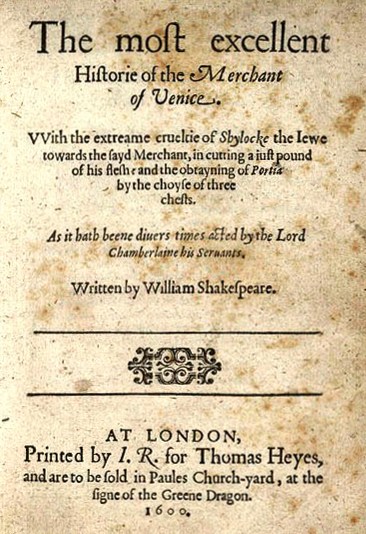
The Merchant of Venice is a play by William Shakespeare, believed to have been written between 1596 and 1598. A merchant in Venice named Antonio defaults on a large loan taken out on behalf of his dear friend, Bassanio, and provided by a Jewish moneylender, Shylock, with seemingly inevitable fatal consequences.
Although classified as a comedy in the First Folio and sharing certain aspects with Shakespeare's other romantic comedies, the play is most remembered for its dramatic scenes, and it is best known for the character Shylock and his famous demand for a "pound of flesh".
The play contains two famous speeches, that of Shylock, "Hath not a Jew eyes?" on the subject of humanity, and that of Portia on "the quality of mercy". Debate exists on whether the play is antisemitic, with Shylock's insistence on his legal right to the pound of flesh being in opposition to his seemingly universal plea for the rights of all people suffering discrimination.
Bassanio, a young Venetian of noble rank, wishes to woo the beautiful and wealthy heiress of Belmont, Portia. Having squandered his estate, he needs 3,000 ducats to subsidise his expenditures as a suitor. Bassanio approaches his friend Antonio, a wealthy merchant of Venice, who has previously and repeatedly bailed him out. Antonio agrees, but has no liquid cash as his ships and merchandise are busy at sea to Tripolis, the Indies, Mexico and England – he promises to cover a bond if Bassanio can find a lender, so Bassanio turns to the Jewish moneylender Shylock and names Antonio as the loan's guarantor.
Antonio has already antagonized Shylock through his outspoken antisemitism and because Antonio's habit of lending money without interest forces Shylock to charge lower rates. Shylock is at first reluctant to grant the loan, citing abuse he has suffered at Antonio's hand. He finally agrees to lend the sum to Bassanio without interest upon one condition: if Antonio were unable to repay it at the specified date, Shylock may take a pound of Antonio's flesh. Bassanio does not want Antonio to accept such a risky condition; Antonio is surprised by what he sees as the moneylender's generosity (no "usance" – interest – is asked for), and he signs the contract. With money in hand, Bassanio leaves for Belmont with his friend Gratiano, who has asked to accompany him. Gratiano is a likeable young man, but he is often flippant, overly talkative, and tactless. Bassanio warns his companion to exercise self-control, and the two leave for Belmont.
Meanwhile, in Belmont, Portia is awash with suitors. Her father left a will stipulating that each of her suitors must choose correctly from one of three caskets, made of gold, silver and lead respectively. Whoever picks the right casket wins Portia's hand. The first suitor, the Prince of Morocco, chooses the gold casket, interpreting its slogan, "Who chooseth me shall gain what many men desire", as referring to Portia. The second suitor, the conceited Prince of Aragon, chooses the silver casket, which proclaims, "Who chooseth me shall get as much as he deserves", as he believes he is full of merit. Both suitors leave empty-handed, having rejected the lead casket because of the baseness of its material and the uninviting nature of its slogan, "Who chooseth me must give and hazard all he hath". The last suitor is Bassanio, whom Portia wishes to succeed, having met him before. As Bassanio ponders his choice, members of Portia's household sing a song that says that "fancy" (not true love) is "It is engendered in the eye, / With gazing fed"; Bassanio chooses the lead casket and wins Portia's hand.
In Venice, news arrives that Antonio's ships have been lost at sea, leaving him unable to repay his bond to Shylock. Shylock, whose daughter Jessica had eloped with the Christian Lorenzo and converted to Christianity, becomes more resolute in seeking retribution against Christians. Jessica had taken with her a considerable portion of Shylock's wealth, including a turquoise ring given to him by his late wife, Leah. Shylock subsequently has Antonio summoned before the court.
At Belmont, Bassanio receives a letter telling him that Antonio has been unable to repay the loan from Shylock. Portia and Bassanio marry, as do Gratiano and Portia's handmaid Nerissa. Bassanio and Gratiano leave for Venice, with money from Portia, to save Antonio's life by offering the money to Shylock. Unknown to Bassanio and Gratiano, Portia sent her servant, Balthazar, to seek the counsel of Portia's cousin, Bellario, a lawyer, at Padua.
Hub AI
The Merchant of Venice AI simulator
(@The Merchant of Venice_simulator)
The Merchant of Venice
The Merchant of Venice is a play by William Shakespeare, believed to have been written between 1596 and 1598. A merchant in Venice named Antonio defaults on a large loan taken out on behalf of his dear friend, Bassanio, and provided by a Jewish moneylender, Shylock, with seemingly inevitable fatal consequences.
Although classified as a comedy in the First Folio and sharing certain aspects with Shakespeare's other romantic comedies, the play is most remembered for its dramatic scenes, and it is best known for the character Shylock and his famous demand for a "pound of flesh".
The play contains two famous speeches, that of Shylock, "Hath not a Jew eyes?" on the subject of humanity, and that of Portia on "the quality of mercy". Debate exists on whether the play is antisemitic, with Shylock's insistence on his legal right to the pound of flesh being in opposition to his seemingly universal plea for the rights of all people suffering discrimination.
Bassanio, a young Venetian of noble rank, wishes to woo the beautiful and wealthy heiress of Belmont, Portia. Having squandered his estate, he needs 3,000 ducats to subsidise his expenditures as a suitor. Bassanio approaches his friend Antonio, a wealthy merchant of Venice, who has previously and repeatedly bailed him out. Antonio agrees, but has no liquid cash as his ships and merchandise are busy at sea to Tripolis, the Indies, Mexico and England – he promises to cover a bond if Bassanio can find a lender, so Bassanio turns to the Jewish moneylender Shylock and names Antonio as the loan's guarantor.
Antonio has already antagonized Shylock through his outspoken antisemitism and because Antonio's habit of lending money without interest forces Shylock to charge lower rates. Shylock is at first reluctant to grant the loan, citing abuse he has suffered at Antonio's hand. He finally agrees to lend the sum to Bassanio without interest upon one condition: if Antonio were unable to repay it at the specified date, Shylock may take a pound of Antonio's flesh. Bassanio does not want Antonio to accept such a risky condition; Antonio is surprised by what he sees as the moneylender's generosity (no "usance" – interest – is asked for), and he signs the contract. With money in hand, Bassanio leaves for Belmont with his friend Gratiano, who has asked to accompany him. Gratiano is a likeable young man, but he is often flippant, overly talkative, and tactless. Bassanio warns his companion to exercise self-control, and the two leave for Belmont.
Meanwhile, in Belmont, Portia is awash with suitors. Her father left a will stipulating that each of her suitors must choose correctly from one of three caskets, made of gold, silver and lead respectively. Whoever picks the right casket wins Portia's hand. The first suitor, the Prince of Morocco, chooses the gold casket, interpreting its slogan, "Who chooseth me shall gain what many men desire", as referring to Portia. The second suitor, the conceited Prince of Aragon, chooses the silver casket, which proclaims, "Who chooseth me shall get as much as he deserves", as he believes he is full of merit. Both suitors leave empty-handed, having rejected the lead casket because of the baseness of its material and the uninviting nature of its slogan, "Who chooseth me must give and hazard all he hath". The last suitor is Bassanio, whom Portia wishes to succeed, having met him before. As Bassanio ponders his choice, members of Portia's household sing a song that says that "fancy" (not true love) is "It is engendered in the eye, / With gazing fed"; Bassanio chooses the lead casket and wins Portia's hand.
In Venice, news arrives that Antonio's ships have been lost at sea, leaving him unable to repay his bond to Shylock. Shylock, whose daughter Jessica had eloped with the Christian Lorenzo and converted to Christianity, becomes more resolute in seeking retribution against Christians. Jessica had taken with her a considerable portion of Shylock's wealth, including a turquoise ring given to him by his late wife, Leah. Shylock subsequently has Antonio summoned before the court.
At Belmont, Bassanio receives a letter telling him that Antonio has been unable to repay the loan from Shylock. Portia and Bassanio marry, as do Gratiano and Portia's handmaid Nerissa. Bassanio and Gratiano leave for Venice, with money from Portia, to save Antonio's life by offering the money to Shylock. Unknown to Bassanio and Gratiano, Portia sent her servant, Balthazar, to seek the counsel of Portia's cousin, Bellario, a lawyer, at Padua.
Recent media