
Recent from talks
The Odd Couple (play)
Knowledge base stats:
Talk channels stats:
Members stats:
The Odd Couple (play)
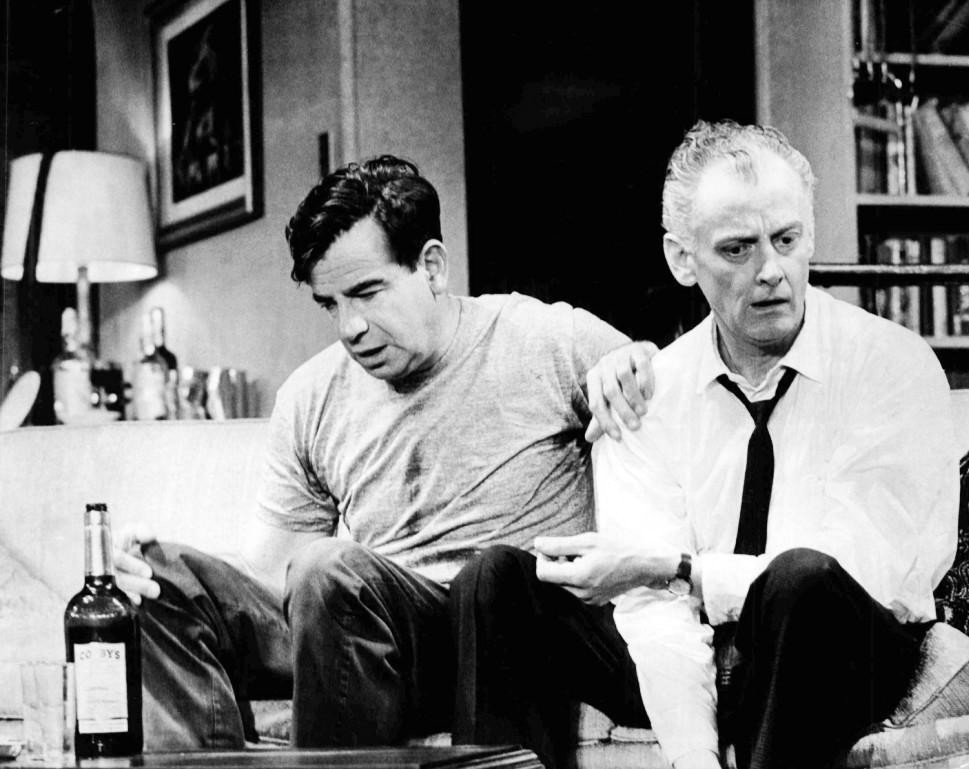
The Odd Couple is a play by Neil Simon. Following its premiere on Broadway in 1965, the characters were revived in a successful 1968 film and 1970s television series, as well as several other derivative works and spin-offs. The plot concerns two mismatched roommates: the neat, uptight Felix Ungar and the slovenly, easygoing Oscar Madison. Simon adapted the play in 1985 to feature a pair of female roommates (Florence Ungar and Olive Madison) in The Female Odd Couple. An updated version of the 1965 show appeared in 2002 with the title Oscar and Felix: A New Look at the Odd Couple.
Sources vary as to the origins of the play. In The Washington Post's obituary of Simon's brother Danny, a television writer, Adam Bernstein wrote that the idea for the play came from his divorce. "Mr. Simon had moved in with a newly single theatrical agent named Roy Gerber in Hollywood, and they invited friends over one night. Mr. Simon botched the pot roast. The next day, Gerber told him: 'Sweetheart, that was a lovely dinner last night. What are we going to have tonight?' Mr. Simon replied: 'What do you mean, cook you dinner? You never take me out to dinner. You never bring me flowers.'" Danny Simon wrote a partial first draft of the play, but then handed over the idea to Neil.
However, in the Mel Brooks biography It's Good to Be the King, author James Robert Parish claims that the play came about after Simon observed Brooks, in a separation from his first wife, living with writer Speed Vogel for three months. Vogel later wrote that Brooks had insomnia, "a brushstroke of paranoia", and "a blood-sugar problem that kept us a scintilla away from insanity".
Simon credited Boston critic Elliot Norton with helping him develop the final act of the play. Norton practiced drama criticism when the relationship between the regional critic and playwrights whose shows were undergoing tryouts in their towns were not as adversarial as they were to become.
Appearing on the public television show Elliot Norton Reviews, during Simon's conversation with the critic, Norton said that the play went "flat" in its final act. As it appeared originally at Boston's Colonial Theatre, the characters the Pigeon Sisters did not appear in the final act.
Simon told The Boston Globe:
He invited one of the stars and the writer. He loved the play and gave it a wonderful review but he said the third act was lacking something. On the show he said, 'You know who I missed in the third act was the Pigeon Sisters,' and it was like a light bulb went off in my head. It made an enormous difference in the play. I rewrote it and it worked very well. I was so grateful to Elliot ... Elliot had such a keen eye. I don't know if he saved the play or not, but he made it a bigger success.
Felix Ungar, a neurotic, neat freak news writer (a photographer in the television series), is thrown out by his wife, and his friend Oscar Madison, a slovenly sportswriter, offers him the opportunity to move in with him, as he fears Felix may kill himself over his martial issues. Despite Oscar's problems – careless spending, excessive gambling, a poorly kept house filled with spoiled food – he seems to enjoy life. Felix, however, seems utterly incapable of enjoying anything and only finds purpose in pointing out his own and other people's mistakes and foibles. Even when he tries to do so in a gentle and constructive way, his corrections and suggestions prove extremely annoying to those around him, eventually breaking up the ritual weekly poker game with friends. Oscar, his closest friend, feels compelled to throw him out after only a brief time together, though he quickly realizes that Felix has had a positive effect on him, leading to the play ending with their friendship restored, though they will live in separate spaces.
Hub AI
The Odd Couple (play) AI simulator
(@The Odd Couple (play)_simulator)
The Odd Couple (play)
The Odd Couple is a play by Neil Simon. Following its premiere on Broadway in 1965, the characters were revived in a successful 1968 film and 1970s television series, as well as several other derivative works and spin-offs. The plot concerns two mismatched roommates: the neat, uptight Felix Ungar and the slovenly, easygoing Oscar Madison. Simon adapted the play in 1985 to feature a pair of female roommates (Florence Ungar and Olive Madison) in The Female Odd Couple. An updated version of the 1965 show appeared in 2002 with the title Oscar and Felix: A New Look at the Odd Couple.
Sources vary as to the origins of the play. In The Washington Post's obituary of Simon's brother Danny, a television writer, Adam Bernstein wrote that the idea for the play came from his divorce. "Mr. Simon had moved in with a newly single theatrical agent named Roy Gerber in Hollywood, and they invited friends over one night. Mr. Simon botched the pot roast. The next day, Gerber told him: 'Sweetheart, that was a lovely dinner last night. What are we going to have tonight?' Mr. Simon replied: 'What do you mean, cook you dinner? You never take me out to dinner. You never bring me flowers.'" Danny Simon wrote a partial first draft of the play, but then handed over the idea to Neil.
However, in the Mel Brooks biography It's Good to Be the King, author James Robert Parish claims that the play came about after Simon observed Brooks, in a separation from his first wife, living with writer Speed Vogel for three months. Vogel later wrote that Brooks had insomnia, "a brushstroke of paranoia", and "a blood-sugar problem that kept us a scintilla away from insanity".
Simon credited Boston critic Elliot Norton with helping him develop the final act of the play. Norton practiced drama criticism when the relationship between the regional critic and playwrights whose shows were undergoing tryouts in their towns were not as adversarial as they were to become.
Appearing on the public television show Elliot Norton Reviews, during Simon's conversation with the critic, Norton said that the play went "flat" in its final act. As it appeared originally at Boston's Colonial Theatre, the characters the Pigeon Sisters did not appear in the final act.
Simon told The Boston Globe:
He invited one of the stars and the writer. He loved the play and gave it a wonderful review but he said the third act was lacking something. On the show he said, 'You know who I missed in the third act was the Pigeon Sisters,' and it was like a light bulb went off in my head. It made an enormous difference in the play. I rewrote it and it worked very well. I was so grateful to Elliot ... Elliot had such a keen eye. I don't know if he saved the play or not, but he made it a bigger success.
Felix Ungar, a neurotic, neat freak news writer (a photographer in the television series), is thrown out by his wife, and his friend Oscar Madison, a slovenly sportswriter, offers him the opportunity to move in with him, as he fears Felix may kill himself over his martial issues. Despite Oscar's problems – careless spending, excessive gambling, a poorly kept house filled with spoiled food – he seems to enjoy life. Felix, however, seems utterly incapable of enjoying anything and only finds purpose in pointing out his own and other people's mistakes and foibles. Even when he tries to do so in a gentle and constructive way, his corrections and suggestions prove extremely annoying to those around him, eventually breaking up the ritual weekly poker game with friends. Oscar, his closest friend, feels compelled to throw him out after only a brief time together, though he quickly realizes that Felix has had a positive effect on him, leading to the play ending with their friendship restored, though they will live in separate spaces.
Recent media