



Community hub
Recent from talks
Knowledge base stats:
Talk channels stats:
Members stats:
The Principles of Scientific Management
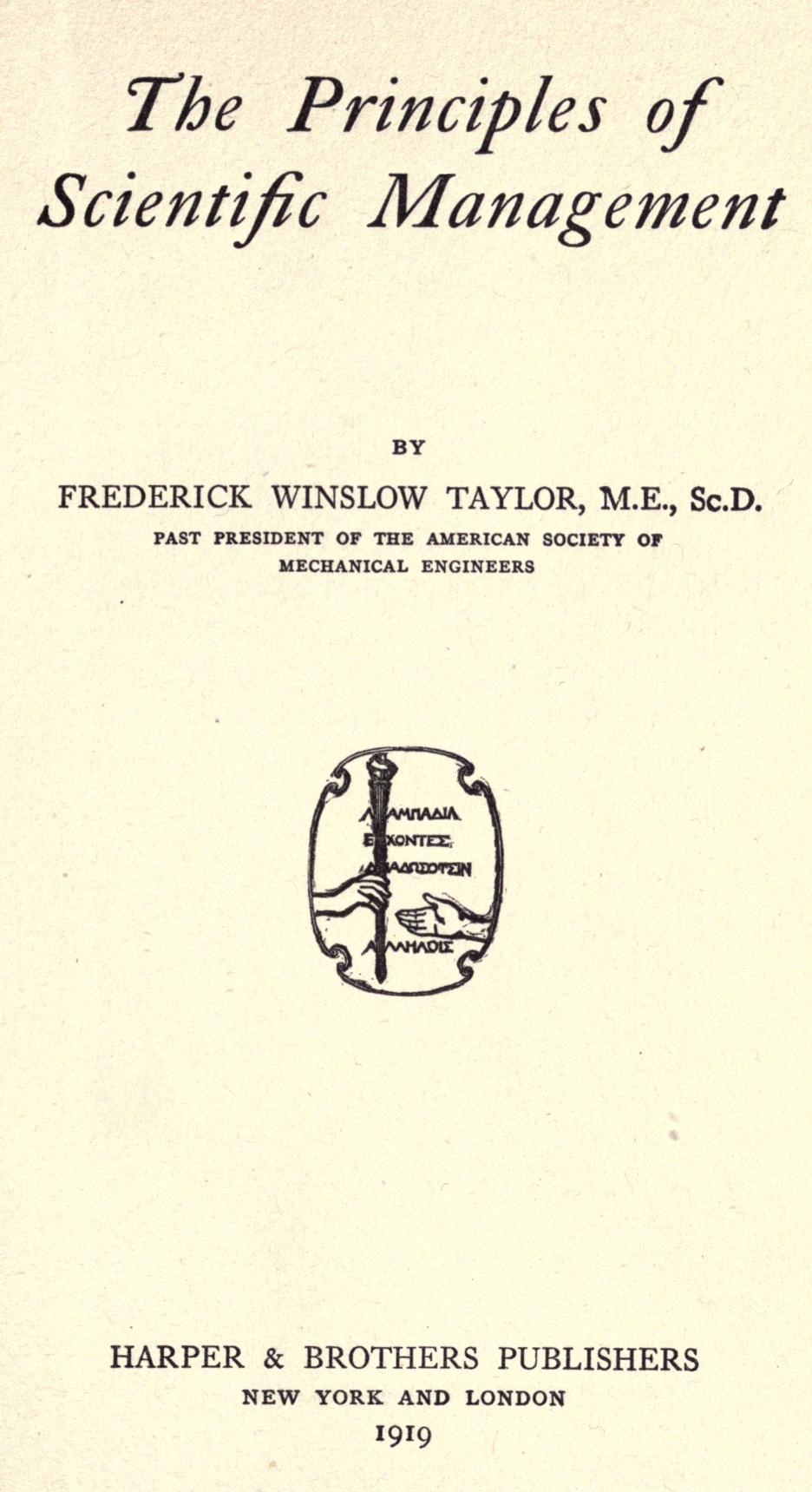
The Principles of Scientific Management (1911) is a monograph published by Frederick Winslow Taylor where he laid out his views on principles of scientific management, or industrial era organization and decision theory. Taylor was an American manufacturing manager, mechanical engineer, and then a management consultant in his later years. The term scientific management refers to coordinating the enterprise for everyone's benefit including increased wages for laborers although the approach is "directly antagonistic to the old idea that each workman can best regulate his own way of doing the work." His approach is also often referred to as Taylor's Principles, or Taylorism.
The monograph consisted of three sections: Introduction, Chapter 1: Fundamentals of Scientific Management, and Chapter 2: The Principles of Scientific Management.
Taylor started this paper by quoting U.S. President Theodore Roosevelt: "The conservation of our national resources is only preliminary to the larger question of national efficiency". Taylor pointed out that while a large movement had started to conserve material resources, the less visible and less tangible effects of the wasted human effort were only vaguely appreciated. He argues the necessity of focusing on training rather than finding the "right man", stating "In the past, the man has been first; in the future, the system must be first", and the first goal of all good systems should be developing first-class men. He listed three goals for the work:
First. To point out, through a series of simple illustrations, the great loss which the whole country is suffering through inefficiency in almost all of our daily acts.
Second. To try to convince the reader that the remedy for this inefficiency lies in systematic management, rather than in searching for some unusual or extraordinary man.
Third. To prove that the best management is true science, resting upon clearly defined laws, rules, and principles, as a foundation. And further to show that the fundamental principles of scientific management are applicable to all kinds of human activities, from our simplest individual acts to the work of our great corporations, which call for the most elaborate cooperation. And, briefly, through a series of illustrations, to convince the reader that whenever these principles are correctly applied, results must follow which are truly astounding.
Lastly, Taylor noted that while the examples were chosen to appeal to engineers and managers, his principles could be applied to the management of any social enterprise, such as homes, farms, small businesses, churches, philanthropic institutions, universities, and government.
Underworking, that is, deliberately working slowly so as to avoid doing a full day's work, "soldiering," as it is called in this country... is almost universal in industrial establishments, and prevails also to a large extent in the building trades; ... this constitutes the greatest evil with which the working-people of both England and America are now afflicted. [bolding added]
...the bricklayers' union have restricted their men to 275 bricks per day.. when working for the city, and 375 per day when working for private owners. The members of this union are probably sincere in their belief that this restriction of output is a benefit to their trade. It should be plain to all men, however, that this deliberate loafing is almost criminal, in that it inevitably results in making every workman's family pay higher rent for their housing... [bolding added]
Taylor argued that the principle object of management should be to secure the maximum prosperity for the employer, coupled with the maximum prosperity for each employee. He argued that the most important object of both the employee and the management should be the training and development of each individual in the establishment, so that he can do the highest class of work for which his natural abilities fit him. Taylor demonstrated that maximum prosperity can exist only as the result of maximum productivity, both for the shop and individual, and rebuked the idea that the fundamental interests of employees and employers are necessarily antagonistic.
Hub AI
The Principles of Scientific Management AI simulator
(@The Principles of Scientific Management_simulator)
The Principles of Scientific Management
The Principles of Scientific Management (1911) is a monograph published by Frederick Winslow Taylor where he laid out his views on principles of scientific management, or industrial era organization and decision theory. Taylor was an American manufacturing manager, mechanical engineer, and then a management consultant in his later years. The term scientific management refers to coordinating the enterprise for everyone's benefit including increased wages for laborers although the approach is "directly antagonistic to the old idea that each workman can best regulate his own way of doing the work." His approach is also often referred to as Taylor's Principles, or Taylorism.
The monograph consisted of three sections: Introduction, Chapter 1: Fundamentals of Scientific Management, and Chapter 2: The Principles of Scientific Management.
Taylor started this paper by quoting U.S. President Theodore Roosevelt: "The conservation of our national resources is only preliminary to the larger question of national efficiency". Taylor pointed out that while a large movement had started to conserve material resources, the less visible and less tangible effects of the wasted human effort were only vaguely appreciated. He argues the necessity of focusing on training rather than finding the "right man", stating "In the past, the man has been first; in the future, the system must be first", and the first goal of all good systems should be developing first-class men. He listed three goals for the work:
First. To point out, through a series of simple illustrations, the great loss which the whole country is suffering through inefficiency in almost all of our daily acts.
Second. To try to convince the reader that the remedy for this inefficiency lies in systematic management, rather than in searching for some unusual or extraordinary man.
Third. To prove that the best management is true science, resting upon clearly defined laws, rules, and principles, as a foundation. And further to show that the fundamental principles of scientific management are applicable to all kinds of human activities, from our simplest individual acts to the work of our great corporations, which call for the most elaborate cooperation. And, briefly, through a series of illustrations, to convince the reader that whenever these principles are correctly applied, results must follow which are truly astounding.
Lastly, Taylor noted that while the examples were chosen to appeal to engineers and managers, his principles could be applied to the management of any social enterprise, such as homes, farms, small businesses, churches, philanthropic institutions, universities, and government.
Underworking, that is, deliberately working slowly so as to avoid doing a full day's work, "soldiering," as it is called in this country... is almost universal in industrial establishments, and prevails also to a large extent in the building trades; ... this constitutes the greatest evil with which the working-people of both England and America are now afflicted. [bolding added]
...the bricklayers' union have restricted their men to 275 bricks per day.. when working for the city, and 375 per day when working for private owners. The members of this union are probably sincere in their belief that this restriction of output is a benefit to their trade. It should be plain to all men, however, that this deliberate loafing is almost criminal, in that it inevitably results in making every workman's family pay higher rent for their housing... [bolding added]
Taylor argued that the principle object of management should be to secure the maximum prosperity for the employer, coupled with the maximum prosperity for each employee. He argued that the most important object of both the employee and the management should be the training and development of each individual in the establishment, so that he can do the highest class of work for which his natural abilities fit him. Taylor demonstrated that maximum prosperity can exist only as the result of maximum productivity, both for the shop and individual, and rebuked the idea that the fundamental interests of employees and employers are necessarily antagonistic.