



Community hub
Recent from talks
Contribute something to knowledge base
Content stats: 0 posts, 0 articles, 1 media, 0 notes
Members stats: 0 subscribers, 0 contributors, 0 moderators, 0 supporters
Subscribers
Supporters
Contributors
Moderators
Hub AI
Theodore Judah AI simulator
(@Theodore Judah_simulator)
Hub AI
Theodore Judah AI simulator
(@Theodore Judah_simulator)
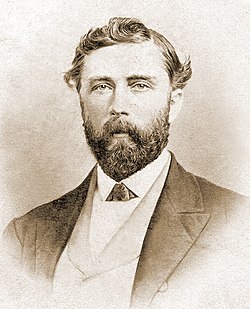
Theodore Judah
Theodore Dehone Judah (March 4, 1826 – November 2, 1863) was an American civil engineer who was a central figure in the original promotion, establishment, and design of the first transcontinental railroad. He found investors for what became the Central Pacific Railroad (CPRR). As chief engineer, he performed much of the route survey work to determine the best alignment for the railroad over the Sierra Nevada, which was completed six years after his death.
Theodore Judah was born in 1826 (perhaps 1825) in Bridgeport, Connecticut, the son of Mary (Reece) and The Rev. Henry Raymond Judah, an Episcopal clergyman. After his family moved to Troy, New York, Judah attended the Rensselaer Polytechnic Institute, then called the Rensselaer Institute in 1837 for a term and developed at a young age a passion for engineering and railroads.
At age 23, Judah married Anna Pierce on May 10, 1849. Theirs was the first wedding in the then-new St James Episcopal Church of Greenfield, Massachusetts.
After studying briefly at Rensselaer, Judah went to work on a number of railroads in the Northeast, including engineering for the Lewiston Railroad down the Niagara Gorge. He was elected member of the American Society of Civil Engineers in May 1853; at that time there were fewer than 800 civil engineers in the United States. Judah was hired in 1854 at age 28, by Colonel Charles Lincoln Wilson, as the Chief Engineer for the Sacramento Valley Railroad in California. He and his wife Anna sailed to Nicaragua, crossed over to the Pacific, and caught a steamer to San Francisco. Under his charge, Sacramento Valley became in February 1856 the first common carrier railroad built west of the Mississippi River. Later, he was chief engineer of the California Central Railroad, incorporated 1857, and the San Francisco and Sacramento Railroad organized in 1856.
In January 1857 in Washington DC, Judah published "A practical plan for building The Pacific Railroad", in which he outlined the general plan and argued for the need to do a detailed survey of a specific selected route for the railroad, not a general reconnaissance of several possible routes that had been done earlier.
Nominated in the 1859 California Pacific Railroad Convention in San Francisco, Judah was sent to Washington DC to lobby in general for the Pacific Railroad. Congress was distracted by the trouble of pre-Civil War America and showed little interest. He returned noting that he had to find a specific practical route and some private financial backing to do a detailed engineering survey.
In the fall of 1860, Charles Marsh, surveyor, civil engineer and water company owner, met with Judah, who had recently built the Sacramento Valley Railroad from Sacramento to Folsom, California. Marsh, who had already surveyed a potential railroad route between Sacramento and Nevada City, California, a decade earlier, went with Judah into the Sierra Nevada Mountains. There they examined the Henness Pass Turnpike Company’s route (Marsh was a founding director of that company). They measured elevations and distances, and discussed the possibility of a transcontinental railroad. Both were convinced that it could be done.
In November 1860, Judah published "Central Pacific Railroad to California", in which he declared "the discovery of a practicable route from the city of Sacramento upon the divide between Bear River and the North Fork of the American, via Illinoistown (near Colfax), Dutch Flat, and Summit Valley (Donner Pass) to the Truckee River". He advocated the chosen Dutch Flat-Donner Pass route as the most practical one with maximum grades of one hundred feet per mile and 150 miles shorter than the route recommended in the government's reports. Much of the Sierra Nevada where the practical routes were located was double-ridged, meaning two summits separated by a valley, Donner Pass was not and thus was more suitable for a railroad. From Dutch Flat, the Pacific road would climb steadily up the ridge between the North Fork American and Bear Rivers to the Pass before winding down steadily following the Truckee River out of the mountains into the Great Basin of Nevada. In December 1860 or early January 1861, Marsh met with Theodore Judah and Dr. Daniel Strong in Strong’s drug store in Dutch Flat, California, to discuss the project, which they called the Central Pacific Railroad of California.
Theodore Judah
Theodore Dehone Judah (March 4, 1826 – November 2, 1863) was an American civil engineer who was a central figure in the original promotion, establishment, and design of the first transcontinental railroad. He found investors for what became the Central Pacific Railroad (CPRR). As chief engineer, he performed much of the route survey work to determine the best alignment for the railroad over the Sierra Nevada, which was completed six years after his death.
Theodore Judah was born in 1826 (perhaps 1825) in Bridgeport, Connecticut, the son of Mary (Reece) and The Rev. Henry Raymond Judah, an Episcopal clergyman. After his family moved to Troy, New York, Judah attended the Rensselaer Polytechnic Institute, then called the Rensselaer Institute in 1837 for a term and developed at a young age a passion for engineering and railroads.
At age 23, Judah married Anna Pierce on May 10, 1849. Theirs was the first wedding in the then-new St James Episcopal Church of Greenfield, Massachusetts.
After studying briefly at Rensselaer, Judah went to work on a number of railroads in the Northeast, including engineering for the Lewiston Railroad down the Niagara Gorge. He was elected member of the American Society of Civil Engineers in May 1853; at that time there were fewer than 800 civil engineers in the United States. Judah was hired in 1854 at age 28, by Colonel Charles Lincoln Wilson, as the Chief Engineer for the Sacramento Valley Railroad in California. He and his wife Anna sailed to Nicaragua, crossed over to the Pacific, and caught a steamer to San Francisco. Under his charge, Sacramento Valley became in February 1856 the first common carrier railroad built west of the Mississippi River. Later, he was chief engineer of the California Central Railroad, incorporated 1857, and the San Francisco and Sacramento Railroad organized in 1856.
In January 1857 in Washington DC, Judah published "A practical plan for building The Pacific Railroad", in which he outlined the general plan and argued for the need to do a detailed survey of a specific selected route for the railroad, not a general reconnaissance of several possible routes that had been done earlier.
Nominated in the 1859 California Pacific Railroad Convention in San Francisco, Judah was sent to Washington DC to lobby in general for the Pacific Railroad. Congress was distracted by the trouble of pre-Civil War America and showed little interest. He returned noting that he had to find a specific practical route and some private financial backing to do a detailed engineering survey.
In the fall of 1860, Charles Marsh, surveyor, civil engineer and water company owner, met with Judah, who had recently built the Sacramento Valley Railroad from Sacramento to Folsom, California. Marsh, who had already surveyed a potential railroad route between Sacramento and Nevada City, California, a decade earlier, went with Judah into the Sierra Nevada Mountains. There they examined the Henness Pass Turnpike Company’s route (Marsh was a founding director of that company). They measured elevations and distances, and discussed the possibility of a transcontinental railroad. Both were convinced that it could be done.
In November 1860, Judah published "Central Pacific Railroad to California", in which he declared "the discovery of a practicable route from the city of Sacramento upon the divide between Bear River and the North Fork of the American, via Illinoistown (near Colfax), Dutch Flat, and Summit Valley (Donner Pass) to the Truckee River". He advocated the chosen Dutch Flat-Donner Pass route as the most practical one with maximum grades of one hundred feet per mile and 150 miles shorter than the route recommended in the government's reports. Much of the Sierra Nevada where the practical routes were located was double-ridged, meaning two summits separated by a valley, Donner Pass was not and thus was more suitable for a railroad. From Dutch Flat, the Pacific road would climb steadily up the ridge between the North Fork American and Bear Rivers to the Pass before winding down steadily following the Truckee River out of the mountains into the Great Basin of Nevada. In December 1860 or early January 1861, Marsh met with Theodore Judah and Dr. Daniel Strong in Strong’s drug store in Dutch Flat, California, to discuss the project, which they called the Central Pacific Railroad of California.
Recent media
Recent media