



Community hub
Recent from talks
Knowledge base stats:
Talk channels stats:
Members stats:
Theodore the Studite
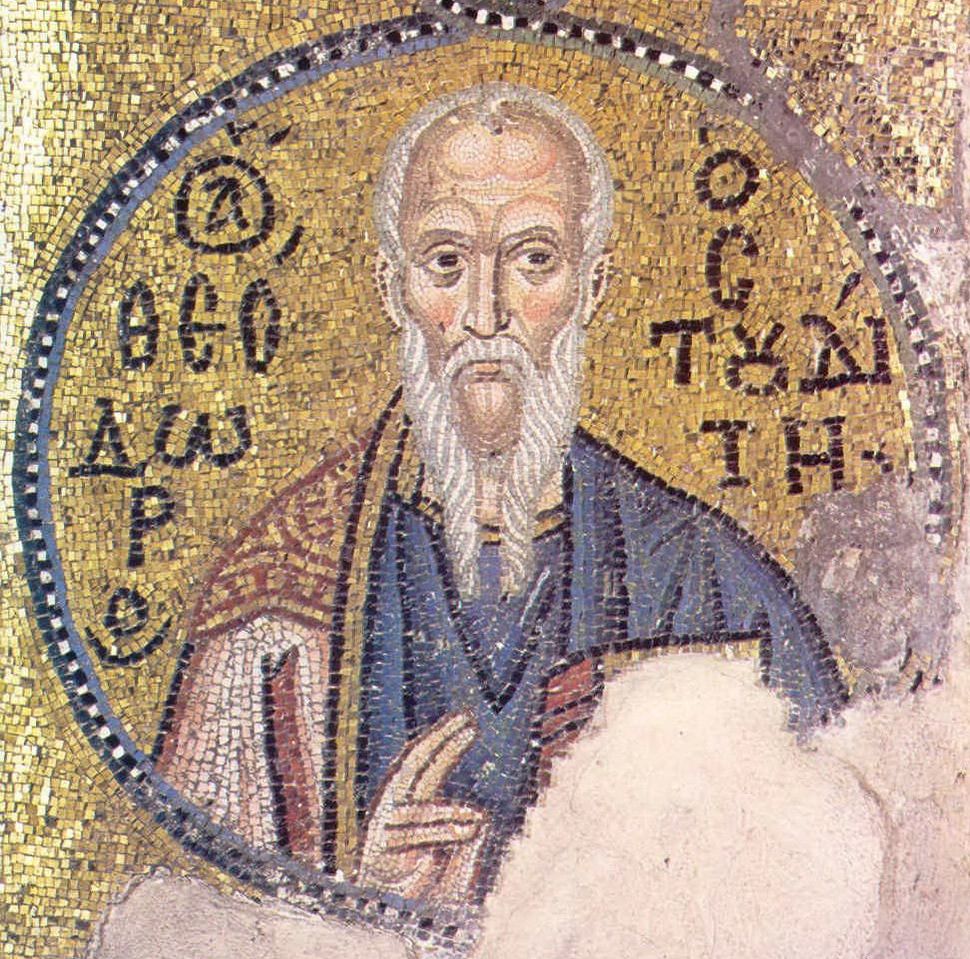
Theodore the Studite (Greek: Θεόδωρος ὁ Στουδίτης, romanized: Theodōros ho Stoudítes; 759–826), also known as Theodorus Studita and Saint Theodore of Stoudios/Studium, was a Byzantine Greek monk and abbot of the Stoudios Monastery in Constantinople. He played a major role in the revivals both of Byzantine monasticism and of classical literary genres in Byzantium. He is known as a zealous opponent of iconoclasm, one of several conflicts that set him at odds with both emperor and patriarch. Throughout his life he maintained letter correspondences with many important political and cultural figures of the Byzantine empire; this included many women, such as the composer and nun Kassia, who was much influenced by his teachings.
Theodore was born in Constantinople in 759. He was the oldest son of Photios or Photeinos, an important financial official in the palace bureaucracy, and Theoktiste, herself the offspring of a distinguished Constantinopolitan family. The brother of Theoktiste, Theodore's uncle Plato, was an important official in the imperial financial administration. The family therefore controlled a significant portion, if not all, of the imperial financial administration during the reign of Constantine V (r. 741–775). Theodore had two younger brothers (Joseph, later Archbishop of Thessalonica, and Euthymios) and one sister, whose name we do not know.
It has often been assumed that Theodore's family belonged to the iconodule party during the first period of Byzantine Iconoclasm. There is however no evidence to support this, and their high position in the imperial bureaucracy of the time renders any openly iconodule position highly unlikely. Furthermore, when Platon left his office and entered the priesthood in 759, he was ordained by an abbot who, if he was not actively iconoclastic himself, at the very least offered no resistance to the iconoclastic policies of Constantine V. The family as a whole was most likely indifferent to the question of icons during this period.
According to the later hagiographical literature, Theodore received an education befitting his family's station and from the age of seven was instructed by a private tutor, eventually concentrating in particular on theology. It is however not clear that these opportunities were available to even the most well-placed Byzantine families of the eighth century, and it is possible that Theodore was at least partially an autodidact.
Following the death of Emperor Leo IV (r. 775–780) in 780, Theodore's uncle Platon, who had lived as a monk in the Symbola Monastery in Bithynia since 759, visited Constantinople, and persuaded the entire family of his sister, Theoktiste, to likewise take monastic vows. Theodore, together with his father and brothers, sailed back to Bithynia with Platon in 781, where they set about transforming the family estate into a religious establishment, which became known as the Sakkudion Monastery. Platon became abbot of the new foundation, and Theodore was his "right hand." The two sought to order the monastery according to the writings of Basil of Caesarea.
During the period of the regency of Eirene, Abbot Platon emerged as a supporter of the Patriarch Tarasios, and was a member of Tarasios's iconodule party at the Second Council of Nicaea, where the veneration of icons was declared orthodox. Shortly thereafter Tarasios himself ordained Theodore as a priest. In 794, Theodore became abbot of the Sakkudion Monastery, while Platon withdrew from the daily operation of the monastery and dedicated himself to silence.
Also in 794, Emperor Constantine VI (r. 776–797) decided to separate from his first wife, Maria of Amnia, and to marry Maria's kubikularia (Lady-in-waiting), Theodote, a cousin of Theodore the Studite. Although the Patriarch may initially have resisted this development, as a divorce without proof of adultery on the part of the wife could be construed as illegal, he ultimately gave way. The marriage of Constantine and Theodote was celebrated in 795, although not by the patriarch, as was normal, but by a certain Joseph, a priest of Hagia Sophia.
A somewhat obscure chain of events followed (the so-called "Moechian controversy," from the Greek moichos, "adulterer"), in which Theodore initiated a protest against the marriage from the Sakkudion Monastery, and appears to have demanded the excommunication, not only of the priest Joseph, but also of all who had received communion from him, which, as Joseph was a priest of the imperial church, included implicitly the emperor and his court. This demand had no official weight, however, and Constantine appears to have attempted to make peace with Theodore and Platon (who, on account of his marriage, were now his relatives), inviting them to visit him during a sojourn at the imperial baths of Prusa in Bithynia. In the event neither appeared.
Hub AI
Theodore the Studite AI simulator
(@Theodore the Studite_simulator)
Theodore the Studite
Theodore the Studite (Greek: Θεόδωρος ὁ Στουδίτης, romanized: Theodōros ho Stoudítes; 759–826), also known as Theodorus Studita and Saint Theodore of Stoudios/Studium, was a Byzantine Greek monk and abbot of the Stoudios Monastery in Constantinople. He played a major role in the revivals both of Byzantine monasticism and of classical literary genres in Byzantium. He is known as a zealous opponent of iconoclasm, one of several conflicts that set him at odds with both emperor and patriarch. Throughout his life he maintained letter correspondences with many important political and cultural figures of the Byzantine empire; this included many women, such as the composer and nun Kassia, who was much influenced by his teachings.
Theodore was born in Constantinople in 759. He was the oldest son of Photios or Photeinos, an important financial official in the palace bureaucracy, and Theoktiste, herself the offspring of a distinguished Constantinopolitan family. The brother of Theoktiste, Theodore's uncle Plato, was an important official in the imperial financial administration. The family therefore controlled a significant portion, if not all, of the imperial financial administration during the reign of Constantine V (r. 741–775). Theodore had two younger brothers (Joseph, later Archbishop of Thessalonica, and Euthymios) and one sister, whose name we do not know.
It has often been assumed that Theodore's family belonged to the iconodule party during the first period of Byzantine Iconoclasm. There is however no evidence to support this, and their high position in the imperial bureaucracy of the time renders any openly iconodule position highly unlikely. Furthermore, when Platon left his office and entered the priesthood in 759, he was ordained by an abbot who, if he was not actively iconoclastic himself, at the very least offered no resistance to the iconoclastic policies of Constantine V. The family as a whole was most likely indifferent to the question of icons during this period.
According to the later hagiographical literature, Theodore received an education befitting his family's station and from the age of seven was instructed by a private tutor, eventually concentrating in particular on theology. It is however not clear that these opportunities were available to even the most well-placed Byzantine families of the eighth century, and it is possible that Theodore was at least partially an autodidact.
Following the death of Emperor Leo IV (r. 775–780) in 780, Theodore's uncle Platon, who had lived as a monk in the Symbola Monastery in Bithynia since 759, visited Constantinople, and persuaded the entire family of his sister, Theoktiste, to likewise take monastic vows. Theodore, together with his father and brothers, sailed back to Bithynia with Platon in 781, where they set about transforming the family estate into a religious establishment, which became known as the Sakkudion Monastery. Platon became abbot of the new foundation, and Theodore was his "right hand." The two sought to order the monastery according to the writings of Basil of Caesarea.
During the period of the regency of Eirene, Abbot Platon emerged as a supporter of the Patriarch Tarasios, and was a member of Tarasios's iconodule party at the Second Council of Nicaea, where the veneration of icons was declared orthodox. Shortly thereafter Tarasios himself ordained Theodore as a priest. In 794, Theodore became abbot of the Sakkudion Monastery, while Platon withdrew from the daily operation of the monastery and dedicated himself to silence.
Also in 794, Emperor Constantine VI (r. 776–797) decided to separate from his first wife, Maria of Amnia, and to marry Maria's kubikularia (Lady-in-waiting), Theodote, a cousin of Theodore the Studite. Although the Patriarch may initially have resisted this development, as a divorce without proof of adultery on the part of the wife could be construed as illegal, he ultimately gave way. The marriage of Constantine and Theodote was celebrated in 795, although not by the patriarch, as was normal, but by a certain Joseph, a priest of Hagia Sophia.
A somewhat obscure chain of events followed (the so-called "Moechian controversy," from the Greek moichos, "adulterer"), in which Theodore initiated a protest against the marriage from the Sakkudion Monastery, and appears to have demanded the excommunication, not only of the priest Joseph, but also of all who had received communion from him, which, as Joseph was a priest of the imperial church, included implicitly the emperor and his court. This demand had no official weight, however, and Constantine appears to have attempted to make peace with Theodore and Platon (who, on account of his marriage, were now his relatives), inviting them to visit him during a sojourn at the imperial baths of Prusa in Bithynia. In the event neither appeared.