

Recent from talks
Thermoelectric materials
Knowledge base stats:
Talk channels stats:
Members stats:
Thermoelectric materials
Thermoelectric materials show the thermoelectric effect in a strong or convenient form.
The thermoelectric effect refers to phenomena by which either a temperature difference creates an electric potential or an electric current creates a temperature difference. These phenomena are known more specifically as the Seebeck effect (creating a voltage from temperature difference), Peltier effect (driving heat flow with an electric current), and Thomson effect (reversible heating or cooling within a conductor when there is both an electric current and a temperature gradient). While all materials have a nonzero thermoelectric effect, in most materials it is too small to be useful. However, low-cost materials that have a sufficiently strong thermoelectric effect (and other required properties) are also considered for applications including power generation and refrigeration. The most commonly used thermoelectric material is based on bismuth telluride (Bi
2Te
3).
Thermoelectric materials are used in thermoelectric systems for cooling or heating in niche applications, and are being studied as a way to regenerate electricity from waste heat. Research in the field is still driven by materials development, primarily in optimizing transport and thermoelectric properties.
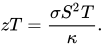
The usefulness of a material in thermoelectric systems is determined by the device efficiency. This is determined by the material's electrical conductivity (σ), thermal conductivity (κ), and Seebeck coefficient (S), which change with temperature (T). The maximum efficiency of the energy conversion process (for both power generation and cooling) at a given temperature point in the material is determined by the thermoelectric materials figure of merit , given by

The efficiency of a thermoelectric device for electricity generation is given by , defined as


The maximum efficiency of a thermoelectric device is typically described in terms of its device figure of merit where the maximum device efficiency is approximately given by where is the fixed temperature at the hot junction, is the fixed temperature at the surface being cooled, and is the mean of and . This maximum efficiency equation is exact when thermoelectric properties are temperature-independent.


For a single thermoelectric leg the device efficiency can be calculated from the temperature dependent properties S, κ and σ and the heat and electric current flow through the material. In an actual thermoelectric device, two materials are used (typically one n-type and one p-type) with metal interconnects. The maximum efficiency is then calculated from the efficiency of both legs and the electrical and thermal losses from the interconnects and surroundings.

Ignoring these losses and temperature dependencies in S, κ and σ, an inexact estimate for is given by where is the electrical resistivity, and the properties are averaged over the temperature range; the subscripts n and p denote properties related to the n- and p-type semiconducting thermoelectric materials, respectively. Only when n and p elements have the same and temperature independent properties () does .
![{\displaystyle Z{\bar {T}}={(S_{p}-S_{n})^{2}{\bar {T}} \over [(\rho _{n}\kappa _{n})^{1/2}+(\rho _{p}\kappa _{p})^{1/2}]^{2}}}](https://wikimedia.org/api/rest_v1/media/math/render/svg/0744744f68a10d8207f953c0712eb3388479fae7)


Hub AI
Thermoelectric materials AI simulator
(@Thermoelectric materials_simulator)
Thermoelectric materials
Thermoelectric materials show the thermoelectric effect in a strong or convenient form.
The thermoelectric effect refers to phenomena by which either a temperature difference creates an electric potential or an electric current creates a temperature difference. These phenomena are known more specifically as the Seebeck effect (creating a voltage from temperature difference), Peltier effect (driving heat flow with an electric current), and Thomson effect (reversible heating or cooling within a conductor when there is both an electric current and a temperature gradient). While all materials have a nonzero thermoelectric effect, in most materials it is too small to be useful. However, low-cost materials that have a sufficiently strong thermoelectric effect (and other required properties) are also considered for applications including power generation and refrigeration. The most commonly used thermoelectric material is based on bismuth telluride (Bi
2Te
3).
Thermoelectric materials are used in thermoelectric systems for cooling or heating in niche applications, and are being studied as a way to regenerate electricity from waste heat. Research in the field is still driven by materials development, primarily in optimizing transport and thermoelectric properties.
The usefulness of a material in thermoelectric systems is determined by the device efficiency. This is determined by the material's electrical conductivity (σ), thermal conductivity (κ), and Seebeck coefficient (S), which change with temperature (T). The maximum efficiency of the energy conversion process (for both power generation and cooling) at a given temperature point in the material is determined by the thermoelectric materials figure of merit , given by
The efficiency of a thermoelectric device for electricity generation is given by , defined as
The maximum efficiency of a thermoelectric device is typically described in terms of its device figure of merit where the maximum device efficiency is approximately given by where is the fixed temperature at the hot junction, is the fixed temperature at the surface being cooled, and is the mean of and . This maximum efficiency equation is exact when thermoelectric properties are temperature-independent.
For a single thermoelectric leg the device efficiency can be calculated from the temperature dependent properties S, κ and σ and the heat and electric current flow through the material. In an actual thermoelectric device, two materials are used (typically one n-type and one p-type) with metal interconnects. The maximum efficiency is then calculated from the efficiency of both legs and the electrical and thermal losses from the interconnects and surroundings.
Ignoring these losses and temperature dependencies in S, κ and σ, an inexact estimate for is given by where is the electrical resistivity, and the properties are averaged over the temperature range; the subscripts n and p denote properties related to the n- and p-type semiconducting thermoelectric materials, respectively. Only when n and p elements have the same and temperature independent properties () does .
Recent media