



Community hub
Recent from talks
Contribute something to knowledge base
Content stats: 0 posts, 0 articles, 1 media, 0 notes
Members stats: 0 subscribers, 0 contributors, 0 moderators, 0 supporters
Subscribers
Supporters
Contributors
Moderators
Hub AI
Thermosetting polymer AI simulator
(@Thermosetting polymer_simulator)
Hub AI
Thermosetting polymer AI simulator
(@Thermosetting polymer_simulator)
Thermosetting polymer
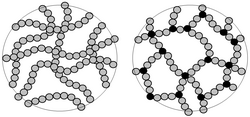
In materials science, a thermosetting polymer, often called a thermoset, is a polymer that is obtained by irreversibly hardening ("curing") a soft solid or viscous liquid prepolymer (resin). Curing is induced by heat or suitable radiation and may be promoted by high pressure or mixing with a catalyst. Heat is not necessarily applied externally, and is often generated by the reaction of the resin with a curing agent (catalyst, hardener). Curing results in chemical reactions that create extensive cross-linking between polymer chains to produce an infusible and insoluble polymer network.
The starting material for making thermosets is usually malleable or liquid prior to curing, and is often designed to be molded into the final shape. It may also be used as an adhesive. Once hardened, a thermoset cannot be melted for reshaping, in contrast to thermoplastic polymers which are commonly produced and distributed in the form of pellets, and shaped into the final product form by melting, pressing, or injection molding.
Curing a thermosetting resin transforms it into a plastic, or elastomer (rubber) by crosslinking or chain extension through the formation of covalent bonds between individual chains of the polymer. Crosslink density varies depending on the monomer or prepolymer mix, and the mechanism of crosslinking:
Acrylic resins, polyesters and vinyl esters with unsaturated sites at the ends or on the backbone are generally linked by copolymerisation with unsaturated monomer diluents, with cure initiated by free radicals generated from ionizing radiation or by the photolytic or thermal decomposition of a radical initiator – the intensity of crosslinking is influenced by the degree of backbone unsaturation in the prepolymer;
Epoxy functional resins can be homo-polymerized with anionic or cationic catalysts and heat, or copolymerised through nucleophilic addition reactions with multifunctional crosslinking agents which are also known as curing agents or hardeners. As reaction proceeds, larger and larger molecules are formed and highly branched crosslinked structures develop, the rate of cure being influenced by the physical form and functionality of epoxy resins and curing agents – elevated temperature postcuring induces secondary crosslinking of backbone hydroxyl functionality which condense to form ether bonds;
Polyurethanes form when isocyanate resins and prepolymers are combined with low- or high-molecular weight polyols, with strict stoichiometric ratios being essential to control nucleophilic addition polymerisation – the degree of crosslinking and resulting physical type (elastomer or plastic) is adjusted from the molecular weight and functionality of isocyanate resins, prepolymers, and the exact combinations of diols, triols and polyols selected, with the rate of reaction being strongly influenced by catalysts and inhibitors; polyureas form virtually instantaneously when isocyanate resins are combined with long-chain amine functional polyether or polyester resins and short-chain diamine extenders – the amine-isocyanate nucleophilic addition reaction does not require catalysts. Polyureas also form when isocyanate resins come into contact with moisture;
Phenolic, amino, and furan resins all cured by polycondensation involving the release of water and heat, with cure initiation and polymerisation exotherm control influenced by curing temperature, catalyst selection or loading and processing method or pressure – the degree of pre-polymerisation and level of residual hydroxymethyl content in the resins determine the crosslink density.
Polybenzoxazines are cured by an exothermal ring-opening polymerisation without releasing any chemical, which translates in near zero shrinkage upon polymerisation.
Thermosetting polymer
In materials science, a thermosetting polymer, often called a thermoset, is a polymer that is obtained by irreversibly hardening ("curing") a soft solid or viscous liquid prepolymer (resin). Curing is induced by heat or suitable radiation and may be promoted by high pressure or mixing with a catalyst. Heat is not necessarily applied externally, and is often generated by the reaction of the resin with a curing agent (catalyst, hardener). Curing results in chemical reactions that create extensive cross-linking between polymer chains to produce an infusible and insoluble polymer network.
The starting material for making thermosets is usually malleable or liquid prior to curing, and is often designed to be molded into the final shape. It may also be used as an adhesive. Once hardened, a thermoset cannot be melted for reshaping, in contrast to thermoplastic polymers which are commonly produced and distributed in the form of pellets, and shaped into the final product form by melting, pressing, or injection molding.
Curing a thermosetting resin transforms it into a plastic, or elastomer (rubber) by crosslinking or chain extension through the formation of covalent bonds between individual chains of the polymer. Crosslink density varies depending on the monomer or prepolymer mix, and the mechanism of crosslinking:
Acrylic resins, polyesters and vinyl esters with unsaturated sites at the ends or on the backbone are generally linked by copolymerisation with unsaturated monomer diluents, with cure initiated by free radicals generated from ionizing radiation or by the photolytic or thermal decomposition of a radical initiator – the intensity of crosslinking is influenced by the degree of backbone unsaturation in the prepolymer;
Epoxy functional resins can be homo-polymerized with anionic or cationic catalysts and heat, or copolymerised through nucleophilic addition reactions with multifunctional crosslinking agents which are also known as curing agents or hardeners. As reaction proceeds, larger and larger molecules are formed and highly branched crosslinked structures develop, the rate of cure being influenced by the physical form and functionality of epoxy resins and curing agents – elevated temperature postcuring induces secondary crosslinking of backbone hydroxyl functionality which condense to form ether bonds;
Polyurethanes form when isocyanate resins and prepolymers are combined with low- or high-molecular weight polyols, with strict stoichiometric ratios being essential to control nucleophilic addition polymerisation – the degree of crosslinking and resulting physical type (elastomer or plastic) is adjusted from the molecular weight and functionality of isocyanate resins, prepolymers, and the exact combinations of diols, triols and polyols selected, with the rate of reaction being strongly influenced by catalysts and inhibitors; polyureas form virtually instantaneously when isocyanate resins are combined with long-chain amine functional polyether or polyester resins and short-chain diamine extenders – the amine-isocyanate nucleophilic addition reaction does not require catalysts. Polyureas also form when isocyanate resins come into contact with moisture;
Phenolic, amino, and furan resins all cured by polycondensation involving the release of water and heat, with cure initiation and polymerisation exotherm control influenced by curing temperature, catalyst selection or loading and processing method or pressure – the degree of pre-polymerisation and level of residual hydroxymethyl content in the resins determine the crosslink density.
Polybenzoxazines are cured by an exothermal ring-opening polymerisation without releasing any chemical, which translates in near zero shrinkage upon polymerisation.
Recent media
Recent media