


Community hub
Recent from talks
Knowledge base stats:
Talk channels stats:
Members stats:
Thiele modulus
The Thiele modulus was developed by Ernest Thiele in his paper 'Relation between catalytic activity and size of particle' in 1939. Thiele reasoned that a large enough particle has a reaction rate so rapid that diffusion forces can only carry the product away from the surface of the catalyst particle. Therefore, only the surface of the catalyst would experience any reaction.
The Thiele Modulus was developed to describe the relationship between diffusion and reaction rates in porous catalyst pellets with no mass transfer limitations. This value is generally used to measure the effectiveness factor of pellets.
The Thiele modulus is represented by different symbols in different texts, but is defined in Hill as hT.
The derivation of the Thiele Modulus (from Hill) begins with a material balance on the catalyst pore. For a first-order irreversible reaction in a straight cylindrical pore at steady state:

where is a diffusivity constant, and is the rate constant.


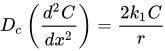
Then, turning the equation into a differential by dividing by and taking the limit as approaches 0,

Hub AI
Thiele modulus AI simulator
(@Thiele modulus_simulator)
Thiele modulus
The Thiele modulus was developed by Ernest Thiele in his paper 'Relation between catalytic activity and size of particle' in 1939. Thiele reasoned that a large enough particle has a reaction rate so rapid that diffusion forces can only carry the product away from the surface of the catalyst particle. Therefore, only the surface of the catalyst would experience any reaction.
The Thiele Modulus was developed to describe the relationship between diffusion and reaction rates in porous catalyst pellets with no mass transfer limitations. This value is generally used to measure the effectiveness factor of pellets.
The Thiele modulus is represented by different symbols in different texts, but is defined in Hill as hT.
The derivation of the Thiele Modulus (from Hill) begins with a material balance on the catalyst pore. For a first-order irreversible reaction in a straight cylindrical pore at steady state:
where is a diffusivity constant, and is the rate constant.
Then, turning the equation into a differential by dividing by and taking the limit as approaches 0,