Hubbry Logo
Thomas StevensonThomas StevensonMain
Open search
Thomas Stevenson
Community hub
Thomas Stevenson
logo
8 pages, 0 posts
0 subscribers
Be the first to start a discussion here.
Thomas Stevenson
Thomas Stevenson
from Wikipedia

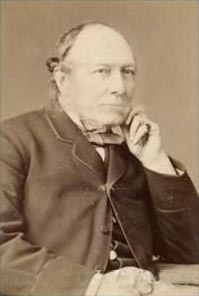
Thomas Stevenson PRSE MInstCE FRSSA FSAScot (22 July 1818 – 8 May 1887) was a pioneering Scottish civil engineer, lighthouse designer and meteorologist, who designed over thirty lighthouses in and around Scotland, as well as the Stevenson screen used in meteorology. His designs, celebrated as ground breaking, ushered in a new era of lighthouse creation.

Key Information

He served as president of the Royal Scottish Society of Arts (1859–60), as president of the Royal Society of Edinburgh (1884–86), and was a co-founder of the Scottish Meteorological Society.[1]

He was the father of writer Robert Louis Stevenson.

Life and career

[edit]

He was born at 2 Baxters Place[2] in Edinburgh, on 22 July 1818, the youngest son of engineer Robert Stevenson, and his wife (and step-sister) Jean Smith. He was educated at the Royal High School in Edinburgh.

Thomas Stevenson was a devout and regular attendee at St. Stephen's Church in Stockbridge, at the north end of St Vincent Street, Edinburgh.

He lived with his family at Baxters Place until he got married in 1848. He then got a house at 8 Howard Place.[3] By 1855 he moved to 1 Inverleith Terrace.[4] From at least 1860 he lived at 17 Heriot Row, a large Georgian terraced townhouse in Edinburgh's New Town.[5]

In 1864, he published The design and construction of harbours: a treatise on maritime engineering. The book was based on an article he had originally written for the Encyclopædia Britannica, and covered the principles and practices involved in harbour design and construction. The work discussed the geological and physical features affecting harbour design, the generation and impact of waves, along with construction materials and masonry types for quay walls. The book also explored the efficacy of tides and fresh water in maintaining outfalls. A second edition of the book was published in 1874.[6]

In 1869, as a successful experiment into using the newly invented electric light for lighthouses, Stevenson had an underwater cable installed from the eastern part of Granton Harbour, and a light on the end of the Trinity Chain Pier was controlled from half a mile away by an operator on the harbour.[7][8] He designed the Stevenson screen as a shelter to shield meteorological instruments, and this has been widely adopted.

He died at 17 Heriot Row in Edinburgh on 8 May 1887 and is buried in the Stevenson family vault in New Calton Cemetery. The vault lies midway along the eastern wall.

Stevenson's formula for the prediction of wave heights

[edit]

In the course of his work as a lighthouse and harbour engineer, Stevenson had made observations of wave heights at various locations in Scotland over a number of years. In 1852, he published a paper in which he suggested that waves increased in height by a ratio approximate to the square root of their distance from the windward shore.[9] Stevenson developed this into the simple formula , in which is the wave height in feet and is the fetch in miles.[10][11]

Essential components for wave height prediction, most notably wind speed, are missing from Stevenson's formula. In 1852, mathematical analysis of the theory of water waves, and methods for numerical assessment of factors such as shoaling and surge, were in their infancy.[12][13] Stevenson's analysis[14] is possibly the first quantitative discussion of wave height as a (square root) function of fetch, and his paper[15] is one of the first quantitative studies of wind speeds in the planetary boundary layer.

Modern analysis of Stevenson's formula indicates that it appears to conservatively estimate wave heights for wind speeds up to around 30 miles per hour, being based on his observations which most likely were taken for fetch lengths under 100 kilometres, without fully developed seas. The breakwater at Wick was exposed to a fetch length of approximately 500 kilometres, and wind speeds far in excess of 30 miles per hour, prior to its eventual destruction.[10][16]

In 1965, the South African engineer Basil Wrigley Wilson proposed a method which can be used to approximate the significant wave height H1/3 and period T1/3 of wind waves generated by a constant wind of speed U blowing over a fetch length F.[17] The units for these quantities are as follows:

  • H1/3 in metres (m)
  • T1/3 in seconds (s)
  • U in metres per second (m/s)
  • F in metres (m)

Wilson's formulae apply when the duration of the wind blowing is sufficiently long, as when the wind blows for only a limited time, waves cannot attain the full height and period corresponding to the wind speed and fetch length.[18] Under conditions were the wind blows for a sufficiently long time, for example during a prolonged storm, the wave height and period can be calculated as follows:

In these formulae, g denotes the acceleration due to gravity, which is approximately 9.807 m/s2. The wind speed U is measured at an elevation of 10 metres above the sea surface. For conditions approximate to those for the Wick breakwater during a storm (fetch length of 500km, wind speed of around 75mph), the graph below shows that Wilson's method predicts a significant wave height (H1/3) of around 1.5 times that of Stevenson's.[9][17]

A graph showing significant wave height (H1/3) in metres predicted using the formulae of Wilson (1965) and Stevenson (1852) for a 75mph (33.528m/s) wind

Nonetheless, whilst Stevenson's formula is highly limited and unsuitable for engineering design application, it was notable for being an early attempt to apply mathematical theory to hydraulic engineering problems, and shows some limited agreement (albeit within a narrow range) with a more advanced formula developed by Ramón Iribarren in 1942.[16][19] A major flaw in Stevenson's formula is the absence of consideration of wind speed, and comparison with Wilson's formula at 3 different wind speeds (30, 50 and 75mph) shows only a reasonable level of agreement for 50mph winds at fetch lengths up to around 100 metres.[9][17]

Comparison of wave height (H1/3) prediction in metres using Stevenson and Wilson formula for 3 different wind speeds

Stevenson himself noted that the formula was an approximation,[20] and actively encouraged further research into similar problems, imploring young engineers to redouble efforts in the advancement of coastal engineering during an 1885 address to the Institution of Civil Engineers in London.[21] In addition to his work on wave growth, he also undertook research into the phenomenon of wave decay inside harbour basins.[22]

The breakwater at Wick, Caithness

[edit]

Stevenson designed and supervised the construction of a breakwater at Wick in 1863, which at the time was the largest herring fishery in Europe. The inner harbour, designed by Thomas Telford, was completed in 1811, followed by the construction of the expanded outer harbour by James Bremner between 1825 and 1834. However, by 1857, the need for increased capacity became evident, leading the British Fishery Society to propose a new breakwater. In 1862 Stevenson, along with his brother David, prepared detailed plans, sections, and specifications for the harbour's extension. This design received support from Sir John Coode and John Hawkshaw. A loan of £62,000 was sanctioned by A. M. Rendel, the engineer for the Public Works Loan Commission.[23]

Construction commenced in April 1863, aiming for a final length of 460 metres. Stevenson's design featured a rubble mound extending to 5.5 metres above the low water mark, following the Crane Rocks. This was capped with block walls and in-filled with rubble, providing a superstructure up to 16 metres wide. The rubble for the mound was sourced from local quarries and transported by steam locomotives. This was then deposited onto the breakwater mound using travelling gantries that ran along the staging, marking a possible first in Scotland for this technique.[24][23] The seaward wall was constructed with a 6:1 batter. Below the waterline, the blocks were dry-jointed, whereas above the high-water mark, initially Roman and later Portland cement mortar was used.[25]

The breakwater failed progressively as a result of several storms, including a storm in 1868 which destroyed a 250 ft (76 m) length of the constructed works,[26] and by 1870 it had lost one third of its entire length. It was eventually abandoned in 1877, after further severe storm damage, despite repeated failed attempts at its reconstruction.[16][23][25] Stevenson noted, in correspondence with the Institution of Civil Engineers, that a single storm had at one stage removed 1,350 tonnes of material from the breakwater, but he was unable to provide the height of the waves during the event.[27]

Applying present-day techniques to calculate local wave conditions demonstrates that the breakwater as built would not have survived without mobilising additional restraint, or a mechanism to abate wave forces.[25] Stevenson's own wave formula would have predicted offshore wave heights for Wick of around 8 to 10 metres, whereas modern observations show that the North Sea exhibits wave heights of up to two to three times this figure.[28][29][30][10]

Family

[edit]

He was brother of the lighthouse engineers Alan and David Stevenson, between 1854 and 1886 he designed many lighthouses, with his brother David, and then with David's son David Alan Stevenson.

He married Margaret Isabella "Maggie" Balfour in 1848, daughter of Rev Lewis Balfour. Their son was the writer Robert Louis Stevenson, who initially caused him much disappointment by failing to follow the engineering interests of his family.

His wife's younger brother, James Melville Balfour (i.e. his brother-in-law), trained under D. & T. Stevenson and then emigrated to New Zealand, where he was first the marine engineer for Otago Province before he was appointed Colonial Marine Engineer.[31][32]

Lighthouses designed by Thomas Stevenson

[edit]
[edit]

See also

[edit]

References

[edit]
[edit]
Revisions and contributorsEdit on WikipediaRead on Wikipedia
from Grokipedia
Thomas Stevenson (1818–1887) was a Scottish renowned for his pioneering work in design and construction, as well as contributions to and harbour . As the youngest son of the celebrated engineer Stevenson—who designed the iconic —Thomas joined the family firm and became a key figure in the , overseeing the building of approximately 28 along Scotland's treacherous coasts, including the challenging Dhu Heartach and Muckle Flugga structures. His innovations, such as the azimuthal condensing system for illumination and the meteorological , earned him international acclaim and influenced maritime safety worldwide. Born on 22 July 1818 in to Robert Stevenson and Jean Smith, Thomas was educated at Edinburgh High School, where he excelled in despite early struggles with arithmetic. He entered his father's practice around 1835–1838, initially assisting on projects like the Little Ross Island in 1843, and became a partner in 1846 alongside his brothers Alan and David, both accomplished . In 1848, he married Margaret Isabella Balfour, with whom he had several children, most notably the author , born in 1850, who would later forgo an career for , causing familial tension. Appointed engineer to the in 1853—a role he held until 1885—Thomas specialized in rock-based amid severe Atlantic conditions, consulting internationally for lighthouse boards in , , and . Stevenson's technical advancements included an improved rain-gauge in 1842 and the holophotal system using dioptric mirrors for enhanced lighthouse optics, detailed in his influential publications such as Lighthouse Illumination (1859, expanded 1881) and The Design and Construction of Harbours (1864, third edition 1886). In , he co-founded the Scottish Meteorological in 1855, served as its honorary secretary from 1871, and introduced the "barometric gradient" concept in 1867 alongside his invention of the ventilated screen for weather instruments in 1864. A of (president in 1885), member of the (elected 1864), and president of the Royal Scottish of Arts (1859–1860), he received gold medals for his harbour designs and optical innovations. Thomas Stevenson died on 8 May 1887 in after a prolonged illness, leaving a legacy that advanced and saved countless lives at sea.

Early Life and Education

Birth and Family Background

Thomas Stevenson was born on 22 July 1818 in , , to Robert Stevenson (1772–1850), a pioneering renowned for designs such as the , and his wife Jean Smith (1779–1846). He was the youngest son in the family, with older brothers Alan Stevenson (1807–1865), who became a specializing in , and David Stevenson (1815–1886), also a and frequent collaborator in later projects. The Stevensons formed part of a prominent engineering dynasty in Scotland; Thomas's grandfather, Thomas Smith (1752–1815), had been appointed the first engineer to the in 1786, establishing the family's enduring legacy in maritime infrastructure and lighthouse technology. From childhood, Thomas gained early exposure to engineering principles through his father's work on major projects, including the groundbreaking completed in 1811, which immersed him in the practical and innovative aspects of the profession.

Schooling and Apprenticeship

Thomas Stevenson received his early education at Alexander Brown's Preparatory School in before attending the Royal High School of , where he completed his formal schooling around the age of 14 or 15 in the early 1830s. His performance at the high school was generally unremarkable, though he developed a proficiency in Latin and later appreciated classical authors such as and ; notably, he exhibited a persistent weakness in arithmetical calculations despite an above-average aptitude for . In his seventeenth year, around , Stevenson commenced his apprenticeship in his father Robert Stevenson's engineering office, serving a regular pupilage that immersed him in the practical aspects of . This training involved hands-on work on various Scottish civil engineering projects, including bridges and harbors, under the family's established firm, which had a long history of such undertakings. During his apprenticeship, Stevenson's early responsibilities encompassed and drafting tasks related to maintenance, which helped cultivate his foundational skills in and techniques essential to the family's engineering legacy. By supervising elements of execution, he gained practical experience that bridged theoretical learning with real-world application. Stevenson completed his apprenticeship in the mid-1840s, around 1842, after which he contributed to his father's practice and later joined his brothers Alan and David in partnership by 1846, signaling his readiness for independent professional contributions.

Professional Career

Entry into Civil Engineering

Upon completing his in 1839, Thomas Stevenson entered independent practice as a , initially assisting his father, Robert Stevenson, on various infrastructure projects, including Edinburgh's emerging systems designed to address the city's growing needs. This early involvement allowed him to apply practical skills in and site management, building on the family's established reputation in . In the 1840s and early 1850s, Stevenson secured his first independent commissions, focusing on tasks amid the region's industrial expansion. These projects demonstrated his growing expertise in structural design and , often involving challenging terrain and environmental factors. Stevenson also collaborated closely with his elder brother Alan on preliminary designs for major undertakings, including supportive contributions to the Lighthouse construction from 1838 to 1844, a complex offshore project primarily led by Alan but benefiting from the family's collective input. By 1854, he transitioned into a full partnership with his brother , forming the firm of D. and T. Stevenson, where they shared responsibilities as consulting engineers on a broad range of civil projects across .

Role with the Northern Lighthouse Board

In 1853, Thomas Stevenson was appointed joint engineer to the (NLB) alongside his brother , succeeding their father in a role that continued the Stevenson family's longstanding oversight of Scotland's maritime aids to . This appointment followed the retirement of their elder brother Alan due to health issues, marking Thomas's transition from partnership in the family firm to official leadership within the NLB. He held the position until his own retirement in 1886, serving jointly with David until 1883 and then briefly as sole engineer before being joined by nephews. Stevenson's responsibilities as encompassed the operational and supervisory duties essential to the NLB's mandate, including conducting annual inspections of all Scottish lighthouses to assess structural integrity and . He also managed budgeting for routine maintenance, repairs, and enhancements, ensuring fiscal accountability within the Board's parliamentary funding framework. Overseeing the of new structures formed a core aspect of his work, where he directed planning, , and execution to expand the network of coastal lights. To streamline operations and concentrate on technical advancements, Stevenson delegated routine management tasks—such as correspondence and day-to-day administration—to a dedicated secretary, a practice that redefined the engineer's role toward greater emphasis on innovation. During his 32-year tenure, he supervised the development and completion of approximately 28 new lighthouses (jointly with David), contributing significantly to Scotland's maritime safety infrastructure. The position presented notable administrative challenges, including coordination with , the equivalent authority for , to harmonize standards and resolve overlapping jurisdictional concerns in shared waters. Securing parliamentary approvals for projects on remote, inhospitable sites often involved navigating legislative processes and advocating for funding through acts of , as required for major undertakings under the NLB's 1786 charter.

Innovations in Engineering

Optical Systems for Lighthouses

Thomas Stevenson's pioneering contributions to lighthouse optics centered on the development of the holophotal system in the late and , which revolutionized illumination by utilizing silvered reflectors to capture and redirect light rays that traditional systems wasted. This azimuthal condensing apparatus combined catoptric (reflecting) and dioptric (refracting) elements, enabling more efficient light projection for fixed, revolving, and intermittent lights, and significantly enhanced visibility for mariners by concentrating beams into narrow horizontal zones. The system addressed limitations in earlier Fresnel lenses by incorporating spherical mirrors and prisms, allowing for customizable light distribution based on a lighthouse's required range and arc coverage. Building on this foundation, Stevenson advanced intermittent and flashing light mechanisms during the , employing rotating lens arrays and occulting shutters to produce distinct temporal signals that helped differentiate nearby lighthouses and reduce confusion at sea. These innovations, detailed in his 1859 treatise Lighthouse Illumination, used clockwork-driven components to create precise eclipses and flashes, improving navigational accuracy in fog-prone or crowded coastal waters. He further introduced combinations of fixed and revolving lights in patented designs from the , such as fixed lights varied by periodic flashes, which allowed a single tower to emit multiple identifiable patterns without additional structures. These mechanical and optical refinements, tested through his role as engineer to the , marked a shift toward standardized signaling protocols across maritime networks. Around 1866, Stevenson experimented with magneto-electric light in using annular lenses, while trials at Granton Harbour involved submarine cables from the eastern pier to power an , producing a vivid mercury light with a holophotal reflector. This experimental setup demonstrated superior visibility—reaching several miles farther than oil lamps—and greater reliability, as the light's steady, high-intensity output avoided the flickering and maintenance issues of flame-based illuminants. He highlighted these advantages in Lighthouse Construction and Illumination (1881), noting the electric light's potential for intense, uniform beams that enhanced safety in industrial harbors. Stevenson's designs were realized through close collaboration with optic manufacturers, notably Chance Brothers of Birmingham, who produced custom holophotal lens systems to his specifications, such as a 1866 condensing optic now preserved in the . These partnerships yielded improvements in light intensity of up to tenfold compared to prior configurations, achieved by optimizing prism arrangements and reflector curvatures for minimal loss. By prioritizing empirical testing and modular components, Stevenson's optical innovations set enduring standards for engineering, influencing global designs well into the electric era.

Wave Height Prediction Formula

Thomas Stevenson developed an empirical formula for estimating the maximum wave height based on the fetch, the distance over which wind blows uninterrupted across the water surface. This formula, derived from extensive field observations along the Scottish coasts during the 1840s and 1850s, provided a practical tool for assessing wave forces in coastal environments exposed to the North Sea and Atlantic Ocean. The relationship posits that wave height increases with the square root of the fetch, reflecting the cumulative energy transfer from wind to waves over greater distances. The formula is expressed as: H=1.5FH = 1.5 \sqrt{F}
Add your contribution
Related Hubs
User Avatar
No comments yet.