
Recent from talks
Threshold displacement energy
Knowledge base stats:
Talk channels stats:
Members stats:
Threshold displacement energy
In materials science, the threshold displacement energy (Td) is the minimum kinetic energy that an atom in a solid needs to be permanently displaced from its site in the lattice to a defect position. It is also known as "displacement threshold energy" or just "displacement energy". In a crystal, a separate threshold displacement energy exists for each crystallographic direction. Then one should distinguish between the minimum (Td,min) and average (Td,ave) over all lattice directions' threshold displacement energies. In amorphous solids, it may be possible to define an effective displacement energy to describe some other average quantity of interest. Threshold displacement energies in typical solids are of the order of 10-50 eV.
The threshold displacement energy is a materials property relevant during high-energy particle radiation of materials. The maximum energy that an irradiating particle can transfer in a binary collision to an atom in a material is given by (including relativistic effects)

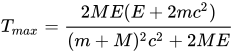
where E is the kinetic energy and m the mass of the incoming irradiating particle and M the mass of the material atom. c is the velocity of light. If the kinetic energy E is much smaller than the mass of the irradiating particle, the equation reduces to

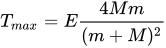
In order for a permanent defect to be produced from initially perfect crystal lattice, the kinetic energy that it receives must be larger than the formation energy of a Frenkel pair. However, while the Frenkel pair formation energies in crystals are typically around 5–10 eV, the average threshold displacement energies are much higher, 20–50 eV. The reason for this apparent discrepancy is that the defect formation is a complex multi-body collision process (a small collision cascade) where the atom that receives a recoil energy can also bounce back, or kick another atom back to its lattice site. Hence, even the minimum threshold displacement energy is usually clearly higher than the Frenkel pair formation energy.
Each crystal direction has in principle its own threshold displacement energy, so for a full description one should know the full threshold displacement surface for all non-equivalent crystallographic directions [hkl]. Then and where the minimum and average is with respect to all angles in three dimensions.
![{\displaystyle T_{d}(\theta ,\phi )=T_{d}([hkl])}](https://wikimedia.org/api/rest_v1/media/math/render/svg/27c6cb150f2cbd13c65e6c3e218b584069100b68)


An additional complication is that the threshold displacement energy for a given direction is not necessarily a step function, but there can be an intermediate energy region where a defect may or may not be formed depending on the random atom displacements. The one can define a lower threshold where a defect may be formed , and an upper one where it is certainly formed . The difference between these two may be surprisingly large, and whether or not this effect is taken into account may have a large effect on the average threshold displacement energy. .


Hub AI
Threshold displacement energy AI simulator
(@Threshold displacement energy_simulator)
Threshold displacement energy
In materials science, the threshold displacement energy (Td) is the minimum kinetic energy that an atom in a solid needs to be permanently displaced from its site in the lattice to a defect position. It is also known as "displacement threshold energy" or just "displacement energy". In a crystal, a separate threshold displacement energy exists for each crystallographic direction. Then one should distinguish between the minimum (Td,min) and average (Td,ave) over all lattice directions' threshold displacement energies. In amorphous solids, it may be possible to define an effective displacement energy to describe some other average quantity of interest. Threshold displacement energies in typical solids are of the order of 10-50 eV.
The threshold displacement energy is a materials property relevant during high-energy particle radiation of materials. The maximum energy that an irradiating particle can transfer in a binary collision to an atom in a material is given by (including relativistic effects)
where E is the kinetic energy and m the mass of the incoming irradiating particle and M the mass of the material atom. c is the velocity of light. If the kinetic energy E is much smaller than the mass of the irradiating particle, the equation reduces to
In order for a permanent defect to be produced from initially perfect crystal lattice, the kinetic energy that it receives must be larger than the formation energy of a Frenkel pair. However, while the Frenkel pair formation energies in crystals are typically around 5–10 eV, the average threshold displacement energies are much higher, 20–50 eV. The reason for this apparent discrepancy is that the defect formation is a complex multi-body collision process (a small collision cascade) where the atom that receives a recoil energy can also bounce back, or kick another atom back to its lattice site. Hence, even the minimum threshold displacement energy is usually clearly higher than the Frenkel pair formation energy.
Each crystal direction has in principle its own threshold displacement energy, so for a full description one should know the full threshold displacement surface for all non-equivalent crystallographic directions [hkl]. Then and where the minimum and average is with respect to all angles in three dimensions.
An additional complication is that the threshold displacement energy for a given direction is not necessarily a step function, but there can be an intermediate energy region where a defect may or may not be formed depending on the random atom displacements. The one can define a lower threshold where a defect may be formed , and an upper one where it is certainly formed . The difference between these two may be surprisingly large, and whether or not this effect is taken into account may have a large effect on the average threshold displacement energy. .