Hubbry Logo
ThuliteThuliteMain
Open search
Thulite
Community hub
Thulite
logo
8 pages, 0 posts
0 subscribers
Be the first to start a discussion here.
Thulite
Thulite
from Wikipedia
Thulite
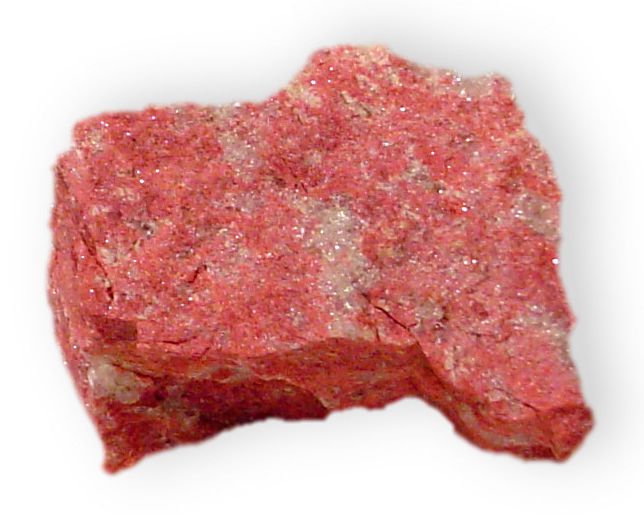
Thulite from Leksvik, Norway.
General
CategorySorosilicate variety
Formula(Ca,Mn)2Al3(SiO4)(Si2O7)O(OH)
Crystal systemOrthorhombic
Identification
ColorPink
Crystal habitMassive
CleavagePerfect {010} imperfect {100}
FractureUneven to conchoidal
Mohs scale hardness6.5
LusterVitreous, pearly on cleavage surfaces
StreakWhite or colorless
Specific gravity3.10–3.38
Optical propertiesbiaxial positive
Refractive index1.69–1.70
Birefringence0.006–0.018
PleochroismPresent, dichroism or trichroism depending on color.

Thulite (sometimes called rosaline) is a translucent, crystalline or massive pink manganese-bearing variety of the mineral zoisite. Manganese substitutes for calcium in the structure with up to two percent Mn2+.[1] Thulite is often mottled with white calcite and occurs as veins and fracture fillings transecting many types of rock. In mineralogical literature, thulite may sometimes refer to any pink zoisite. Clinothulite is the manganese bearing variety of monoclinic clinozoisite.[2]

Thulite was first discovered at a place called Sauland in Telemark county, Norway in 1820.[3] It is named after the mythical island of Thule in the belief that the island is Scandinavia.[3] Thulite is used as a gemstone and carving material in the manufacture of jewelry and ornamental objects.

Thulite is also found in the Austrian Tyrol and in Mitchell County, North Carolina. A new, more recent find of a small quantity of thulite was discovered near Riverside in Okanogan County, Washington, US[3] and in Snillfjord Municipality in Trøndelag county, Norway during tunnel constructions in December 2018.[4] Thulite is also found in New Zealand in the Otago region of the South Island.

Thulite is also found in Namibia. The occurrence is spread throughout the Namib Desert and generally has ridges with a NE to SW setting. The color can be highly variable with most deposits being greenish in nature, but on occasion the desirable pink color is to be found.[citation needed]

References

[edit]
[edit]
Revisions and contributorsEdit on WikipediaRead on Wikipedia
from Grokipedia
Thulite is a pink variety of the mineral , distinguished by its trivalent (Mn³⁺) content that substitutes for aluminum to produce the characteristic rosy hue. It is the national stone of . It has the chemical formula Ca₂Al₃(SiO₄)(Si₂O₇)O(OH), and belongs to the group, crystallizing in the orthorhombic system often as prismatic or fibrous aggregates. First discovered in near Kleppan in Sauland, Hjartdal, , , it was named after "Thule," the term for the northernmost part of the known world, believed to encompass . With a Mohs of 6 to 6.5, thulite exhibits a vitreous to pearly luster, a specific gravity of about 3.2 to 3.3, and is typically translucent to opaque, featuring shades from light to deep rose, sometimes mottled with white inclusions. Thulite forms primarily in metamorphic environments, such as schists, gneisses, and marbles, through regional of rocks containing calcium, aluminum, and silica, often associated with of feldspars or other silicates. Notable occurrences include the type locality near Sauland in Norway's region (including Tørdal), as well as Leksvik in , deposits in , , where it appears in pegmatites (though many specimens are the related clinothulite variety), and in . The mineral's formation requires enrichment, which is relatively rare, making high-quality thulite specimens sought after by collectors. Due to its appealing color and moderate hardness, thulite is valued in lapidary arts for crafting cabochons, beads, and carvings, as well as in jewelry like pendants and earrings, though its relative softness requires protective settings to prevent scratching. It is also used for decorative objects such as inlays and small sculptures, capitalizing on its mottled patterns for aesthetic appeal. While not industrially significant, thulite's gemological properties make it a niche collectible among enthusiasts, with remaining a primary source for fine examples.

Etymology and History

Etymology

The name thulite derives from "," an and Roman term for the northernmost region of the known world, mythically associated with and symbolizing the far north. The word originates from the Greek "Θούλη" (Thoúlē), first recorded by the explorer of around 320 BC as a landmass approximately six days' sail north of Britain. Roman geographer later referenced in his , placing it at the extreme northern latitude of 63°N and extending its depiction as an elongated , further embedding its lore in classical . The mineral thulite was named in 1820 by Scottish mineralogist Robert Jameson to honor this ancient nomenclature, reflecting its initial discovery in , then considered part of the Thulean realm. This etymological choice underscores the stone's geographical ties to the , evoking the mythical allure of the distant north in early 19th-century mineralogy.

Discovery and Historical Significance

Thulite was first discovered in 1820 near Sauland in , , during routine prospecting at the Kleppan locality by local miners. The pink variety of attracted early attention as a geological curiosity in the region, though initial reports were informal and tied to local mining activities. Thulite was first published and described in 1820 by Scottish mineralogist Robert Jameson. The first detailed account of the deposit appeared in 1845, when German-Norwegian mineralogist Theodor Scheerer documented it following his travels in , describing the site's mineral associations in detail. This marked an important step in recognizing the deposit's uniqueness within Norway's metamorphic terrains. In 1879, Norwegian geologist Waldemar Christopher Brøgger provided the first crystallographic description, formally classifying thulite as a distinct manganese-bearing variety of . The emergence of thulite in coincided with the Romantic era's fascination with Scandinavian geology, as European scholars explored the region's rugged landscapes and diversity for insights into Earth's formation. Early mentions appeared in catalogs and reports, contributing to the broader documentation of Nordic resources during a time of expanding geological surveys. Throughout the , thulite saw limited use, primarily as specimens in private and institutional collections valued for their aesthetic appeal and scientific novelty, rather than practical applications. Its transition to interest did not occur until the , when improved cutting techniques highlighted its ornamental potential.

Composition and Structure

Chemical Composition

Thulite is a variety of the mineral zoisite with the general chemical formula \ceCa2Al3(SiO4)(Si2O7)O(OH)\ce{Ca2Al3(SiO4)(Si2O7)O(OH)}. The pink coloration is due to trivalent manganese (Mn³⁺) substituting for aluminum, yielding the formula \ceCa2(Al,Mn3+)3(SiO4)(Si2O7)O(OH)\ce{Ca2(Al,Mn^{3+})3(SiO4)(Si2O7)O(OH)}. Manganese content typically ranges from trace amounts to several weight percent MnO, with higher concentrations producing deeper pink hues. Trace elements such as Fe or Mg may occur in minimal amounts but do not significantly alter the primary composition. As a sorosilicate mineral, thulite belongs to the epidote supergroup, specifically recognized as a manganese-rich variety of . This classification highlights its framework, consisting of isolated [SiO₄] tetrahedra and [Si₂O₇] groups linked by aluminum octahedra and calcium sites. Specimens of thulite are often intergrown with , which can introduce impurities and affect the overall purity of samples, resulting in mottled appearances.

Crystal Structure

Thulite crystallizes in the orthorhombic system, specifically belonging to the dipyramidal crystal class with Pnma. This symmetry defines its atomic arrangement as a sorosilicate, featuring isolated SiO₄ tetrahedra and double Si₂O₇ groups linked by shared oxygen atoms, alongside aluminum cations primarily in octahedral coordination within the structure. The unit cell parameters for thulite, consistent with its parent mineral , are approximately a = 16.24 , b = 5.55 , and c = 9.85 , with Z = 4 formula units per cell. In terms of , thulite most commonly occurs as massive or columnar aggregates, with individual crystals rarely developing as prismatic forms up to 10 cm in length; these prisms are typically deeply striated and exhibit poor terminations. It frequently forms fibrous or granular textures, contributing to its compact, rock-like appearance in natural deposits. Thulite represents the orthorhombic polymorphic form of manganese-bearing , distinguishing it from clinothulite, the monoclinic variant that shares a similar but adopts the space group . This polymorphism arises from differences in the ordering of cations and the arrangement of the groups, with the orthorhombic structure of thulite providing greater symmetry in the octahedral sites occupied by Al and Mn³⁺.

Physical and Optical Properties

General Physical Properties

Thulite exhibits a Mohs of 6 to , rendering it moderately resistant to scratching and suitable for use in jewelry, though it remains vulnerable to abrasion from harder materials such as or . The specific of thulite ranges from 3.10 to 3.38, with variations attributable to differences in content and the presence of inclusions that alter the overall density. Thulite displays perfect cleavage on the {010} plane and imperfect cleavage on {100}, which influences its tendency to break along these structural planes during cutting or wear. Its is uneven to conchoidal, contributing to irregular breaks when cleavage is not followed. As a brittle , thulite has low tenacity, meaning it fractures easily under stress and requires careful handling to avoid chipping. The streak of thulite is , a consistent diagnostic trait observed when the mineral is powdered on an unglazed surface. Thulite is typically translucent to opaque in diaphaneity, with its appearance often mottled due to inclusions of that create or grayish patterns within the matrix.

Optical and Luster Properties

Thulite displays a distinctive to reddish-pink coloration, resulting from the substitution of ions for aluminum in the crystal structure. This content imparts the gem's appealing hue, with intensity varying based on the concentration of the impurity, often appearing mottled when intergrown with or . The luster of thulite is typically vitreous, transitioning to pearly on cleavage surfaces, which enhances its aesthetic appeal in polished specimens. In terms of gemological , thulite is biaxial positive with refractive indices ranging from nα = 1.696–1.700, nβ = 1.696–1.702, and nγ = 1.702–1.718, corresponding to a mean value of approximately 1.70. is low at 0.006–0.018, contributing to its subtle optical effects. is weak, manifesting as slight variations in pink tones across the optical axes—pale pink to red along X and Y, and deeper pink along Z—making it less pronounced than in other varieties like . Thulite is generally translucent, though high-quality material can approach transparency, allowing light to penetrate and highlight its color. It exhibits no or only weak response under light, with any observed glow typically attributable to associated minerals rather than the thulite itself.

Occurrence and Varieties

Type Locality and Primary Deposits

Thulite's type locality is the Øvstebø deposit near Kleppan in Sauland, Hjartdal municipality, county, , where the manganese-bearing variety of was first described in 1823. This site represents the original occurrence of the mineral, embedded within rocks of the Telemark formation. In this region, thulite forms in veins and lenses that transect porphyry, , and surrounding gneissic rocks, resulting from regional under epidote- conditions. The veins, striking N 70° W and dipping steeply northward, developed through interactions between the host bedrock and slow-moving hydrothermal solutions during low- to medium-grade , often incorporating and as associated phases. Other primary deposits occur in the region, particularly the Leksvik Thulite Quarry at Hindremseter, Indre Fosen municipality, where thulite appears in similar metamorphic and hosts. These sites feature thulite in veins alongside , , and minor , formed under comparable metamorphic processes involving calcium- and manganese-rich protoliths. Extraction at these Norwegian localities has been small-scale since the , with early blasting noted at the Øvstebø site and commercial sales from Leksvik documented in 1890 at prices of 175-200 Norwegian kroner per ton. Activity peaked in the post-2000s era through hobbyist and artisanal collecting, utilizing basic tools like hammers and chisels in accessible outcrops. Norwegian deposits, especially in and , produce the most vibrant , gem-grade thulite specimens, characterized by intense manganese-induced coloration and minimal impurities compared to other global finds.

Global Occurrences and Varieties

, a variety of , occurs in various metamorphic and igneous settings worldwide, though deposits are limited and often small-scale. Significant localities include , where it is most abundant and of high quality, particularly in the and regions; Austria's Tyrol ; the , notably Mitchell County in ; New Zealand's sites in the Tasman Region, such as the Pikikiruna Range; Namibia's Erongo area in pegmatites; and . In the , thulite has been documented in at least 12 states, with notable occurrences in metamorphic rocks of the Appalachian region, including 's Hawk and Mines. Namibia's Erongo deposits yield darker material from pegmatitic veins, while New Zealand's Pikikiruna Range sites produce specimens in schistose terrains. A recognized variety is clinothulite, the monoclinic counterpart to thulite, which is a manganese-bearing clinozoisite often mistaken for thulite due to similar coloration and composition. Thulite itself is defined as the orthorhombic form with hues from substitution, distinguishing it from rarer chromium-influenced red zoisite variants sometimes called ruby zoisite. No other major subtypes are formally named, though color variations range from pale to vivid depending on content and host rock impurities. Geologically, thulite forms primarily in metamorphic environments such as eclogites, schists, and skarns, or in hydrothermal veins cutting through these rocks, with rarer occurrences in pegmatites representing igneous associations. Overall, thulite remains rare, with serving as the primary source for gem-quality material; discoveries in the , including the 2018 tunnel construction in and the 2019 Åstfjorden find, have increased supply from this region without altering its scarcity elsewhere.

Uses and Identification

Gemological and Ornamental Uses

Thulite is primarily utilized in jewelry as cabochons and beads for necklaces, earrings, bracelets, and brooches, leveraging its opaque pink hue for decorative appeal. It is also carved into figurines, intaglios, sculptures, boxes, and vases due to its ease of working and vibrant color, making it suitable for ornamental objects. Its popularity in Scandinavian jewelry designs, often set in silver, stems from its status as Norway's national . As an affordable , thulite typically ranges from $1 to $10 per carat as of 2025, depending on color intensity, clarity, and size, with larger pieces commanding higher prices per carat among collectors. Its limited sources contribute to moderate market value, though it remains accessible for jewelry enthusiasts who value its soft pink tones. Thulite is frequently stabilized with or to improve durability and enhance luster, a permanent treatment that does not alter its color. is rarely applied, as excessive heat can damage the stone. In modern metaphysical practices, thulite symbolizes love and emotional harmony, though it holds no such . Despite its Mohs hardness of 6 to 7, thulite's and susceptibility to acids, abrasions, and harsh chemicals limit its use in high-end or high-wear jewelry like rings, necessitating protective settings.

Identification and Distinction from Similar Minerals

Thulite is identified primarily through its diagnostic physical and optical properties, including a specific gravity ranging from 3.1 to 3.4 and a refractive index of 1.69 to 1.70. Hardness on the Mohs scale is 6 to 7, providing a key reference for initial field or lab assessment. When calcite inclusions are present, which is common in many specimens, thulite exhibits fizzing upon exposure to dilute hydrochloric acid (HCl), as the acid reacts with the carbonate component to produce carbon dioxide gas. Pure zoisite portions do not react, distinguishing intergrowths from pure carbonates. Spectroscopic analysis confirms the manganese content responsible for the pink coloration, with characteristic absorption bands in the visible spectrum due to Mn³⁺ ions. These bands result in transmission of red and blue light, yielding the observed pink to reddish hues. In gemological testing, thulite displays weak pleochroism, observable via dichroscope as subtle shifts from colorless or pale pink to deeper pink or reddish tones along different crystallographic axes. It is generally inert under long-wave or short-wave ultraviolet light, though some specimens may show weak fluorescence, aiding differentiation from strongly fluorescent mimics. Thulite is distinguished from similar pink minerals by its combination of properties. Unlike rhodochrosite, a with hardness of 3.5 to 4 and strong, immediate in cold dilute HCl due to its composition (MnCO₃), thulite's reaction is localized to inclusions and its silicate structure remains intact. Kunzite (spodumene variety) exhibits a lower (1.66 to 1.68), higher (0.029), and perfect prismatic cleavage, along with greater ; it also fluoresces orange under UV. Pink has a lower (1.62 to 1.64), higher hardness (7 to 7.5), no cleavage, and strong from colorless to pink to green. Synthetic mimics of thulite are rare, as no widespread commercial production exists, but any imitations can be identified by the absence of natural inclusions such as mottled veining or schistose textures typical in thulite. Advanced testing like can further confirm the structure without synthetic uniformity.

References

Add your contribution
Related Hubs
User Avatar
No comments yet.