



Community hub
Recent from talks
Contribute something to knowledge base
Content stats: 0 posts, 0 articles, 1 media, 0 notes
Members stats: 0 subscribers, 0 contributors, 0 moderators, 0 supporters
Subscribers
Supporters
Contributors
Moderators
Hub AI
Ticlopidine AI simulator
(@Ticlopidine_simulator)
Hub AI
Ticlopidine AI simulator
(@Ticlopidine_simulator)
Ticlopidine
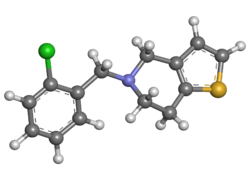
Ticlopidine, sold under the brand name Ticlid, is a medication used to reduce the risk of thrombotic strokes. It is an antiplatelet drug in the thienopyridine family which is an adenosine diphosphate (ADP) receptor inhibitor. Research initially showed that it was useful for preventing strokes and coronary stent occlusions. However, because of its rare but serious side effects of neutropenia and thrombotic microangiopathy it was primarily used in patients in whom aspirin was not tolerated, or in whom dual antiplatelet therapy was desirable. With the advent of newer and safer antiplatelet drugs such as clopidogrel and ticagrelor, its use remained limited.
It was patented in 1973 and approved for medical use in 1978.
Ticlopidine is indicated for the prevention of strokes and when combined with aspirin, for people with a new coronary stent to prevent closure.
Ticlopidine is considered a second-line option for the prevention of thrombotic strokes among patients who have previously had a stroke or TIA. Studies have shown that it is superior to aspirin in the prevention of death or future strokes. However, it also has more frequent and serious side effects compared to aspirin, so it is reserved for those patients that cannot take aspirin.
When a patient needs to have a stent placed in one of the vessels around their heart, it is important that that stent stay open to keep blood flowing to the heart. Therefore, patients with stents must take medications after the procedure to help maintain that blood flow. Ticlopidine, taken together with aspirin, is FDA approved for this purpose, and in studies it has been shown to work better than aspirin alone or aspirin with an anticoagulant. However, ticlopidine’s serious side effects make it less useful than its cousin, clopidogrel. Current recommendations no longer recommend ticlopidine’s use.
The use of ticlopidine is contraindicated in anyone with:
Because of the increased risk of bleeding, patients taking ticlopidine should discontinue the medication 10–14 days before surgery.
The most serious side effects associated with ticlopidine are those that affect the blood cells, although these life-threatening complications are relatively rare. The most common side effects include:
Ticlopidine
Ticlopidine, sold under the brand name Ticlid, is a medication used to reduce the risk of thrombotic strokes. It is an antiplatelet drug in the thienopyridine family which is an adenosine diphosphate (ADP) receptor inhibitor. Research initially showed that it was useful for preventing strokes and coronary stent occlusions. However, because of its rare but serious side effects of neutropenia and thrombotic microangiopathy it was primarily used in patients in whom aspirin was not tolerated, or in whom dual antiplatelet therapy was desirable. With the advent of newer and safer antiplatelet drugs such as clopidogrel and ticagrelor, its use remained limited.
It was patented in 1973 and approved for medical use in 1978.
Ticlopidine is indicated for the prevention of strokes and when combined with aspirin, for people with a new coronary stent to prevent closure.
Ticlopidine is considered a second-line option for the prevention of thrombotic strokes among patients who have previously had a stroke or TIA. Studies have shown that it is superior to aspirin in the prevention of death or future strokes. However, it also has more frequent and serious side effects compared to aspirin, so it is reserved for those patients that cannot take aspirin.
When a patient needs to have a stent placed in one of the vessels around their heart, it is important that that stent stay open to keep blood flowing to the heart. Therefore, patients with stents must take medications after the procedure to help maintain that blood flow. Ticlopidine, taken together with aspirin, is FDA approved for this purpose, and in studies it has been shown to work better than aspirin alone or aspirin with an anticoagulant. However, ticlopidine’s serious side effects make it less useful than its cousin, clopidogrel. Current recommendations no longer recommend ticlopidine’s use.
The use of ticlopidine is contraindicated in anyone with:
Because of the increased risk of bleeding, patients taking ticlopidine should discontinue the medication 10–14 days before surgery.
The most serious side effects associated with ticlopidine are those that affect the blood cells, although these life-threatening complications are relatively rare. The most common side effects include:
Recent media
Recent media