Hubbry Logo
logo
Timothy Stoen
Community hub

Timothy Stoen

logo
0 subscribers
Read side by side
from Wikipedia

Timothy Oliver Stoen (born January 16, 1938) is an American attorney best known for his central role as a member of the Peoples Temple, and as an opponent of the group during a multi-year custody battle over his six-year-old son, John. The custody battle triggered a chain of events which led to U.S. Representative Leo Ryan's investigation into the Temple's remote settlement of Jonestown in northern Guyana, which became internationally notorious in 1978 after 918 people – including Stoen's son – died in the settlement and on a nearby airstrip. Stoen continued to work as a deputy district attorney in Mendocino County, California, where he was assigned to the District Attorney's Fort Bragg office. Stoen later joined the Mendocino County Public Defenders. He is now[when?] in the private practice of law.[1]

Key Information

Early life

[edit]

Timothy Stoen was born in Milwaukee, Wisconsin,[2] the child of religious middle-class parents from Littleton, Colorado.[3] Throughout high school and college he was a scholar, athlete and devout Christian.[3] Stoen graduated from Wheaton College with a B.A. in political science.[2] He graduated from Stanford Law School in 1964 and was admitted to the California bar in 1965.[3][4]

Stoen worked for a year in an Oakland real estate office before joining the Mendocino County District Attorney's Office in Ukiah as a deputy district attorney.[3][5] In 1967, Stoen left this position with the intention of doing work for flower children and similar hippie groups in San Francisco's Haight-Ashbury district,[3] and also worked as a staff attorney for the Legal Aid Society of Alameda County.[3] Though he represented black militants and supported an ecological platform, he briefly considered running for office as a Republican.[3]

In 1970, Stoen married Grace Lucy Grech, whom he had met at a march at the San Francisco Civic Center against overpopulation and pollution.[6] Their son, John Victor Stoen, was born on January 25, 1972.[7]

Temple beginnings

[edit]

Introduction to Peoples Temple

[edit]
Timothy Stoen is located in California
Los Angeles
Los Angeles
San Francisco
San Francisco
Ukiah
Ukiah
Bakersfield
Bakersfield
Fresno
Fresno
Sacramento
Sacramento
Santa Rosa
Santa Rosa
Some of the Peoples Temple's California Locations

Stoen first encountered the Peoples Temple when it was suggested that he ask the group to help renovate the Mendocino County legal aid offices.[3] Two dozen Temple volunteers showed up the following Sunday, and Stoen began sending people to the Temple for drug and marriage counseling.[3][8] He became impressed with the purported character and good deeds of the Temple's leader, Reverend Jim Jones, especially when he saw Jones scrubbing toilets in the Temple's Ukiah headquarters.[3] By the end of 1969, when violence erupted in Berkeley over People's Park and Third World students' rights, Stoen began to integrate his personal life with the Temple.[9]

In 1970, Stoen moved to the Temple's headquarters, where he worked as a deputy district attorney and head of Mendocino County's civil division.[5][10] He began providing legal aid for the Temple and politically converted to the Temple's socialist ideology.[11]

San Francisco Assistant District Attorney

[edit]

Despite still referring to its Ukiah facility as its "mother church", the Peoples Temple moved its headquarters to San Francisco around 1972. Following the 1975 mayoral election, former San Francisco District Attorney Joseph Freitas named Stoen to lead a special unit to investigate election fraud charges.[12] Shortly thereafter, Freitas hired Stoen as an assistant district attorney in the consumer frauds division.[13]

Stoen found no evidence of election fraud, but Temple members later alleged that the Temple arranged for "busloads" of members to be transported from Redwood Valley to San Francisco to vote in that election under threats of physical violence.[14] When asked how Jones could know for whom they voted, one member responded, "You don't understand, we wanted to do what he told us to."[14] Stoen later claimed that he was not aware at the time of election fraud, despite being in charge of the special unit investigating that specific crime, but that it could have happened without his knowledge because, "Jim Jones kept a lot of things from me."[14]

Defection from the Peoples Temple

[edit]

On February 6, 1972, just two weeks after his son John was born, Stoen signed an affidavit in which he stated that Jones was the child's biological father.[15] The single-page document eventually became the most important piece of paper in the Temple's history. Stoen's affidavit not only seemed to contradict his putative paternity, but also "bound the child to Jones and the church for life."[13] In the years to follow, Jones would cite the affidavit countless times to demonstrate his paternity of the child, to denigrate Grace's worthiness to be a mother, and to dismiss Stoen's claims of custody rights.[15]

Grace, meanwhile, had grown to greatly dislike the Temple. Not only had she been forced to give up John by signing the affidavit, but she had also been berated and threatened – sometimes by Jones himself – in Temple meetings for denying Jones' paternity of the child, watched the child be publicly paddled, listened to Jones portray Stoen as a homosexual, and witnessed the beating of a 40-year-old woman who had claimed the Temple turned members into robots.[16] Grace and Temple member Walter "Smitty" Jones (no relation to Jim Jones) agreed to leave together.[17] In July 1976, Grace and Smitty fled to Lake Tahoe.[17]

Grace was unable to take John with her; he had already been sent to the Temple's Jonestown settlement in Guyana, and she did not want to put his life in jeopardy along with hers.[15] Nevertheless, Grace began to fight for custody almost immediately after her defection. In February 1977, Grace threatened to divorce Stoen.[18] Fearing that possible legal action against Stoen would make the custody dispute public, Jones sent him to Jonestown.[18] Stoen quit his job as assistant district attorney and began working in Guyana, both at Jonestown and at the Temple's headquarters in the capital of Georgetown.[19] However, distrustful Temple members were secretly spying on Stoen and examining the contents of his briefcase.[20] Within a year, Stoen also left the Temple, returned to San Francisco, and joined Grace's custody battle. Stoen subsequently became the chief antagonist to Jones, who encouraged Jonestown residents to write detailed, humiliating fantasies about murdering Stoen.[15]

Battling the Temple

[edit]

In July 1977, Jones moved several hundred Temple members to Jonestown,[21] on the same night that an editor at New West magazine read Jones a pending article, written by Marshall Kilduff, detailing allegations of abuse by former Temple members.[21][22] Two months later, a Georgetown court ordered the Temple to show cause why a final order should not be issued compelling the return of John to his mother.[23] A few days later, the same court issued a second order for Jones' arrest.[24]

In fear of being held in contempt of the court orders, and in an attempt to further manipulate his followers, Jones staged a false sniper attack on himself and began a series of "White Night" rallies, called the "Six Day Siege", where he told Temple members about attacks from outsiders and had members surround Jonestown with guns and machetes.[25] Angela Davis and Huey Newton communicated via radio-telephone to the Jonestown crowd, urging them to hold strong against the "conspiracy."[26] Jones made radio broadcasts stating "we will die unless we are granted freedom from harassment and asylum."[27] Guyanese Deputy Prime Minister Ptolemy Reid finally assured Jones' wife Marceline that Guyana Defence Force would not invade Jonestown.[28] A court clerk refused to sign the arrest warrant for Jones, and there was talk of interference in the legal process by the Guyanese government.[29]

After this initial round of the Stoen custody dispute, Jones directed Temple members to write to over a dozen foreign governments inquiring about their immigration policies in the event that they had to flee Guyana.[30] He also wrote the U.S. State Department inquiring about North Korea and Albania.[30]

Concerned Relatives

[edit]

Meanwhile, in San Francisco, the Stoens and other relatives of Jonestown members began attending meetings at the home of Jeannie Mills.[31] Calling themselves the "Concerned Relatives",[31] the group began sharing details of their grievances with the Temple, interviewed Temple defectors, and reviewed shortwave radio transcripts of communications between Jonestown and the Temple's San Francisco headquarters.[31] Temple surveillance teams, aware of these meetings, checked licence plates in front of Mills' house to determine the identity of their "enemies."[31] Stoen's addition to the group was vital because of his knowledge of Temple operations, his letter-writing campaigns to the Secretary of State and the Guyanese government, and his trips to Washington, D.C. to lobby for a federal investigation.[8] Stoen became the Concerned Relatives' primary legal representative and filed four court actions against the Temple and its leadership on November 18, 1978, on the group's behalf.[15]

Congressman Leo Ryan

In November 1977, an order was issued in a San Francisco court granting custody of John to his mother, Grace.[32] The court order meant that Jones could not return to the U.S. without facing contempt proceedings for failing to turn over the child; it also meant Jones could never let the child leave Jonestown.[15]

In January 1978, Stoen travelled to Georgetown in an unsuccessful bid to take custody of the child.[33] A Guyanese judge recused himself from the case because his life had been threatened, and the new judge had to restart the process from the beginning.[29] A Guyanese official approached Stoen and told him to leave immediately one week before his visa expired.[34] While at the airport, three Temple members surrounded Stoen and threatened his life unless he dropped his legal action.[34] Although Stoen wanted to travel to Jonestown to retrieve John, he thought "if I went back, I thought I would probably be a corpse within thirty days."[8]

After Stoen returned to Washington in January 1978, he visited with nine members of Congress, including U.S. Representative Leo Ryan of California.[35] The Temple, likewise, sent members to visit eight of the nine Congressman in order to discredit Stoen.[35] Stoen also wrote a white paper to Congress that stated how Jones was illegally holding his son.[36] The white paper claimed that any action by the Guyanese military to retrieve the child could result in harm to John or others, and insisted that members of Congress write Guyanese Prime Minister Forbes Burnham to take action.[36] Ryan wrote such a letter on Stoen's behalf.[37] Several other congressmen also wrote to Burnham about Stoen's concerns.[36]

At the end of January 1978, Stoen and fellow Concerned Relative Steven Katsaris met State Department officials.[36] They insisted that Jones' mental condition was deteriorating and that he was suffering from "paranoid megalomania".[36] Stoen urged the State Department to request officially that Guyana "speedily enforce" the custody order that the Stoens had won.[36]

Media spotlight

[edit]

Feeling the international pressure, on February 17, 1978, Jones submitted to an interview with reporter Tim Reiterman of the San Francisco Examiner via radio-telephone.[38] Reiterman's story about the Stoen custody battle, appearing in the Examiner's February 18 preview edition of that Sunday's paper,[39] undermined Jones' credibility.[39] Temple attorneys immediately sent a letter to the Examiner threatening litigation,[39] as well as the 1972 affidavit which named Jones as the father of Stoen's son.[40] Columnist Herb Caen, a supporter of the Temple, reprinted the affidavit in the San Francisco Chronicle.[40]

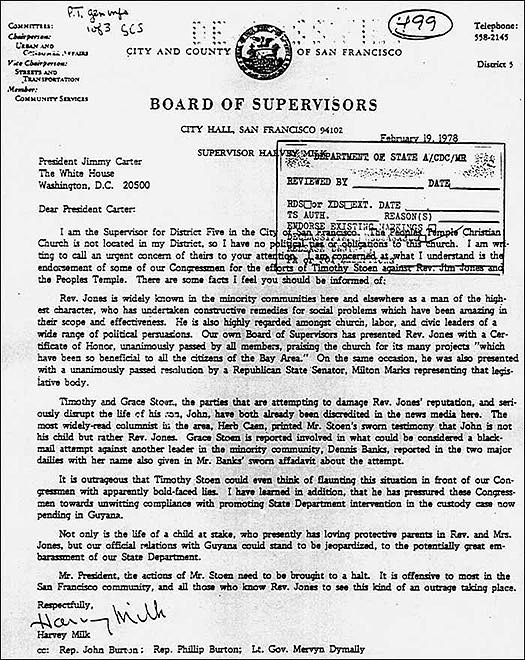
The next day, February 19, Harvey Milk, a member of the San Francisco Board of Supervisors, wrote a letter to U.S. President Jimmy Carter supporting Jones.[41][42][43][44] The Temple had assisted Milk's 1976 election race to become a California State assembly member,[45] and Milk had visited and spoken at Temple rallies.[46][47] In the letter to President Carter, Milk wrote "Rev. Jones is widely known in the minority communities and elsewhere as a man of the highest character...[41] Timothy and Grace Stoen [are] the parties attempting to damage Rev. Jones reputation". Milk also wrote "[i]t is outrageous that Timothy Stoen could even think of flaunting this situation in front of Congressman with apparent bold-faced lies."[41] The letter demanded that "the actions of Mr. Stoen need to be brought to a halt."[41]

Affidavits and lawsuits

[edit]

On March 14, 1978, Temple member Pam Moten sent an open letter to Congress suggesting that members of the Concerned Relatives group were conspiring with the Federal Communications Commission (FCC) and the Internal Revenue Service (IRS) against the group,[48] stating that "radical Trotskyite elements which defected from our organization when we refused to follow their violent course have been orchestrating a campaign against us."[48] Moten's letter suggested that Soviet overtures to assist the Temple might embarrass the U.S.: "[i]n fact, several overtures have been made from Russia, which sees our current harassment as a form of political persecution. We do not want to take assistance from any people nor do we want to become an international issue."[48]

On April 11, the Concerned Relatives distributed a packet of documents, including letters and affidavits that they titled an "Accusation of Human Rights Violations by Rev. James Warren Jones" to the Peoples Temple, members of the press and members of Congress.[49] The accusations chronicled mistreatment in Jonestown, which it portrayed as an armed encampment, and described hard labor, passport confiscation and statements about Jones' speeches speaking of suicide and conspiracies against the Temple.[49] On May 10, the Temple retorted with their own "Open Statement" alleging the Concerned Relatives were part of a massive conspiracy and attacking the "so called Free Enterprise system" and "racist ... corporate power."[50] It further portrayed the group as lying and attempting to "destroy us."[50]

In June 1978, Deborah Layton and her attorney drafted a further affidavit detailing alleged crimes by the Temple and substandard living conditions in Jonestown.[51][52] Stoen and other Concerned Relatives had monitored the Temple's shortwave radio broadcasts, and Stoen filed complaints with the FCC in the autumn of 1977 citing the Temple for breaching regulations.[53] In later affidavits and lawsuits filed in 1978, Stoen cited communications the group had intercepted through their monitoring.[53]

Stoen acted as the lawyer in three different lawsuits filed in May and June 1978 on behalf of members of the Concerned Relatives against Jones and other Temple members, collectively seeking over $56 million in damages.[54] On July 10, 1978, the Temple sued Stoen for $150 million, charging that Stoen violated his attorney-client relationship by using privileged information in his suits against the Temple.[55] The suit alleged that Stoen was attempting to "harass and oppress" his former client and sought to enjoin Stoen from soliciting former members as clients in suits against the Temple.[55]

Final trip

[edit]

By October 1978, all of the defectors had allied with Stoen and the Concerned Relatives.[56] On October 3, Stoen told the State Department that he would retrieve his son John from Jonestown by force if necessary.[57] Three days later he sent a telegram reiterating the threat and warning of the danger of mass suicide at the settlement.[57]

As pressure grew, the Temple learned that Stoen would accompany an investigatory trip by Rep. Ryan to Guyana.[58] On November 15, 1978, both Grace and Tim Stoen traveled with the Ryan delegation to Georgetown.[59] However, they were not permitted to accompany the delegation on its trip to Jonestown on November 17.[60] While the Stoens remained in Georgetown, the Ryan delegation was attacked on November 18 at an airstrip in Port Kaituma, near Jonestown.[61] Ryan and four others were killed by Temple members wielding rifles and shotguns, while several others were injured.[61]

Stoen encountered Jones' son Stephan in his Georgetown hotel, neither knowing that Jones was conducting a mass murder-suicide two hundred miles away.[62] As they spoke, 909 inhabitants of Jonestown,[63] 276 of them children, died of apparent cyanide poisoning, mostly in and around the settlement's central pavilion.[64] An audio recording of Jones, speaking to his followers during the massacre, mentions Stoen:[65] Jones stated:[65]

What we'd like to get are the people that caused this stuff, and some – if some people here are p – are prepared and know how to do that, to go in town and get Timothy Stoen, but there's no plane. There's no plane. You can't catch a plane in time. He's responsible for it. He brought these people to us. He and [Jeannie Mills]. The people in San Francisco will not – not be idle over this. They'll not take our death in vain[clarification needed], you know. ...

It's suicide. Plenty have done it. Stoen has done it. But somebody ought to live. Somebody – Can they talk to – and I've talked to San Francisco – see that Stoen does not get by with this infamy – with this infamy. He has done the thing he wanted to do. Have us destroyed. ...

Tim Stoen has nobody else to hate. He has nobody else to hate. Then he'll destroy himself.

— Jim Jones on the final "death tape"

Jones also discussed whether the Temple should include Stoen among the names of those committing "revolutionary suicide",[65] and whether to include children in the plan:[65]

do you think I'd put John's life above others? If I put John's life above others, I wouldn't be standing with Ujara [nickname of Don Sly, a Temple member who attempted to stab Rep. Ryan]. I'd send John out – out, and he could go out on the driveway tonight. ... I know, but he's no – he's no different to me than any of these children here. He's just one of my children. I don't prefer one above another. I don't prefer him above Ujara. I can't do that. I can't separate myself from your actions or his actions.

— Jim Jones on the final "death tape"

Six-year-old John Stoen was found poisoned in Jim Jones' cabin at Jonestown.[66] The mass murder-suicide was the greatest single loss of American civilian life in a non-natural disaster until September 11, 2001.[67]

Career after Jonestown

[edit]

From 1980 to 1984, Stoen was corporate counsel for Pacific Energy & Minerals, Ltd.[5] For some time thereafter, he worked at a private practice.[5] In 1998, Stoen ran for the California State Senate and lost in the Democratic primary, receiving 34.5% of the vote.[68] On his political philosophy page, he stated:[69]

Life-experience education as the adversary of Jim Jones and the person Jones blamed for his downfall ("Tim Stoen is responsible for this....We win when we go down"), learning at the core of my being the truth of Lord Acton's dictum that "Power tends to corrupt and absolute power corrupts absolutely." One who has experienced the abuse of power has learned a profound lesson in wisdom and can more likely be trusted with power.

Later, Stoen returned to work for the district attorney's offices in Humboldt and Mendocino counties.[8] Former Mendocino County District Attorney Norm Vroman, who hired Stoen back to the Ukiah office in 2000, stated "frankly, I've never seen him lose a case."[8] He remains an active member of the California bar into his late 80s.[70]

References

[edit]
[edit]
Revisions and contributorsEdit on WikipediaRead on Wikipedia
from Grokipedia
Timothy Oliver Stoen is an American attorney renowned for his dual roles in the Peoples Temple: as a devoted legal architect enabling the expansion and defense of Jim Jones' organization during the 1970s, and later as a key defector whose custody battle over his son John Victor Stoen—whom Jones falsely claimed to have fathered via a preemptive affidavit Stoen signed—escalated confrontations that drew public and governmental attention to the group's coercive practices.[1][2] Stoen, a Stanford Law School graduate who initially encountered Jones while working as a San Francisco deputy district attorney, drafted legal documents shielding the Temple from lawsuits, facilitated its political alliances, and managed internal purges, embodying the group's shift from communal idealism to authoritarian control.[3][1] His 1977 departure, prompted by disillusionment with Jones' paranoia and the Temple's relocation to Guyana, positioned Stoen among the "Concerned Relatives" who lobbied officials and media, indirectly catalyzing Congressman Leo Ryan's investigative trip and the ensuing Jonestown mass killing-suicides that claimed over 900 lives.[1][2] Post-Jonestown, Stoen transitioned to public service in Mendocino County, California, joining the District Attorney's office as a prosecutor around 2000, where he handled criminal cases before entering private practice focused on defense work.[4][5] These experiences informed his 2015 memoir, Marked for Death, which details his entanglement with and escape from what he describes as Jones' demonic manipulations, underscoring the causal perils of ideological surrender to charismatic frauds.[6]

Early Life and Education

Childhood and Family Background

Timothy Oliver Stoen was born on January 16, 1938, in Milwaukee, Wisconsin.[7] His parents were Joel Arnold Stoen (1909–2003), born in Faulk County, South Dakota, and Lucile Verne Oliver (1912–2008), who hailed from a background that emphasized religious values.[8][9] The Stoen family provided a middle-class upbringing, with roots tracing to Norwegian heritage through the paternal surname, derived from Old Norse terms for enclosed pastures or landing places.[4][10] Stoen had two younger brothers, Joel Thomas Stoen and Jonathan Douglas Stoen (1942–1992), growing up in an environment shaped by his parents' religious orientation.[7][8] The family relocated to Littleton, Colorado, sometime after his birth, where Stoen completed his secondary education, graduating from Littleton High School in 1956.[11] This period reflected a stable, conventional American family structure, with no documented early indications of the ideological pursuits that would later define his career.[4]

Academic and Professional Training

Timothy Stoen earned a Bachelor of Arts degree in political science from Wheaton College in Illinois in 1960.[12] He then attended Stanford Law School, receiving a Doctor of Jurisprudence in 1964.[13] Stoen was admitted to the California State Bar in 1965.[14] Following law school, Stoen briefly worked in an Oakland real estate firm for one year before entering public service as a deputy district attorney in the San Francisco District Attorney's office in 1966.[14] In this role, he gained prosecutorial experience handling criminal cases, which formed the basis of his early legal practice amid the social upheavals of the late 1960s.[15] By 1967, as a recent law graduate, Stoen was actively engaged in district attorney duties in San Francisco.[15]

Initial Involvement with Peoples Temple

Attraction to the Movement

Timothy Stoen, then a deputy district attorney in San Francisco with an evangelical Christian background, first encountered Peoples Temple in 1967 while directing the Legal Services Foundation in Ukiah, California. Volunteers from the church in nearby Redwood Valley arrived unannounced—20 to 30 members strong—and renovated the foundation's dilapidated offices in a single day, demonstrating remarkable altruism and organizational efficiency that impressed Stoen.[15] This act of communal service aligned with his growing interest in social justice amid the 1960s civil rights and anti-poverty movements, prompting him to investigate the group further.[1] By 1968, Stoen attended a Peoples Temple service at the Ukiah fairgrounds, where he observed an integrated congregation of Black and white members interacting harmoniously, a rarity in the era's racially divided society. He met Jim Jones's son, Jim Jones Jr., and was struck by the apparent genuine affection across racial lines, including Jones's personal interactions such as embracing elderly Black women and expressing love, which Stoen later described as emblematic of the movement's commitment to equality.[3] Motivated by anger over systemic racism and social disparities, as well as a personal cognitive dissonance between his professional life and countercultural ideals, Stoen viewed the Temple as a vehicle for racial integration and aid to the oppressed—qualities he sought in a church absent from his prior fundamentalist experiences.[15][1] He began associating with the Temple informally that year, providing legal assistance while maintaining his district attorney role in Mendocino County.[3] Stoen formally joined Peoples Temple around 1969, relocating to Ukiah to deepen his involvement and serve as the group's primary legal counsel, seeing it as his "personal agency for social justice."[16] His attraction stemmed from the Temple's early reputation as a progressive, interracial ministry emphasizing communal support and opposition to inequality, which resonated with his legal training and ethical convictions shaped by evangelical roots and the era's activist fervor.[1] Initially, Stoen perceived Jim Jones as a compassionate leader dedicated to building an egalitarian society, free legal aid he offered reinforcing his commitment to the cause.[15] This phase marked the beginning of his dual role balancing Temple duties with public service, including bringing his wife Grace into the fold shortly after.[15]

Early Roles and Commitments

Timothy Stoen encountered Jim Jones in 1968 while working as a deputy district attorney in San Francisco, observing the Peoples Temple's multiracial services in Fillmore and being struck by the evident racial harmony and Jones's affectionate interactions with Black congregants.[3] Drawn to the group's emphasis on social justice and integration amid the era's civil rights struggles, Stoen formally joined the Peoples Temple in late 1969, viewing it as a vehicle for progressive activism.[1] [16] He soon introduced his wife, Grace Stoen, to the organization, and the couple's legal expertise aided its operations in Redwood Valley and urban outreach.[17] In his initial capacity, Stoen served as the Temple's primary legal counsel starting in 1969, offering pro bono advice and defending the group against external criticisms and lawsuits during its expansion phase.[1] Balancing this with his role as Mendocino County assistant district attorney, he handled property transactions, tax-exempt status filings, and responses to allegations of abuse or financial impropriety, framing the Temple as a legitimate communal enterprise.[15] By October 1973, Stoen had ascended to chairman of the Peoples Temple board of directors, where he convened and led a pivotal meeting of seven members that unanimously approved the establishment of an agricultural mission in Guyana, signaling his commitment to the group's international ambitions.[1] Stoen's early allegiance extended to personal sacrifices aligning with Temple doctrines; in 1972, he executed an affidavit declaring himself unable to father children and designating Jim Jones as the biological father of their son, John Victor Stoen (born January 25, 1972), to reinforce communal child-rearing practices and Jones's symbolic paternity over members' offspring.[17] [1] These actions underscored his role not merely as an attorney but as a key architect of the Temple's legal and ideological framework in its formative California years.[1]

Service as Assistant District Attorney

Stoen began his service as an Assistant District Attorney in Mendocino County, California, around 1970, shortly after joining Peoples Temple in 1969.[5] [1] In this capacity, he prosecuted criminal cases for approximately six years, including a two-year stint as Deputy District Attorney where he acted as Chief Prosecuting Attorney for one year.[5] His office was located in Ukiah, near the Temple's Redwood Valley headquarters, facilitating his concurrent role as a key legal advisor to Jim Jones, whom he represented in non-official capacities outside work hours.[1] Stoen explicitly acknowledged this duality, stating he prioritized his prosecutorial career while committing to Temple activities, which included drafting legal documents and defending the group against external critics.[1] During this period, Stoen handled general criminal prosecutions but avoided direct involvement in cases concerning Temple members, reflecting an implicit conflict of interest due to his loyalty to Jones.[15] No formal recusal records are documented, though his position allowed influence over local law enforcement interactions with the Temple, which was expanding politically in the region.[1] Critics later alleged that his role enabled the Temple to evade scrutiny for internal abuses, but Stoen maintained that his official duties remained separate and professionally executed.[15] In 1976, Stoen temporarily shifted to the San Francisco District Attorney's office under Joseph Freitas, supervising the voter fraud unit amid investigations into irregularities during George Moscone's mayoral election campaign.[5] [1] Peoples Temple members had mobilized extensively to support Moscone, prompting accusations of coordinated voter fraud involving multiple voting and absentee ballot manipulations.[1] Stoen oversaw prosecutions that resulted in about 50 charges against individuals for false registrations, but he concluded there was insufficient evidence implicating the Temple systematically, a finding disputed by some observers who attributed it to his affiliations.[1] He simultaneously managed special prosecutions related to organized crime, leveraging his expertise while continuing to serve as Temple counsel.[5] This episode highlighted tensions in his public service, as his Temple ties—unknown to superiors—potentially compromised impartiality in politically sensitive probes.[1] Timothy Stoen, a Stanford Law School graduate and deputy district attorney in San Francisco, first encountered Jim Jones in 1968 while investigating complaints against Peoples Temple but soon aligned with the group.[3] By 1970, after relocating to Mendocino County as head of the district attorney's civil division, Stoen formally joined Peoples Temple and began serving as its principal legal counsel, providing pro bono services to Jones and the organization through 1977.[15] [1] In this capacity, he acted as attorney of record, advised on operational expansion, and donated a significant portion of his public salary—estimated at over $100,000 cumulatively—to Temple coffers, framing his contributions as support for its socialist objectives.[15] Stoen's legal work encompassed defending Peoples Temple against external criticisms and lawsuits, including media exposés and allegations of voter fraud tied to Jones's endorsement of George Moscone in the 1975 San Francisco mayoral election.[1] He handled property transactions, such as notarizing deeds for Temple acquisitions, and managed financial maneuvers like asset transfers to overseas accounts to safeguard against perceived threats.[1] Additionally, in October 1973, Stoen drafted a strategic memorandum outlining legal steps for establishing a Temple agricultural mission in Guyana, anticipating potential U.S. regulatory hurdles.[1] These efforts positioned him as a key architect of the Temple's legal fortifications, leveraging his prosecutorial expertise to counter adversaries while maintaining his county role, which raised unaddressed conflict-of-interest concerns at the time.[15] Throughout his tenure, Stoen chaired the Temple's board of directors and coordinated responses to defectors and journalists, often initiating aggressive countermeasures such as threats of litigation to deter scrutiny.[1] His counsel extended to internal governance, advising Jones on compliance with tax and nonprofit regulations amid the group's rapid growth from a few hundred to thousands of members by the mid-1970s.[3] This dual public-private allegiance enabled the Temple to navigate bureaucratic obstacles effectively until Stoen's departure in 1977, after which he reversed course and pursued custody claims against Jones.[15] Archival records from the period, including Temple documents, corroborate his active role, though post-defection accounts by Stoen himself emphasize ideological commitment over any contemporaneous doubts.[1]

Drafting of Controversial Affidavits

As Peoples Temple's chief legal counsel, Timothy Stoen drafted and executed affidavits attributing paternity of select children to Jim Jones, including his own son John Victor, as a means to affirm member loyalty and preempt future custody disputes by defectors.[18] These documents, prepared under Jones' direction, renounced biological claims by nominal fathers and positioned Jones as the spiritual and legal progenitor, thereby tying offspring to the Temple's communal structure.[19][18] On February 6, 1972, in Ukiah, California, Stoen signed a notarized affidavit declaring that he had entreated Jones in April 1971—while separated from his wife Grace—to sire a child due to Stoen's self-professed infertility, resulting in John Victor's birth on January 25, 1972.[20] In the text, Stoen relinquished "any paternal biological claims" on the boy, describing the arrangement as a privilege that allowed him to raise the child in service to Jones' vision of advancing "God's kingdom on earth," with the affidavit witnessed by Marceline Jones, Jim Jones' wife.[20][20] Such affidavits functioned as preemptive legal safeguards against apostasy, ensuring children remained under Temple control even if parents departed, and were replicated in Temple records for enforcement.[18] Stoen facilitated similar pledges from other members, embedding them within the organization's strategy of familial reconfiguration to foster dependence on Jones.[18] The documents' controversy intensified after Stoen's 1977 defection, when he and Grace pursued custody of John Victor—then in Jonestown—asserting Stoen's biological fatherhood and challenging the affidavit's validity as a coerced loyalty test rather than a genuine account.[18] The Temple countered by upholding the affidavit to claim Jones' paternity, citing physical resemblances and avoiding blood tests to shield the child, a dispute that persisted until John Victor's death by poisoning in Jones' cabin during the November 18, 1978, mass suicide.[18][18] This episode underscored the affidavits' role in escalating internal conflicts into protracted legal confrontations, contributing to the Temple's unraveling.[18]

Personal Ties and Internal Conflicts

Marriage to Grace Stoen and Family Dynamics

Timothy Stoen married Grace Lucy Grech on June 27, 1970, after meeting her at a San Francisco march against overpopulation and pollution. The couple soon became involved with Peoples Temple, with Grace attending her first meeting in Redwood Valley in 1970 alongside Stoen. Their son, John Victor Stoen, was born on January 25, 1972, in Santa Rosa, California.[7][21][12] Within the Temple, the Stoens' family dynamics reflected the group's ideological demands, which prioritized communal loyalty over conventional marital norms. On February 6, 1972, shortly after John Victor's birth, Stoen executed an affidavit declaring Jim Jones the biological father of the child and affirming that he had knowingly given Grace permission to engage in sexual relations with Jones to advance the Temple's revolutionary principles, including breaking down racial barriers through interracial procreation. This arrangement underscored the couple's deep commitment to Jones' authority, with Stoen viewing it as a progressive act aligned with the Temple's socialist ethos.[18] Grace Stoen rose to a prominent administrative role in the Temple, serving as a key counselor and aide, while Timothy focused on legal matters, which strained traditional family boundaries as both subordinated personal ties to organizational duties. The marriage endured amid these internal Temple conflicts until Grace's departure from the group on July 4, 1976, after which the couple became estranged; their divorce was finalized on November 20, 1979.[22][17][7]

Paternity Dispute Over John Victor Stoen

Grace Stoen, wife of Timothy Stoen, became involved in a sexual relationship with Peoples Temple leader Jim Jones in the early 1970s, during a period when the Stoens were prominent members of the organization. John Victor Stoen was born on January 25, 1972, with his birth certificate listing Grace Grech Stoen as the mother and Timothy O. Stoen as the father.[23] Multiple accounts from Temple members indicate that Grace had conceived the child with Jones, a claim she reportedly confided to several associates.[24] On February 6, 1972, two weeks after the birth, Timothy Stoen, acting as the Temple's attorney, signed a notarized affidavit explicitly stating that Jim Jones was the biological father of John Victor Stoen.[18] The document, witnessed by Marceline Jones, was intended to affirm Jones's paternal role and bind the child to the Temple's communal structure, reflecting Stoen's commitment to the organization at the time. This affidavit later served as a key piece of evidence in disputes, as it directly contradicted claims of Stoen's biological paternity while acknowledging his legal status as the husband.[2] In August 1977, as tensions escalated following defections, the Temple collected affidavits from over a dozen members who attested that Grace Stoen had repeatedly admitted Jim Jones was John Victor's biological father. For instance, Carolyn Layton declared under oath that Grace had told her "many times that Jim Jones was the real father of John Stoen and not Tim Stoen," and instructed the child to refer to Jones as "your dad." Similar statements from Tim Carter, Lynetta Jones, and others described Grace's open acknowledgment of Jones's paternity and her expressions of special attachment to the child as the leader's son.[24] These documents were gathered in Guyana to bolster Jones's position against emerging custody challenges, though no DNA testing was ever conducted to resolve biological questions, leaving the affidavits and testimonies as the primary evidence supporting Jones's paternity.[25] The paternity issue intensified into a formal dispute after Grace Stoen's defection from the Temple in July 1976, when she sought to retrieve her son, who had been raised communally within the group. Timothy Stoen initially authorized the Temple via power of attorney in late 1976 to transport John Victor to Jonestown, Guyana, but defected himself in November 1977 and joined the custody effort, asserting his legal paternity as the presumed father under marriage laws.[2] Jones invoked Stoen's 1972 affidavit and the supporting member testimonies to claim biological and moral rights to the child, refusing to return him and viewing the battle as a threat to Temple sovereignty. A California court granted Grace sole physical custody in November 1977, but enforcement failed due to the child's location in Guyana, where local rulings initially favored Jones.[26] The standoff contributed to broader conflicts, as Jones perceived the custody push as part of a conspiracy against him. John Victor Stoen remained in Jonestown and perished in the mass deaths of November 18, 1978, at age six, eliminating any possibility of resolving the biological question through later testing.[25] The dispute highlighted internal Temple dynamics, including coerced loyalties and communal child-rearing, but Stoen's early affidavit—made without apparent duress—stands as the most direct concession of non-paternity from the legal father himself.[18]

Defection from Peoples Temple

Catalyst of Grace Stoen's Departure

Grace Stoen's departure from Peoples Temple on July 4, 1976, was precipitated by years of accumulating personal and institutional strains within the organization. As head counselor, she endured grueling work schedules with minimal sleep, contributing to profound exhaustion that eroded her commitment to the group.[21] Her marriage to Timothy Stoen had deteriorated amid the Temple's communal child-rearing practices, which separated her from their son, John Victor, fostering psychological detachment through relentless criticism of her parenting.[21] Witnessing escalating abuses under Jim Jones further disillusioned her, including public humiliations and physical beatings of members, which highlighted the group's authoritarian control.[21] Jones's repeated threats that defectors would be killed instilled pervasive fear, yet these very conditions, combined with her romantic involvement with Walter Jones—a Temple member who later became her second husband—provided the impetus to flee from Ukiah, California.[21][22] She left John Victor behind in San Francisco, a decision influenced by fears that attempting to take him would provoke immediate confrontation and custody resistance from Temple loyalists, as later explained by Timothy Stoen in arranging safeguards for the child.[27] This exit marked her as an early high-profile defector, though Temple affidavits subsequently portrayed her departure as motivated by infidelity and abandonment of maternal duties, dismissing underlying grievances as instability.[22] Her actions intensified custody disputes but underscored the internal conflicts driving individual exits amid the Temple's coercive environment.[22]

Stoen's Formal Exit and Initial Motivations

Timothy Stoen formally exited the Peoples Temple in June 1977 while stationed at the organization's agricultural mission in Jonestown, Guyana.[12] He departed amid escalating internal tensions, leaving his five-year-old son, John Victor Stoen, in the care of Temple teachers due to an ongoing custody dispute.[12] Stoen's defection followed his wife Grace's departure from the Temple in July 1976, after which she sought to reclaim custody of their son, whom Jim Jones had claimed as his own based on a 1971 affidavit Stoen had signed affirming Jones's paternity to protect the child within the Temple's communal structure.[1] Courts in Mendocino County, California, issued orders in August and November 1977 recognizing Stoen as the biological father and mandating the child's return, which Jones refused to honor.[12] Stoen's initial motivations centered on opposition to the Temple's authoritarian practices and concerns over its coercive methods. In a January 1978 statement, he cited his resignation as stemming from "disagreement over its authoritarian practices," highlighting Jones's exercise of control through "fraud, fear, physical beatings and appropriation of property," as reported in contemporaneous accounts.[12] These issues had alienated him progressively since around June 1975, though he remained involved until the Temple's mass relocation to Guyana in 1977.[1] The custody battle intensified his resolve, positioning the return of John Victor as a primary driver, intertwined with broader disillusionment with Jones's leadership.[1] Stoen later framed his exit as a break from a deteriorating utopian vision marred by paranoia and abuse, though Temple records portrayed it as personal betrayal rather than principled objection.[1]

Campaigns Against the Temple

Formation and Activities of Concerned Relatives

The Concerned Relatives group emerged in late 1977 as a coalition of former Peoples Temple members, relatives of those who had relocated to Jonestown, Guyana, and external critics, primarily in response to the Temple's mass migration from California earlier that year, which isolated hundreds of individuals under Jim Jones' control.[28] [29] Timothy Stoen, a former Temple legal counsel who defected amid personal and ideological conflicts, played a pivotal role in its organization, leveraging his attorney background and insider knowledge to unify efforts among estranged family members like his ex-wife Grace Stoen.[1] [15] The group's formation was driven by reports of coercion, inadequate living conditions, and restricted communication from Jonestown, prompting relatives to seek intervention to extract loved ones or verify their welfare.[28] [30] Key activities of the Concerned Relatives included intensive lobbying of U.S. government officials, such as letter-writing campaigns to the Secretary of State and appeals for investigations into Jonestown's operations, alleging involuntary detention and human rights abuses.[31] [30] Stoen and others monitored Peoples Temple shortwave radio transmissions from Guyana, documenting potential violations and filing formal complaints with the Federal Communications Commission in autumn 1977 to challenge the group's broadcasts.[1] The group distributed informational flyers highlighting the isolation of relatives in Jonestown under Jones' authority, emphasizing shared familial bonds as their sole unifying factor and calling for external scrutiny.[32] [29] These efforts escalated public and official awareness, providing defectors' testimonies to media outlets and contributing inside intelligence on Temple practices, which Stoen's involvement amplified through his legal expertise.[15] [28] Following his defection from Peoples Temple in July 1977, Timothy Stoen, as the legal father of John Victor Stoen (born January 25, 1972), allied with his estranged wife Grace Stoen to pursue custody of the child, who had been taken to the Temple's Jonestown settlement in Guyana.[1] A San Francisco Superior Court granted preliminary custody to Grace Stoen on August 26, 1977, and ordered Jim Jones to appear for a full hearing on November 18, 1977, while John Victor remained in Jonestown, placing him outside U.S. jurisdiction.[1] [2] This ruling stemmed from earlier affidavits, including Stoen's February 6, 1972, declaration acknowledging Jones as the biological father—a document Jones later invoked to assert paternity and defy the order—but Stoen maintained his legal parental rights based on marriage and bonding with the child.[2] [33] To enforce the California custody order internationally, Stoen's attorney, Jeffrey Haas, traveled to Guyana in August 1977, securing a writ of habeas corpus from Justice A. G. Bishop, with a hearing scheduled shortly thereafter; Jones and Temple representatives failed to appear, prompting arrest warrants.[34] In January 1978, Timothy and Grace Stoen personally arrived in Georgetown to advance the case, facing a February hearing amid Temple counterclaims of parental unfitness and Jones's paternity; the Stoens encountered arrest threats for alleged false statements and deportation orders, which U.S. Embassy intervention overturned to allow proceedings to continue.[34] These efforts highlighted Stoen's strategy of leveraging bilateral diplomacy and local courts, including U.S. diplomatic notes urging Guyanese due process, though Jones's non-compliance and relocation of John Victor to Jonestown thwarted retrieval.[34] As legal counsel for the Concerned Relatives group—formed to oppose Temple practices—Stoen coordinated broader litigation against Jones and Peoples Temple, filing multiple lawsuits by late 1978 seeking the return of family members, including John Victor, and millions in damages for alleged abuses.[1] [2] This included an October 3, 1978, declaration emphasizing John Victor's repatriation as a priority, alongside proposals for mediated resolutions trading reduced legal pressure for the child's release.[1] Stoen's tactics extended to lobbying U.S. officials in Washington, D.C., in January 1978 with Grace Stoen and attorney Haas, aiming to escalate scrutiny on Temple operations and indirectly pressure compliance with custody rulings.[1] Despite these measures, the battles intensified Temple paranoia, contributing to John Victor's death in the November 18, 1978, Jonestown events without resolving custody in the Stoens' favor.[1]

Media Engagement and Public Exposure Efforts

Following his defection, Timothy Stoen co-founded the Concerned Relatives group in the summer of 1977, comprising ex-members and family of Temple residents, to publicize allegations of abuse, coercion, and financial impropriety within Peoples Temple and its Jonestown settlement.[28] The group disseminated reports of physical intimidation, psychological manipulation, and isolation tactics to media outlets and government officials, framing the organization as a "mind-control" entity that prevented defections and family contact.[35] These efforts included organized letter-writing campaigns targeting the Federal Communications Commission to investigate Temple broadcasts and lobbying U.S. agencies for intervention in Jonestown conditions.[36] Stoen personally contributed to early media scrutiny by supporting, albeit initially reluctantly, his ex-wife Grace Stoen's participation in a July 1977 New West magazine exposé, which featured defectors' accounts of Temple disciplinary practices like beatings and coerced confessions, prompting Jones to relocate more members to Guyana amid rising public attention.[1] Concerned Relatives escalated outreach in late 1977 and early 1978, sharing affidavits and custody dispute details with journalists to highlight risks to children and vulnerable adults in Jonestown, though Temple spokespeople countered with press releases denying the claims as fabrications by disgruntled apostates.[37] In January 1978, Stoen joined Washington, D.C., lobbying trips to urge congressional and State Department action, amplifying calls for on-site inspections that indirectly fueled media interest in the Temple's operations.[1] These public exposure initiatives faced Temple retaliation, including lawsuits and character assassinations labeling Stoen a careerist opportunist, but they succeeded in sustaining investigative pressure, contributing to broader coverage that preceded Congressman Leo Ryan's fact-finding mission.[37] Stoen's legal background lent credibility to the group's narratives, positioning him as a key defector voice in portraying Jones's evolution from social justice advocate to paranoid authoritarian.[1]

The Jonestown Denouement

Escalation Leading to Congressional Visit

Following the formation of the Concerned Relatives group in 1977, Timothy Stoen assumed a leadership role by November 1977, coordinating efforts to highlight alleged abuses in Peoples Temple and secure the release of family members from Jonestown.[1] [28] The group, comprising defectors and relatives, accused the Temple of human rights violations, including coerced labor and threats of violence, and produced petitions and flyers to publicize these claims.[28] [38] Stoen and his ex-wife Grace intensified lobbying in Washington, D.C., starting in January 1978, targeting Congressman Leo Ryan with detailed accounts of custody disputes and welfare concerns for their son, John Victor Stoen, who remained in Jonestown.[1] [39] Stoen submitted eight requests for welfare checks on his son between January and November 1978, while the Concerned Relatives filed lawsuits seeking millions in damages against the Temple for alleged fraudulent practices.[39] The defection of Deborah Layton on May 12, 1978, provided a pivotal affidavit describing Jonestown as a site of psychological coercion and potential mass suicide, which she presented to congressional committees on November 9, 1978, amplifying the urgency.[39] These pressures culminated in Ryan's decision to lead a fact-finding delegation, announced on November 7, 1978, after meeting repeatedly with Concerned Relatives, including Grace Stoen, who urged intervention two to three times.[30] [39] On October 6, 1978, Stoen publicly threatened legal action to retrieve his son, escalating tensions and prompting Ryan to plan the trip by September 1, 1978.[39] Ahead of the delegation's departure on November 14, 1978, Stoen requested armed police escorts, anticipating resistance from Temple members.[1] This sequence of legal, media, and congressional advocacy by Stoen and the Concerned Relatives directly precipitated Ryan's visit to Guyana on November 15-17, 1978, aimed at verifying claims of involuntary confinement.[39]

Immediate Aftermath of the Massacre

In the hours and days following the November 18, 1978, Jonestown massacre, in which 909 Peoples Temple members died by forced ingestion of cyanide-laced Flavor Aid under Jim Jones's orders—preceded by the ambush killing of U.S. Congressman Leo Ryan, three journalists, and a Temple defector at the Port Kaituma airstrip—Timothy Stoen emerged as a key figure providing context to reporters on the Temple's operations and the escalating paranoia fueled by his custody battle over John Victor Stoen.[40][41] Stoen, who had defected in mid-1977 and lobbied for investigations into the Temple, described Jones's actions as a "punishment" for perceived betrayals, including his own exit and legal challenges, which Jones had framed in Temple communications as existential threats.[40] On November 27, 1978, Stoen detailed to The New York Times the origins of the contentious 1976 notarized affidavit he signed, in which he claimed to have requested Jones impregnate Grace Stoen to ensure their son received a "correct socialist upbringing" amid concerns over potential U.S. custody laws disadvantaging non-biological fathers.[42] Stoen asserted the document was drafted under Jones's directive to bolster the leader's symbolic paternity claim—treating the child as a "guarantee" of loyalty—rather than reflecting genuine intent, and that he had retracted it upon defection after recognizing the Temple's manipulative dynamics.[42] This explanation countered Temple-produced evidence used to discredit defectors, highlighting how the dispute had intensified Jones's isolation and white-knight narratives within the commune.[42] Stoen's prior affidavits warning of Jonestown's "mass suicide rehearsals"—which he claimed to have observed during a June 1977 visit—received renewed scrutiny in the aftermath, underscoring the validity of defectors' alerts that U.S. officials had largely dismissed prior to Ryan's trip.[41] By late November, as body recovery efforts began and investigations into Temple finances and abuses ramped up, Stoen cooperated with authorities, though immediate public focus remained on explicating the custody saga's role in Jones's descent into fatal confrontation.[1] In a private December 1978 diary entry, Stoen expressed introspection, questioning, "Did I push Jones too hard on JOHN?" amid the scale of the deaths.[1]

Loss of John Victor Stoen

John Victor Stoen, born on January 25, 1972, in Santa Rosa, California, to Grace Stoen and listed with Timothy Stoen as father on his birth certificate, was taken to the Peoples Temple's Jonestown settlement in Guyana in December 1976 at age four.[23][27] The relocation occurred amid a custody dispute in which Temple leader Jim Jones asserted paternity over the boy—despite lacking biological evidence—and defied multiple U.S. court rulings, including a June 1977 Superior Court order in San Mateo County awarding custody to Grace Stoen and mandating the child's return.[43][2] Jones's refusal, framed by him as protection against defector "attacks," intensified Temple paranoia and legal confrontations with Stoen and other Concerned Relatives, positioning John Victor as a symbolic flashpoint in the conflict.[21] On November 18, 1978, following the ambush murder of Congressman Leo Ryan and his entourage at Port Kaituma, Jones directed the mass administration of cyanide-laced Flavor Aid to Jonestown residents, resulting in over 900 deaths, including roughly 304 children under 18.[44] John Victor, aged six, perished in the event—likely by poisoning, consistent with the method used on most young victims—though his body was not found among those in the central pavilion, suggesting death in a separate structure or sequence.[45][46] His remains were unidentified initially amid the chaos of decomposition in Guyana's climate but later confirmed via records and buried in a mass grave at Oak Hill Memorial Park in Oakland, California; neither parent claimed the body, possibly due to logistical barriers or emotional resolution.[47] The loss marked the irreversible failure of Timothy Stoen's multiyear campaign to recover his son, which had involved affidavits, lawsuits, and diplomatic pressures on Guyana authorities.[2] Stoen, monitoring events from California, anticipated catastrophe that evening as radio reports emerged, later recalling it as a "horrific night" of dread over his son's impending death, with no viable rescue amid Jonestown's isolation.[48] This outcome validated defectors' warnings of child endangerment but at the cost of John Victor's life, highlighting Jones's prioritization of control over welfare—Stoen attributing retention to "hatred" rather than affection—and the lethal risks of the Temple's revolutionary ideology.[21][45]

Post-Jonestown Professional Trajectory

Resumption as Deputy District Attorney

Following the Jonestown massacre on November 18, 1978, Stoen entered a prolonged period of deep depression lasting about ten years, during which he largely withdrew from professional activities amid grief over his son's death and reflections on his prior involvement with Peoples Temple.[15] Recovery commenced around 1988 after a television interview prompted him to relocate to Ukiah, California, where he began confronting lingering personal and community repercussions from his Temple associations.[15] Stoen resumed his prosecutorial career on June 26, 2000, by rejoining the Mendocino County District Attorney's office as a deputy district attorney, marking a return to the role he had held prior to his Temple involvement in the 1960s and 1970s.[3][15] In this capacity, he handled criminal prosecutions, including a landmark identity theft case in Ukiah that established legal precedents and earned recognition from the California District Attorneys Association for its impact on consumer protection law.[15] His performance in Mendocino County led to further professional advancement, though initial resumption focused on rebuilding expertise in white-collar and complex crimes reflective of his earlier legal background.[15] By 2010, Stoen's prosecutorial work earned him a nomination for Prosecutor of the Year by the California District Attorneys Association, underscoring effective rehabilitation of his public service credentials post-Jonestown.[3] Following his roles in district attorney's offices in the early 2000s, Stoen served as Assistant District Attorney in Humboldt County from 2002, handling prosecutions amid local political scrutiny.[49][15] In May 2005, he was reassigned within Humboldt County to the position of special prosecutor.[50] By July 2005, Stoen returned to Mendocino County District Attorney's Office, where District Attorney Norm Vroman appointed him to lead investigations into white-collar crimes.[51] Stoen continued public service as a deputy district attorney in Mendocino County through at least 2006, focusing on prosecution duties.[52] Later, he transitioned to defense work, serving as Deputy Public Defender in Mendocino County, including roles documented in legal briefs and payroll records as recently as 2022, where he handled criminal defense cases.[53][54][55] In private practice, Stoen operates as Timothy Stoen Attorney in Mendocino, California, specializing in criminal defense, DUI cases, business law, civil rights, environmental law, and general practice across Northern California.[56] He has conducted more than 100 jury trials throughout his career.[57] His practice emphasizes representation in Mendocino County and surrounding areas, maintaining an active California State Bar license.[13]

Reflections and Later Writings

Authorship of "Marked for Death"

In 2015, Timothy Stoen self-published Marked for Death: My War with Jim Jones the Devil of Jonestown, a memoir detailing his personal experiences within the Peoples Temple from initial involvement as a legal advisor and high-ranking member to his defection and subsequent opposition to Jim Jones.[58] [4] The book traces Stoen's trajectory as Jones's attorney and chairman of the Temple's board, emphasizing his role in legal strategies before breaking away in 1977 amid custody disputes over his son, John Victor Stoen, whom Jones claimed as his own.[6] Stoen frames the narrative as a "war" against Jones, portraying the Temple leader's evolution from perceived utopian visionary to a figure Stoen describes as demonic, culminating in the Jonestown massacre of November 18, 1978, where 918 people died by cyanide poisoning or gunfire.[59] [60] Stoen wrote the book decades after the events, drawing on his firsthand knowledge to argue that Jones's charisma masked manipulative control, including coerced loyalty oaths and threats against defectors like himself, whom Jones explicitly "marked for death" in Temple rhetoric.[1] The memoir includes Stoen's reflections on his own ideological seduction by the Temple's social justice appeals in the 1970s, followed by disillusionment over Jones's abuses, such as fabricated healings and surveillance of members.[3] Publication occurred through Stoen's own efforts, without traditional editorial oversight, which some analyses note leads to a lawyerly precision in phrasing that prioritizes self-defense over broader transparency on Temple dynamics.[1] An alternate edition titled Love Them to Death: At War with the Devil at Jonestown appears identical in content, suggesting a rebranding or digital variant released around the same period.[61] The authorship reflects Stoen's post-Jonestown career pivot toward public reckoning, as he resumed legal practice in Mendocino County while documenting his role to counter narratives of Temple apologetics.[4] Critics from Peoples Temple scholarship, such as the Alternative Considerations of Jonestown & Peoples Temple project, observe that while the book provides unique insider details on Stoen's custody battle and defection efforts, its self-published nature limits external verification and occasionally employs selective emphasis to mitigate Stoen's early enablement of Jones's authority.[1] Stoen positions the work as a cautionary account of cultic deception, underscoring causal factors like Jones's psychological dominance over vulnerable followers, though it avoids deep engagement with systemic critiques of 1970s countercultural movements that facilitated such groups.[6]

Assessments of Utopian Ideals and Cult Dynamics

Timothy Stoen initially viewed Peoples Temple as a vehicle for realizing radical egalitarian and communal ideals, inspired by biblical principles of shared possessions and social justice. In a 1979 reflection, he stated that he joined the group to "serve mankind by building a tightly knit utopian society which would be a model," driven by an intense personal commitment: "I wanted utopia so damn bad I could die. In fact, I fully expected to die."[62] Stoen credited Jim Jones with masterful storytelling that vividly portrayed this utopian vision, describing Jones as a "master mythmaker" who wove "the tapestry of a utopian dream so beautifully."[62] These ideals emphasized destroying individual egos in favor of a collective identity, which Stoen saw as essential for achieving equality, though he later acknowledged that such goals required manipulative "tricks" to enforce.[62] In his 2015 memoir Marked for Death: My War with Jim Jones the Devil of Jonestown, Stoen assesses the cult dynamics that corrupted these utopian aspirations, portraying Jones as a leader who devolved from inspirational figure to authoritarian manipulator driven by paranoia and absolute power.[6] He describes how Jones's influence led members, including himself, to engage in "stupid," "naïve," and "idiotic" actions, reflecting the psychological control exerted through loyalty tests, forced communal living, and suppression of dissent.[1] The Temple's ethos clashed with conventional family structures, prioritizing group allegiance over personal ties, which Stoen links to Jones's characterization as having "sold out" to destructive forces, ultimately culminating in the mass deaths at Jonestown.[1] Stoen attributes the failure of the utopian project to Jones's unchecked charisma and ego, which subverted egalitarian goals into a totalitarian system marked by isolation, fear-mongering about external threats like CIA infiltration, and exploitation of members' idealism.[6] While early Temple communities in California operated relatively harmoniously in Jones's absence, his growing paranoia eroded trust and rationality, transforming aspirational communalism into a fatal delusion.[62] Stoen's analysis underscores the vulnerability of utopian movements to cult-like degeneration when led by individuals who prioritize personal control over transparent, accountable governance.[1]

Controversies and Alternative Perspectives

Criticisms of Enabling Temple Abuses

Critics, including former Temple members and investigative reporters, have accused Timothy Stoen of enabling the Peoples Temple's abuses through his role as the organization's primary legal counsel and his position as Mendocino County Deputy District Attorney from 1976 to 1977.[1] As a high-ranking advisor to Jim Jones, Stoen drafted legal documents and pursued lawsuits that deflected allegations of physical beatings, coerced confessions, and financial improprieties raised by early defectors, thereby prolonging the group's operations and exposing more members to harm.[63] For instance, in response to a 1972 New West magazine exposé detailing beatings and mock suicides, Stoen coordinated defamation suits against the publication and its sources, which delayed public awareness of systemic violence.[64] A focal point of criticism centers on Stoen's 1972 affidavit regarding the paternity of his son, John Victor Stoen, born January 25, 1972. In the document, Stoen attested that he had "procured" his wife Grace's impregnation by Jones, stating: "Should Reverend Jones be indeed the natural father of John Victor Stoen, I want it absolutely clear that I am the one that is responsible for this."[18] Detractors argue this legally validated Jones's sexual dominance over female members, including coerced relations framed as ideological duties, thereby institutionalizing exploitation within the Temple's leadership structure.[65] Stoen's later reversal—claiming biological paternity upon defection in 1977—intensified Temple paranoia, contributing to the isolation in Jonestown where abuses escalated, but critics contend his initial endorsement provided crucial early cover for Jones's personal predations.[44] Stoen's prosecutorial authority amplified accusations of complicity, as he allegedly leveraged it to intimidate critics and suppress inquiries into Temple misconduct. Ex-Temple aide Terri Buford testified that Stoen used threats of prosecution to "terrorize" members into loyalty, linking him to instances of harassment against defectors reporting child endangerment and elder abuse.[63] He also reportedly quashed a 1970s investigation into election irregularities involving Temple members, shielding the group from accountability that might have prompted earlier interventions.[66] Descriptions of Stoen as Jones's "top enforcer" stem from such actions, with one analysis noting his unique access and influence could have halted abuses but instead fortified the regime.[67] In 2005, Stoen publicly apologized to San Francisco Examiner reporter David Wise, acknowledging: "You were right … I was wrong," for aiding efforts that "made [his] life miserable" through legal harassment over Temple exposés.[68] This admission, alongside his 1977 defection letter wishing Jonestown's "goals we share be realized," has fueled claims that Stoen prioritized institutional loyalty over evident harms, such as routine corporal punishments documented in defector affidavits he once dismissed.[69] While Stoen has defended his tenure as driven by anti-poverty ideals, skeptics from the Concerned Relatives group argue his legal maneuvers delayed external scrutiny until after hundreds had relocated to Guyana, where isolation enabled unchecked deterioration.[1]

Disputes Over Defection Sincerity and Timeline

Timothy Stoen formally defected from the Peoples Temple in early 1977, though the precise date varies in accounts, with some sources placing it in March and others in June.[70][71] His defection followed his estranged wife Grace Stoen's departure in July 1976, which Stoen later described as disrupting his own planned exit by alerting Temple leadership to potential dissent among key members.[1] Temple records indicate that by late summer 1977, Jim Jones had confirmed Stoen's opposition and viewed it as a catalyst for intensified internal security measures.[72] A core dispute centers on the sincerity of Stoen's commitment to the Temple prior to his defection, highlighted by a notarized affidavit he signed on February 6, 1972, declaring Jim Jones the biological father of their son, John Victor Stoen, born that month.[18] Stoen maintained the statement was a precautionary measure to ensure Jones, as Temple leader, would raise the child in the event of his own death, aligning with the group's ideological emphasis on collective spiritual paternity over biological ties.[42] Critics within the Temple, including affidavits from members collected in August 1977, portrayed this and other actions as evidence of Stoen's opportunistic loyalty, arguing he used his legal expertise to shield the group from scrutiny while privately hedging his allegiance.[73] These documents accused Stoen of allying with external adversaries post-defection primarily to reclaim custody of John Victor, whom the Temple claimed as Jones's child based on the affidavit, rather than out of principled objection to the group's practices.[73][18] Further contention arose over whether Stoen's defection stemmed from genuine horror at escalating abuses—such as threats and surveillance he helped orchestrate as Temple counsel—or from personal grievances, particularly the custody battle that intensified after Grace's exit.[15] Temple loyalists, in lawsuits and internal communications, alleged Stoen's campaign against the group was a vendetta fueled by failed internal power struggles, citing his prior role in defending Jones against defectors and critics as proof of insincere opposition.[74] Stoen countered that his delayed departure allowed him to gather evidence of financial improprieties and violence, but skeptics noted the timing aligned closely with custody filings in Guyana courts by September 1977, suggesting self-interest over altruism. Independent analyses, drawing from declassified files, highlight how the Stoen dispute amplified Temple paranoia, but question whether Stoen's pre-defection immersion in legal cover-ups indicated complicity rather than reluctant participation.[75] Timeline inconsistencies fuel additional skepticism, with Stoen claiming in later reflections that he contemplated defection as early as 1976 but postponed it to avoid detection, a narrative disputed by Temple records showing his active involvement in operations until his abrupt exit.[1] Affidavits from members describe Stoen as duplicitous during visits to Guyana in 1973 and beyond, implying disloyalty predated the public break but was concealed for strategic advantage.[73] While Stoen's post-defection efforts, including cooperation with Concerned Relatives groups, contributed to investigations preceding the Jonestown events, detractors argue the chronology—defection amid custody escalation—undermines claims of pure ideological rupture, portraying it instead as a calculated pivot amid unraveling Temple defenses.[1][15]

Temple Members' Counter-Narratives

Peoples Temple members and leadership articulated counter-narratives framing Timothy Stoen's defection as opportunistic and insincere, attributing it primarily to personal ambition and the custody dispute over John Victor Stoen rather than genuine ethical concerns about the organization.[73] [1] In affidavits dated August 20, 1977, signed by figures including Marceline Jones, Sharon Amos, and Richard Tropp, Stoen was depicted as an elitist "bourgeois lawyer" who feigned socialist commitment while avoiding communal labor and maintaining a luxurious lifestyle, such as owning a Porsche and expensive furnishings.[73] These documents accused him of using the Temple as a platform for political advancement, with aspirations to high office like the presidency, and opposing the Guyana agricultural project as antithetical to his individualistic goals.[73] Temple responses emphasized Stoen's hypocrisy in post-defection criticisms, claiming he had authored or approved the very illegal and violent strategies he later denounced, including defenses in cases involving alleged fraud and intimidation.[74] A July 1978 countersuit against Stoen alleged that his lawsuits exploited attorney-client privilege by disclosing confidential information gained during his tenure as chief legal counsel, portraying his actions as a "personal vendetta" fueled by frustration over losing custody influence rather than principled opposition.[74] Members like Eugene Chaikin and Deborah Blakey asserted in affidavits that Stoen's loyalty was superficial, marked by selfishness and a lack of true ideological alignment, with suspicions of external influences such as CIA ties raised by Jim Jones to explain his alienation.[73] [1] These narratives positioned Stoen as a betrayer who benefited from the Temple's resources—retaining personal earnings outside the communal pool—only to undermine it after failing to dominate internally.[73] Leadership confronted him as early as June 1975 over perceived disloyalty, including questions about his sexuality and commitment, which Temple accounts framed as evidence of his underlying opportunism rather than victimization.[1] While produced within a highly controlled environment under Jones' influence, these member statements consistently rejected Stoen's defector status as heroic, instead recasting him as a self-serving figure whose timeline of alienation aligned with familial and career setbacks.[73] [74]

References

User Avatar
No comments yet.