Hubbry Logo
Conspiracy theoryConspiracy theoryMain
Open search
Conspiracy theory
Community hub
Conspiracy theory
logo
8 pages, 0 posts
0 subscribers
Be the first to start a discussion here.
Conspiracy theory
Conspiracy theory
from Wikipedia

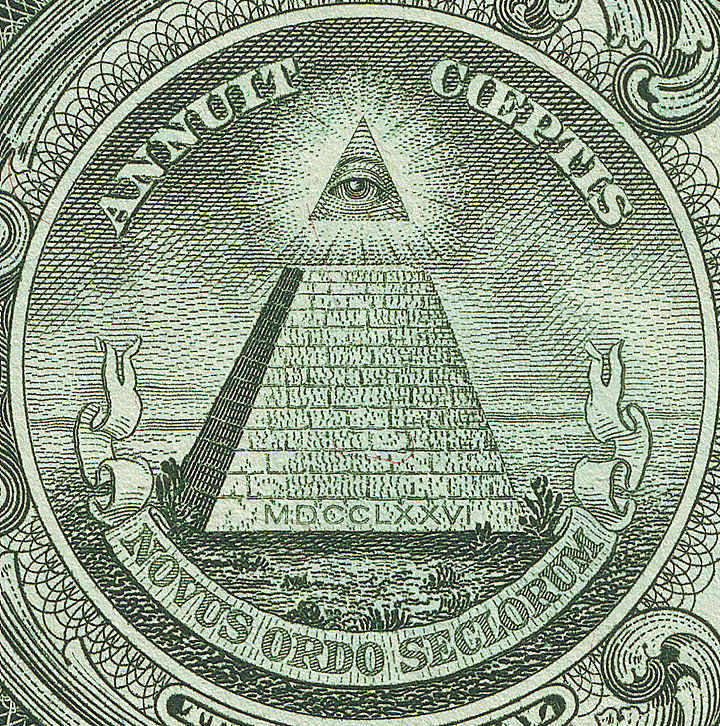
The Eye of Providence, as seen on the US$1 bill, has been perceived by some to be evidence of a conspiracy linking the Founding Fathers of the United States to the New World Order conspiracy theory.[1]: 58 [2]: 47–49 

A conspiracy theory is an explanation for an event or situation that asserts the existence of a conspiracy (generally by powerful sinister groups, often political in motivation),[3][4][5] when other explanations are more probable.[3][6][7] The term generally has a negative connotation, implying that the appeal of a conspiracy theory is based in prejudice, emotional conviction, insufficient evidence, and/or paranoia.[8] A conspiracy theory is distinct from a conspiracy; it refers to a hypothesized conspiracy with specific characteristics, including but not limited to opposition to the mainstream consensus among those who are qualified to evaluate its accuracy, such as scientists or historians.[9][10][11] As such, conspiracy theories are identified as lay theories.

Conspiracy theories tend to be internally consistent and correlate with each other;[12] they are generally designed to resist falsification either by evidence against them or a lack of evidence for them.[13] They are reinforced by circular reasoning: both evidence against the conspiracy and absence of evidence for it are misinterpreted as evidence of its truth.[8][14] Psychologist Stephan Lewandowsky observes "the stronger the evidence against a conspiracy, the more the conspirators must want people to believe their version of events."[15] As a consequence, the conspiracy becomes a matter of faith rather than something that can be proven or disproven.[1][16] Studies have linked belief in conspiracy theories to distrust of authority and political cynicism.[17][18][19] Some researchers suggest that conspiracist ideation—belief in conspiracy theories—may be psychologically harmful or pathological.[20][21] Such belief is correlated with psychological projection, paranoia, and Machiavellianism.[22][23]

Psychologists usually attribute belief in conspiracy theories to a number of psychopathological conditions such as paranoia, schizotypy, narcissism, and insecure attachment,[9] or to a form of cognitive bias called "illusory pattern perception".[24][25] It has also been linked with the so-called Dark triad personality types, whose common feature is lack of empathy.[26] However, a 2020 review article found that most cognitive scientists view conspiracy theorizing as typically nonpathological, given that unfounded belief in conspiracy is common across both historical and contemporary cultures, and may arise from innate human tendencies towards gossip, group cohesion, and religion.[9] One historical review of conspiracy theories concluded that "Evidence suggests that the aversive feelings that people experience when in crisis—fear, uncertainty, and the feeling of being out of control—stimulate a motivation to make sense of the situation, increasing the likelihood of perceiving conspiracies in social situations."[27]

Historically, conspiracy theories have been closely linked to prejudice, propaganda, witch hunts, wars, and genocides.[12][28][29][30][31] They are often strongly believed by the perpetrators of terrorist attacks, and were used as justification by Timothy McVeigh and Anders Breivik, as well as by governments such as Nazi Germany, the Soviet Union,[28] and Turkey.[32] AIDS denialism by the government of South Africa, motivated by conspiracy theories, caused an estimated 330,000 deaths from AIDS.[33][34][35] QAnon and denialism about the 2020 United States presidential election results led to the January 6 United States Capitol attack,[36][37][38] and belief in conspiracy theories about genetically modified foods led the government of Zambia to reject food aid during a famine,[29] at a time when three million people in the country were suffering from hunger.[39] Conspiracy theories are a significant obstacle to improvements in public health,[29][40] encouraging opposition to such public health measures as vaccination and water fluoridation. They have been linked to outbreaks of vaccine-preventable diseases.[29][33][40][41] Other effects of conspiracy theories include reduced trust in scientific evidence,[12][29][42] radicalization and ideological reinforcement of extremist groups,[28][43] and negative consequences for the economy.[28]

Conspiracy theories once limited to fringe audiences have become commonplace in mass media, the Internet, and social media,[9][12] emerging as a cultural phenomenon of the late 20th and early 21st centuries.[44][45][46][47] They are widespread around the world and are often commonly believed, some even held by the majority of the population.[48][49][50] Interventions to reduce the occurrence of conspiracy beliefs include maintaining an open society, encouraging people to use analytical thinking, and reducing feelings of uncertainty, anxiety, or powerlessness.[42][48][49][51]

Origin and usage

[edit]

The Oxford English Dictionary defines conspiracy theory as "the theory that an event or phenomenon occurs as a result of a conspiracy between interested parties; spec. a belief that some covert but influential agency (typically political in motivation and oppressive in intent) is responsible for an unexplained event". It cites a 1909 article in The American Historical Review as the earliest usage example,[52][53] although it also appeared in print for several decades before.[54]

The earliest known usage was by the American author Charles Astor Bristed, in a letter to the editor published in The New York Times on 11 January 1863.[55] He used it to refer to claims that British aristocrats were intentionally weakening the United States during the American Civil War in order to advance their financial interests.

England has had quite enough to do in Europe and Asia, without going out of her way to meddle with America. It was a physical and moral impossibility that she could be carrying on a gigantic conspiracy against us. But our masses, having only a rough general knowledge of foreign affairs, and not unnaturally somewhat exaggerating the space which we occupy in the world's eye, do not appreciate the complications which rendered such a conspiracy impossible. They only look at the sudden right-about-face movement of the English Press and public, which is most readily accounted for on the conspiracy theory.[55]

The term is also used as a way to discredit dissenting analyses.[56] Robert Blaskiewicz comments that examples of the term were used as early as the nineteenth century and states that its usage has always been derogatory.[57] According to a study by Andrew McKenzie-McHarg, in contrast, in the nineteenth century the term conspiracy theory simply "suggests a plausible postulate of a conspiracy" and "did not, at this stage, carry any connotations, either negative or positive", though sometimes a postulate so-labeled was criticized.[58] The author and activist George Monbiot argued that the terms "conspiracy theory" and "conspiracy theorist" are misleading, as conspiracies truly exist and theories are "rational explanations subject to disproof". Instead, he proposed the terms "conspiracy fiction" and "conspiracy fantasist".[59]

Alleged CIA origins

[edit]
The Warren Report

The term "conspiracy theory" is itself the subject of a conspiracy theory, which posits that the term was popularized by the CIA in order to discredit conspiratorial believers, particularly critics of the Warren Commission, by making them a target of ridicule.[60] In his 2013 book Conspiracy Theory in America, the political scientist Lance deHaven-Smith wrote that the term entered everyday language in the United States after 1964, the year in which the Warren Commission published its findings on the assassination of John F. Kennedy, with The New York Times running five stories that year using the term.[61]

Whether the CIA was responsible for popularising the term "conspiracy theory" was analyzed by Michael Butter, a Professor of American Literary and Cultural History at the University of Tübingen. Butter wrote in 2020 that the CIA document Concerning Criticism of the Warren Report, which proponents of the theory use as evidence of CIA motive and intention, does not contain the phrase "conspiracy theory" in the singular, and only uses the term "conspiracy theories" once, in the sentence: "Conspiracy theories have frequently thrown suspicion on our organisation [sic], for example, by falsely alleging that Lee Harvey Oswald worked for us."[62][63]

Difference from conspiracy

[edit]

A conspiracy theory is not simply a conspiracy, which refers to any covert plan involving two or more people.[10] In contrast, the term "conspiracy theory" refers to hypothesized conspiracies that have specific characteristics. For example, conspiracist beliefs invariably oppose the mainstream consensus among those people who are qualified to evaluate their accuracy, such as scientists or historians.[11] Conspiracy theorists see themselves as having privileged access to socially persecuted knowledge or a stigmatized mode of thought that separates them from the masses who believe the official account.[10] Michael Barkun describes a conspiracy theory as a "template imposed upon the world to give the appearance of order to events".[10]

Real conspiracies, even very simple ones, are difficult to conceal and routinely experience unexpected problems.[64] In contrast, conspiracy theories suggest that conspiracies are unrealistically successful and that groups of conspirators, such as bureaucracies, can act with near-perfect competence and secrecy. The causes of events or situations are simplified to exclude complex or interacting factors, as well as the role of chance and unintended consequences. Nearly all observations are explained as having been deliberately planned by the alleged conspirators.[64]

In conspiracy theories, the conspirators are usually claimed to be acting with extreme malice.[64] As described by Robert Brotherton:

The malevolent intent assumed by most conspiracy theories goes far beyond everyday plots borne out of self-interest, corruption, cruelty, and criminality. The postulated conspirators are not merely people with selfish agendas or differing values. Rather, conspiracy theories postulate a black-and-white world in which good is struggling against evil. The general public is cast as the victim of organised persecution, and the motives of the alleged conspirators often verge on pure maniacal evil. At the very least, the conspirators are said to have an almost inhuman disregard for the basic liberty and well-being of the general population. More grandiose conspiracy theories portray the conspirators as being Evil Incarnate: of having caused all the ills from which we suffer, committing abominable acts of unthinkable cruelty on a routine basis, and striving ultimately to subvert or destroy everything we hold dear.[64]

Examples

[edit]

A conspiracy theory may take any matter as its subject, but certain subjects attract greater interest than others. Favored subjects include famous deaths and assassinations, morally dubious government activities, suppressed technologies, and "false flag" terrorism. Among the best-known conspiracy theories relate to the assassination of John F. Kennedy, the 1969 Apollo Moon landings, and the 9/11 terrorist attacks, as well as numerous theories pertaining to alleged plots for world domination by various groups, both real and imaginary.[65]

Popularity

[edit]

Conspiracy beliefs are widespread around the world.[48] In rural Africa, common targets of conspiracy theorizing include societal elites, enemy tribes, and the Western world, with conspirators often alleged to enact their plans via sorcery or witchcraft; one common belief identifies modern technology as itself being a form of sorcery, created with the goal of harming or controlling the people.[48] In China, one widely published conspiracy theory claims that a number of events including the rise of Hitler, the 1997 Asian financial crisis, and climate change were planned by the Rothschild family, which may have led to effects on discussions about China's currency policy.[49][66]

Conspiracy theories once limited to fringe audiences have become commonplace in mass media, contributing to conspiracism emerging as a cultural phenomenon in the United States of the late 20th and early 21st centuries.[44][45][46][47] The general predisposition to believe conspiracy theories cuts across partisan and ideological lines. Conspiratorial thinking is correlated with antigovernmental orientations and a low sense of political efficacy, with conspiracy believers perceiving a governmental threat to individual rights and displaying a deep skepticism that who one votes for really matters.[67]

Conspiracy theories are often commonly believed, some even being held by the majority of the population.[48][49][50] A broad cross-section of Americans today gives credence to at least some conspiracy theories.[68] For instance, a study conducted in 2016 found that 10% of Americans think the chemtrail conspiracy theory is "completely true" and 20–30% think it is "somewhat true".[69] This puts "the equivalent of 120 million Americans in the 'chemtrails are real' camp".[69] Belief in conspiracy theories has therefore become a topic of interest for sociologists, psychologists and experts in folklore.

Conspiracy theories are widely present on the Web in the form of blogs and YouTube videos, as well as on social media. Whether the Web has increased the prevalence of conspiracy theories or not is an open research question.[70] The presence and representation of conspiracy theories in search engine results has been monitored and studied, showing significant variation across different topics, and a general absence of reputable, high-quality links in the results.[71]

One conspiracy theory that propagated through former US President Barack Obama's time in office[72] claimed that he was born in Kenya, instead of Hawaii where he was actually born.[73] Former governor of Arkansas and political opponent of Obama Mike Huckabee made headlines in 2011[74] when he, among other members of Republican leadership, continued to question Obama's citizenship status.

Belief in conspiracy theories in the United States, December 2020 – NPR/Ipsos poll, ±3.3%[75]
Conspiracy theory Believe Not sure
"A group of Satan-worshipping elites who run a child sex ring are trying to control our politics and media" (QAnon)
17%
37%
"Several mass shootings in recent years were staged hoaxes" (crisis actor theory)
12%
27%
Barack Obama was not born in the United States (birtherism)
19%
22%
Moon landing conspiracy theories
8%
20%
9/11 conspiracy theories
7%
20%

Types

[edit]

A conspiracy theory can be local or international, focused on single events or covering multiple incidents and entire countries, regions and periods of history.[10] According to Russell Muirhead and Nancy Rosenblum, historically, traditional conspiracism has entailed a "theory", but over time, "conspiracy" and "theory" have become decoupled, as modern conspiracism is often without any kind of theory behind it.[76][77]

Walker's five kinds

[edit]

Jesse Walker (2013) has identified five kinds of conspiracy theories:[78]

  • The "Enemy Outside" refers to theories based on figures alleged to be scheming against a community from without.
  • The "Enemy Within" finds the conspirators lurking inside the nation, indistinguishable from ordinary citizens.
  • The "Enemy Above" involves powerful people manipulating events for their own gain.
  • The "Enemy Below" features the lower classes working to overturn the social order.
  • The "Benevolent Conspiracies" are angelic forces that work behind the scenes to improve the world and help people.

Barkun's three types

[edit]

Michael Barkun has identified three classifications of conspiracy theory:[79]

  • Event conspiracy theories. This refers to limited and well-defined events. Examples may include such conspiracy theories as those concerning the Kennedy assassination, 9/11, and the spread of AIDS.
  • Systemic conspiracy theories. The conspiracy is believed to have broad goals, usually conceived as securing control of a country, a region, or even the entire world. The goals are sweeping, whilst the conspiratorial machinery is generally simple: a single, evil organization implements a plan to infiltrate and subvert existing institutions. This is a common scenario in conspiracy theories that focus on the alleged machinations of Jews, Freemasons, Communism, or the Catholic Church.
  • Superconspiracy theories. For Barkun, such theories link multiple alleged conspiracies together hierarchically. At the summit is a distant but all-powerful evil force. His cited examples are the ideas of David Icke and Milton William Cooper.

Rothbard: shallow vs. deep

[edit]

Murray Rothbard argues in favor of a model that contrasts "deep" conspiracy theories to "shallow" ones. According to Rothbard, a "shallow" theorist observes an event and asks Cui bono? ("Who benefits?"), jumping to the conclusion that a posited beneficiary is responsible for covertly influencing events. On the other hand, the "deep" conspiracy theorist begins with a hunch and then seeks out evidence. Rothbard describes this latter activity as a matter of confirming with certain facts one's initial paranoia.[80]

Lack of evidence

[edit]

Belief in conspiracy theories is generally based not on evidence but on the faith of the believer.[81] As such conspiracy theories are identified as lay theories.[82][83] Noam Chomsky contrasts conspiracy theory to institutional analysis, which focuses mainly on the public, long-term behavior of publicly known institutions, as recorded in, for example, scholarly documents or mainstream media reports.[84] Conspiracy theory conversely posits the existence of secretive coalitions of individuals and speculates on their alleged activities.[85][86] Belief in conspiracy theories is associated with biases in reasoning, such as the conjunction fallacy.[87]

Clare Birchall at King's College London describes conspiracy theory as a "form of popular knowledge or interpretation".[a] The use of the word 'knowledge' here suggests ways in which conspiracy theory may be considered in relation to legitimate modes of knowing.[b] The relationship between legitimate and illegitimate knowledge, Birchall claims, is closer than common dismissals of conspiracy theory contend.[89]

Theories involving multiple conspirators that are proven to be correct, such as the Watergate scandal, are usually referred to as investigative journalism or historical analysis rather than conspiracy theory.[90] Bjerg (2016) writes: "the way we normally use the term conspiracy theory excludes instances where the theory has been generally accepted as true. The Watergate scandal serves as the standard reference."[91] By contrast, the term "Watergate conspiracy theory" is used to refer to a variety of hypotheses in which those convicted in the conspiracy were in fact the victims of a deeper conspiracy.[92] There are also attempts to analyze the theory of conspiracy theories (conspiracy theory theory) to ensure that the term "conspiracy theory" is used to refer to narratives that have been debunked by experts, rather than as a generalized dismissal.[93]

Rhetoric

[edit]

Conspiracy theory rhetoric exploits several important cognitive biases, including proportionality bias, attribution bias, and confirmation bias.[33] Their arguments often take the form of asking reasonable questions, but without providing an answer based on strong evidence.[94] Conspiracy theories are most successful when proponents can gather followers from the general public, such as in politics, religion and journalism. These proponents may not necessarily believe the conspiracy theory; instead, they may just use it in an attempt to gain public approval. Conspiratorial claims can act as a successful rhetorical strategy to convince a portion of the public via appeal to emotion.[29]

Conspiracy theories typically justify themselves by focusing on gaps or ambiguities in knowledge, and then arguing that the true explanation for this must be a conspiracy.[64] In contrast, any evidence that directly supports their claims is generally of low quality. For example, conspiracy theories are often dependent on eyewitness testimony, despite its unreliability, while disregarding objective analyses of the evidence.[64]

Conspiracy theories are not able to be falsified and are reinforced by fallacious arguments. In particular, the logical fallacy circular reasoning is used by conspiracy theorists: both evidence against the conspiracy and an absence of evidence for it are re-interpreted as evidence of its truth,[8][14] whereby the conspiracy becomes a matter of faith rather than something that can be proved or disproved.[1][16] The epistemic strategy of conspiracy theories has been called "cascade logic": each time new evidence becomes available, a conspiracy theory is able to dismiss it by claiming that even more people must be part of the cover-up.[29][64] Any information that contradicts the conspiracy theory is suggested to be disinformation by the alleged conspiracy.[42] Similarly, the continued lack of evidence directly supporting conspiracist claims is portrayed as confirming the existence of a conspiracy of silence; the fact that other people have not found or exposed any conspiracy is taken as evidence that those people are part of the plot, rather than considering that it may be because no conspiracy exists.[33][64] This strategy lets conspiracy theories insulate themselves from neutral analyses of the evidence, and makes them resistant to questioning or correction, which is called "epistemic self-insulation".[33][64]

In 2013, 97% of peer-reviewed climate science papers that took a position on the cause of global warming said that humans are responsible, 3% said they were not. Among Fox News guests the same year, this was presented as a false balance between the two viewpoints, with 31% of invited guests believing it was happening and 69% not.[95]

Conspiracy theorists often take advantage of false balance in the media. They may claim to be presenting a legitimate alternative viewpoint that deserves equal time to argue its case; for example, this strategy has been used by the Teach the Controversy campaign to promote intelligent design, which often claims that there is a conspiracy of scientists suppressing their views. If they successfully find a platform to present their views in a debate format, they focus on using rhetorical ad hominems and attacking perceived flaws in the mainstream account, while avoiding any discussion of the shortcomings in their own position.[29]

The typical approach of conspiracy theories is to challenge any action or statement from authorities, using even the most tenuous justifications. Responses are then assessed using a double standard, where failing to provide an immediate response to the satisfaction of the conspiracy theorist will be claimed to prove a conspiracy. Any minor errors in the response are heavily emphasized, while deficiencies in the arguments of other proponents are generally excused.[29]

In science, conspiracists may suggest that a scientific theory can be disproven by a single perceived deficiency, even though such events are extremely rare. In addition, both disregarding the claims and attempting to address them will be interpreted as proof of a conspiracy.[29] Other conspiracist arguments may not be scientific; for example, in response to the IPCC Second Assessment Report in 1996, much of the opposition centered on promoting a procedural objection to the report's creation. Specifically, it was claimed that part of the procedure reflected a conspiracy to silence dissenters, which served as motivation for opponents of the report and successfully redirected a significant amount of the public discussion away from the science.[29]

Consequences

[edit]
Third Reich Nazi antisemitic propaganda poster entitled Das jüdische Komplott ("The Jewish Conspiracy")

Historically, conspiracy theories have been closely linked to prejudice, witch hunts, wars, and genocides.[28][29] They are often strongly believed by the perpetrators of terrorist attacks, and were used as justification by Timothy McVeigh, Anders Breivik and Brenton Tarrant, as well as by governments such as Nazi Germany and the Soviet Union.[28] AIDS denialism by the government of South Africa, motivated by conspiracy theories, caused an estimated 330,000 deaths from AIDS,[33][34][35] while belief in conspiracy theories about genetically modified foods led the government of Zambia to reject food aid during a famine,[29] at a time when 3 million people in the country were suffering from hunger.[39]

Conspiracy theories are a significant obstacle to improvements in public health.[29][40] People who believe in health-related conspiracy theories are less likely to follow medical advice, and more likely to use alternative medicine instead.[28] Conspiratorial anti-vaccination beliefs, such as conspiracy theories about pharmaceutical companies, can result in reduced vaccination rates and have been linked to outbreaks of vaccine-preventable diseases.[33][29][41][40] Health-related conspiracy theories often inspire resistance to water fluoridation, and contributed to the impact of the Lancet MMR autism fraud.[29][40]

Conspiracy theories are a fundamental component of a wide range of radicalized and extremist groups, where they may play an important role in reinforcing the ideology and psychology of their members as well as further radicalizing their beliefs.[28][43] These conspiracy theories often share common themes, even among groups that would otherwise be fundamentally opposed, such as the antisemitic conspiracy theories found among political extremists on both the far right and far left.[28] More generally, belief in conspiracy theories is associated with holding extreme and uncompromising viewpoints, and may help people in maintaining those viewpoints.[42] While conspiracy theories are not always present in extremist groups, and do not always lead to violence when they are, they can make the group more extreme, provide an enemy to direct hatred towards, and isolate members from the rest of society. Conspiracy theories are most likely to inspire violence when they call for urgent action, appeal to prejudices, or demonize and scapegoat enemies.[43]

Conspiracy theorizing in the workplace can also have economic consequences. For example, it leads to lower job satisfaction and lower commitment, resulting in workers being more likely to leave their jobs.[28] Comparisons have also been made with the effects of workplace rumors, which share some characteristics with conspiracy theories and result in both decreased productivity and increased stress. Subsequent effects on managers include reduced profits, reduced trust from employees, and damage to the company's image.[28][96]

Conspiracy theories can divert attention from important social, political, and scientific issues.[97][98] In addition, they have been used to discredit scientific evidence to the general public or in a legal context. Conspiratorial strategies also share characteristics with those used by lawyers who are attempting to discredit expert testimony, such as claiming that the experts have ulterior motives in testifying, or attempting to find someone who will provide statements to imply that expert opinion is more divided than it actually is.[29]

It is possible that conspiracy theories may also produce some compensatory benefits to society in certain situations. For example, they may help people identify governmental deceptions, particularly in repressive societies, and encourage government transparency.[49][97] However, real conspiracies are normally revealed by people working within the system, such as whistleblowers and journalists, and most of the effort spent by conspiracy theorists is inherently misdirected.[43] The most dangerous conspiracy theories are likely to be those that incite violence, scapegoat disadvantaged groups, or spread misinformation about important societal issues.[99]

Interventions

[edit]

Target audience

[edit]

Strategies to address conspiracy theories have been divided into two categories based on whether the target audience is the conspiracy theorists or the general public.[51][49] These strategies have been described as reducing either the supply or the demand for conspiracy theories.[49] Both approaches can be used at the same time, although there may be issues of limited resources, or if arguments are used which may appeal to one audience at the expense of the other.[49]

Brief scientific literacy interventions, particularly those focusing on critical thinking skills, can effectively undermine conspiracy beliefs and related behaviors. Research led by Penn State scholars, published in the Journal of Consumer Research, found that enhancing scientific knowledge and reasoning through short interventions, such as videos explaining concepts like correlation and causation, reduces the endorsement of conspiracy theories. These interventions were most effective against conspiracy theories based on faulty reasoning and were successful even among groups prone to conspiracy beliefs. The studies, involving over 2,700 participants, highlight the importance of educational interventions in mitigating conspiracy beliefs, especially when timed to influence critical decision-making.[100]

General public

[edit]

People who feel empowered are more resistant to conspiracy theories. Methods to promote empowerment include encouraging people to use analytical thinking, priming people to think of situations where they are in control, and ensuring that decisions by society and government are seen to follow procedural fairness (the use of fair decision-making procedures).[51]

Methods of refutation which have shown effectiveness in various circumstances include: providing facts that demonstrate the conspiracy theory is false, attempting to discredit the source, explaining how the logic is invalid or misleading, and providing links to fact-checking websites.[51] It can also be effective to use these strategies in advance, informing people that they could encounter misleading information in the future, and why the information should be rejected (also called inoculation or prebunking).[51][101][102] While it has been suggested that discussing conspiracy theories can raise their profile and make them seem more legitimate to the public, the discussion can put people on guard instead as long as it is sufficiently persuasive.[9]

Other approaches to reduce the appeal of conspiracy theories in general among the public may be based in the emotional and social nature of conspiratorial beliefs. For example, interventions that promote analytical thinking in the general public are likely to be effective. Another approach is to intervene in ways that decrease negative emotions, and specifically to improve feelings of personal hope and empowerment.[48]

Conspiracy theorists

[edit]

It is much more difficult to convince people who already believe in conspiracy theories.[49][51] Conspiracist belief systems are not based on external evidence, but instead use circular logic where every belief is supported by other conspiracist beliefs.[51] In addition, conspiracy theories have a "self-sealing" nature, in which the types of arguments used to support them make them resistant to questioning from others.[49]

Characteristics of successful strategies for reaching conspiracy theorists have been divided into several broad categories: 1) Arguments can be presented by "trusted messengers", such as people who were formerly members of an extremist group. 2) Since conspiracy theorists think of themselves as people who value critical thinking, this can be affirmed and then redirected to encourage being more critical when analyzing the conspiracy theory. 3) Approaches demonstrate empathy, and are based on building understanding together, which is supported by modeling open-mindedness in order to encourage the conspiracy theorists to do likewise. 4) The conspiracy theories are not attacked with ridicule or aggressive deconstruction, and interactions are not treated like an argument to be won; this approach can work with the general public, but among conspiracy theorists it may simply be rejected.[51]

Interventions that reduce feelings of uncertainty, anxiety, or powerlessness result in a reduction in conspiracy beliefs.[42] Other possible strategies to mitigate the effect of conspiracy theories include education, media literacy, and increasing governmental openness and transparency.[101] Due to the relationship between conspiracy theories and political extremism, the academic literature on deradicalization is also important.[51]

One approach describes conspiracy theories as resulting from a "crippled epistemology", in which a person encounters or accepts very few relevant sources of information.[49][103] A conspiracy theory is more likely to appear justified to people with a limited "informational environment" who only encounter misleading information. These people may be "epistemologically isolated" in self-enclosed networks. From the perspective of people within these networks, disconnected from the information available to the rest of society, believing in conspiracy theories may appear to be justified.[49][103] In these cases, the solution would be to break the group's informational isolation.[49]

Reducing transmission

[edit]

Public exposure to conspiracy theories can be reduced by interventions that reduce their ability to spread, such as by encouraging people to reflect before sharing a news story.[51] Researchers Carlos Diaz Ruiz and Tomas Nilsson have proposed technical and rhetorical interventions to counter the spread of conspiracy theories on social media.[104]

Interventions to counter the spread of conspiracy theories on social media[104]
Type of intervention Intervention
Technical Expose sources that insert and circulate conspiracy theories on social media (flagging).
Diminish the source's capacity to monetize conspiracies (demonetization).
Slow down the circulation of conspiracy theories (algorithm)
Rhetorical Issue authoritative corrections (fact-checking).
Authority-based corrections and fact-checking may backfire because personal worldviews cannot be proved wrong.
Enlist spokespeople that can be perceived as allies and insiders.
Rebuttals must spring from an epistemology that participants are already familiar with.
Give believers of conspiracies an "exit ramp" to dis-invest themselves without facing ridicule.

Government policies

[edit]

The primary defense against conspiracy theories is to maintain an open society, in which many sources of reliable information are available, and government sources are known to be credible rather than propaganda. Additionally, independent nongovernmental organizations are able to correct misinformation without requiring people to trust the government.[49] The absence of civil rights and civil liberties reduces the number of information sources available to the population, which may lead people to support conspiracy theories.[49] Since the credibility of conspiracy theories can be increased if governments act dishonestly or otherwise engage in objectionable actions, avoiding such actions is also a relevant strategy.[101]

Joseph Pierre has said that mistrust in authoritative institutions is the core component underlying many conspiracy theories and that this mistrust creates an epistemic vacuum and makes individuals searching for answers vulnerable to misinformation. Therefore, one possible solution is offering consumers a seat at the table to mend their mistrust in institutions.[105] Regarding the challenges of this approach, Pierre has said, "The challenge with acknowledging areas of uncertainty within a public sphere is that doing so can be weaponized to reinforce a post-truth view of the world in which everything is debatable, and any counter-position is just as valid. Although I like to think of myself as a middle of the road kind of individual, it is important to keep in mind that the truth does not always lie in the middle of a debate, whether we are talking about climate change, vaccines, or antipsychotic medications."[106]

Researchers have recommended that public policies should take into account the possibility of conspiracy theories relating to any policy or policy area, and prepare to combat them in advance.[101][9] Conspiracy theories have suddenly arisen in the context of policy issues as disparate as land-use laws and bicycle-sharing programs.[101] In the case of public communications by government officials, factors that improve the effectiveness of communication include using clear and simple messages, and using messengers which are trusted by the target population. Government information about conspiracy theories is more likely to be believed if the messenger is perceived as being part of someone's in-group. Official representatives may be more effective if they share characteristics with the target groups, such as ethnicity.[101]

In addition, when the government communicates with citizens to combat conspiracy theories, online methods are more efficient compared to other methods such as print publications. This also promotes transparency, can improve a message's perceived trustworthiness, and is more effective at reaching underrepresented demographics. However, as of 2019, many governmental websites do not take full advantage of the available information-sharing opportunities. Similarly, social media accounts need to be used effectively in order to achieve meaningful communication with the public, such as by responding to requests that citizens send to those accounts. Other steps include adapting messages to the communication styles used on the social media platform in question, and promoting a culture of openness. Since mixed messaging can support conspiracy theories, it is also important to avoid conflicting accounts, such as by ensuring the accuracy of messages on the social media accounts of individual members of the organization.[101]

Public health campaigns

[edit]

Successful methods for dispelling conspiracy theories have been studied in the context of public health campaigns. A key characteristic of communication strategies to address medical conspiracy theories is the use of techniques that rely less on emotional appeals. It is more effective to use methods that encourage people to process information rationally. The use of visual aids is also an essential part of these strategies. Since conspiracy theories are based on intuitive thinking, and visual information processing relies on intuition, visual aids are able to compete directly for the public's attention.[9]

In public health campaigns, information retention by the public is highest for loss-framed messages that include more extreme outcomes. However, excessively appealing to catastrophic scenarios (e.g. low vaccination rates causing an epidemic) may provoke anxiety, which is associated with conspiracism and could increase belief in conspiracy theories instead. Scare tactics have sometimes had mixed results, but are generally considered ineffective. An example of this is the use of images that showcase disturbing health outcomes, such as the impact of smoking on dental health. One possible explanation is that information processed via the fear response is typically not evaluated rationally, which may prevent the message from being linked to the desired behaviors.[9]

A particularly important technique is the use of focus groups to understand exactly what people believe, and the reasons they give for those beliefs. This allows messaging to focus on the specific concerns that people identify, and on topics that are easily misinterpreted by the public, since these are factors which conspiracy theories can take advantage of. In addition, discussions with focus groups and observations of the group dynamics can indicate which anti-conspiracist ideas are most likely to spread.[9]

Interventions that address medical conspiracy theories by reducing powerlessness include emphasizing the principle of informed consent, giving patients all the relevant information without imposing decisions on them, to ensure that they have a sense of control. Improving access to healthcare also reduces medical conspiracism. However, doing so by political efforts can also fuel additional conspiracy theories, which occurred with the Affordable Care Act (Obamacare) in the United States. Another successful strategy is to require people to watch a short video when they fulfil requirements such as registration for school or a drivers' license, which has been demonstrated to improve vaccination rates and signups for organ donation.[9]

Another approach is based on viewing conspiracy theories as narratives which express personal and cultural values, making them less susceptible to straightforward factual corrections, and more effectively addressed by counter-narratives.[102][107] Counter-narratives can be more engaging and memorable than simple corrections, and can be adapted to the specific values held by individuals and cultures. These narratives may depict personal experiences, or alternatively they can be cultural narratives. In the context of vaccination, examples of cultural narratives include stories about scientific breakthroughs, about the world before vaccinations, or about heroic and altruistic researchers. The themes to be addressed would be those that could be exploited by conspiracy theories to increase vaccine hesitancy, such as perceptions of vaccine risk, lack of patient empowerment, and lack of trust in medical authorities.[102]

Backfire effects

[edit]

It has been suggested that directly countering misinformation can be counterproductive. For example, since conspiracy theories can reinterpret disconfirming information as part of their narrative, refuting a claim can result in accidentally reinforcing it,[64][108] which is referred to as a "backfire effect".[109] In addition, publishing criticism of conspiracy theories can result in legitimizing them.[97] In this context, possible interventions include carefully selecting which conspiracy theories to refute, requesting additional analyses from independent observers, and introducing cognitive diversity into conspiratorial communities by undermining their poor epistemology.[97] Any legitimization effect might also be reduced by responding to more conspiracy theories rather than fewer.[49]

There are psychological mechanisms by which backfire effects could potentially occur, but the evidence on this topic is mixed, and backfire effects are very rare in practice.[102][109][110] A 2020 review of the scientific literature on backfire effects found that there have been widespread failures to replicate their existence, even under conditions that would be theoretically favorable to observing them.[109] Due to the lack of reproducibility, as of 2020 most researchers believe that backfire effects are either unlikely to occur on the broader population level, or they only occur in very specific circumstances, or they do not exist.[109] Brendan Nyhan, one of the researchers who initially proposed the occurrence of backfire effects, wrote in 2021 that the persistence of misinformation is most likely due to other factors.[110]

In general, people do reject conspiracy theories when they learn about their contradictions and lack of evidence.[9] For most people, corrections and fact-checking are very unlikely to have a negative impact, and there is no specific group of people in which backfire effects have been consistently observed.[109] Presenting people with factual corrections, or highlighting the logical contradictions in conspiracy theories, has been demonstrated to have a positive effect in many circumstances.[48][108] For example, this has been studied in the case of informing believers in 9/11 conspiracy theories about statements by actual experts and witnesses.[48] One possibility is that criticism is most likely to backfire if it challenges someone's worldview or identity. This suggests that an effective approach may be to provide criticism while avoiding such challenges.[108]

Psychology

[edit]

The widespread belief in conspiracy theories has become a topic of interest for sociologists, psychologists, and experts in folklore since at least the 1960s, when a number of conspiracy theories arose regarding the assassination of U.S. President John F. Kennedy. Sociologist Türkay Salim Nefes underlines the political nature of conspiracy theories. He suggests that one of the most important characteristics of these accounts is their attempt to unveil the "real but hidden" power relations in social groups.[111][112] The term "conspiracism" was popularized by academic Frank P. Mintz in the 1980s. According to Mintz, conspiracism denotes "belief in the primacy of conspiracies in the unfolding of history":[113]: 4 

Conspiracism serves the needs of diverse political and social groups in America and elsewhere. It identifies elites, blames them for economic and social catastrophes, and assumes that things will be better once popular action can remove them from positions of power. As such, conspiracy theories do not typify a particular epoch or ideology.[113]: 199 

Research suggests, on a psychological level, conspiracist ideation—belief in conspiracy theories—can be harmful or pathological,[20][21] and is highly correlated with psychological projection, as well as with paranoia, which is predicted by the degree of a person's Machiavellianism.[114] The propensity to believe in conspiracy theories is strongly associated with the mental health disorder of schizotypy.[115][116][117][118][119] Conspiracy theories once limited to fringe audiences have become commonplace in mass media, emerging as a cultural phenomenon of the late 20th and early 21st centuries.[44][45][46][47] Exposure to conspiracy theories in news media and popular entertainment increases receptiveness to conspiratorial ideas, and has also increased the social acceptability of fringe beliefs.[28][120]

Conspiracy theories often use complicated and detailed arguments, including ones that appear analytical or scientific. However, belief in conspiracy theories is primarily driven by emotion.[48] One of the most widely confirmed facts about conspiracy theories is that belief in a single conspiracy theory is often associated with belief in other conspiracy theories.[33][121] This even applies when the conspiracy theories directly contradict each other—e.g., believing that Osama bin Laden was already dead before his compound in Pakistan was attacked makes the same person more likely to believe that he is still alive. One conclusion from this finding is that the content of a conspiracist belief is less important than the idea of a coverup by the authorities.[33][98][122] Analytical thinking aids in reducing belief in conspiracy theories, in part because it emphasizes rational and critical cognition.[42]

Some psychologists assert that explanations related to conspiracy theories can be, and often are, "internally consistent" with strong beliefs previously held prior to the event that sparked the belief in a conspiracy.[42] People who believe in conspiracy theories tend to believe in other unsubstantiated claims, including pseudoscience and paranormal phenomena.[123]

Attractions

[edit]

Psychological motives for believing in conspiracy theories can be categorized as epistemic, existential, or social. These motives are particularly acute in vulnerable and disadvantaged populations. However, it does not appear that the beliefs help to address these motives; in fact, they may be self-defeating, acting to make the situation worse instead.[42][108] For example, while conspiratorial beliefs can result from a perceived sense of powerlessness, exposure to conspiracy theories immediately suppresses personal feelings of autonomy and control. Furthermore, they also make people less likely to take actions that could improve their circumstances.[42][108]

This is additionally supported by the fact that conspiracy theories have a number of disadvantageous attributes.[42] For example, they promote a hostile and distrustful view of other people and groups allegedly acting based on antisocial and cynical motivations. This is expected to lead to increased social alienation and anomie and reduced social capital. Similarly, they depict the public as ignorant and powerless against the alleged conspirators, with important aspects of society determined by malevolent forces, a viewpoint that is likely to be disempowering.[42]

Each person may endorse conspiracy theories for one of many different reasons.[124] The most consistently demonstrated characteristics of people who find conspiracy theories appealing are a feeling of alienation, unhappiness or dissatisfaction with their situation, an unconventional worldview, and a sense of disempowerment.[124] While various aspects of personality affect susceptibility to conspiracy theories, none of the Big Five personality traits are associated with conspiracy beliefs.[124]

The political scientist Michael Barkun, discussing the usage of "conspiracy theory" in contemporary American culture, holds that this term is used for a belief that explains an event as the result of a secret plot by exceptionally powerful and cunning conspirators to achieve a malevolent end.[125][126] According to Barkun, the appeal of conspiracism is threefold:

  • First, conspiracy theories claim to explain what institutional analysis cannot. They appear to make sense out of a world that is otherwise confusing.
  • Second, they do so in an appealingly simple way, by dividing the world sharply between the forces of light, and the forces of darkness. They trace all evil back to a single source, the conspirators and their agents.
  • Third, conspiracy theories are often presented as special, secret knowledge unknown or unappreciated by others. For conspiracy theorists, the masses are a brainwashed herd, while the conspiracy theorists in the know can congratulate themselves on penetrating the plotters' deceptions.[126]

This third point is supported by the research of Roland Imhoff, professor of social psychology at the Johannes Gutenberg University Mainz. His research suggests that the smaller the minority believing in a specific theory, the more attractive it is to conspiracy theorists.[127] Humanistic psychologists argue that even if a posited cabal behind an alleged conspiracy is almost always perceived as hostile, there often remains an element of reassurance for theorists. This is because it is a consolation to imagine that humans create difficulties in human affairs and remain within human control. If a cabal can be implicated, there may be a hope of breaking its power or of joining it. Belief in the power of a cabal is an implicit assertion of human dignity—an unconscious affirmation that man is responsible for his own destiny.[128]

People formulate conspiracy theories to explain, for example, power relations in social groups and the perceived existence of evil forces.[c][126][111][112] Proposed psychological origins of conspiracy theorising include projection; the personal need to explain "a significant event [with] a significant cause;" and the product of various kinds and stages of thought disorder, such as paranoid disposition, ranging in severity to diagnosable mental illnesses. Some people prefer socio-political explanations over the insecurity of encountering random, unpredictable, or otherwise inexplicable events.[129][130][131][132][133][134] According to Berlet and Lyons, "Conspiracism is a particular narrative form of scapegoating that frames demonized enemies as part of a vast insidious plot against the common good, while it valorizes the scapegoater as a hero for sounding the alarm".[135]

Causes

[edit]

Some psychologists believe that a search for meaning is common in conspiracism. Once cognized, confirmation bias and avoidance of cognitive dissonance may reinforce the belief. When a conspiracy theory has become embedded within a social group, communal reinforcement may also play a part.[136]

Inquiry into possible motives behind the accepting of irrational conspiracy theories has linked[137] these beliefs to distress resulting from an event that occurred, such as the events of 9/11. Additional research suggests that "delusional ideation" is the trait most likely to indicate a stronger belief in conspiracy theories.[138] Research also shows an increased attachment to these irrational beliefs leads to a decreased desire for civic engagement.[87] Belief in conspiracy theories is correlated with low intelligence, lower analytical thinking, anxiety disorders, paranoia, and authoritarian beliefs.[139][140][141]

Professor Quassim Cassam argues that conspiracy theorists hold their beliefs due to flaws in their thinking and, more precisely, their intellectual character. He cites philosopher Linda Trinkaus Zagzebski and her book Virtues of the Mind in outlining intellectual virtues (such as humility, caution, and carefulness) and intellectual vices (such as gullibility, carelessness, and closed-mindedness). Whereas intellectual virtues help reach sound examination, intellectual vices "impede effective and responsible inquiry", meaning that those prone to believing in conspiracy theories possess certain vices while lacking necessary virtues.[142]

Some researchers have suggested that conspiracy theories could be partially caused by the human brain's mechanisms for detecting dangerous coalitions. Such a mechanism could have been helpful in the small-scale environment humanity evolved in but is mismatched in a modern, complex society and thus "misfire", perceiving conspiracies where none exist.[143]

Projection

[edit]

Some historians have argued that psychological projection is prevalent amongst conspiracy theorists. According to the argument, this projection is manifested in the form of attributing undesirable characteristics of the self to the conspirators. Historian Richard Hofstadter stated that:

This enemy seems on many counts a projection of the self; both the ideal and the unacceptable aspects of the self are attributed to him. A fundamental paradox of the paranoid style is the imitation of the enemy. The enemy, for example, may be the cosmopolitan intellectual, but the paranoid will outdo him in the apparatus of scholarship, even of pedantry. ... The Ku Klux Klan imitated Catholicism to the point of donning priestly vestments, developing an elaborate ritual and an equally elaborate hierarchy. The John Birch Society emulates Communist cells and quasi-secret operation through "front" groups, and preaches a ruthless prosecution of the ideological war along lines very similar to those it finds in the Communist enemy. Spokesmen of the various fundamentalist anti-Communist "crusades" openly express their admiration for the dedication, discipline, and strategic ingenuity the Communist cause calls forth.[132]

Hofstadter also noted that "sexual freedom" is a vice frequently attributed to the conspiracist's target group, noting that "very often the fantasies of true believers reveal strong sadomasochistic outlets, vividly expressed, for example, in the delight of anti-Masons with the cruelty of Masonic punishments".[132]

Physiology

[edit]

Marcel Danesi suggests that people who believe conspiracy theories have difficulty rethinking situations. Exposure to those theories has caused neural pathways to be more rigid and less subject to change. Initial susceptibility to believing these theories' lies, dehumanizing language, and metaphors leads to the acceptance of larger and more extensive theories because the hardened neural pathways are already present. Repetition of the "facts" of conspiracy theories and their connected lies simply reinforces the rigidity of those pathways. Thus, conspiracy theories and dehumanizing lies are not mere hyperbole; they can actually change the way people think:

Unfortunately, research into this brain wiring also shows that once people begin to believe lies, they are unlikely to change their minds even when confronted with evidence that contradicts their beliefs. It is a form of brainwashing. Once the brain has carved out a well-worn path of believing deceit, it is even harder to step out of that path – which is how fanatics are born. Instead, these people will seek out information that confirms their beliefs, avoid anything that is in conflict with them, or even turn the contrasting information on its head, so as to make it fit their beliefs.

People with strong convictions will have a hard time changing their minds, given how embedded a lie becomes in the mind. In fact, there are scientists and scholars still studying the best tools and tricks to combat lies with some combination of brain training and linguistic awareness.[144]

Sociology

[edit]

In addition to psychological factors such as conspiracist ideation, sociological factors also help account for who believes in which conspiracy theories. Such theories tend to get more traction among election losers in society, for example, and the emphasis on conspiracy theories by elites and leaders tends to increase belief among followers with higher levels of conspiracy thinking.[145] Christopher Hitchens described conspiracy theories as the "exhaust fumes of democracy":[133] the unavoidable result of a large amount of information circulating among a large number of people.

Conspiracy theories may be emotionally satisfying, as they assign blame to a group to which the theorist does not belong and, thus, absolve the theorist of moral or political responsibility in society.[146] Likewise, Roger Cohen writing for The New York Times has said that, "captive minds; ... resort to conspiracy theory because it is the ultimate refuge of the powerless. If you cannot change your own life, it must be that some greater force controls the world."[134]

Sociological historian Holger Herwig found in studying German explanations for the origins of World War I, "Those events that are most important are hardest to understand because they attract the greatest attention from myth makers and charlatans."[147] Justin Fox of Time magazine argues that Wall Street traders are among the most conspiracy-minded group of people, and ascribes this to the reality of some financial market conspiracies, and to the ability of conspiracy theories to provide necessary orientation in the market's day-to-day movements.[129]

Influence of critical theory

[edit]

Bruno Latour notes that the language and intellectual tactics of critical theory have been appropriated by those he describes as conspiracy theorists, including climate-change denialists and the 9/11 Truth movement: "Maybe I am taking conspiracy theories too seriously, but I am worried to detect, in those mad mixtures of knee-jerk disbelief, punctilious demands for proofs, and free use of powerful explanation from the social neverland, many of the weapons of social critique."[148]

Fusion paranoia

[edit]

Michael Kelly, a Washington Post journalist and critic of anti-war movements on both the left and right, coined the term "fusion paranoia" to refer to a political convergence of left-wing and right-wing activists around anti-war issues and civil liberties, which he said were motivated by a shared belief in conspiracism or shared anti-government views.[149]

Barkun has adopted this term to refer to how the synthesis of paranoid conspiracy theories, which were once limited to American fringe audiences, has given them mass appeal and enabled them to become commonplace in mass media,[150] thereby inaugurating an unrivaled period of people actively preparing for apocalyptic or millenarian scenarios in the United States of the late 20th and early 21st centuries.[151] Barkun notes the occurrence of lone-wolf conflicts with law enforcement acting as a proxy for threatening the established political powers.[152]

Viability

[edit]

As evidence that undermines an alleged conspiracy grows, the number of alleged conspirators also grows in the minds of conspiracy theorists. This is because of an assumption that the alleged conspirators often have competing interests. For example, if Republican President George W. Bush is allegedly responsible for the 9/11 terrorist attacks, and the Democratic party did not pursue exposing this alleged plot, that must mean that both the Democratic and Republican parties are conspirators in the alleged plot. It also assumes that the alleged conspirators are so competent that they can fool the entire world, but so incompetent that even the unskilled conspiracy theorists can find mistakes they make that prove the fraud. At some point, the number of alleged conspirators, combined with the contradictions within the alleged conspirators' interests and competence, becomes so great that maintaining the theory becomes an obvious exercise in absurdity.[153]

The physicist David Robert Grimes estimated the time it would take for a conspiracy to be exposed based on the number of people involved.[154][155] His calculations used data from the PRISM surveillance program, the Tuskegee syphilis experiment, and the FBI forensic scandal. Grimes estimated that:

  • A Moon landing hoax would require the involvement of 411,000 people and would be exposed within 3.68 years;
  • Climate-change fraud would require a minimum of 29,083 people (published climate scientists only) and would be exposed within 26.77 years, or up to 405,000 people, in which case it would be exposed within 3.70 years;
  • A vaccination conspiracy would require a minimum of 22,000 people (without drug companies) and would be exposed within at least 3.15 years and at most 34.78 years depending on the number involved;
  • A conspiracy to suppress a cure for cancer would require 714,000 people and would be exposed within 3.17 years.

Grimes's study did not consider exposure by sources outside of the alleged conspiracy. It only considered exposure from within the alleged conspiracy through whistleblowers or through incompetence.[156] Subsequent comments on the PubPeer website[157] point out that these calculations must exclude successful conspiracies since, by definition, we don't know about them, and are wrong by an order of magnitude about Bletchley Park, which remained a secret far longer than Grimes' calculations predicted.

Terminology

[edit]

The term "truth seeker" is adopted by some conspiracy theorists when describing themselves on social media.[158] Conspiracy theorists are often referred to derogatorily as "cookers" in Australia.[159] The term "cooker" is also loosely associated with the far right.[160][161]

Politics

[edit]
A 2008 poll found that majorities in only 9 of 17 countries believed that al-Qaeda carried out the 9/11 attacks.[162]

The philosopher Karl Popper described the central problem of conspiracy theories as a form of fundamental attribution error, where every event is generally perceived as being intentional and planned, greatly underestimating the effects of randomness and unintended consequences.[98] In his book The Open Society and Its Enemies, he used the term "the conspiracy theory of society" to denote the idea that social phenomena such as "war, unemployment, poverty, shortages ... [are] the result of direct design by some powerful individuals and groups".[163] Popper argued that totalitarianism was founded on conspiracy theories which drew on imaginary plots which were driven by paranoid scenarios predicated on tribalism, chauvinism, or racism. He also noted that conspirators very rarely achieved their goal.[164]

Historically, real conspiracies have usually had little effect on history and have had unforeseen consequences for the conspirators, in contrast to conspiracy theories, which often posit grand, sinister organizations or world-changing events, the evidence for which has been erased or obscured.[165][166] As described by Bruce Cumings, history is instead "moved by the broad forces and large structures of human collectivities".[165]

Arab world

[edit]

Conspiracy theories are a prevalent feature of Arab culture and politics.[167] Variants include conspiracies involving colonialism, Zionism, superpowers, oil, and the war on terrorism, which is often referred to in Arab media as a "war against Islam".[167] For example, The Protocols of the Elders of Zion, an infamous hoax document purporting to be a Jewish plan for world domination, is commonly read and promoted in the Muslim world.[168][169][170] Roger Cohen has suggested that the popularity of conspiracy theories in the Arab world is "the ultimate refuge of the powerless".[134] Al-Mumin Said has noted the danger of such theories, for they "keep us not only from the truth but also from confronting our faults and problems".[171] Osama bin Laden and Ayman al-Zawahiri used conspiracy theories about the United States to gain support for al-Qaeda in the Arab world, and as rhetoric to distinguish themselves from similar groups, although they may not have believed the conspiratorial claims themselves.[172]

Turkey

[edit]

Conspiracy theories are a prevalent feature of culture and politics in Turkey. Conspiracism is an important phenomenon in understanding Turkish politics.[173] This is explained by a desire to "make up for our lost Ottoman grandeur",[173] the humiliation of perceiving Turkey as part of "the malfunctioning half" of the world,[174] and a "low level of media literacy among the Turkish population."[175]

There are a wide variety of conspiracy theories including the Judeo-Masonic conspiracy theory,[176][177] the international Jewish conspiracy theory, and the war against Islam conspiracy theory. For example, Islamists, dissatisfied with the modernist and secularist reforms that took place throughout the history of the Ottoman Empire and the Turkish Republic, have put forward many conspiracy theories to defame the Treaty of Lausanne, an important peace treaty for the country, and the republic's founder Kemal Atatürk.[178][179] Another example is the Sèvres syndrome, a reference to the Treaty of Sèvres of 1920, a popular belief in Turkey that dangerous internal and external enemies, especially the West, are "conspiring to weaken and carve up the Turkish Republic".[180]

United States

[edit]

The historian Richard Hofstadter addressed the role of paranoia and conspiracism throughout U.S. history in his 1964 essay "The Paranoid Style in American Politics". Bernard Bailyn's classic The Ideological Origins of the American Revolution (1967) notes that a similar phenomenon could be found in North America during the time preceding the American Revolution. Conspiracism labels people's attitudes and the type of conspiracy theories that are more global and historical in proportion.[181]

Harry G. West and others have noted that while conspiracy theorists may often be dismissed as a fringe minority, certain evidence suggests that a wide range of the U.S. believes in conspiracy theories. West also compares those theories to hypernationalism and religious fundamentalism.[182][183] Theologian Robert Jewett and philosopher John Shelton Lawrence attribute the enduring popularity of conspiracy theories in the U.S. to the Cold War, McCarthyism, and counterculture rejection of authority. They state that among both the left-wing and right-wing, there remains a willingness to use real events, such as Soviet plots, inconsistencies in the Warren Report, and the 9/11 attacks, to support the existence of unverified and ongoing large-scale conspiracies.[184]

In his studies of "American political demonology", historian Michael Paul Rogin too analyzed this paranoid style of politics that has occurred throughout American history. Conspiracy theories frequently identify an imaginary subversive group that is supposedly attacking the nation and requires the government and allied forces to engage in harsh extra-legal repression of those threatening subversives. Rogin cites examples from the Red Scares of 1919 to McCarthy's anti-communist campaign in the 1950s and, more recently, fears of immigrant hordes invading the US. Unlike Hofstadter, Rogin saw these "countersubversive" fears as frequently coming from those in power and dominant groups instead of from the dispossessed. Unlike Robert Jewett, Rogin blamed not the counterculture but America's dominant culture of liberal individualism and the fears it stimulated to explain the periodic eruption of irrational conspiracy theories.[185] The Watergate scandal has also been used to bestow legitimacy to other conspiracy theories, with Richard Nixon himself commenting that it served as a "Rorschach ink blot" which invited others to fill in the underlying pattern.[90]

Historian Kathryn S. Olmsted cites three reasons why Americans are prone to believing in government conspiracy theories:

  1. Genuine government overreach and secrecy during the Cold War, such as Watergate, the Tuskegee syphilis experiment, Project MKUltra, and the CIA's assassination attempts on Fidel Castro in collaboration with mobsters.
  2. Precedent set by official government-sanctioned conspiracy theories for propaganda, such as claims of German infiltration of the U.S. during World War II or the debunked claim that Saddam Hussein played a role in the 9/11 attacks.
  3. Distrust fostered by the government's spying on and harassment of dissenters, such as the Sedition Act of 1918, COINTELPRO, and as part of various Red Scares.[186]

Alex Jones referenced numerous conspiracy theories for convincing his supporters to endorse Ron Paul over Mitt Romney in the 2012 Republican Party presidential primaries and Donald Trump over Hillary Clinton in the 2016 United States presidential election.[187][188] Into the 2020s, the QAnon conspiracy theory alleges that Trump is fighting against a deep-state cabal of child sex-abusing and Satan-worshipping Democrats.[36][37][189][190][191][192]

See also

[edit]

References

[edit]

Further reading

[edit]
[edit]
Revisions and contributorsEdit on WikipediaRead on Wikipedia
from Grokipedia
A conspiracy theory posits that major events, patterns, or phenomena arise primarily from clandestine, coordinated actions by influential actors pursuing hidden agendas, typically evading detection through deception or control of information channels. The label "conspiracy theory" frequently functions as a pejorative term to stigmatize and discredit proponents of alternative explanations by associating their views with irrationality, akin to historical uses of "heresy" for silencing conflicting beliefs. Such theories often attribute causality to secretive cabals rather than prosaic or multifactorial explanations supported by available evidence. While genuine conspiracies—coordinated illicit efforts by groups, such as the Watergate break-in or the U.S. government's Tuskegee syphilis experiments—have been empirically verified through declassified documents, whistleblower testimony, and legal proceedings, conspiracy theories frequently diverge by invoking implausible scopes, unproven actors, or mechanisms resistant to falsification. Belief in them remains prevalent across demographics, with surveys indicating that substantial minorities endorse specific theories like hidden elite manipulations of global events, though aggregate endorsement has shown modest declines in some longitudinal data sets. Psychological research links proneness to such beliefs with traits like interpersonal distrust, emotional instability, and biases favoring agentic over stochastic interpretations of complexity. These narratives can mobilize scrutiny of power structures, occasionally aligning with later disclosures of malfeasance, yet they more commonly foster polarization, erode institutional trust, and correlate with maladaptive outcomes including reduced adherence to evidence-based policies. Empirical studies underscore their social contagion via networks amplifying uncertainty, while critiques highlight how elite institutions may reflexively stigmatize heterodox inquiries to preserve consensus, potentially obscuring valid causal inquiries amid systemic informational asymmetries.

Definition and Origins

Etymology and Historical Usage

The word conspiracy originates from the Latin conspirare, literally "to breathe together" (con- "together" + spirare "to breathe"), denoting a secret agreement or harmonious plot among parties, often for illicit ends. This etymon entered Middle English around the mid-14th century via Anglo-French conspiracie, initially carrying connotations of both unity and clandestine scheming before evolving toward predominantly negative associations with unlawful combinations. By the 16th century, conspiracy was commonly applied in legal and political contexts to describe agreements for criminal or seditious purposes, as seen in English common law precedents. The compound phrase conspiracy theory—referring to an explanatory hypothesis positing secretive plots orchestrated by powerful groups with malevolent intentions aimed at harming others or society as the cause of an event—first appeared in print on January 4, 1863, in a letter published in The New York Times. The correspondent used it to describe interpretations of the American Civil War's outbreak as engineered by British interests to weaken the United States, framing such views as speculative attributions of malice over happenstance. Subsequent 19th-century instances, including references to the 1881 assassination of President James A. Garfield, employed the term neutrally to denote analytical claims of coordinated intrigue amid public skepticism of official narratives. Usage proliferated in the 1870s, often in journalistic critiques of alleged elite machinations during economic or political upheavals, without inherent pejorative intent. In the 20th century, philosopher Karl Popper advanced the term's intellectual profile in his 1945 book The Open Society and Its Enemies, where he lambasted the "conspiracy theory of society" as a flawed heuristic that reduces complex historical outcomes to deliberate cabals, neglecting emergent unintended consequences and systemic forces. Popper's critique, rooted in falsifiability and open empirical inquiry, positioned conspiracy theory as a methodological pitfall rather than mere descriptive label. The phrase gained derogatory overtones following the 1963 assassination of President John F. Kennedy; a 1967 CIA internal dispatch (No. 1035-960) explicitly urged media allies to deploy "conspiracy theories" and "conspiracy theorists" to discredit Warren Commission skeptics, thereby associating the term with irrationality despite its prior neutral applications. This strategic reframing, while not originating the phrase, amplified its use as a rhetorical dismissal, particularly in institutional discourse prone to defending official accounts against alternative causal explanations.

Alleged Origins in CIA Propaganda

In 1967, the Central Intelligence Agency (CIA) issued Dispatch 1035-960, a classified memorandum titled "Countering Criticism of the Warren Report," distributed to media contacts and psychological warfare specialists. This document, declassified in 1976 under the Freedom of Information Act, responded to public skepticism regarding the Warren Commission's 1964 conclusion that Lee Harvey Oswald acted alone in assassinating President John F. Kennedy on November 22, 1963. It advised emphasizing the Commission's evidence, portraying critics as politically motivated or emotionally unstable, and employing the phrase "conspiracy theories" to describe alternative explanations, ranging from "the simple and naive to the most complex and sophisticated." The dispatch suggested that such labeling would undermine doubters by associating their views with irrationality, without directly inventing the terminology. Proponents of the allegation, including some independent researchers and online commentators, argue that this dispatch marked the term "conspiracy theory" as a deliberate propaganda tool to delegitimize inquiries into official narratives, particularly those challenging state-sanctioned accounts like the Kennedy assassination. They point to the CIA's history of media influence operations, such as Operation Mockingbird, which involved recruiting journalists to shape public opinion during the Cold War. This interpretation gained traction in the 2010s via social media and books like Lance deHaven-Smith's Conspiracy Theory in America (2013), which posits the memo as evidence of a broader effort to pathologize dissent. However, these claims often overlook or downplay pre-1967 linguistic evidence, reflecting a selective emphasis that aligns with narratives of institutional cover-ups. Contrary to the allegation of origination, archival records confirm the phrase "conspiracy theory" appeared in English-language sources well before 1967. The Oxford English Dictionary traces its earliest recorded use to 1863 in The New American Cyclopaedia, discussing political machinations during the American Civil War. It recurred in 1881 New York Times articles analyzing theories surrounding the assassination of President James A. Garfield on July 2, 1881, where physicians and officials debated coordinated plots versus lone action. Philosopher Karl Popper further popularized a critical framing in The Open Society and Its Enemies (1945), using "conspiracy theory of society" to critique overly simplistic attributions of historical events to secret cabals, predating CIA involvement by over two decades. These instances demonstrate the term's neutral descriptive role in academic and journalistic contexts prior to its alleged weaponization. While the CIA dispatch did not coin the expression, it arguably accelerated its pejorative deployment in mainstream discourse, particularly against Warren Report skeptics whose numbers grew post-1964—polls by 1966 showed over 60% of Americans rejecting the lone gunman finding. Fact-checking outlets like the Associated Press and Snopes, drawing from digitized newspaper archives, refute invention claims but acknowledge the memo's role in rhetorical strategy. This nuance highlights how intelligence agencies, amid Cold War imperatives to counter Soviet disinformation, could amplify existing linguistic tools for narrative control, though empirical evidence limits the "origins" narrative to a meta-conspiracy theory itself. Sources affirming pre-CIA usage, such as historical corpora, carry higher credibility due to their archival independence from institutional incentives, unlike interpretations reliant on declassified memos subject to selective redaction.

Distinction from Actual Conspiracies

Defining Conspiracy vs. Conspiracy Theory

A conspiracy denotes a secret agreement among two or more persons to commit an unlawful act or to pursue a lawful end through unlawful means, typically requiring an overt act in furtherance of the plan and prosecutable under criminal law. Such agreements are verifiable through empirical evidence, including communications, financial records, or participant admissions, as seen in cases like the 1972 Watergate break-in, where operatives coordinated under political directives leading to convictions. Legally, the essence of conspiracy lies in the mutual intent and coordination to violate laws, distinguishing it from mere speculation or independent actions. In contrast, a conspiracy theory posits that major events or patterns arise from deliberate, covert schemes by influential actors—often governments, corporations, or elites—rejecting official narratives in favor of hidden machinations, even when simpler explanations suffice based on available data. Definitions emphasize its explanatory nature: a belief attributing outcomes to secretive collusion for malevolent ends, frequently involving implausible secrecy scales or motives that demand extraordinary coordination without proportional leaks. Unlike factual conspiracies, these theories often exhibit resistance to falsification, interpreting disconfirming evidence as engineered disinformation, which undermines causal testing against first-principles scrutiny of incentives and logistics. The core distinction hinges on evidentiary rigor and falsifiability: proven conspiracies yield to investigation via tangible proofs, enabling accountability, as in the 18 U.S.C. § 371 prosecutions requiring demonstrable agreements and acts. Conspiracy theories, however, prioritize narrative coherence over empirical validation, proliferating when data gaps invite speculation but falter under probabilistic analysis—true plots rarely sustain vast, leak-proof operations without detection, per historical patterns of exposed schemes like the 1940s Manhattan Project leaks despite compartmentalization. This divide underscores causal realism: verifiable plots reflect human agency within feasible constraints, while theories often inflate secrecy to explain complexity, sidelining Occam's razor where mundane factors like incompetence or coincidence align better with observed outcomes.

Examples of Proven Conspiracies Initially Dismissed

The Tuskegee Syphilis Study, conducted by the U.S. Public Health Service from 1932 to 1972, involved withholding penicillin treatment from approximately 400 African American men infected with syphilis in Macon County, Alabama, under the guise of providing free healthcare, to observe the disease's untreated progression. Initial reports of deliberate medical neglect were dismissed by officials as baseless accusations against a benevolent public health initiative, with federal agencies denying ethical lapses until an Associated Press exposé on October 16, 1972, revealed internal documents confirming the conspiracy, leading to the study's termination, a presidential apology in 1997, and a $10 million settlement. Project MKUltra, a CIA program launched in 1953 and spanning until at least 1973, encompassed over 150 subprojects experimenting with LSD, hypnosis, sensory deprivation, and electroshock on unwitting U.S. and Canadian citizens, including mental patients and prisoners, to explore mind control for interrogation and behavioral modification. Claims of government-sanctioned drugging and psychological torture were routinely labeled paranoid delusions by intelligence officials and media during the Cold War era, but Senate Select Committee hearings in 1975, followed by declassification of thousands of documents in 1977, substantiated the program's scope, including the 1953 death of CIA scientist Frank Olson from LSD administration. The Gulf of Tonkin Incident on August 2 and 4, 1964, involved U.S. claims of unprovoked North Vietnamese attacks on the USS Maddox and Turner Joy, which President Lyndon B. Johnson cited to secure the Gulf of Tonkin Resolution on August 7, escalating U.S. involvement in the Vietnam War to over 500,000 troops. Contemporary skepticism about the second attack's authenticity was derided as anti-war hysteria, yet declassified NSA documents and 2005 audio tapes released by the National Security Agency confirmed the incident was exaggerated or fabricated, with sonar anomalies mistaken for torpedoes and no enemy vessels present on August 4. Operation Northwoods, proposed by the U.S. Joint Chiefs of Staff in 1962, outlined false-flag operations including staged hijackings, bombings of U.S. planes and cities blamed on Cuba, and sinking boats of Cuban refugees to justify military invasion. The plan, rejected by President Kennedy, was dismissed as fictional warmongering when leaked excerpts surfaced in the 1990s, but full declassification via the John F. Kennedy Assassination Records Review Board in 1997 verified its authenticity through original memos signed by Chairman Lyman Lemnitzer. COINTELPRO, an FBI initiative from 1956 to 1971, targeted civil rights leaders, anti-war activists, and groups like the Black Panthers through illegal surveillance, disinformation campaigns, and incitement of violence to neutralize perceived domestic threats. Allegations of systematic government sabotage were rejected by the FBI as subversive fabrications until the Citizens' Commission to Investigate the FBI burglary of its Media, Pennsylvania office on March 8, 1971, exposed 1,000 documents detailing the program's tactics, corroborated by the Church Committee's 1976 report confirming over 2,000 operations.

Psychological Foundations

Psychological research on conspiracy beliefs has grown since the 1990s, initially examining patterns where endorsement of one theory predicts belief in others, even incompatible ones, leading to the monological belief system concept. The field expanded rapidly after 2010, driven by events like terrorist attacks, financial crises, and social media's rise. A pivotal 2017 framework by Douglas et al. categorized motives into epistemic (desire for understanding, certainty, accuracy), existential (needs for safety, control, autonomy), and social (maintenance of positive self and ingroup image). A 2025 meta-analysis of 279 studies synthesized evidence confirming moderate positive associations between conspiracy beliefs and these motives, with effect sizes ranging from r = .14 to .16.

Cognitive Biases and Attractions

Belief in conspiracy theories is frequently associated with cognitive biases that facilitate the detection of ostensibly meaningful patterns in ambiguous or complex data, thereby providing psychological satisfaction through perceived explanatory power. Empirical research indicates that individuals prone to conspiracy theorizing exhibit heightened susceptibility to illusory pattern perception, where random or coincidental events are interpreted as evidence of intentional orchestration. For instance, studies have demonstrated that believers overestimate the likelihood of conspiratorial causation in scenarios involving probabilistic outcomes, such as coin toss sequences perceived as rigged. This bias aligns with apophenia, the tendency to discern connections in unrelated phenomena, which correlates positively with endorsement of conspiracy narratives across diverse samples. Confirmation bias further amplifies attraction by prompting selective attention to information that aligns with preconceived suspicions while discounting contradictory evidence. Psychological experiments reveal that conspiracy adherents are more likely to interpret ambiguous stimuli—such as neutral statements about public figures—as supportive of their theories, reinforcing a cycle of validation without rigorous falsification. A literature review of multiple empirical studies confirms this bias's centrality, noting its role in sustaining beliefs despite accumulating disconfirmatory data, as believers prioritize anecdotal or cherry-picked anecdotes over systematic analysis. Similarly, the jumping-to-conclusions bias, characterized by hasty inferences from limited evidence, has been linked to conspiratorial ideation in clinical and non-clinical populations, with meta-analytic evidence showing stronger effects among those with paranoia-like traits. These biases contribute to the appeal of conspiracy theories by fulfilling epistemic motives, such as the desire for certainty amid uncertainty or threats, while existential motives provide compensatory control by identifying agents behind events, and social motives protect ingroup identity against perceived enemies. Research posits that in epistemically threatening contexts—like pandemics or geopolitical upheavals—individuals drawn to such theories experience reduced anxiety through a sense of mastery, as mundane explanations fail to satisfy proportionality intuitions demanding grand causes for significant events. However, while these mechanisms explain widespread susceptibility, they do not preclude the veracity of specific claims; biases operate universally but manifest more prominently in those with lower analytical deliberation, per correlational data from large-scale surveys. Cognitive studies show negative correlations with analytic thinking and educational attainment, but recent analyses indicate these may be confounded by implausible claims in scales; for plausible conspiracy theories, associations with cognitive skills weaken or disappear. Delusion-like reasoning errors, including overconfidence in intuitive judgments, predict generalized conspiracy endorsement, with five distinct biases—such as bias against disconfirmatory evidence—emerging as significant predictors in controlled studies conducted as recently as 2025.

Individual and Physiological Factors

Meta-analytic evidence indicates no substantial links between conspiracy beliefs and Big Five personality traits, including openness, conscientiousness, extraversion, agreeableness, and neuroticism, but stronger associations exist with schizotypy, paranoia, narcissism, authoritarianism, and social dominance orientation. Individuals prone to conspiracy beliefs often exhibit elevated schizotypal traits, including unusual perceptual experiences, magical thinking, and interpersonal discomfort, as evidenced by multiple empirical studies and meta-analyses. A 2022 meta-analysis of 47 studies involving over 28,000 participants reported a moderate correlation (r = 0.26) between schizotypy and belief in conspiracy theories, with the strongest links to subscales measuring odd beliefs and cognitive-perceptual distortions. This association holds across diverse populations and conspiracy topics, suggesting schizotypy predisposes individuals to pattern-seeking interpretations that favor hidden agency over coincidence or randomness. Paranoia and related traits, such as suspiciousness and interpersonal distrust, also predict conspiracy endorsement, independent of broader schizotypy in some models. For instance, a 2023 study of over 1,000 U.S. adults found that those scoring high on paranoia scales were 1.5 times more likely to endorse theories involving elite malevolence, controlling for demographics and education. Elements of the dark triad—narcissism, Machiavellianism, and psychopathy—show weaker but consistent positive links, particularly narcissism, which correlates with a need for uniqueness that aligns with contrarian worldviews. These traits are typically assessed via validated inventories like the Schizotypal Personality Questionnaire or Short Dark Triad scale, revealing effect sizes around r = 0.15-0.20 in large-scale surveys. Physiological markers include altered neural processing during information evaluation, with electroencephalography (EEG) studies demonstrating reduced frontal beta oscillatory activity (13-30 Hz) in conspiracy believers during perceptual decision tasks. In a 2023 experiment with 60 participants, this attenuation—linked to diminished executive control and evidence integration—was more pronounced in high believers, correlating with endorsement of pseudoscientific claims (r = -0.32). Neuroimaging further implicates dopaminergic pathways; elevated dopamine signaling, as inferred from genetic proxies and pharmacological models, promotes illusory pattern detection, akin to mild hallucinatory states where unrelated events cohere into narratives of intent. Functional MRI data from 2025 research showed conspiracy-prone individuals exhibit heightened amygdala activation and reduced prefrontal modulation when encountering disconfirming evidence, facilitating emotional over rational processing. These findings, while correlational, point to heritable neurobiological vulnerabilities rather than purely environmental influences.

Sociological and Cultural Dimensions

Group Dynamics and Social Spread

Conspiracy theories often emerge and persist within social groups characterized by perceived intergroup conflict, where in-groups view themselves as victimized by powerful out-groups, fostering endorsement of narratives attributing events to secretive malevolence. Empirical research indicates that such beliefs reflect basic structures of intergroup dynamics, with conspiracy endorsement serving to protect in-group identity and explain threats from perceived antagonists. For instance, studies show that social identity processes, including identification with marginalized or threatened collectives, predict greater conspiratorial thinking, as these theories provide a framework for understanding group disadvantages without requiring individual accountability. Within groups, reinforcement occurs through mechanisms like social proof and normative influence, where shared beliefs gain validity from collective affirmation rather than external evidence. Participants in affinity-based networks, such as online forums or ideological communities, repeatedly encounter aligning viewpoints, amplifying initial suspicions into entrenched convictions via repeated exposure. Group polarization exacerbates this, as discussions within homogeneous settings shift opinions toward extremes, with echo chambers—environments of mutual reinforcement—sustaining theories by minimizing dissonant information and rewarding conformity. Experimental findings demonstrate that individuals sharing conspiracy content receive positive social feedback, such as increased engagement or status signals, which motivates further propagation and solidifies group cohesion around the narrative. Social spread operates as a contagion process, facilitated by opinion leaders within groups who disseminate theories to signal loyalty or dominance, often at the cost of perceived warmth but gaining reputational benefits in receptive circles. Network analyses reveal that beliefs diffuse rapidly through dense ties in ideologically aligned clusters, where low interpersonal trust outside the group heightens susceptibility to internal narratives over institutional sources. Longitudinal studies link this dynamics to outcomes like reduced intergroup cooperation, as conspiracy endorsement correlates with eroded social capital, prioritizing in-group protection over broader societal evidence. While individual predispositions initiate belief, group-level processes—rooted in evolutionary pressures for coalitional vigilance—drive exponential spread, particularly when theories align with collective grievances.

Influence of Postmodernism and Critical Theory

Postmodernism, characterized by philosopher Jean-François Lyotard's 1979 formulation as "incredulity toward metanarratives," promotes skepticism toward overarching explanations of historical and social events provided by authorities, creating fertile ground for conspiracy theories that posit hidden alternatives to official narratives. This rejection of grand unifying stories, evident in cultural analyses from the late 1970s onward, parallels the conspiracist tendency to view dominant accounts as fabricated constructs, often without requiring proportional evidence for counterclaims. For instance, literary and cultural studies have linked postmodern deconstruction to heightened paranoia in narratives, where metanarrative subversion mirrors conspiracy motifs in works like Thomas Pynchon's The Crying of Lot 49. Critical theory, rooted in the Frankfurt School's mid-20th-century critiques, employs a "hermeneutics of suspicion" toward power structures, systematically questioning surface-level realities for underlying ideological manipulations, as in Theodor Adorno and Max Horkheimer's 1947 Dialectic of Enlightenment, which portrayed mass media as a tool of social control. This approach, while aimed at emancipation through rational critique, shares formal affinities with conspiracy thinking by emphasizing concealed causal agents behind observable phenomena, potentially leading to unfalsifiable attributions of intent when empirical boundaries are overlooked. Scholars note that such suspicion, when extended beyond verifiable systemic critiques, risks ensnaring adherents in patterns akin to conspiracism, where all events are interpreted through lenses of oppression without disconfirming data. The permeation of these ideas into academic and cultural discourse since the 1960s has contributed to broader epistemological erosion, where relativism diminishes confidence in objective inquiry, amplifying conspiracy appeal amid institutional distrust. Analyses trace this to postmodernism's subtle normalization of subjective "truths," enabling conspiracy theories to thrive as democratized counter-explanations in a fragmented informational landscape. Empirical studies of post-1960s cultural shifts, including the JFK assassination's conspiracy surge, correlate this philosophical skepticism with rising incredulity toward official reports, as postmodern conditions favored narrative multiplicity over evidential consensus. While critical theory warns against conspiratorial traps by advocating dialectical rigor, its pervasive application in fields like cultural studies has, per some observers, inadvertently primed publics for paranoid interpretations by framing power as omnipresent and insidious.

Mechanisms of Propagation

Traditional Media and Government Roles

Governments have employed strategies to influence traditional media coverage in order to counteract the propagation of conspiracy theories challenging official narratives. In 1967, the U.S. Central Intelligence Agency issued Dispatch #1035-960, directing media contacts to defend the Warren Commission's conclusions on President John F. Kennedy's assassination by emphasizing evidentiary weaknesses in alternative accounts, attributing motives to critics as politically or financially driven, and advocating for unified media rebuttals to discourage public engagement with such theories. This approach, revealed through declassified documents, exemplifies how state actors coordinate with media to marginalize dissent, often intensifying suspicions of coordinated suppression among skeptics. Traditional media outlets contribute to the lifecycle of conspiracy theories through both amplification and containment efforts. Sensational reporting on unresolved events, such as the 1947 Roswell incident initially covered by newspapers as a "flying disc" recovery before official retraction, can embed speculative elements in public consciousness, sustaining theories despite subsequent clarifications. Conversely, uniform dismissal by major networks—often aligned with government positions—may provoke backlash, as perceived as evasive rather than evidentiary, particularly amid documented institutional biases favoring establishment viewpoints over contrarian analysis. In cases of real conspiracies later verified, initial media reluctance or government opacity delayed acknowledgment, retroactively validating theory proponents; for example, the 1970s revelations of CIA's MKUltra program followed years of media underreporting despite whistleblower claims dismissed as conspiratorial. This pattern underscores how media-government interplay can inadvertently propagate theories by eroding trust in official channels, prompting reliance on alternative interpretations when discrepancies arise.

Digital Age: Internet and Social Media

The advent of the internet facilitated the origination of conspiracy theories in anonymous online forums such as 4chan and Reddit, where users could post unverified claims without traditional gatekeepers. For instance, the QAnon theory emerged on 4chan's /pol/ board on October 28, 2017, with an anonymous poster "Q" alleging insider knowledge of a secret war against a supposed cabal. These platforms enabled rapid iteration and refinement of narratives through user interactions, often blending factual events with speculative interpretations, as seen in early discussions linking real political figures to unproven global plots. Social media platforms like Twitter, Facebook, and YouTube then amplified these theories via algorithmic recommendations that prioritize content maximizing user engagement, such as sensational or emotionally charged posts. Empirical studies indicate a positive association between frequent social media use and endorsement of conspiracy beliefs, with platforms' feed algorithms exposing users to increasingly aligned content, though causation remains debated due to self-selection effects. For QAnon, initial fringe posts gained mainstream traction on Twitter by mid-2018, evolving into a movement with millions of adherents by 2020, fueled by retweets and hashtag campaigns that bypassed editorial oversight. During the COVID-19 pandemic, conspiracy claims about virus origins or vaccines spread virally, with analysis of Twitter data showing 83% of reinforcing links originating from non-mainstream sources, highlighting how algorithms favored novel, outlier narratives over consensus views. While concepts like echo chambers—groups reinforcing shared beliefs—and filter bubbles—personalized feeds limiting diverse exposure—have been invoked to explain persistence, systematic reviews of user data find limited evidence for their prevalence in driving belief polarization; most users encounter cross-cutting information, and self-selection into communities plays a larger causal role. Deplatforming efforts, such as Facebook and Twitter's 2020-2021 bans on QAnon content, prompted migration to alternative sites like Telegram, where communities proved resilient, sustaining narratives through decentralized networks. Conversely, platforms' internal moderation practices, exposed in the 2022 Twitter Files releases, demonstrated selective suppression of stories like the October 2020 New York Post report on Hunter Biden's laptop—initially labeled misinformation—lending empirical validation to claims of institutional bias against dissenting theories, which in turn bolstered online skepticism toward centralized control. This digital propagation mechanism has democratized information flow, enabling the surfacing of empirically supported hypotheses previously dismissed, such as the COVID-19 lab-leak origin gaining traction via online discourse by early 2021 despite academic and media resistance. However, it has also accelerated unverified claims leading to real-world actions, including the January 6, 2021, U.S. Capitol events tied to election fraud narratives amplified online. Studies modeling spread dynamics, akin to epidemiological models, show conspiracy content diffusing faster than corrections due to novelty bias, with peak virality occurring within hours of posting. Overall, the internet's structure favors causal realism in unfiltered debate but risks causal confusion when low-cost virality outpaces verification.

Mainstream Dismissal and Its Effects

Mainstream institutions, including government agencies, academia, and legacy media, frequently dismiss alternative explanations for significant events by categorizing them as "conspiracy theories," a tactic that avoids substantive engagement with evidence. A notable instance occurred in 1967 when the CIA issued Dispatch 1035-960, instructing media allies to counter criticisms of the Warren Commission's conclusion that Lee Harvey Oswald acted alone in assassinating President Kennedy, emphasizing the need to portray conspiracy proponents as politically motivated or financially interested while highlighting the Commission's supposed thoroughness. This approach, rooted in countering perceived threats to official narratives, has been replicated across contexts, often leveraging institutional authority to marginalize dissent without falsifying specific claims. Such dismissal stifles empirical scrutiny and public discourse, as labeling inhibits open investigation into anomalies or inconsistencies that might otherwise prompt rigorous analysis. By framing skeptics as irrational or fringe, authorities discourage participation from credible researchers, potentially delaying the exposure of genuine irregularities. This dynamic fosters a chilling effect on whistleblowers and journalists, who risk reputational damage for pursuing leads that challenge consensus views, as seen in early treatments of theories now acknowledged as plausible. When initially dismissed theories later gain evidentiary support, mainstream rejection erodes public confidence in institutions, amplifying cynicism and distrust. For instance, the COVID-19 lab-leak hypothesis was widely derided as a conspiracy theory in 2020, with media outlets and experts like Anthony Fauci emphasizing natural origins while downplaying lab safety concerns at the Wuhan Institute of Virology; subsequent U.S. intelligence assessments and FBI conclusions deeming it likely have fueled perceptions of coordinated suppression, contributing to plummeting media trust levels, which Gallup polls show dropped to 32% in 2023 among Americans. Historical precedents, such as the CIA's MKUltra mind-control program and the Tuskegee syphilis experiments, dismissed as paranoid fantasies before declassification in the 1970s revealed deliberate cover-ups, further illustrate how premature dismissal, when erroneous, validates broader suspicions of systemic opacity. The cumulative impact includes heightened polarization, as alienated audiences migrate to alternative platforms, forming echo chambers that amplify unverified claims while mainstream sources lose influence. This shift, evidenced by studies linking mislabeling of plausible hypotheses to reduced institutional credibility, can inadvertently bolster unfounded theories by creating a backlash against perceived gatekeeping, though it also underscores the need for evidence-based rebuttals over ad hominem tactics to maintain epistemic integrity. Over-reliance on dismissal without transparent verification risks a societal feedback loop where declining trust perpetuates further detachment from official accounts, complicating efforts to discern truth amid proliferating narratives.

Typologies and Categorizations

Academic Classifications

Scholars in political science and sociology have developed typologies to classify conspiracy theories based on their structure and scope, distinguishing them from mere suspicions of wrongdoing or verified plots. One prominent framework, proposed by Michael Barkun in his analysis of American conspiracism, delineates three categories: event conspiracies, systemic conspiracies, and superconspiracies. Event conspiracies posit that a specific, discrete occurrence—such as an assassination, terrorist attack, or accident—was orchestrated by a small, identifiable group acting in secret, often to achieve a singular objective. Examples include claims that the 1963 assassination of President John F. Kennedy involved a covert cabal beyond the official lone-gunman narrative, or that the 2001 September 11 attacks were an inside job by elements within the U.S. government. These theories typically remain bounded, focusing on explanatory power for one incident without implying broader systemic control. Systemic conspiracies extend beyond isolated events to allege an enduring network of influence by a hidden elite operating within or dominating established institutions. Here, the conspiracy maintains ongoing power through infiltration, such as assertions that a shadowy group controls international banking systems or media outlets to manipulate global events. Barkun notes these differ from event theories by emphasizing sustained structural dominance rather than one-off actions. Superconspiracies represent the most expansive and interconnected form, wherein multiple conspiracies interlink into a grand, overarching narrative, often portraying conspirators as plotting against one another in a labyrinthine web. This category, according to Barkun, fosters highly complex and potentially self-contradictory claims, such as those merging Illuminati control, extraterrestrial involvement, and apocalyptic prophecies into a singular malevolent force. The proliferation of such theories correlates with the internet's role in fusing disparate ideas, amplifying their scope beyond empirical containment. Alternative classifications emphasize psychosocial dimensions over narrative structure. For instance, a 2024 study categorizes theories by their implications for social groups (targeting insiders versus outsiders), ideological alignment (threatening or affirming core values), and the attributed status of alleged perpetrators (elite versus subordinate actors), highlighting how these factors predict belief endorsement across diverse populations. Other frameworks, such as those distinguishing "upward" theories (elites victimizing masses) from "downward" ones (masses or subordinates deceiving elites), underscore motivational asymmetries in perceived power dynamics. These typologies aid in analyzing propagation patterns but vary in empirical validation, with structural models like Barkun's more frequently applied to historical case studies due to their descriptive fidelity to observed theory evolution.

Shallow vs. Deep Conspiracies

Shallow conspiracies involve limited-scope plots by small groups pursuing narrow objectives, often driven by identifiable motives such as financial gain or political advantage. These are more plausible due to fewer participants, reducing the risk of detection through leaks or defections. Verified examples include the Watergate break-in on June 17, 1972, executed by seven individuals tied to President Richard Nixon's Committee to Re-elect the President, which aimed to sabotage Democratic operations and was exposed within two years, leading to Nixon's resignation on August 9, 1974. Another is the Enron Corporation's accounting fraud from the late 1990s to 2001, where executives like CEO Jeffrey Skilling manipulated financial reports to hide debt exceeding $13 billion, deceiving investors until bankruptcy on December 2, 2001. Such cases demonstrate that shallow conspiracies can succeed temporarily but rarely endure without exposure, as internal whistleblowers or investigations reveal them. Deep conspiracies, by contrast, posit expansive, interconnected networks of elites orchestrating systemic control over global events, economies, and institutions, often spanning decades or centuries. Libertarian economist Murray Rothbard distinguished these from shallow ones by analytical depth: shallow theories halt at cui bono (who benefits?), attributing events to direct beneficiaries, while deep theories uncover entrenched power structures, particularly state monopolies on coercion that enable broader manipulation. Examples include claims of a "New World Order" cabal engineering wars, pandemics, and financial crises for totalitarian aims, as alleged in theories linking groups like the Bilderberg meetings to world domination. These require implausible secrecy among vast numbers—potentially thousands or millions—heightening failure probability, as physicist David Robert Grimes modeled using Poisson statistics for leak rates: a conspiracy with 1,000 participants might last 6.3 years before detection, but one with 10,000 collapses in under a month under conservative whistleblower assumptions. Empirical patterns favor shallow over deep conspiracies' viability, as proven plots like CIA's MKUltra mind-control experiments (1953–1973), involving hundreds of personnel dosing unwitting subjects with LSD, leaked via declassification in 1975 rather than perpetual cover-up. Deep theories often emerge from pattern-seeking amid complex systems but falter under causal scrutiny, overattributing emergent outcomes (e.g., policy incentives) to intentional coordination without proportional evidence, while ignoring incentives for defection in large groups. Mainstream academic sources, potentially biased toward dismissing state-centric critiques, underemphasize verified shallow government plots like the Gulf of Tonkin incident's exaggeration on August 4, 1964, which escalated U.S. Vietnam involvement via falsified reports. Thus, shallow conspiracies align better with observed historical data, where secrecy holds only briefly absent institutional enforcement.

Epistemology and Evidence

Burden of Proof and Falsifiability

In rational inquiry, the burden of proof rests on the proponent of a conspiracy theory, who asserts the existence of a hidden, coordinated plot diverging from publicly accepted accounts. This principle, rooted in evidentiary standards of logic and philosophy, requires claimants to furnish positive evidence proportional to the claim's departure from baseline expectations of human behavior and institutional transparency, rather than demanding that skeptics disprove the allegation. For instance, theories positing large-scale deceptions by governments or elites carry an elevated burden, as they imply improbable levels of secrecy and competence among diverse actors, necessitating documentation such as leaked internal records or whistleblower testimonies with verifiable provenance. Astronomer Carl Sagan articulated this as "extraordinary claims require extraordinary evidence," a standard formalized in skeptical methodology by 1979 and grounded in probabilistic reasoning: hypotheses with low prior likelihood, such as omnipotent cabals orchestrating global events, demand correspondingly strong empirical support to shift credence from default explanations. Failure to meet this threshold often results in theories relying on circumstantial correlations or anecdotal patterns, which, while suggestive, insufficiently distinguish conspiracy from coincidence or error. Empirical studies of belief formation indicate that shifting the burden prematurely to authorities risks entrenching unfounded suspicions, whereas rigorous claimant responsibility fosters discernment between verifiable malfeasance and speculation. Falsifiability, as delineated by philosopher Karl Popper in 1934, provides a demarcation criterion for testable claims: a theory qualifies as robust if it risks empirical refutation through observable contradictions, rather than immunizing itself via ad hoc adjustments. Many conspiracy theories falter here, as they construct explanatory frameworks where counterevidence—such as forensic analyses or eyewitness discrepancies—is reabsorbed as fabricated by the conspirators, precluding decisive disproof and resembling pseudoscience. For example, assertions of faked historical events like the Apollo moon landings often dismiss photographic or material artifacts as planted, rendering the core hypothesis immune to contradiction. This structure perpetuates resilience against scrutiny but undermines epistemic progress, as unfalsifiable narratives evade the iterative refinement central to knowledge accumulation. Historical conspiracies that surfaced as fact, by contrast, yielded falsifiable predictions retrospectively validated through declassified data, illustrating how genuine plots leave testable residues absent in purely conjectural models.

Evaluating Claims: Empirical Standards

Empirical evaluation of conspiracy theory claims demands adherence to standards derived from the scientific method, prioritizing observable, reproducible evidence over speculation or anecdotal reports. Claims must generate specific, testable predictions that can be assessed independently, without presupposing the conspiracy's existence to interpret results. For instance, verifiable data from controlled experiments, archival records, or statistical analyses takes precedence, as these minimize subjective interpretation and allow for replication by disinterested parties. This approach counters common pitfalls in conspiracy narratives, such as selective use of outliers as "proof" while dismissing broader datasets as manipulated, which undermines reproducibility. A core standard is falsifiability, as articulated by philosopher Karl Popper, requiring that a claim be structured to permit potential disproof through empirical means; theories that explain away all contrary evidence—often by alleging suppression or fabrication by the conspirators—fail this test and resemble pseudoscience rather than empirical inquiry. In practice, this means assessing whether proposed mechanisms for secrecy or coordination align with observed human behavior and historical precedents, where large-scale plots rarely endure without defection or leakage, as evidenced by declassified operations like the CIA's MKUltra program, which surfaced through leaks and investigations rather than perpetual concealment. Probabilistic reasoning further refines evaluation: claims positing improbable coordination among diverse actors over extended periods must contend with entropy in information systems, where the likelihood of sustained silence decreases exponentially with group size, supported by game-theoretic models of cooperation under scrutiny. Parsimony, embodied in Occam's razor, directs evaluators to favor explanations invoking fewer unverified entities or processes; thus, a hypothesis attributing an event to mundane incompetence or coincidence merits priority over one requiring flawless execution by hidden cabals, absent direct corroboration. This principle does not preclude genuine conspiracies but insists on extraordinary evidence proportional to the claim's complexity, such as forensic traces, whistleblower testimonies vetted against incentives for fabrication, or patterns in leaked documents that withstand cross-verification. For instance, conspiracy theories alleging that certain high-profile criminal cases are entirely fabricated often arise from disputed elements like official rulings on the accused's death (e.g., suicides supported by released surveillance footage), the absence of purported documents (e.g., client lists confirmed nonexistent by authorities), or connections to influential figures; however, these claims typically lack reputable evidence and conflict with court records and official investigations. Institutional biases in source selection warrant caution: mainstream academic and media outlets, often aligned with establishment narratives, may underemphasize empirical anomalies favoring alternative explanations, as seen in delayed acknowledgments of verified plots like the Gulf of Tonkin incident, necessitating triangulation across primary data from government archives and independent analyses. Ultimately, empirical rigor transitions dubious theories toward fact only when cumulative evidence overrides initial skepticism, updating priors via Bayesian inference rather than dogmatic rejection.

Transition from Theory to Verified Fact

Some conspiracy theories have transitioned to verified historical facts upon the accumulation of declassified documents, whistleblower testimonies, and official investigations, demonstrating that rigorous empirical scrutiny can elevate dismissed hypotheses to established reality. This process typically involves initial skepticism from authorities and media, followed by irrefutable evidence emerging through leaks, congressional probes, or Freedom of Information Act releases, which reveal deliberate cover-ups or operations previously denied. Such transitions underscore the importance of falsifiability and persistent inquiry, as early lack of proof does not equate to falsehood, but verification demands concrete, causal linkages like primary documents or participant admissions. A prominent example is Project MKUltra, the Central Intelligence Agency's covert program of human experimentation on mind control techniques, including LSD dosing without consent, which operated from 1953 to at least 1973. Initially regarded as fringe paranoia amid Cold War secrecy, the program's existence was confirmed in 1975 through the Church Committee's Senate hearings, which uncovered over 20,000 pages of declassified documents detailing unethical tests on unwitting U.S. and Canadian citizens, including prisoners and mental patients. CIA Director Richard Helms had ordered most records destroyed in 1973, but surviving financial and inspector general reports provided causal evidence of the agency's role in behavioral modification research, leading to public outrage and executive orders banning such non-consensual experiments. The Tuskegee Syphilis Study exemplifies governmental medical deception transitioning to fact via journalistic exposure. From 1932 to 1972, the U.S. Public Health Service withheld penicillin treatment from 399 African American men with syphilis in Macon County, Alabama, to observe the disease's progression, despite effective cures becoming available by the 1940s; participants were deceived with promises of free healthcare. Dismissed as baseless rumors for decades, the study's reality was verified in 1972 when Associated Press reporter Jean Heller published whistleblower accounts from Peter Buxtun, prompting its immediate termination, a federal apology from President Clinton in 1997, and the establishment of the Office for Human Research Protections. Empirical data from study records showed at least 28 direct deaths and 100 infant mortality cases attributable to untreated syphilis, confirming the ethical violations. Military false-flag proposals also illustrate this shift, as seen in Operation Northwoods, a 1962 Joint Chiefs of Staff plan to stage terrorist acts on U.S. soil—such as hijacking planes or sinking ships—and blame Cuba to justify invasion. Rejected by President Kennedy, the memorandum was declassified in 1997 under the JFK Assassination Records Collection Act, with full documents released by the National Security Archive revealing detailed scenarios for fabricated pretexts, including casualty simulations. This verification, via original memos initialed by Chairman Lyman Lemnitzer, exposed how high-level proposals for deception could be initially concealed as implausible conspiracism. The Gulf of Tonkin incident further demonstrates escalation through fabricated evidence. On August 4, 1964, U.S. officials claimed a second unprovoked North Vietnamese torpedo attack on the USS Maddox, prompting the Gulf of Tonkin Resolution and Vietnam War expansion; however, declassified National Security Agency signals intelligence in 2005 confirmed no such attack occurred, with reports skewed by ambiguous sonar readings and confirmation bias amid covert U.S. operations. Historian Robert Hanyok's analysis of intercepts showed deliberate misrepresentation by naval and NSA analysts to support retaliation, leading to over 58,000 U.S. deaths; this causal chain from distorted intel to policy was verified through primary audio tapes and memos, transforming initial doubts into accepted historical fact.

Political Contexts

In the United States

Conspiracy theories have permeated United States politics since the nation's founding, often arising from crises and revelations of government misconduct. The assassination of President John F. Kennedy on November 22, 1963, exemplifies this, with persistent doubts about the official account. A 2023 Gallup poll revealed that 65% of Americans reject the lone gunman theory, attributing involvement to others such as the CIA, Mafia, or Cuban exiles, fueled by inconsistencies in the Warren Commission's 1964 findings and later disclosures of withheld evidence. Similarly, confirmed government operations have validated suspicions: the CIA's MKUltra program (1953–1973) conducted non-consensual mind-control experiments using LSD and hypnosis on unwitting citizens, while the Tuskegee syphilis study (1932–1972) deliberately denied penicillin to over 400 African American men to observe untreated disease progression, actions exposed in 1972 and leading to a 1974 lawsuit settlement. These verified deceptions, alongside events like the FBI's COINTELPRO (1956–1971) disrupting civil rights groups, have eroded institutional trust, making political actors prone to invoking secretive cabals to explain policy failures or scandals. In contemporary politics, theories tied to national security events influence partisan divides. Following the September 11, 2001, attacks, claims emerged of U.S. government orchestration or foreknowledge to justify wars, with early polls showing 36% of Americans suspecting complicity by 2006, though belief has since waned to minority levels amid engineering analyses debunking controlled demolition assertions. Political figures have amplified such narratives; for instance, during the 2020 election, assertions of widespread fraud—alleging rigged voting machines and ballot stuffing—gained traction among 70% of Republican voters per a 2021 Reuters/Ipsos survey, despite over 60 lawsuits rejecting evidence of systemic irregularities. Courts, including those with Trump-appointed judges, dismissed claims for insufficient proof, yet the rhetoric contributed to the January 6, 2021, Capitol events, where participants cited electoral conspiracies. Bipartisan engagement persists, though asymmetric media scrutiny highlights institutional biases. Democrats and media outlets frequently promoted Trump-Russia collusion theories post-2016, based on the Steele dossier later discredited for unverified claims, with the 2019–2023 Durham report documenting FBI reliance on flawed intelligence without probable cause. Conversely, mainstream coverage has framed Republican-leaning theories, like 2020 fraud or COVID-19 lab origins (initially dismissed but later deemed plausible by U.S. intelligence in 2023), as existential threats, while academic studies indicate comparable conspiracy endorsement across parties when adjusted for question framing. This selective dismissal, amid left-leaning dominance in journalism (87% of reporters donating to Democrats per 2013 data), fosters perceptions of coordinated narrative control, perpetuating cycles of distrust in electoral and policy arenas.

International Variations

Belief in conspiracy theories exhibits significant international variations, correlating with national levels of corruption, collectivism, and economic development; studies indicate higher prevalence in countries with greater corruption, stronger collectivist cultures, and lower GDP per capita. Politically, these beliefs often align with ideological extremes, particularly right-wing orientations, though patterns differ by context, with authoritarian regimes sometimes promoting state-endorsed narratives to consolidate power or externalize blame. In Europe, conspiracy theories frequently center on supranational institutions and demographic shifts, such as claims of elite-orchestrated mass immigration under the "Great Replacement" framework, which have bolstered populist parties by amplifying distrust in the European Union and national governments. ![World opinion on 9/11 conspiracies][center]
In Russia, conspiracy theories serve as tools of statecraft, with political elites deploying narratives of Western plots to divide domestic opposition and justify foreign policy, as seen in disinformation campaigns portraying Ukraine's 2014 revolution and subsequent events as CIA-orchestrated coups. These state-amplified claims, including allegations of bioweapons labs funded by the U.S. in Ukraine, have mobilized public support for military actions while suppressing dissent. In Latin America, particularly Brazil, conspiracy theories have infiltrated electoral politics, exemplified by former President Jair Bolsonaro's promotion of election fraud claims in 2022, echoing U.S.-style denialism and culminating in the January 8, 2023, Brasília riots by his supporters.
In the Middle East, conspiracy theories predominantly feature anti-Western and anti-Israel motifs, such as assertions of U.S.-Israeli orchestration of regional upheavals or the Arab Spring, which permeate political discourse and reinforce regime narratives in countries like Egypt and Syria. These beliefs, widespread among populations, shape foreign policy skepticism and intergroup tensions, with surveys showing strong associations between generalized anti-Western sentiment and endorsement of such theories. Cross-nationally, events like the September 11 attacks reveal stark disparities, with endorsement of insider-plot theories reaching majorities in several Muslim-majority countries by 2008, contrasting with lower rates in Western nations and influencing bilateral political relations.

Consequences and Impacts

Positive Contributions to Truth-Seeking

Conspiracy theories have, in select instances, catalyzed investigations that exposed verifiable covert operations or deceptions by powerful entities, thereby enhancing public accountability and empirical scrutiny. For example, allegations of U.S. government mind control experiments, initially dismissed as fringe paranoia in the 1950s and 1960s, were substantiated by the 1975 Church Committee hearings, which revealed CIA's Project MKUltra involved non-consensual LSD dosing, hypnosis, and sensory deprivation on hundreds of unwitting subjects across 80 institutions from 1953 to 1973. Similarly, suspicions within affected communities about deliberate withholding of syphilis treatment from African American men, long ignored as baseless rumors, prompted a 1972 Associated Press exposé that confirmed the U.S. Public Health Service's 40-year Tuskegee study (1932–1972) deceived 399 participants by denying penicillin after its 1947 availability, resulting in unnecessary deaths and infections. These cases illustrate how purported conspiracy theories can function as early warning signals against institutional malfeasance, compelling declassification or journalistic probes that align with first-principles demands for evidence over narrative. The Watergate scandal (1972–1974), where initial claims of a White House-orchestrated break-in and cover-up were derided as overreach, evolved through persistent inquiry into proven abuses, including Nixon administration efforts to obstruct justice via the CIA and FBI, leading to Nixon's 1974 resignation. Such outcomes underscore a deterrent effect: awareness of potential exposure incentivizes restraint among elites, as theorized in analyses of conspiracy theorizing's societal role in monitoring power concentrations. More broadly, the epistemic value lies in cultivating distributed skepticism, countering monolithic trust in authorities prone to self-preservation. Real conspiracies, defined as coordinated secretive actions for illicit ends, occur empirically—e.g., Big Tobacco's documented suppression of smoking-cancer links from the 1950s, validated by 1998 Master Settlement Agreement releases of internal memos admitting deception. This vigilance promotes causal realism by prioritizing disconfirmable hypotheses over deference, particularly amid documented biases in establishment sources that may downplay elite coordination. In recent contexts, like the SARS-CoV-2 lab-leak hypothesis—marginalized as conspiratorial in 2020 but endorsed as plausible by U.S. intelligence agencies including the FBI (moderate confidence in lab origin, 2023)—initial outsider scrutiny pressured reevaluation of official zoonotic assumptions lacking direct evidence. By challenging default credulity, conspiracy theorizing thus aids truth-seeking through adversarial testing, though success hinges on empirical falsifiability rather than unfalsifiable grand narratives; verified instances affirm its utility in revealing causal realities obscured by power asymmetries.

Negative Societal Effects

Belief in conspiracy theories has been shown to erode public trust in institutions through mechanisms such as heightened skepticism toward official narratives, even when the theories target unrelated entities. Experimental studies reveal that exposure to conspiracy content reduces confidence in governmental bodies, with participants exhibiting lower institutional trust post-exposure compared to control groups. This erosion extends to democratic processes, where conspiracy endorsement correlates with diminished faith in electoral systems and policy-making, as evidenced by surveys linking such beliefs to broader cynicism toward established authorities. In public health domains, conspiracy theories demonstrably hinder preventive measures, particularly vaccination campaigns. Anti-vaccine narratives, positing hidden agendas by pharmaceutical entities or governments, inversely predict uptake intentions; a study of 1,351 U.S. adults found that stronger endorsement of these beliefs reduced willingness to vaccinate via lowered perceived safety and efficacy. During the COVID-19 pandemic, similar beliefs forecasted non-adherence to booster recommendations across European cohorts, with data from over 8,000 respondents showing conspiracy-prone individuals 20-30% less likely to comply, contributing to excess mortality in hesitant populations. Conspiracy theories also correlate with increased support for political violence, providing ideological justification for aggressive actions against perceived perpetrators. Empirical analyses of U.S. samples link endorsement of theories like election fraud claims to elevated approval of violent tactics, with regression models indicating a 15-25% variance explained by conspiracy intensity in violence endorsement. Real-world manifestations include the 2016 Pizzagate incident, where belief in a child-trafficking ring prompted an armed intrusion into a Washington, D.C., pizzeria, and QAnon-inspired participation in the January 6, 2021, Capitol events, where adherents comprised up to 25% of arrested individuals per FBI assessments. These patterns extend internationally, with theories fueling arson attacks on 5G infrastructure in the UK during 2020 lockdowns, tied to COVID-origins misinformation. Socially, conspiracy mindsets exacerbate prejudice and intergroup hostility, framing outgroups as complicit in hidden plots. Meta-analyses confirm positive associations with discriminatory attitudes, where believers exhibit 10-20% higher bias scores toward minorities or political opponents, undermining social cohesion. This dynamic amplifies polarization, as echo-chamber propagation on digital platforms reinforces divisions, with longitudinal data showing sustained belief entrenchment leading to reduced cross-partisan dialogue. Overall, these effects compound during crises, diverting attention from evidence-based responses and fostering inaction on verifiable threats like climate policy or public safety protocols.

Recent Case Studies

The hypothesis that SARS-CoV-2, the virus causing COVID-19, escaped from the Wuhan Institute of Virology due to a laboratory accident emerged in early 2020 amid limited initial evidence but gained traction as circumstantial data accumulated, including the institute's proximity to the outbreak epicenter (approximately 12 miles away), its history of conducting gain-of-function research on bat coronaviruses, and reports of lab safety lapses as early as November 2019. Initially dismissed by many public health officials and media outlets as a fringe conspiracy theory—often equated with unsubstantiated claims of bioweapon engineering—the lab-leak scenario faced suppression on social media platforms and criticism from scientists affiliated with the World Health Organization's early investigations, which prioritized a natural zoonotic spillover without equivalent scrutiny of lab origins. By 2021, U.S. intelligence assessments rated it as plausible, with some agencies expressing moderate confidence; this view strengthened in subsequent years, culminating in a 2025 report from Germany's Federal Intelligence Service estimating an 80-90% probability of accidental release, based on classified analysis of Chinese research activities. The WHO's Scientific Advisory Group for Origins in June 2025 reiterated the need for further data transparency from China, noting unresolved biosafety concerns at the Wuhan lab, though direct proof remains elusive due to restricted access. This case illustrates how institutional reluctance—potentially influenced by geopolitical sensitivities and funding ties to Wuhan research—delayed empirical evaluation, transitioning a marginalized theory toward mainstream scientific debate without conclusive verification. Claims of widespread voter fraud in the 2020 U.S. presidential election, primarily alleging manipulated mail-in ballots, rigged voting machines, and dead voters, proliferated post-November 3, 2020, fueled by then-President Donald Trump's assertions that the election was "stolen" and supported by affidavits from poll watchers and statistical analyses purporting irregularities in battleground states like Georgia, Michigan, and Pennsylvania. Over 60 lawsuits challenging results were filed by Trump allies, but nearly all were dismissed by courts—including those with Trump-appointed judges—for lack of admissible evidence, with judges citing speculative claims unsupported by data; for instance, a Pennsylvania federal court ruled in November 2020 that fraud allegations relied on "strained legal arguments without merit and speculative accusations" unsubstantiated by witness testimony or documents. Independent audits, such as Arizona's 2021 Maricopa County review, confirmed Biden's victory margin, while a voter data expert hired by the Trump campaign in 2020 concluded in 2024 that no evidence existed of fraud sufficient to alter outcomes. The Heritage Foundation's database documents approximately 1,500 proven fraud instances nationwide since 1982, including a handful from 2020, but these represent isolated cases (e.g., double voting or non-citizen ballots) totaling far below thresholds needed to sway results, with rates under 0.0001% of votes cast. Persistent belief in systemic fraud, held by about 30% of Republicans as of 2023 surveys, correlates with distrust in election administration rather than empirical anomalies, highlighting how anecdotal reports and unverified data can sustain theories absent causal proof. QAnon, a sprawling narrative alleging a global cabal of satanic pedophiles controlling governments and media—suppressed by figures like Donald Trump as a secret warrior—intensified from 2017 but peaked in influence around 2020-2021, intertwining with COVID-19 skepticism and election claims to inspire real-world actions, including the involvement of adherents in the January 6, 2021, U.S. Capitol riot where at least 13% of defendants charged had QAnon ties. Originating from anonymous "Q" drops on 4chan promising imminent "storm" arrests, the theory lacked falsifiable predictions—many failed prophecies, such as Hillary Clinton's 2017 indictment, went unaddressed by proponents—yet persisted through decentralized online communities, amassing millions of adherents by 2020 per social media analytics. Post-riot platform deplatforming reduced visibility, but QAnon motifs endured, evolving into broader "deep state" distrust; a 2024 analysis noted its migration to less-moderated sites, with family impacts including estrangement reported in surveys of over 1,000 affected households. By late 2024, despite Q's inactivity since 2020, elements influenced election rhetoric, though no empirical evidence has validated core tenets like child-trafficking rings run by elites, underscoring QAnon's reliance on confirmation bias over verifiable data. This case demonstrates how unfalsifiable, adaptive narratives can mobilize action while evading disproof, contributing to polarized epistemic environments.

Responses and Interventions

Debunking Techniques and Limitations

Debunking conspiracy theories typically involves presenting factual corrections that directly contradict specific claims within the theory, such as supplying verifiable evidence from primary documents or scientific data to refute assertions of hidden plots. Empirical studies indicate that interventions fostering an analytical mindset, including exercises that prompt critical evaluation of evidence and logical inconsistencies, reduce belief in conspiracy theories more effectively than mere factual rebuttals alone, with effect sizes showing up to a 20-30% decline in endorsement across multiple experiments. Prebunking, or preemptively exposing individuals to weakened versions of common conspiratorial arguments alongside explanations of manipulative techniques like selective evidence use, has demonstrated sustained resistance to misinformation in controlled trials, akin to psychological inoculation against cognitive biases. Recent research highlights the potential of interactive dialogues, including those facilitated by AI chatbots trained to deliver tailored, evidence-based counterarguments without confrontation, which have achieved durable reductions in conspiracy beliefs—averaging 20% immediately and persisting for months in longitudinal assessments—by addressing personal motivations and encouraging self-reflection on uncertainties. However, these methods require repetition, as corrective effects often decay over time without reinforcement, with one meta-analysis finding that while initial belief reductions occur, they weaken within weeks absent ongoing exposure. Limitations arise from the unfalsifiable structure of many conspiracy theories, which adapt to new evidence by incorporating debunkers into the narrative as complicit actors, rendering comprehensive refutation challenging even with rigorous data. Although the backfire effect—where corrections entrench beliefs—is rare in general populations and largely overstated in prior literature, it manifests more reliably when debunking threatens core worldviews or identities, as seen in experiments where politically aligned corrections prompted stronger adherence among partisans. Credibility gaps exacerbate this, as believers often dismiss mainstream sources due to perceived institutional biases, necessitating trust-building from neutral or alternative validators, though empirical success remains modest and context-dependent.

Backfire Effects and Critiques

The backfire effect refers to instances where attempts to correct misinformation, including conspiracy beliefs, result in strengthened adherence to the original misconception rather than its reduction. Early studies, such as those by Nyhan and Reifler in 2010 on political misperceptions, documented this phenomenon among politically polarized individuals, where factual corrections sometimes intensified prior views due to motivated reasoning or worldview threats. However, subsequent empirical reviews have found backfire effects to be rare and context-specific, particularly in conspiracy theory debunking; a 2022 Nature review of misinformation resistance concluded that overkill corrections—those providing excessive detail—lack empirical support for causing backfire, while familiarity effects from repeated exposure to myths may inadvertently reinforce them without direct confrontation. In conspiracy contexts, a 2023 PLOS One systematic review of 25 interventions across thousands of participants showed that most debunking efforts reduced belief without backfiring, though isolated cases occurred when corrections clashed with core identities or were delivered by distrusted sources. Critiques of debunking strategies highlight their potential to exacerbate conspiracy endorsement under certain conditions, such as when perceived as elite censorship, which aligns with narratives of hidden control and erodes trust in institutions. For example, a 2024 BBC analysis of "conspiracy loops" argued that direct refutations often reinforce believers' suspicions of cover-ups, as lack of acceptance is interpreted as evidence of suppression, creating a self-sustaining cycle independent of factual merit. Empirical evidence supports this limitation: a 2023 study in Cognitive Research found no replicable backfire from standalone corrections on misinformation reliance, but noted that worldview-relevant conspiracies (e.g., those tied to group identity) resisted change more than neutral ones, suggesting identity protection mechanisms over simple factual errors. Critics, including those in a 2019 Nieman Lab synthesis of broader research, contend the backfire effect is overstated as a general risk, with meta-analyses indicating corrections typically weaken false beliefs without reversal, yet warn against overgeneralizing success to high-stakes conspiracies where source credibility biases—often amplified by institutional distrust—undermine interventions. Further critiques emphasize that debunking's focus on symptom-level refutation neglects causal roots like epistemic vulnerabilities or social motivations for conspiracy adoption, potentially entrenching divisions rather than fostering independent verification. A 2023 Scientific American review of counter-strategies found fact-checking effective for low-engagement believers but less so for entrenched ones, where it can confirm preconceptions of biased gatekeeping, particularly given documented asymmetries in institutional trust (e.g., lower confidence in mainstream media among conspiracy adherents). This aligns with causal observations that aggressive corrections from perceived adversaries mimic the very secrecy conspiracies allege, as seen in post-2016 election analyses where fact-checks on election fraud claims sometimes bolstered skepticism toward official narratives. Proponents of alternative approaches argue for prioritizing preemptive inoculation—exposing individuals to weakened conspiracy arguments in advance—over reactive debunking, as evidenced by studies showing sustained belief reductions without backfire risks, though they acknowledge scalability challenges in real-world application. Overall, while backfire remains empirically uncommon, critiques underscore the need for tailored, credibility-neutral methods to avoid iatrogenic effects that perpetuate rather than resolve conspiratorial thinking.

Promoting Epistemic Rigor Over Censorship

Censorship of conspiracy theories, often implemented by governments or platforms, risks exacerbating belief through psychological reactance, where suppressed information is perceived as more credible due to perceived cover-ups. Experimental research indicates that exposure to censorship signals can heighten endorsement of conspiratorial narratives by fostering distrust in authorities, as individuals infer hidden motives behind restrictions. Such interventions fail to address underlying cognitive vulnerabilities, potentially driving adherents to alternative echo chambers rather than resolving epistemic errors. In contrast, fostering epistemic rigor through critical thinking training has demonstrated measurable reductions in conspiracy beliefs. A 2025 randomized controlled trial involving secondary school students found that a standardized critical thinking intervention significantly lowered both conspiracy and paranormal beliefs, with effects persisting post-intervention. Similarly, priming analytic thinking—such as encouraging deliberate reasoning over intuition—correlates with decreased endorsement of unsubstantiated theories, as evidenced by studies linking lower intuitive tendencies to reduced conspiracism. These approaches prioritize evaluating claims against empirical evidence and logical consistency, circumventing reliance on authoritative debunking that may trigger defensive responses. Scientific literacy programs further bolster resistance to conspiracies by equipping individuals with tools to assess causal claims and probabilistic reasoning. Research from 2024 shows that higher scientific literacy undermines conspiracy adherence by enabling accurate debunking through knowledge of verifiable mechanisms, independent of general education levels. Longitudinal analyses confirm that education's protective effect stems from enhanced cognitive complexity and skepticism toward unfalsifiable narratives, rather than mere exposure to facts. Interventions like brief scientific literacy modules have proven effective in preempting novel conspiracy emergence, emphasizing proactive skill-building over reactive suppression. Emerging methods, such as AI-facilitated dialogues, extend this rigor by sustaining personalized, evidence-based counterarguments, yielding durable belief reductions lasting months in controlled trials. Unlike censorship, which institutional sources may advocate amid biases toward narrative control, epistemic strategies empower autonomous verification, aligning with causal mechanisms of belief formation rooted in evidential appraisal. This paradigm shift prioritizes systemic cultivation of reasoning capacities to mitigate misinformation's persistence.

References

  1. https://en.wikiversity.org/wiki/Understanding_Misbelief/Conspiracy_Theories_That_Turned_Out_to_Be_True
Add your contribution
Related Hubs
User Avatar
No comments yet.