
Recent from talks
Timur Shah Durrani
Knowledge base stats:
Talk channels stats:
Members stats:
Timur Shah Durrani
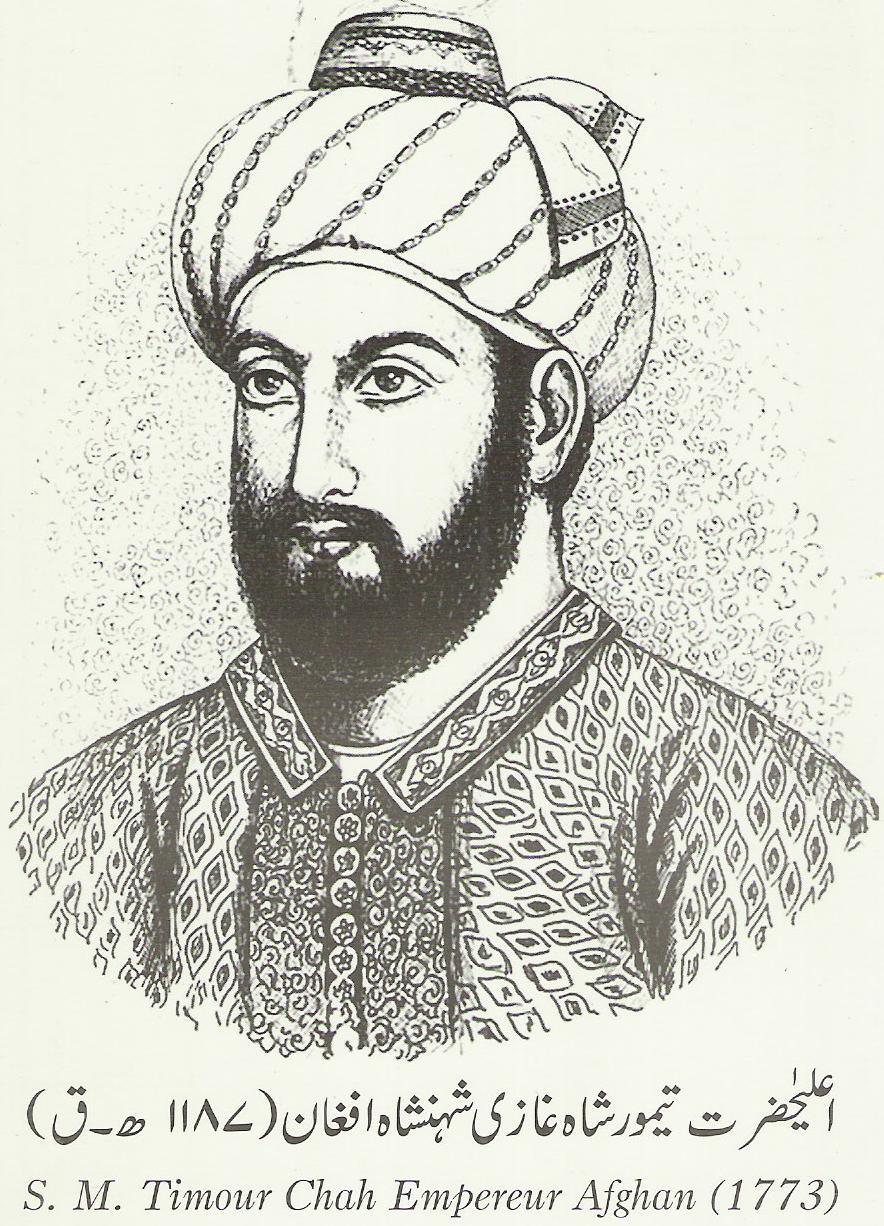
Timur Shah Durrani (born Timur Khan Abdali; December 1746 – 20 May 1793) was the second ruler of the Afghan Durrani Empire, from November 1772 until his death in 1793. An ethnic Pashtun, he was the second eldest son of Ahmad Shah Durrani.
Timur Shah was born in December 1746, in Mashhad.
He received the city of Sirhind as a wedding gift under his governorship, and was later given the title of Viceroy of Punjab, Kashmir and the Sirhind district in 1757 (when he was only 11 years old), by his father Ahmad Shah Durrani for one year, from May 1757 until April 1758. Ahmad Shah Durrani had immediately appointed Toryal Khan Afridi, the eldest son of his army's commander and his most trustworthy soldier, Awalmir Khan Afridi, to teach horseback riding and swordsmanship to Timur. Toryal Khan Afridi also had the responsibility for the safety and protection of Timur, so he continuously stayed with Timur in the royal palace.
Timur Shah ascended to the throne of the Durrani Empire in November 1772 with Shah Humayun giving up his throne.
Timur Shah went to Peshawar to spend the winter there.
Timur's army crossed the Indus at Attock on 15 January 1775. His forces, though smaller than those of the Sikhs, were supplemented by Faizullah Khan's contingent of some 25,000 men. At Attock, Sikh forces under Milkha Singh of Rawalpindi boldly advanced to intercept Timur Shah's army. In the ensuing skirmish, the Sikhs were defeated and withdrew towards the banks of the Chenab River. Despite this setback, their resistance delayed Timur's march and exposed the weakness of his position.
Fayz Allah Khan Khalil was a leading zamindar in the Peshawar region and a figure to whom rural communities frequently turned for leadership and counsel. He belonged to the Khalil tribe, a large Afghan tribal confederation residing around Peshawar and traditionally linked by lineage to the Durrani ruling elite. His influence among local tribes and landholders made him a significant regional power.
During the reign of Timur Shah Durrani, tensions persisted within the empire due to administrative centralization, tribal rivalries, and military pressures along the Indian frontier. Sikh forces were increasingly active in Punjab, creating widespread anxiety among Afghan officials and Muslim communities. Fayz Allah Khan exploited these concerns as a pretext to gather armed followers.
Hub AI
Timur Shah Durrani AI simulator
(@Timur Shah Durrani_simulator)
Timur Shah Durrani
Timur Shah Durrani (born Timur Khan Abdali; December 1746 – 20 May 1793) was the second ruler of the Afghan Durrani Empire, from November 1772 until his death in 1793. An ethnic Pashtun, he was the second eldest son of Ahmad Shah Durrani.
Timur Shah was born in December 1746, in Mashhad.
He received the city of Sirhind as a wedding gift under his governorship, and was later given the title of Viceroy of Punjab, Kashmir and the Sirhind district in 1757 (when he was only 11 years old), by his father Ahmad Shah Durrani for one year, from May 1757 until April 1758. Ahmad Shah Durrani had immediately appointed Toryal Khan Afridi, the eldest son of his army's commander and his most trustworthy soldier, Awalmir Khan Afridi, to teach horseback riding and swordsmanship to Timur. Toryal Khan Afridi also had the responsibility for the safety and protection of Timur, so he continuously stayed with Timur in the royal palace.
Timur Shah ascended to the throne of the Durrani Empire in November 1772 with Shah Humayun giving up his throne.
Timur Shah went to Peshawar to spend the winter there.
Timur's army crossed the Indus at Attock on 15 January 1775. His forces, though smaller than those of the Sikhs, were supplemented by Faizullah Khan's contingent of some 25,000 men. At Attock, Sikh forces under Milkha Singh of Rawalpindi boldly advanced to intercept Timur Shah's army. In the ensuing skirmish, the Sikhs were defeated and withdrew towards the banks of the Chenab River. Despite this setback, their resistance delayed Timur's march and exposed the weakness of his position.
Fayz Allah Khan Khalil was a leading zamindar in the Peshawar region and a figure to whom rural communities frequently turned for leadership and counsel. He belonged to the Khalil tribe, a large Afghan tribal confederation residing around Peshawar and traditionally linked by lineage to the Durrani ruling elite. His influence among local tribes and landholders made him a significant regional power.
During the reign of Timur Shah Durrani, tensions persisted within the empire due to administrative centralization, tribal rivalries, and military pressures along the Indian frontier. Sikh forces were increasingly active in Punjab, creating widespread anxiety among Afghan officials and Muslim communities. Fayz Allah Khan exploited these concerns as a pretext to gather armed followers.
Recent media