



Community hub
Recent from talks
Knowledge base stats:
Talk channels stats:
Members stats:
Tironian notes
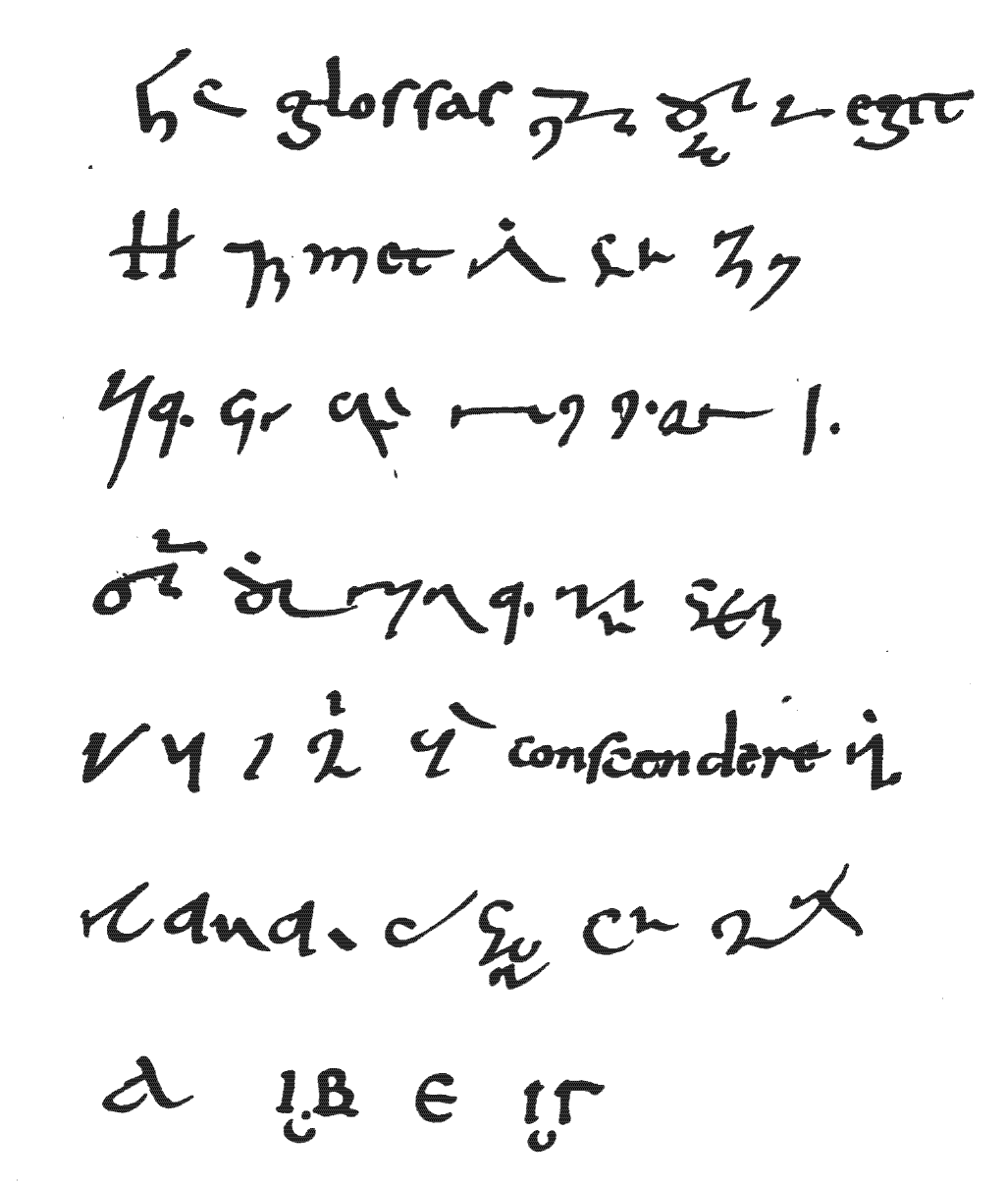
Tironian notes (Latin: notae Tironianae) are a form of thousands of signs that were formerly used in a system of shorthand (Tironian shorthand) dating from the 1st century BCE and named after Tiro, a personal secretary to Marcus Tullius Cicero, who is often credited as their inventor. Tiro's system consisted of about 4,000 signs, extended to 5,000 signs by others. During the medieval period, Tiro's notation system was taught in European monasteries and expanded to a total of about 13,000 signs. The use of Tironian notes lasted into the 17th century. A few Tironian signs are still used today.
Tironian notes can be themselves composites (ligatures) of simpler Tironian notes, the resulting compound being still shorter than the word it replaces. This accounts in part for the large number of attested Tironian notes, and for the wide variation in estimates of the total number of Tironian notes. Further, the "same" sign can have other variant forms, leading to the same issue.
Before Tironian shorthand became popularized, literature professor Anthony Di Renzo explains, "no true Latin shorthand existed." The only systematized form of abbreviation in Latin was used for legal notations (notae juris). This system, however, was deliberately abstruse and accessible only to people with specialized knowledge. Otherwise, shorthand was improvised for note-taking or writing personal communications, and some of these notations would not have been understood outside of closed circles. Some abbreviations of Latin words and phrases were commonly recognized, such as those of praenomina, and were typically used for inscriptions on monuments.
Scholars infer that Marcus Tullius Cicero (106–43 BC) recognized the need for a comprehensive, standard Latin notation system after learning about the Greek shorthand system. Cicero presumably delegated the task of creating such a system for Latin to his slave and personal secretary Tiro. Tiro's position required him to quickly and accurately transcribe dictations from Cicero, such as speeches, professional and personal correspondence, and business transactions, sometimes while walking through the forum or during fast-paced and contentious government and legal proceedings. Nicknamed "the father of stenography" by historians, Tiro developed a highly refined and accurate method that used Latin letters and abstract symbols to represent prepositions, truncated words, contractions, syllables, and inflections. According to Di Renzo: "Tiro then combined these mixed signs like notes in a score to record not just phrases, but, as Cicero marvels in a letter to Atticus, 'whole sentences.'" Tiro's highly refined and accurate method became the first standardized and widely adopted system of Latin shorthand. The system consisted of abbreviations and abstract symbols, which were either contrived by Tiro or borrowed from Greek shorthand.
Dio Cassius attributes the invention of shorthand to Maecenas, and states that he employed his freedman Aquila in teaching the system to numerous others. Isidore of Seville, however, details another version of the early history of the system, ascribing the invention of the art to Quintus Ennius, who he says invented 1100 marks (Latin: notae). Isidore states that Tiro brought the practice to Rome, but only used Tironian notes for prepositions. According to Plutarch in "Life of Cato the Younger", Cicero's secretaries established the first examples of the art of Latin shorthand:
This only of all Cato’s speeches, it is said, was preserved; for Cicero, the consul, had disposed, in various parts of the senate-house, several of the most expert and rapid writers, whom he had taught to make figures comprising numerous words in a few short strokes; as up to that time they had not used those we call short-hand writers, who then, as it is said, established the first example of the art.
There are no surviving copies of Tiro's original manual and code, so knowledge of it is based on biographical records and copies of Tironian tables from the medieval period. Historians typically date the invention of Tiro's system as 63 BC, when it was first used in official government business according to Plutarch in his biography of Cato the Younger in The Lives of the Noble Grecians and Romans. Before Tiro's system was institutionalized, he used it himself as he was developing and fine-tuning it, which historians suspect may have been as early as 75 BC, when Cicero held public office in Sicily and needed his notes and correspondences to be written in code to protect sensitive information he gathered about corruption among other government officials there.
There is evidence that Tiro taught his system to Cicero and his other scribes, and possibly to his friends and family, before it came into wide use. In "Life of Cato the Younger", Plutarch wrote that during Senate hearings in 65 BC relating to the first Catilinarian conspiracy, Tiro and Cicero's other secretaries were in the audience meticulously and rapidly transcribing Cicero's oration. On many of the oldest Tironian tables, lines from this speech were frequently used as examples, leading scholars to theorize it was originally transcribed using Tironian shorthand. Scholars also believe that in preparation for speeches, Tiro drafted outlines in shorthand that Cicero used as notes while speaking.
Hub AI
Tironian notes AI simulator
(@Tironian notes_simulator)
Tironian notes
Tironian notes (Latin: notae Tironianae) are a form of thousands of signs that were formerly used in a system of shorthand (Tironian shorthand) dating from the 1st century BCE and named after Tiro, a personal secretary to Marcus Tullius Cicero, who is often credited as their inventor. Tiro's system consisted of about 4,000 signs, extended to 5,000 signs by others. During the medieval period, Tiro's notation system was taught in European monasteries and expanded to a total of about 13,000 signs. The use of Tironian notes lasted into the 17th century. A few Tironian signs are still used today.
Tironian notes can be themselves composites (ligatures) of simpler Tironian notes, the resulting compound being still shorter than the word it replaces. This accounts in part for the large number of attested Tironian notes, and for the wide variation in estimates of the total number of Tironian notes. Further, the "same" sign can have other variant forms, leading to the same issue.
Before Tironian shorthand became popularized, literature professor Anthony Di Renzo explains, "no true Latin shorthand existed." The only systematized form of abbreviation in Latin was used for legal notations (notae juris). This system, however, was deliberately abstruse and accessible only to people with specialized knowledge. Otherwise, shorthand was improvised for note-taking or writing personal communications, and some of these notations would not have been understood outside of closed circles. Some abbreviations of Latin words and phrases were commonly recognized, such as those of praenomina, and were typically used for inscriptions on monuments.
Scholars infer that Marcus Tullius Cicero (106–43 BC) recognized the need for a comprehensive, standard Latin notation system after learning about the Greek shorthand system. Cicero presumably delegated the task of creating such a system for Latin to his slave and personal secretary Tiro. Tiro's position required him to quickly and accurately transcribe dictations from Cicero, such as speeches, professional and personal correspondence, and business transactions, sometimes while walking through the forum or during fast-paced and contentious government and legal proceedings. Nicknamed "the father of stenography" by historians, Tiro developed a highly refined and accurate method that used Latin letters and abstract symbols to represent prepositions, truncated words, contractions, syllables, and inflections. According to Di Renzo: "Tiro then combined these mixed signs like notes in a score to record not just phrases, but, as Cicero marvels in a letter to Atticus, 'whole sentences.'" Tiro's highly refined and accurate method became the first standardized and widely adopted system of Latin shorthand. The system consisted of abbreviations and abstract symbols, which were either contrived by Tiro or borrowed from Greek shorthand.
Dio Cassius attributes the invention of shorthand to Maecenas, and states that he employed his freedman Aquila in teaching the system to numerous others. Isidore of Seville, however, details another version of the early history of the system, ascribing the invention of the art to Quintus Ennius, who he says invented 1100 marks (Latin: notae). Isidore states that Tiro brought the practice to Rome, but only used Tironian notes for prepositions. According to Plutarch in "Life of Cato the Younger", Cicero's secretaries established the first examples of the art of Latin shorthand:
This only of all Cato’s speeches, it is said, was preserved; for Cicero, the consul, had disposed, in various parts of the senate-house, several of the most expert and rapid writers, whom he had taught to make figures comprising numerous words in a few short strokes; as up to that time they had not used those we call short-hand writers, who then, as it is said, established the first example of the art.
There are no surviving copies of Tiro's original manual and code, so knowledge of it is based on biographical records and copies of Tironian tables from the medieval period. Historians typically date the invention of Tiro's system as 63 BC, when it was first used in official government business according to Plutarch in his biography of Cato the Younger in The Lives of the Noble Grecians and Romans. Before Tiro's system was institutionalized, he used it himself as he was developing and fine-tuning it, which historians suspect may have been as early as 75 BC, when Cicero held public office in Sicily and needed his notes and correspondences to be written in code to protect sensitive information he gathered about corruption among other government officials there.
There is evidence that Tiro taught his system to Cicero and his other scribes, and possibly to his friends and family, before it came into wide use. In "Life of Cato the Younger", Plutarch wrote that during Senate hearings in 65 BC relating to the first Catilinarian conspiracy, Tiro and Cicero's other secretaries were in the audience meticulously and rapidly transcribing Cicero's oration. On many of the oldest Tironian tables, lines from this speech were frequently used as examples, leading scholars to theorize it was originally transcribed using Tironian shorthand. Scholars also believe that in preparation for speeches, Tiro drafted outlines in shorthand that Cicero used as notes while speaking.