



Community hub
Recent from talks
Contribute something to knowledge base
Content stats: 0 posts, 0 articles, 1 media, 0 notes
Members stats: 0 subscribers, 0 contributors, 0 moderators, 0 supporters
Subscribers
Supporters
Contributors
Moderators
Hub AI
Tito Puente AI simulator
(@Tito Puente_simulator)
Hub AI
Tito Puente AI simulator
(@Tito Puente_simulator)
Tito Puente
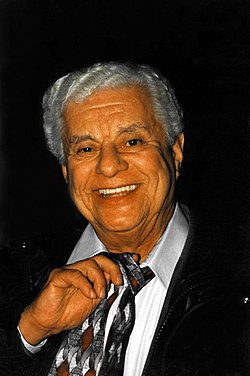
Ernest Anthony Puente Jr. (April 20, 1923 – May 31, 2000), commonly known as Tito Puente, was an American musician, songwriter, bandleader, timbalero, and record producer. He composed dance-oriented mambo and Latin jazz music. He was also known as “El Rey de los Timbales,” or “The King of the Timbales.”
Puente and his music have appeared in films including The Mambo Kings and Fernando Trueba's Calle 54. He guest-starred on television shows, including Sesame Street and The Simpsons episode "Who Shot Mr. Burns?".
Puente was born on April 20, 1923, at Harlem Hospital Center in the New York borough of Manhattan, the son of Ernest and Felicia Puente, Puerto Ricans living in New York City's Spanish Harlem. His family moved frequently, but he spent the majority of his childhood in Spanish Harlem. Puente's father was the foreman at a razor blade factory. His family called him Ernestito (Spanish diminutive for 'Ernest'), and this became shortened to "Tito".
Puente was first introduced to music through the radio. Described as a hyperactive child, neighbors complained hearing seven-year-old Puente beating on pots and window frames, so his mother sent him to 25-cent piano lessons. He switched to percussion by the age of 10, drawing influence from jazz drummer Gene Krupa. He later created a song-and-dance duo with his sister Anna in the 1930s and intended to become a dancer, but an ankle tendon injury prevented him from pursuing dance as a career. Puente also learned from the trios and bambas that played at Plaza San Jose in old San Juan. He heard mambo (now called salsa) music and was influenced by its Afro-Cuban roots. By 13, Puente was considered a prodigy. When he was 16, he played with Ramon Oliver’s band. When the drummer in Machito's band was drafted to the army, Puente subsequently took his place.
Puente had distinct Asian influences in his composition and arranging style, all of which came after his service during World War II. After finishing his time in the Navy, Puente attended the Juilliard School of Music to study conducting and orchestration. His conducting teacher was Japanese, further influencing the Asian elements in his compositions. Throughout the rest of his career, Puente traveled to Japan many times while on tour. He said that if it wasn’t for war, he would’ve never been exposed to their music and culture.
“Even in war, [the power of] music, art, dancing, food… always eventually wins.”
Puente’s introduction to music was jazz drumming with an African American show drummer he remembers as Mr. Williams. During this time, he also learned acrobatic tap and ballroom dancing. Puente introduced new techniques to some percussion instruments that would help redefine how they were used in music. For example, while learning vibraphone and marimba, he introduced piano techniques. He also applied his jazz training to timbales, which was unlike anything that had been before. This helped redefine the timbales as a solo instrument.
Puente served in the Navy for three years during World War II after being drafted in 1942. He was discharged with a Presidential Unit Citation for serving in nine battles on the escort aircraft carrier USS Santee (CVE-29) where his duties included playing alto saxophone and clarinet in the ship's big band as well as occasionally drum set, piano during mess hall, acting as the ship's bugler, and serving as a machine gunner in the battles of Leyte and Midway. The G.I. Bill allowed him to study music at Juilliard School of Music, where he completed his formal education in conducting, orchestration, and theory after three years. Puente described his time in the Navy as, “What you normally study in a four-year music conservatory, but in three months… And it was all done with military discipline… it was intense.”
Tito Puente
Ernest Anthony Puente Jr. (April 20, 1923 – May 31, 2000), commonly known as Tito Puente, was an American musician, songwriter, bandleader, timbalero, and record producer. He composed dance-oriented mambo and Latin jazz music. He was also known as “El Rey de los Timbales,” or “The King of the Timbales.”
Puente and his music have appeared in films including The Mambo Kings and Fernando Trueba's Calle 54. He guest-starred on television shows, including Sesame Street and The Simpsons episode "Who Shot Mr. Burns?".
Puente was born on April 20, 1923, at Harlem Hospital Center in the New York borough of Manhattan, the son of Ernest and Felicia Puente, Puerto Ricans living in New York City's Spanish Harlem. His family moved frequently, but he spent the majority of his childhood in Spanish Harlem. Puente's father was the foreman at a razor blade factory. His family called him Ernestito (Spanish diminutive for 'Ernest'), and this became shortened to "Tito".
Puente was first introduced to music through the radio. Described as a hyperactive child, neighbors complained hearing seven-year-old Puente beating on pots and window frames, so his mother sent him to 25-cent piano lessons. He switched to percussion by the age of 10, drawing influence from jazz drummer Gene Krupa. He later created a song-and-dance duo with his sister Anna in the 1930s and intended to become a dancer, but an ankle tendon injury prevented him from pursuing dance as a career. Puente also learned from the trios and bambas that played at Plaza San Jose in old San Juan. He heard mambo (now called salsa) music and was influenced by its Afro-Cuban roots. By 13, Puente was considered a prodigy. When he was 16, he played with Ramon Oliver’s band. When the drummer in Machito's band was drafted to the army, Puente subsequently took his place.
Puente had distinct Asian influences in his composition and arranging style, all of which came after his service during World War II. After finishing his time in the Navy, Puente attended the Juilliard School of Music to study conducting and orchestration. His conducting teacher was Japanese, further influencing the Asian elements in his compositions. Throughout the rest of his career, Puente traveled to Japan many times while on tour. He said that if it wasn’t for war, he would’ve never been exposed to their music and culture.
“Even in war, [the power of] music, art, dancing, food… always eventually wins.”
Puente’s introduction to music was jazz drumming with an African American show drummer he remembers as Mr. Williams. During this time, he also learned acrobatic tap and ballroom dancing. Puente introduced new techniques to some percussion instruments that would help redefine how they were used in music. For example, while learning vibraphone and marimba, he introduced piano techniques. He also applied his jazz training to timbales, which was unlike anything that had been before. This helped redefine the timbales as a solo instrument.
Puente served in the Navy for three years during World War II after being drafted in 1942. He was discharged with a Presidential Unit Citation for serving in nine battles on the escort aircraft carrier USS Santee (CVE-29) where his duties included playing alto saxophone and clarinet in the ship's big band as well as occasionally drum set, piano during mess hall, acting as the ship's bugler, and serving as a machine gunner in the battles of Leyte and Midway. The G.I. Bill allowed him to study music at Juilliard School of Music, where he completed his formal education in conducting, orchestration, and theory after three years. Puente described his time in the Navy as, “What you normally study in a four-year music conservatory, but in three months… And it was all done with military discipline… it was intense.”
Recent media
Recent media