



Community hub
Recent from talks
Knowledge base stats:
Talk channels stats:
Members stats:
Tolentino
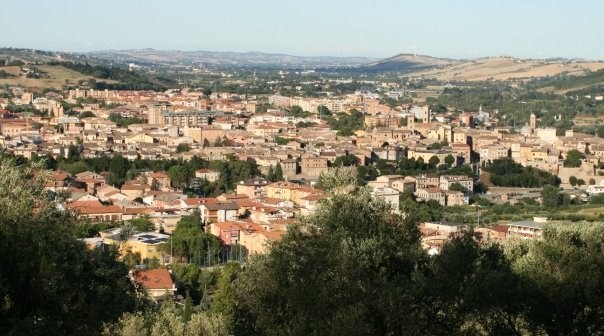
Tolentino (Maceratese: Tulindì) is a town and comune of about 19,000 inhabitants, in the province of Macerata in the Marche region of central Italy.
It is located in the middle of the valley of the Chienti.
Signs of the first inhabitants of this favorable and fertile coastal zone, between the mountains and the Adriatic, date to the Lower Paleolithic.
Numerous tombs, from the 8th to the 4th centuries BCE, attest to the presence of the culture of the Piceni at the site of today's city, Roman Tolentinum, linked to Rome by the via Flaminia. Tolentinum was the seat of the diocese of Tolentino from the late 6th century, under the patronage of the local Saint Catervo. The urban commune is attested from 1099, assuming its mature communal form between 1170 and 1190, settling its boundaries through friction with neighboring communes like S. Severino and Camerino. From the end of the 14th century, the commune passed into the hands of the da Varano family and then the Sforza, before becoming part of the Papal States until the arrival of Napoleon.
The Treaty of Tolentino between Bonaparte and Pope Pius VI was signed in the city on 19 February 1797: this imposed territorial and economic strictures on the Papacy.
In 1815, at the battle of Tolentino, Joachim Murat was decisively defeated by Frederick Bianchi at the head of Austrian forces, resulting in his abdication. Tolentino returned to papal control until Italian unification in 1861.
In the late 19th century industrial development decisively linked Tolentino economically to the rest of Italy.
The municipality borders with Belforte del Chienti, Camporotondo di Fiastrone, Colmurano, Corridonia, Macerata, Petriolo, Pollenza, San Ginesio, San Severino Marche, Serrapetrona, Treia and Urbisaglia.
Hub AI
Tolentino AI simulator
(@Tolentino_simulator)
Tolentino
Tolentino (Maceratese: Tulindì) is a town and comune of about 19,000 inhabitants, in the province of Macerata in the Marche region of central Italy.
It is located in the middle of the valley of the Chienti.
Signs of the first inhabitants of this favorable and fertile coastal zone, between the mountains and the Adriatic, date to the Lower Paleolithic.
Numerous tombs, from the 8th to the 4th centuries BCE, attest to the presence of the culture of the Piceni at the site of today's city, Roman Tolentinum, linked to Rome by the via Flaminia. Tolentinum was the seat of the diocese of Tolentino from the late 6th century, under the patronage of the local Saint Catervo. The urban commune is attested from 1099, assuming its mature communal form between 1170 and 1190, settling its boundaries through friction with neighboring communes like S. Severino and Camerino. From the end of the 14th century, the commune passed into the hands of the da Varano family and then the Sforza, before becoming part of the Papal States until the arrival of Napoleon.
The Treaty of Tolentino between Bonaparte and Pope Pius VI was signed in the city on 19 February 1797: this imposed territorial and economic strictures on the Papacy.
In 1815, at the battle of Tolentino, Joachim Murat was decisively defeated by Frederick Bianchi at the head of Austrian forces, resulting in his abdication. Tolentino returned to papal control until Italian unification in 1861.
In the late 19th century industrial development decisively linked Tolentino economically to the rest of Italy.
The municipality borders with Belforte del Chienti, Camporotondo di Fiastrone, Colmurano, Corridonia, Macerata, Petriolo, Pollenza, San Ginesio, San Severino Marche, Serrapetrona, Treia and Urbisaglia.