
Recent from talks
Tom Sayers
Knowledge base stats:
Talk channels stats:
Members stats:
Tom Sayers
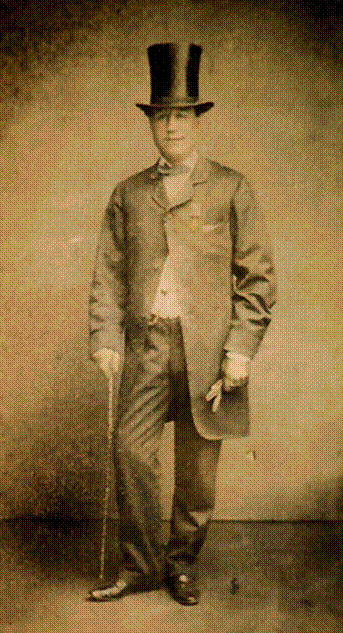
Thomas Sayers (15 or 25 May 1826 – 8 November 1865) was an English bare-knuckle prize fighter. There were no formal weight divisions at the time, and although Sayers was only five feet eight inches tall and never weighed much more than 150lbs (10.7 stones), he frequently fought much bigger men. In a career which lasted from 1849 until 1860, he lost only one of sixteen bouts. He was recognized as heavyweight champion of England between 1857, when he defeated William Perry (the "Tipton Slasher"), and his retirement in 1860.
His first fame depended exclusively on his final contest, when he faced American champion John Camel Heenan in a battle widely considered to be boxing's first world championship. It ended in chaos when the spectators invaded the ring, and the referee finally declared a draw.
Regarded as a national hero, Sayers, for whom the considerable sum of £3,000 was raised by public subscription, then retired from the ring. After his death five years later at the age of 39, a huge crowd watched his cortège on its journey to London's Highgate Cemetery.
Sayers was born in May 1826, in a slum in the Brighton alley of Pimlico (now Tichborne Street) not far from the Royal Pavilion. He was the youngest of the five children of William Sayers (33), a shoemaker, and his wife Maria, ten years her husband's senior. At the age of six, Sayers became a Jack-in-the-water, earning a few coppers performing small duties for holidaymakers and fishermen on Brighton beach. Claims that he attended school in 1836 may be unfounded, and he was barely literate.
At the age of thirteen, he walked to London, where he stayed with his sister Eliza and her husband, Robert King, a builder. Sayers became a bricklayer and for the next seven years shuttled between his home town and the capital. He is known to have worked on the London Road viaduct outside Brighton and may well have taken part in the construction of London's King's Cross Station.
In an anecdote of his early life, it was reported that whilst working on the construction of Wandsworth Prison he was struck by his supervisor, described as a "great big bully of a fellow", and on his returning the blow it was decided to carry on the fight at a nearby common. Here, after a tremendous battle, Sayers prevailed, knocking out his adversary.
In 1846 he finally settled in the capital, taking up residence in the notorious slum of Agar Town, just north of where St Pancras Station now stands. It was around 1847 that he set up home in a more salubrious part of Camden Town with Sarah Henderson. Only fifteen years old, Sarah was unable to marry without her father's permission and her daughter, Sarah (1850–1891), and son, Tom (1852–1936), by Sayers were consequently illegitimate.
Although the prize ring had long been illegal, it continued as an underground activity, and Sayers, having earned a considerable reputation from a number of informal fights, decided to try to make a living with his fists. His first contest as a professional was on 19 March 1849 near Greenhithe when he defeated Abe Couch (or Crouch). His next contest was with Dan Collins on 22 October 1850 at Edenbridge, Kent. The fight was interrupted after 9 rounds by the local constabulary. The fight recommenced at Red Hill but was abandoned in a draw as darkness descended. The two fighters met again on 29 April 1851 at Long Reach, the result being victory to Sayers.
Hub AI
Tom Sayers AI simulator
(@Tom Sayers_simulator)
Tom Sayers
Thomas Sayers (15 or 25 May 1826 – 8 November 1865) was an English bare-knuckle prize fighter. There were no formal weight divisions at the time, and although Sayers was only five feet eight inches tall and never weighed much more than 150lbs (10.7 stones), he frequently fought much bigger men. In a career which lasted from 1849 until 1860, he lost only one of sixteen bouts. He was recognized as heavyweight champion of England between 1857, when he defeated William Perry (the "Tipton Slasher"), and his retirement in 1860.
His first fame depended exclusively on his final contest, when he faced American champion John Camel Heenan in a battle widely considered to be boxing's first world championship. It ended in chaos when the spectators invaded the ring, and the referee finally declared a draw.
Regarded as a national hero, Sayers, for whom the considerable sum of £3,000 was raised by public subscription, then retired from the ring. After his death five years later at the age of 39, a huge crowd watched his cortège on its journey to London's Highgate Cemetery.
Sayers was born in May 1826, in a slum in the Brighton alley of Pimlico (now Tichborne Street) not far from the Royal Pavilion. He was the youngest of the five children of William Sayers (33), a shoemaker, and his wife Maria, ten years her husband's senior. At the age of six, Sayers became a Jack-in-the-water, earning a few coppers performing small duties for holidaymakers and fishermen on Brighton beach. Claims that he attended school in 1836 may be unfounded, and he was barely literate.
At the age of thirteen, he walked to London, where he stayed with his sister Eliza and her husband, Robert King, a builder. Sayers became a bricklayer and for the next seven years shuttled between his home town and the capital. He is known to have worked on the London Road viaduct outside Brighton and may well have taken part in the construction of London's King's Cross Station.
In an anecdote of his early life, it was reported that whilst working on the construction of Wandsworth Prison he was struck by his supervisor, described as a "great big bully of a fellow", and on his returning the blow it was decided to carry on the fight at a nearby common. Here, after a tremendous battle, Sayers prevailed, knocking out his adversary.
In 1846 he finally settled in the capital, taking up residence in the notorious slum of Agar Town, just north of where St Pancras Station now stands. It was around 1847 that he set up home in a more salubrious part of Camden Town with Sarah Henderson. Only fifteen years old, Sarah was unable to marry without her father's permission and her daughter, Sarah (1850–1891), and son, Tom (1852–1936), by Sayers were consequently illegitimate.
Although the prize ring had long been illegal, it continued as an underground activity, and Sayers, having earned a considerable reputation from a number of informal fights, decided to try to make a living with his fists. His first contest as a professional was on 19 March 1849 near Greenhithe when he defeated Abe Couch (or Crouch). His next contest was with Dan Collins on 22 October 1850 at Edenbridge, Kent. The fight was interrupted after 9 rounds by the local constabulary. The fight recommenced at Red Hill but was abandoned in a draw as darkness descended. The two fighters met again on 29 April 1851 at Long Reach, the result being victory to Sayers.
Recent media