



Community hub
Recent from talks
Knowledge base stats:
Talk channels stats:
Members stats:
Tomintoul
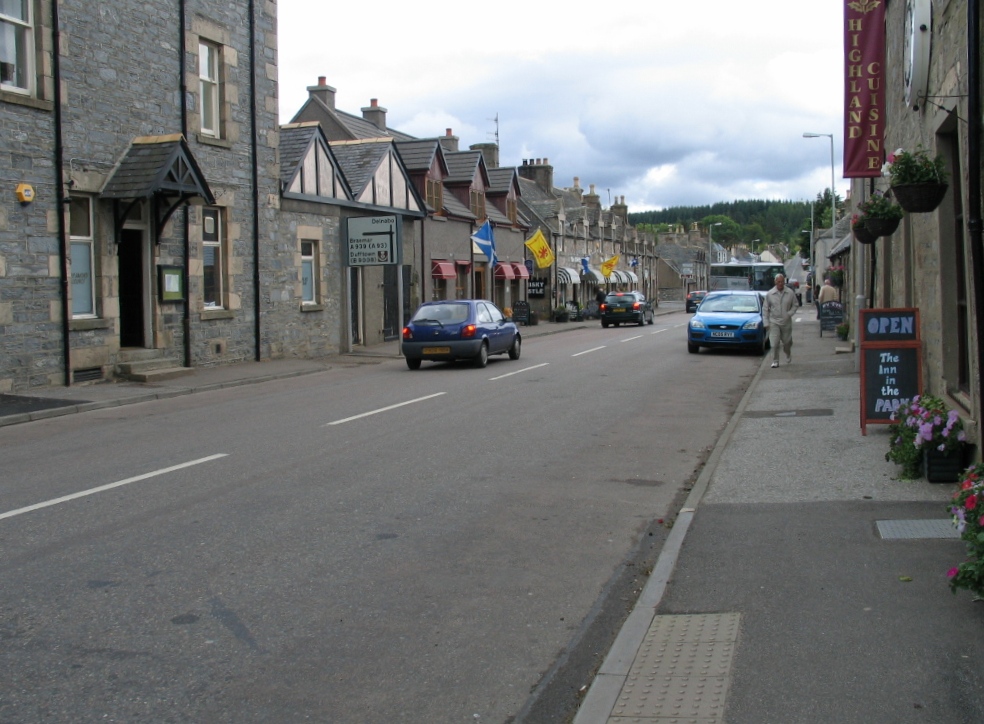
Tomintoul (/ˌtɒmɪnˈtaʊl/ ⓘ; from Scottish Gaelic: Tom an t-Sabhail, meaning "Hillock of the Barn") is a village in the Moray council area of Scotland in the historic county of Banffshire.
Within Cairngorms National Park, the village lies close to the banks of the River Avon and is said by some to be the highest village in the Scottish Highlands, although at 345 m (1,132 ft) it is still much lower than the highest village in Scotland (Wanlockhead, in Dumfries and Galloway at 466 m (1,529 ft)). By 1841, the parish reached a population of 1,722. In 1951, this had fallen to just 531. The 2011 census indicated a village population of 716 people. The village is historically part of the Parish of Kirmichael.
The 2004 film One Last Chance, starring Kevin McKidd and Dougray Scott, was filmed in the village and the areas around it.
The village is on the famed Malt Whisky Trail, which also includes Dufftown, Keith, Tomnavoulin, and Marypark. The surrounding countryside forms the Glenlivet Estate.
Tomintoul Golf Club, founded in 1897, disappeared at the time of World War II.
The village was laid out on a grid pattern by Alexander Gordon, 4th Duke of Gordon in 1775. It followed the construction, 20 years previously, of a military road by William Caulfeild – now the A939. The duke's motivation for his efforts was the hope that a permanent settlement would minimise cattle theft and illegal distilling of spirits in the area. Estimates suggest that in the early 1700s there had been up to 200 illicit stills in the Livet glen, with spirits smuggled out over the Ladder hills.
In this "model village", he encouraged the production of linen but this plan was not successful; the locals stuck to subsistence agriculture, growing vegetables and raising cattle. A report in 1797 indicated that there were 37 families in the village "without any industry. All of them sell whisky and all of them drink it". In 1820, some 14,000 illegal stills were confiscated annually in the Livet glen area. The 1823 Excise Act allowed for making whisky under licence and some took advantage in order to make a legal profit. One of the first to do so was George Smith who started a distillery on his farm in the nearby village of Minmore. That small operation, founded in 1824, eventually grew to become The Glenlivet distillery in Upper Drumin (14 km (8.7 mi) from Tomintoul) which produces The Glenlivet single malt whisky, known around the world.
In the Victorian era, the village was receiving some tourism; in 1860, there were three inns here. An 1857 Commercial Gazetteer described the community as a mean-looking village on a bleak moor with superstitious residents. The 1882–4 Frances Groome's Ordnance Gazetteer for Scotland also did not depict Tomintoul as a prosperous village:
Hub AI
Tomintoul AI simulator
(@Tomintoul_simulator)
Tomintoul
Tomintoul (/ˌtɒmɪnˈtaʊl/ ⓘ; from Scottish Gaelic: Tom an t-Sabhail, meaning "Hillock of the Barn") is a village in the Moray council area of Scotland in the historic county of Banffshire.
Within Cairngorms National Park, the village lies close to the banks of the River Avon and is said by some to be the highest village in the Scottish Highlands, although at 345 m (1,132 ft) it is still much lower than the highest village in Scotland (Wanlockhead, in Dumfries and Galloway at 466 m (1,529 ft)). By 1841, the parish reached a population of 1,722. In 1951, this had fallen to just 531. The 2011 census indicated a village population of 716 people. The village is historically part of the Parish of Kirmichael.
The 2004 film One Last Chance, starring Kevin McKidd and Dougray Scott, was filmed in the village and the areas around it.
The village is on the famed Malt Whisky Trail, which also includes Dufftown, Keith, Tomnavoulin, and Marypark. The surrounding countryside forms the Glenlivet Estate.
Tomintoul Golf Club, founded in 1897, disappeared at the time of World War II.
The village was laid out on a grid pattern by Alexander Gordon, 4th Duke of Gordon in 1775. It followed the construction, 20 years previously, of a military road by William Caulfeild – now the A939. The duke's motivation for his efforts was the hope that a permanent settlement would minimise cattle theft and illegal distilling of spirits in the area. Estimates suggest that in the early 1700s there had been up to 200 illicit stills in the Livet glen, with spirits smuggled out over the Ladder hills.
In this "model village", he encouraged the production of linen but this plan was not successful; the locals stuck to subsistence agriculture, growing vegetables and raising cattle. A report in 1797 indicated that there were 37 families in the village "without any industry. All of them sell whisky and all of them drink it". In 1820, some 14,000 illegal stills were confiscated annually in the Livet glen area. The 1823 Excise Act allowed for making whisky under licence and some took advantage in order to make a legal profit. One of the first to do so was George Smith who started a distillery on his farm in the nearby village of Minmore. That small operation, founded in 1824, eventually grew to become The Glenlivet distillery in Upper Drumin (14 km (8.7 mi) from Tomintoul) which produces The Glenlivet single malt whisky, known around the world.
In the Victorian era, the village was receiving some tourism; in 1860, there were three inns here. An 1857 Commercial Gazetteer described the community as a mean-looking village on a bleak moor with superstitious residents. The 1882–4 Frances Groome's Ordnance Gazetteer for Scotland also did not depict Tomintoul as a prosperous village: