


Community hub
Recent from talks
Contribute something
Nothing was collected or created yet.
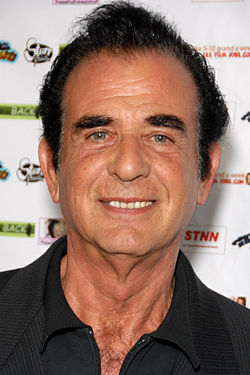
Tony Tarantino
View on Wikipedia
Raymond Anthony Tarantino (/ˌtærənˈtiːnoʊ/ TARR-ən-TEE-noh; July 4, 1940 – December 8, 2023) was an American actor and film producer. He was best known as the father of filmmaker Quentin Tarantino.
Key Information


Biography
[edit]Tarantino was born in New York City on July 4, 1940, the son of Italian-American parents Elizabeth Jean (née Salvaggio) and Dominic James Tarantino.[1][2][3]
Tarantino met Connie McHugh during her trip to Los Angeles; the two were married before they had their only child together, Quentin Tarantino (born 1963), who later became a filmmaker.[4] Tarantino left the family before his son was born.[5] Quentin said in a 2010 interview, "I never knew my father. That's the thing. I never knew him. He wanted to be an actor. Now he's an actor only because he has my last name. But he was never part of my life. I didn't know him. I've never met him."[6] In October 2015, the two were at odds when Quentin received backlash from police unions after speaking at an anti-police brutality rally in New York and said, "I have to call the murderers the murderers." The elder Tarantino responded that he had relatives in the police and that what his son had said was "dead wrong".[7]
Tarantino revealed in 2017 that, when he was 20 years old in 1960, talent agent Henry Willson offered him acting opportunities and a lavish lifestyle in exchange for sex.[5] He says he punched Willson in the face, knocking him to the ground, after which Willson said Tarantino would never work in Hollywood or New York again as an actor.[5] He stated he was thereafter quickly fired from his role on the western television series Dick Powell's Zane Grey Theatre,[5] and used the stage name "Tony Maro" to book several acting jobs with Paramount as an extra, but was fired within two hours once his true identity was discovered.[5] In his later years, he produced films such as Prism[7] and Underbelly Blues.[8]
Tarantino died in Los Angeles on December 8, 2023, at the age of 83.[9]
Filmography
[edit]As producer
[edit]| Year | Title |
|---|---|
| 2011 | Underbelly Blues |
| 2012 | Mediterranean Blue |
As director
[edit]| Year | Title |
|---|---|
| 2003 | Blood Money |
As actor
[edit]| Year | Title |
|---|---|
| 1999 | It's the Rage |
| Family Tree | |
| Holy Hollywood | |
| 2003 | Blood Money |
| 2008 | Harvest Moon |
| 2011 | Underbelly Blues |
| 2012 | Mediterranean Blue |
References
[edit]- ^ "Le origini meridionali di Quentin Tarantino, genio indiscusso del cinema contemporaneo". May 27, 2020.
- ^ "Tarantino Productions". www.tarantinoproductions.com.
- ^ "Quentin Tarantino e le sue origini italiane: Ecco di dov'è la sua famiglia".
- ^ "Tony Tarantino". Movies & TV Dept. The New York Times. 2013. Archived from the original on March 7, 2013.
- ^ a b c d e Sblendorio, Peter (November 11, 2017). "Quentin Tarantino's dad Tony claims Hollywood agent tried to sign him in exchange for sex". New York Daily News.
- ^ Secher, Benjamin (February 8, 2010). "Quentin Tarantino interview: 'All my movies are achingly personal'". The Daily Telegraph. Retrieved May 2, 2017.
- ^ a b Pulver, Andrew (January 27, 2016). "Tarantino's father to donate to police: 'Quentin's ignorance really upset me'". The Guardian.
- ^ Lanier, Hunter (April 1, 2018). "Underbelly Blues". Film Threat.
- ^ "Tony Tarantino". Legacy.com. Retrieved December 24, 2023.
External links
[edit]Tony Tarantino
View on GrokipediaEarly Life
Family Background and Upbringing
Tony Tarantino was born on July 4, 1940, in Queens, New York City, to parents of Italian-Sicilian descent, Elizabeth Jean Salvaggio and Dominic James Tarantino.[7] [8] He had one sibling, a sister named Dianne Tarantino.[8] Tarantino's upbringing in the Italian-American community of Queens exposed him to a bilingual household environment, contributing to his fluency in English, Italian, and French.[5] [7] This cultural heritage, rooted in his parents' Sicilian origins, shaped his early formative years amid New York's diverse urban landscape prior to his family's eventual relocation westward.[7]Military Service
Tony Tarantino served in the United States Marine Corps following his early life in Queens, New York.[9][8] Born on July 4, 1940, his enlistment likely occurred in the late 1950s or early 1960s, aligning with Cold War-era commitments amid post-World War II geopolitical strains, though specific dates and deployments remain undocumented in public records.[9][8] As a Marine veteran, Tarantino's experience emphasized discipline and service, qualities that underpinned his later self-presentation as a patriot.[8][10] Obituaries and contemporary profiles consistently pair his veteran status with patriotic descriptors, portraying a man whose military background fostered enduring national loyalty.[8][10] While no detailed records specify combat roles or aviation training within the Corps, his service preceded civilian achievements like obtaining a pilot's license, reflecting skills in precision and resilience honed through military rigor.[8][9]Entertainment Career
Early Hollywood Experiences and Setbacks
In 1960, at the age of 20, Tony Tarantino secured a role on the CBS Western television series Dick Powell's Zane Grey Theatre, marking one of his initial professional acting opportunities in Hollywood. However, he was quickly dismissed from the production after rejecting advances from talent agent Henry Willson, who conditioned a lucrative contract and additional career prospects on sexual compliance—a practice emblematic of the era's predatory "casting couch" dynamics in the industry.[11] Undeterred by the termination, Tarantino adopted the pseudonym "Tony Maro" to secure uncredited extra positions at Paramount Pictures, enabling him to persist in the field amid blacklisting risks associated with defying influential figures like Willson. This adaptation highlighted his determination to circumvent systemic barriers without yielding to coercive norms, as he later recounted in a 2017 interview amid broader revelations of Hollywood misconduct.[11]Acting Roles
Tony Tarantino began his acting career in the early 1960s following graduation from the Pasadena Playhouse drama school. His initial screen work consisted primarily of uncredited extra roles, including appearances in the MGM musical comedy Where the Boys Are (1960) and a short-lived engagement on the CBS Western anthology series Dick Powell's Zane Grey Theatre, where he was dismissed after using the stage name Tony Maro for bookings but failing to meet production standards.[1][12] Tarantino's subsequent acting pursuits yielded sporadic credits over four decades, largely confined to supporting parts in independent films and low-budget features, reflecting a career marked by persistence amid limited commercial success. In the late 1990s, he portrayed Dr. Stevens in the drama Family Tree (1999) and appeared in the ensemble cast of the crime thriller It's the Rage (also known as All the Rage, 1999).[1][13] Key roles in the 2000s included Sal, a mobster figure, in the action film Blood Money (2003); Dick Richards in the Hollywood satire Holy Hollywood (2004); and an unspecified character in Harvest Moon (2008). Later credits encompassed Vince in the short film Folly (2010), a role in Underbelly Blues (2011), and Tony Alamo in the drama Mediterranean Blue (2012).[1][14][15] His final on-screen appearance was as a guest on the talk show BSA Live (2020).[1] These performances positioned Tarantino as a character actor in niche, often self-produced or fringe projects, distinct from mainstream cinema and underscoring a trajectory of modest visibility without leading roles or widespread recognition.[1][9]Producing and Directing Work
Tony Tarantino co-directed the independent thriller Blood Money in 2003 alongside James E. Meyer, marking one of his primary directorial efforts in low-budget filmmaking.[14] The project highlighted his involvement in hands-on production outside major studio systems.[1] In producing, Tarantino executive produced Underbelly Blues in 2011 through his company, Tarantino Productions LLC, focusing on independent features with limited distribution.[16] [17] He also served as associate producer for Mediterranean Blue in 2012, a Spanish-language thriller involving international collaboration.[18] Additional producing credits include Holy Hollywood in 2004 and planned projects like Prism.[1] Beyond core credits, Tarantino pursued screenwriting and music composition for his endeavors, alongside work in music videos and documentaries, underscoring his entrepreneurial approach to entertainment production.[17] These efforts centered on self-financed, non-mainstream ventures rather than Hollywood blockbusters.[1]Filmography
As Actor
- Where the Boys Are (1960, uncredited minor role).[1][13]
- Family Tree (1999, Dr. Stevens).[13][6]
- All the Rage (1999).[1][13]
- Blood Money (2003, Sal).[1]
- Holy Hollywood (2004, Dick Richards).[1][19]
- BSA Live (2020, guest appearance).[1][13]
As Producer
Tony Tarantino founded Tarantino Productions LLC, through which he took on production roles in a small number of independent films during the 2010s, emphasizing niche themes like blues music narratives and Mediterranean cultural settings.[1] These projects typically involved modest budgets characteristic of low-tier independent cinema, with Tarantino handling executive oversight or associate duties rather than day-to-day hands-on production.[1] His output remained limited, reflecting selective involvement in co-productions aligned with personal interests in music-infused storytelling and regional European motifs.[1] Key production credits include:- Underbelly Blues (2011), executive producer; a blues-themed independent feature exploring underground music scenes.
- Mediterranean Blue (2012), associate producer; a drama incorporating Mediterranean locales and cultural elements.
As Director
Tony Tarantino's directorial output was limited to small-scale independent projects, reflecting his hands-on approach in low-budget filmmaking informed by his acting experience. His primary feature credit came as co-director of the 2003 thriller Blood Money alongside James E. Meyer, a film he also produced and starred in as the lead character tasked with defusing a bomb amid monetary stakes.[14] The production, indicative of indie constraints with no major studio backing, garnered poor reception, holding a 2.3/10 rating on IMDb from 1,037 user votes.[20] In 2004, Tarantino co-directed the short film Holy Hollywood with Dick Richards, which earned a selection by the Valley Film Festival committee, highlighting modest recognition within niche circuits.[21][15] No further directorial works, including uncredited efforts or additional shorts, are documented in available records. These endeavors underscore Tarantino's pursuit of creative control in constrained environments, though critical and audience response remained limited.[1]