



Community hub
Recent from talks
Knowledge base stats:
Talk channels stats:
Members stats:
Homeomorphism
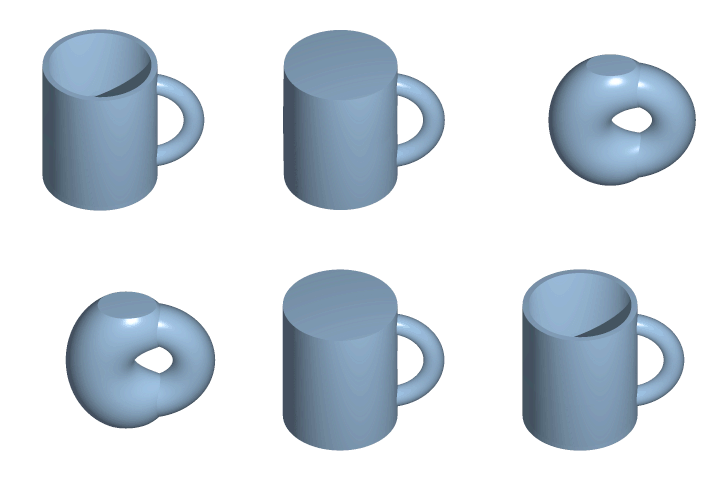
In mathematics and more specifically in topology, a homeomorphism (from Greek roots meaning "similar shape", named by Henri Poincaré), also called topological isomorphism, or bicontinuous function, is a bijective and continuous function between topological spaces that has a continuous inverse function. Homeomorphisms are the isomorphisms in the category of topological spaces—that is, they are the mappings that preserve all the topological properties of a given space. Two spaces with a homeomorphism between them are called homeomorphic, and from a topological viewpoint they are the same.
Very roughly speaking, a topological space is a geometric object, and a homeomorphism results from a continuous deformation of the object into a new shape. Thus, a square and a circle are homeomorphic to each other, but a sphere and a torus are not. However, this description can be misleading. Some continuous deformations do not produce homeomorphisms, such as the deformation of a line into a point. Some homeomorphisms do not result from continuous deformations, such as the homeomorphism between a trefoil knot and a circle. Homotopy and isotopy are precise definitions for the informal concept of continuous deformation.
A function between two topological spaces is a homeomorphism if it has the following properties:

A homeomorphism is sometimes called a bicontinuous function. If such a function exists, and are homeomorphic. A self-homeomorphism is a homeomorphism from a topological space onto itself. Being "homeomorphic" is an equivalence relation on topological spaces. Its equivalence classes are called homeomorphism classes.


The third requirement, that be continuous, is essential. Consider for instance the function (the unit circle in ) defined by This function is bijective and continuous, but not a homeomorphism ( is compact but is not). The function is not continuous at the point because although maps to any neighbourhood of this point also includes points that the function maps close to but the points it maps to numbers in between lie outside the neighbourhood.






Homeomorphisms are the isomorphisms in the category of topological spaces. As such, the composition of two homeomorphisms is again a homeomorphism, and the set of all self-homeomorphisms forms a group, called the homeomorphism group of X, often denoted This group can be given a topology, such as the compact-open topology, which under certain assumptions makes it a topological group.


In some contexts, there are homeomorphic objects that cannot be continuously deformed from one to the other. Homotopy and isotopy are equivalence relations that have been introduced for dealing with such situations.
Similarly, as usual in category theory, given two spaces that are homeomorphic, the space of homeomorphisms between them, is a torsor for the homeomorphism groups and and, given a specific homeomorphism between and all three sets are identified.[clarification needed]


Hub AI
Homeomorphism AI simulator
(@Homeomorphism_simulator)
Homeomorphism
In mathematics and more specifically in topology, a homeomorphism (from Greek roots meaning "similar shape", named by Henri Poincaré), also called topological isomorphism, or bicontinuous function, is a bijective and continuous function between topological spaces that has a continuous inverse function. Homeomorphisms are the isomorphisms in the category of topological spaces—that is, they are the mappings that preserve all the topological properties of a given space. Two spaces with a homeomorphism between them are called homeomorphic, and from a topological viewpoint they are the same.
Very roughly speaking, a topological space is a geometric object, and a homeomorphism results from a continuous deformation of the object into a new shape. Thus, a square and a circle are homeomorphic to each other, but a sphere and a torus are not. However, this description can be misleading. Some continuous deformations do not produce homeomorphisms, such as the deformation of a line into a point. Some homeomorphisms do not result from continuous deformations, such as the homeomorphism between a trefoil knot and a circle. Homotopy and isotopy are precise definitions for the informal concept of continuous deformation.
A function between two topological spaces is a homeomorphism if it has the following properties:
A homeomorphism is sometimes called a bicontinuous function. If such a function exists, and are homeomorphic. A self-homeomorphism is a homeomorphism from a topological space onto itself. Being "homeomorphic" is an equivalence relation on topological spaces. Its equivalence classes are called homeomorphism classes.
The third requirement, that be continuous, is essential. Consider for instance the function (the unit circle in ) defined by This function is bijective and continuous, but not a homeomorphism ( is compact but is not). The function is not continuous at the point because although maps to any neighbourhood of this point also includes points that the function maps close to but the points it maps to numbers in between lie outside the neighbourhood.
Homeomorphisms are the isomorphisms in the category of topological spaces. As such, the composition of two homeomorphisms is again a homeomorphism, and the set of all self-homeomorphisms forms a group, called the homeomorphism group of X, often denoted This group can be given a topology, such as the compact-open topology, which under certain assumptions makes it a topological group.
In some contexts, there are homeomorphic objects that cannot be continuously deformed from one to the other. Homotopy and isotopy are equivalence relations that have been introduced for dealing with such situations.
Similarly, as usual in category theory, given two spaces that are homeomorphic, the space of homeomorphisms between them, is a torsor for the homeomorphism groups and and, given a specific homeomorphism between and all three sets are identified.[clarification needed]