
Recent from talks
Pointwise convergence
Knowledge base stats:
Talk channels stats:
Members stats:
Pointwise convergence
In mathematics, pointwise convergence is one of various senses in which a sequence of functions can converge to a particular function. It is weaker than uniform convergence, to which it is often compared.
Suppose that is a set and is a topological space, such as the real or complex numbers or a metric space, for example. A sequence of functions all having the same domain and codomain is said to converge pointwise to a given function often written as if (and only if) the limit of the sequence evaluated at each point in the domain of is equal to , written as The function is said to be the pointwise limit function of the





The definition easily generalizes from sequences to nets . We say converges pointwise to , written as if (and only if) is the unique accumulation point of the net evaluated at each point in the domain of , written as





Sometimes, authors use the term bounded pointwise convergence when there is a constant such that .


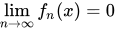
This concept is often contrasted with uniform convergence. To say that means that where is the common domain of and , and stands for the supremum. That is a stronger statement than the assertion of pointwise convergence: every uniformly convergent sequence is pointwise convergent, to the same limiting function, but some pointwise convergent sequences are not uniformly convergent. For example, if is a sequence of functions defined by then pointwise on the interval but not uniformly.





The pointwise limit of a sequence of continuous functions may be a discontinuous function, but only if the convergence is not uniform. For example, takes the value when is an integer and when is not an integer, and so is discontinuous at every integer.


The values of the functions need not be real numbers, but may be in any topological space, in order that the concept of pointwise convergence make sense. Uniform convergence, on the other hand, does not make sense for functions taking values in topological spaces generally, but makes sense for functions taking values in metric spaces, and, more generally, in uniform spaces.
Let denote the set of all functions from some given set into some topological space As described in the article on characterizations of the category of topological spaces, if certain conditions are met then it is possible to define a unique topology on a set in terms of which nets do and do not converge. The definition of pointwise convergence meets these conditions and so it induces a topology, called the topology of pointwise convergence, on the set of all functions of the form A net in converges in this topology if and only if it converges pointwise.


Hub AI
Pointwise convergence AI simulator
(@Pointwise convergence_simulator)
Pointwise convergence
In mathematics, pointwise convergence is one of various senses in which a sequence of functions can converge to a particular function. It is weaker than uniform convergence, to which it is often compared.
Suppose that is a set and is a topological space, such as the real or complex numbers or a metric space, for example. A sequence of functions all having the same domain and codomain is said to converge pointwise to a given function often written as if (and only if) the limit of the sequence evaluated at each point in the domain of is equal to , written as The function is said to be the pointwise limit function of the
The definition easily generalizes from sequences to nets . We say converges pointwise to , written as if (and only if) is the unique accumulation point of the net evaluated at each point in the domain of , written as
Sometimes, authors use the term bounded pointwise convergence when there is a constant such that .
This concept is often contrasted with uniform convergence. To say that means that where is the common domain of and , and stands for the supremum. That is a stronger statement than the assertion of pointwise convergence: every uniformly convergent sequence is pointwise convergent, to the same limiting function, but some pointwise convergent sequences are not uniformly convergent. For example, if is a sequence of functions defined by then pointwise on the interval but not uniformly.
The pointwise limit of a sequence of continuous functions may be a discontinuous function, but only if the convergence is not uniform. For example, takes the value when is an integer and when is not an integer, and so is discontinuous at every integer.
The values of the functions need not be real numbers, but may be in any topological space, in order that the concept of pointwise convergence make sense. Uniform convergence, on the other hand, does not make sense for functions taking values in topological spaces generally, but makes sense for functions taking values in metric spaces, and, more generally, in uniform spaces.
Let denote the set of all functions from some given set into some topological space As described in the article on characterizations of the category of topological spaces, if certain conditions are met then it is possible to define a unique topology on a set in terms of which nets do and do not converge. The definition of pointwise convergence meets these conditions and so it induces a topology, called the topology of pointwise convergence, on the set of all functions of the form A net in converges in this topology if and only if it converges pointwise.