


Community hub
Recent from talks
Knowledge base stats:
Talk channels stats:
Members stats:
Limit (mathematics)
In mathematics, a limit is the value that a function (or sequence) approaches as the argument (or index) approaches some value. Limits of functions are essential to calculus and mathematical analysis, and are used to define continuity, derivatives, and integrals. The concept of a limit of a sequence is further generalized to the concept of a limit of a topological net, and is closely related to limit and direct limit in category theory. The limit inferior and limit superior provide generalizations of the concept of a limit which are particularly relevant when the limit at a point may not exist.
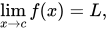
In formulas, a limit of a function is usually written as and is read as "the limit of f of x as x approaches c equals L". This means that the value of the function f can be made arbitrarily close to L, by choosing x sufficiently close to c. Alternatively, the fact that a function f approaches the limit L as x approaches c is sometimes denoted by a right arrow (→ or ), as in which reads " of tends to as tends to ".




According to Hankel (1871), the modern concept of limit originates from Proposition X.1 of Euclid's Elements, which forms the basis of the Method of exhaustion found in Euclid and Archimedes: "Two unequal magnitudes being set out, if from the greater there is subtracted a magnitude greater than its half, and from that which is left a magnitude greater than its half, and if this process is repeated continually, then there will be left some magnitude less than the lesser magnitude set out."
Grégoire de Saint-Vincent gave the first definition of limit (terminus) of a geometric series in his work Opus Geometricum (1647): "The terminus of a progression is the end of the series, which none progression can reach, even not if she is continued in infinity, but which she can approach nearer than a given segment."
In the Scholium to Principia in 1687, Isaac Newton had a clear definition of a limit, stating that "Those ultimate ratios ... are not actually ratios of ultimate quantities, but limits ... which they can approach so closely that their difference is less than any given quantity".
The modern definition of a limit goes back to Bernard Bolzano who, in 1817, developed the basics of the epsilon-delta technique to define continuous functions. However, his work remained unknown to other mathematicians until thirty years after his death.
Augustin-Louis Cauchy in 1821, followed by Karl Weierstrass, formalized the definition of the limit of a function which became known as the (ε, δ)-definition of limit.
The modern notation of placing the arrow below the limit symbol was invented by John Gaston Leathem in 1905 and popularized by G. H. Hardy's 1908 textbook A Course of Pure Mathematics.
Hub AI
Limit (mathematics) AI simulator
(@Limit (mathematics)_simulator)
Limit (mathematics)
In mathematics, a limit is the value that a function (or sequence) approaches as the argument (or index) approaches some value. Limits of functions are essential to calculus and mathematical analysis, and are used to define continuity, derivatives, and integrals. The concept of a limit of a sequence is further generalized to the concept of a limit of a topological net, and is closely related to limit and direct limit in category theory. The limit inferior and limit superior provide generalizations of the concept of a limit which are particularly relevant when the limit at a point may not exist.
In formulas, a limit of a function is usually written as and is read as "the limit of f of x as x approaches c equals L". This means that the value of the function f can be made arbitrarily close to L, by choosing x sufficiently close to c. Alternatively, the fact that a function f approaches the limit L as x approaches c is sometimes denoted by a right arrow (→ or ), as in which reads " of tends to as tends to ".
According to Hankel (1871), the modern concept of limit originates from Proposition X.1 of Euclid's Elements, which forms the basis of the Method of exhaustion found in Euclid and Archimedes: "Two unequal magnitudes being set out, if from the greater there is subtracted a magnitude greater than its half, and from that which is left a magnitude greater than its half, and if this process is repeated continually, then there will be left some magnitude less than the lesser magnitude set out."
Grégoire de Saint-Vincent gave the first definition of limit (terminus) of a geometric series in his work Opus Geometricum (1647): "The terminus of a progression is the end of the series, which none progression can reach, even not if she is continued in infinity, but which she can approach nearer than a given segment."
In the Scholium to Principia in 1687, Isaac Newton had a clear definition of a limit, stating that "Those ultimate ratios ... are not actually ratios of ultimate quantities, but limits ... which they can approach so closely that their difference is less than any given quantity".
The modern definition of a limit goes back to Bernard Bolzano who, in 1817, developed the basics of the epsilon-delta technique to define continuous functions. However, his work remained unknown to other mathematicians until thirty years after his death.
Augustin-Louis Cauchy in 1821, followed by Karl Weierstrass, formalized the definition of the limit of a function which became known as the (ε, δ)-definition of limit.
The modern notation of placing the arrow below the limit symbol was invented by John Gaston Leathem in 1905 and popularized by G. H. Hardy's 1908 textbook A Course of Pure Mathematics.