Illustration of toroidal coordinates, which are obtained by rotating a two-dimensional bipolar coordinate system about the axis separating its two foci. The foci are located at a distance 1 from the vertical z-axis. The portion of the red sphere that lies above the -plane is the σ = 30° isosurface, the blue torus is the τ = 0.5 isosurface, and the yellow half-plane is the φ = 60° isosurface. The green half-plane marks the x-z plane, from which φ is measured. The black point is located at the intersection of the red, blue and yellow isosurfaces, at Cartesian coordinates roughly (0.996, −1.725, 1.911).
Toroidal coordinates are a three-dimensional orthogonalcoordinate system that results from rotating the two-dimensional bipolar coordinate system about the axis that separates its two foci. Thus, the two foci and in bipolar coordinates become a ring of radius in the plane of the toroidal coordinate system; the -axis is the axis of rotation. The focal ring is also known as the reference circle.
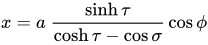
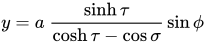
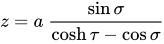
The most common definition of toroidal coordinates is
together with ).
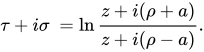
The coordinate of a point equals the angle and the coordinate equals the natural logarithm of the ratio of the distances and to opposite sides of the focal ring
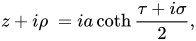
Rotating this two-dimensional bipolar coordinate system about the vertical axis produces the three-dimensional toroidal coordinate system above. A circle on the vertical axis becomes the red sphere, whereas a circle on the horizontal axis becomes the blue torus.
Surfaces of constant correspond to spheres of different radii
that all pass through the focal ring but are not concentric. The surfaces of constant are non-intersecting tori of different radii
that surround the focal ring. The centers of the constant- spheres lie along the -axis, whereas the constant- tori are centered in the plane.
The coordinates may be calculated from the Cartesian coordinates (x, y, z) as follows. The azimuthal angle is given by the formula
The cylindrical radius of the point P is given by
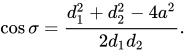
and its distances to the foci in the plane defined by is given by
Geometric interpretation of the coordinates σ and τ of a point P. Observed in the plane of constant azimuthal angle , toroidal coordinates are equivalent to bipolar coordinates. The angle is formed by the two foci in this plane and P, whereas is the logarithm of the ratio of distances to the foci. The corresponding circles of constant and are shown in red and blue, respectively, and meet at right angles (magenta box); they are orthogonal.
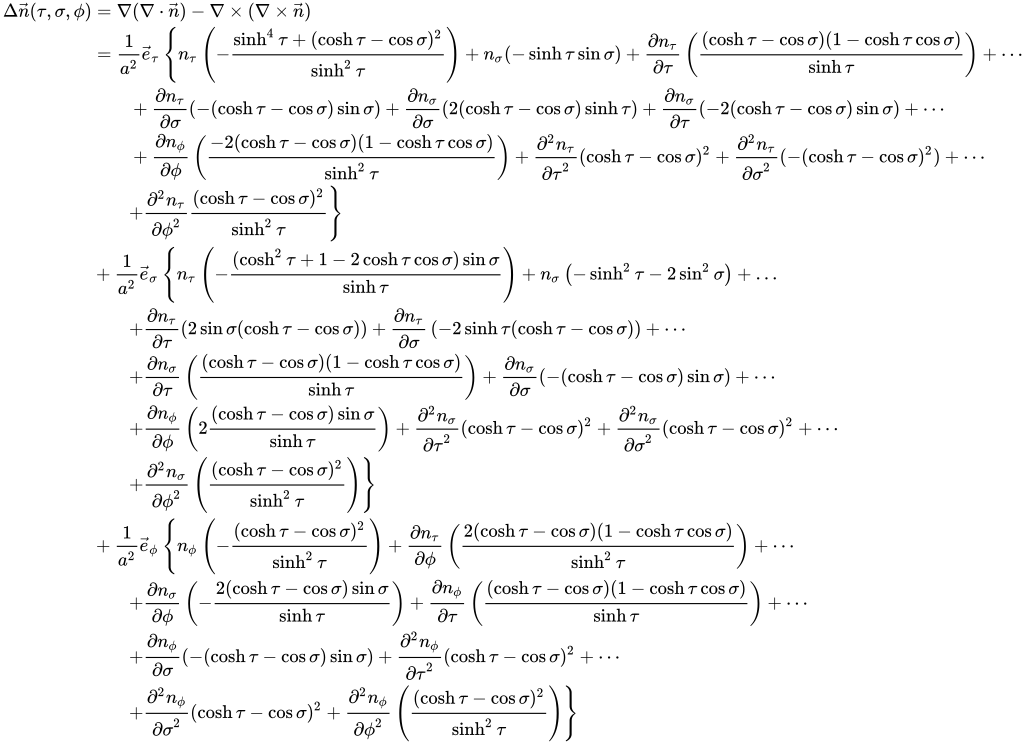
For a vector field the Vector Laplacian is given by
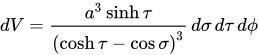
Other differential operators such as
and can be expressed in the coordinates by substituting
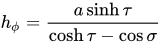
the scale factors into the general formulae
found in orthogonal coordinates.
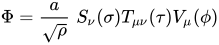
Where P and Q are associated Legendre functions of the first and second kind. These Legendre functions are often referred to as toroidal harmonics.
Toroidal harmonics have many interesting properties. If you make a variable substitution then, for instance, with vanishing order (the convention is to not write the order when it vanishes) and
and
where and are the complete elliptic integrals of the first and second kind respectively. The rest of the toroidal harmonics can be obtained, for instance, in terms of the complete elliptic integrals, by using recurrence relations for associated Legendre functions.
Alternatively, a different substitution may be made (Andrews 2006)
where
Again, a separable equation is obtained. A particular solution obtained by separation of variables is then:
where each function is a linear combination of:
Note that although the toroidal harmonics are used again for the T function, the argument is rather than and the and indices are exchanged. This method is useful for situations in which the boundary conditions are independent of the spherical angle , such as the charged ring, an infinite half plane, or two parallel planes. For identities relating the toroidal harmonics with argument hyperbolic
cosine with those of argument hyperbolic cotangent, see the Whipple formulae.
Arfken G (1970). Mathematical Methods for Physicists (2nd ed.). Orlando, FL: Academic Press. pp. 112–115.
Andrews, Mark (2006). "Alternative separation of Laplace's equation in toroidal coordinates and its application to electrostatics". Journal of Electrostatics. 64 (10): 664–672. CiteSeerX10.1.1.205.5658. doi:10.1016/j.elstat.2005.11.005.
Moon P H, Spencer D E (1988). "Toroidal Coordinates (η, θ, ψ)". Field Theory Handbook, Including Coordinate Systems, Differential Equations, and Their Solutions (2nd ed., 3rd revised printing ed.). New York: Springer Verlag. pp. 112–115 (Section IV, E4Ry). ISBN978-0-387-02732-6.
Toroidal coordinates are a three-dimensional orthogonal curvilinear coordinate system in Euclidean space, formed by rotating the two-dimensional bipolar coordinate system about one of its axes to generate surfaces of revolution including tori and spheres.[1] The system employs coordinates (η,τ,ϕ), where η ranges from −∞ to ∞ (labeling toroidal surfaces), τ from 0 to 2π (labeling spheres), and ϕ from 0 to 2π (azimuthal angle), with position given by
and a>0 as a focal distance scale factor.[1][2]The scale factors for η and τ are identical, hη=hτ=coshη−cosτa, while hϕ=coshη−cosτa∣sinhη∣, reflecting the system's orthogonality and suitability for problems with axial symmetry.[1] Laplace's equation separates completely in these coordinates, enabling analytical solutions via separation of variables, though the Helmholtz equation does not.[2] This separability makes toroidal coordinates valuable in mathematical physics for boundary value problems.[1]In applications, toroidal coordinates facilitate the analysis of vortex rings in hydrodynamics and electrostatic potentials around toroidal conductors, where the geometry aligns with the coordinate surfaces.[1] They also appear in more specialized contexts, such as modeling electromagnetic fields in toroidal geometries and certain exact solutions to Einstein's field equations in general relativity.[3] Despite their utility for symmetric problems, the coordinates are less commonly used than cylindrical or spherical systems due to the complexity of the metric.[1]
Fundamentals
Definition and notation
Toroidal coordinates (η,τ,ϕ) form a three-dimensional orthogonal curvilinear coordinate system, where η∈(−∞,∞) represents the toroidal parameter, 0≤τ<2π the poloidal parameter, and 0≤ϕ<2π the azimuthal angle.[1] These coordinates are particularly useful for problems exhibiting toroidal symmetry, such as those involving rings or doughnut-shaped geometries.[4]Toroidal coordinates are derived by rotating the two-dimensional bipolar coordinate system about one of its axes, which generates a focal ring of radius a lying in the xy-plane and centered at the origin.[4] In the bipolar system, the foci are points separated by distance 2a along the x-axis; upon rotation about the z-axis, these foci trace out the circular ring that serves as the singularity locus in the three-dimensional system.[5]The transformation from toroidal coordinates to Cartesian coordinates (x,y,z) is given by
where a>0 is a scaling parameter determining the radius of the focal ring.[1] These equations ensure that the coordinate surfaces align with toroidal and poloidal features, with the denominator coshη−cosτ preventing singularities except along the focal ring.[6]Physically, the toroidal parameter η corresponds to η=ln(d2/d1), where d1 and d2 are the distances from a given point to the nearest and farthest points, respectively, on the focal ring (with the sign allowing coverage inside and outside).[7] This logarithmic ratio captures the scaling behavior relative to the ring's geometry, while τ measures the angular position in the poloidal plane, and ϕ tracks the rotation around the z-axis.[1]
Geometric interpretation
Toroidal coordinates (η,τ,ϕ) provide a curvilinear system suited for geometries exhibiting toroidal symmetry, where the parameter a>0 defines the radius of the focal ring—a degenerate circle of radius a lying in the xy-plane centered at the origin.[7] The coordinate surfaces intersect along this focal ring, which serves as a singularity locus where the metric degenerates.Surfaces of constant τ (with 0<τ<π) form a family of spheres that all pass through the focal ring. These spheres are centered on the z-axis at (0,0,acotτ) and have radius a∣cscτ∣, satisfying the equation
x2+y2+(z−acotτ)2=sin2τa2.
[7] As τ→0+ or τ→π−, cotτ→+∞ or −∞, respectively, while cscτ→+∞, causing the centers to recede to z=±∞ with radii expanding proportionally; consequently, these spheres degenerate into the xy-plane (z=0).[7] For τ∈(π,2π), the surfaces mirror those for 2π−τ due to periodicity.Surfaces of constant η (with η=0) form a family of tori that encircle the focal ring, generated by rotating a circle in the ρz-plane (where ρ=x2+y2) about the z-axis. These tori have major radius acoth∣η∣ and minor (tube) radius a\csch∣η∣, satisfying the equation
z2+(x2+y2−acoth∣η∣)2=sinh2∣η∣a2.
[7] As ∣η∣→∞, coth∣η∣→1 and \csch∣η∣→0, causing the tori to approach the focal ring.[7] As ∣η∣→0, coth∣η∣→+∞ and \csch∣η∣→+∞, with the inner radius approaching 0 and outer expanding to infinity, such that the tori encompass larger volumes around the ring.[7] Negative η duplicate the surfaces of positive ∣η∣ due to the odd nature of sinhη.Surfaces of constant ϕ (with 0≤ϕ<2π) are meridional half-planes containing the z-axis, providing azimuthal symmetry. The full set of coordinate surfaces—constant η tori, constant τ spheres, and constant ϕ planes—are mutually orthogonal everywhere except at the focal ring, where the orthogonality condition holds in the limiting sense as a consequence of the system's triorthogonal curvilinear design.[7] This orthogonality facilitates the separation of variables in partial differential equations for toroidal geometries.[8]
Transformations
Toroidal to Cartesian coordinates
Toroidal coordinates (η,τ,ϕ) are obtained by rotating the two-dimensional bipolar coordinate system about the z-axis, where the bipolar system in the xz-plane uses foci separated by distance 2a.[9] In the bipolar representation, the coordinates transform to the plane as x′=coshη−cosτasinhη and z=coshη−cosτasinτ, with η∈(−∞,∞) labeling toroidal surfaces (degenerate to circles through the foci in 2D) and τ∈[0,2π) labeling spheres (degenerate to circles orthogonal to the first family, with centers on the axis joining the foci). Introducing the azimuthal angle ϕ∈[0,2π) via rotation yields the full three-dimensional transformation to Cartesian coordinates:
x=coshη−cosτasinhηcosϕ,
y=coshη−cosτasinhηsinϕ,
z=coshη−cosτasinτ.
Here, a>0 is the radius of the degenerate focal ring lying in the xy-plane at z=0 and ρ=a.[9]The cylindrical radius ρ=x2+y2 simplifies directly to ρ=coshη−cosτa∣sinhη∣, reflecting the radial distance from the z-axis independent of ϕ.[9]In limiting cases, as ∣η∣→0, the coordinates describe regions far from the focal ring, where the geometry approximates spherical coordinates centered at the origin.[7]
Cartesian to toroidal coordinates
To convert a point given in Cartesian coordinates (x,y,z) to toroidal coordinates (η,τ,ϕ), where a>0 is the fixed parameter defining the radius of the focal ring in the xy-plane, the process begins by determining the azimuthal angle ϕ and the cylindrical radius ρ.The azimuthal angle is ϕ=\atan2(y,x), which ranges from −π to π and provides the rotational symmetry around the z-axis.[10] The cylindrical radius is ρ=x2+y2.[10]Next, compute the distances from the point to the near and far sides of the focal ring:
d1=(ρ+a)2+z2,d2=∣ρ−a∣2+z2.
The toroidal coordinate η, which parameterizes surfaces of constant η as tori, can be computed as η=ln(d2d1) for the exterior region (ρ>a or away from ring), yielding η≥0. For the interior region, η<0 is obtained by adjusting the sign appropriately, e.g., η=−ln(d2d1) when using the switched distances. η=0 corresponds to the z-axis.[10][7]The poloidal coordinate τ, which traces meridional circles on constant-η surfaces, is determined via
cosτ=2d1d2d12+d22−4a2.
This expression yields values in [−1,1], corresponding to τ∈[0,2π). To resolve the angle fully, compute
sinτ=az(coshη−cosτ),
where the sign of sinτ matches that of z. The angle is then τ=\atan2(sinτ,cosτ).[10]This inverse mapping is well-defined for points not on the branch cut, which is typically a half-plane containing the focal ring (e.g., z ≥ 0, σ = 0). Near the ring, coordinates become multi-valued, requiring careful choice of branch. The system covers all of Euclidean space except this branch cut surface.[10]
Scale factors and metric
Scale factors
In toroidal coordinates, defined by the parameters −∞<η<∞, 0≤τ<2π, and 0≤ϕ<2π, with a scale parameter a>0, the position vector r(η,τ,ϕ) in Cartesian coordinates is given by
[1] These relations follow from rotating the two-dimensional bipolar coordinate system about an axis to generate toroidal surfaces.[7]The scale factors hτ, hη, and hϕ quantify the local stretching of the coordinate lines and are essential for the metric tensor in this orthogonal curvilinear system. They are computed as the magnitudes of the partial derivatives of the position vector with respect to each coordinate: hq=∂q∂r for q=τ,η,ϕ.[1]To derive hτ, one evaluates ∂τ∂r, which involves differentiating each Cartesian component with respect to τ while holding η and ϕ fixed. The components are
The magnitude hτ=(∂τ∂x)2+(∂τ∂y)2+(∂τ∂z)2 simplifies to
hτ=coshη−cosτa.
A similar computation for hη=∂η∂r yields the identical expression
hη=coshη−cosτa,
reflecting the symmetry between the τ and η directions in the generating bipolar system.[1][7]For the azimuthal direction, hϕ=∂ϕ∂r is obtained by differentiating with respect to ϕ:
This form arises because the ϕ-derivative corresponds to rotation around the z-axis, scaled by the distance from that axis.[1][7]The orthogonality of the coordinate system is confirmed by verifying that the basis vectors are mutually perpendicular, i.e., ∂τ∂r⋅∂η∂r=0, ∂τ∂r⋅∂ϕ∂r=0, and ∂η∂r⋅∂ϕ∂r=0. These dot products vanish due to the structure of the transformation equations, ensuring a diagonal metric tensor. Notably, the common denominator coshη−cosτ>0 (for real η and τ∈[0,2π)) appears in all scale factors, highlighting the focal nature of the coordinates around the ring at radius a.[1]
Line and volume elements
In toroidal coordinates (η,τ,ϕ), the infinitesimal line element ds is constructed from the scale factors hη, hτ, and hϕ as the metric tensor for this orthogonal curvilinear system.[11] The squared line element takes the form
where a is the scale parameter defining the coordinate system's geometry.[11][12] This expression facilitates the computation of arc lengths along each coordinate direction, given by dlτ=hτdτ, dlη=hηdη, and dlϕ=hϕdϕ.[11]The volume element dV in toroidal coordinates, essential for triple integrals over regions such as tori or annular volumes, is the product of the scale factors times the differentials:
dV=hτhηhϕdτdηdϕ=(coshη−cosτ)3a3∣sinhη∣dτdηdϕ.
This form arises directly from the orthogonality of the coordinate surfaces and accounts for the varying density of points near the degenerate ring at η=0.[11][12]Surface elements on coordinate surfaces follow similarly from pairs of scale factors. For instance, on a surface of constant τ, the area element is dAηϕ=hηhϕdηdϕ, which describes patches on spherical surfaces.[11] Analogous expressions hold for the other constant-coordinate surfaces, enabling surface integrals in applications like flux calculations.
Differential operators
Gradient, divergence, and curl
In toroidal coordinates (η,τ,ϕ), the unit vectors e^η, e^τ, and e^ϕ are mutually orthogonal and form a right-handed basis.[1]The gradient of a scalar function f is expressed as
∇f=hη1∂η∂fe^η+hτ1∂τ∂fe^τ+hϕ1∂ϕ∂fe^ϕ,
where hη, hτ, and hϕ denote the scale factors along each coordinate direction.[1]For a vector field A=Aηe^η+Aτe^τ+Aϕe^ϕ, the divergence takes the form
where hη, hτ, and hϕ are the scale factors.[14]In toroidal coordinates, the scale factors are hη=hτ=coshη−cosτa and hϕ=coshη−cosτasinhη, with a>0 the scale parameter.[7] Substituting these into the general expression yields the scalar Laplacian
This form follows directly from the scale factors.[15]For the vector Laplacian ∇2A, the expression in orthogonal curvilinear coordinates generally expands to ∇(∇⋅A)−∇×(∇×A), where the divergence, gradient, and curl are as defined using the toroidal scale factors; full component-wise expansion is complex due to coupling between coordinate directions.[14]Near the focal ring (the degenerate circle of radius a in the xy-plane, approached as η→0), the scale factors exhibit singularities: hη and hτ remain finite except at τ=0, but hϕ→0 as sinhη→0, leading to coordinate degeneracy and requiring special treatment in solutions to avoid unphysical behavior.[16]
Applications
In electrostatics and magnetostatics
Toroidal coordinates are particularly suited for solving electrostatic problems involving axisymmetric geometries, such as the electric potential around a charged conducting torus.[1] The scalar potential Φ satisfies Laplace's equation ∇²Φ = 0 in the region exterior to the torus, with boundary conditions specifying constant potential on the torus surface. Solutions are obtained by expanding Φ in a series of toroidal harmonics, which naturally conform to the toroidal geometry and ensure the boundary conditions are met.[2] This approach leverages the separability of Laplace's equation in toroidal coordinates, providing an exact series representation for the potential without approximations for thin tori.In magnetostatics, toroidal coordinates facilitate the computation of the magnetic field generated by a current-carrying ring, such as in the Biot-Savart law applied to a circular loop. The magnetic scalar potential for a current ring is derived by integrating the Biot-Savart contributions in toroidal variables (η, τ, φ), yielding expressions involving toroidal functions that simplify the azimuthal symmetry. This formulation is advantageous for off-axis field calculations, avoiding the elliptic integrals required in Cartesian or cylindrical coordinates.[17]Such calculations find practical applications in the design of transformer coils, where toroidal windings minimize leakage flux, and in MRI magnet systems, where precise field uniformity around ring-like superconducting coils is essential for imaging quality. For instance, the electric field exterior to a toroidal conductor can be determined from the gradient of the series-expanded potential, incorporating associated Legendre functions of half-integer order to capture the field variations near the surface.[1]
In plasma physics and fusion
In plasma physics, particularly for fusion research, toroidal coordinates facilitate the modeling of magnetic confinement devices like tokamaks and stellarators by enabling the expansion of vacuum magnetic fields in toroidal harmonics, which aids in equilibrium studies. This approach represents the magnetic field using half-integer Legendre functions, allowing efficient computation of field configurations outside the plasma where currents are absent. Such expansions are essential for analyzing how external coil geometries produce the required nested flux surfaces for particle confinement.[18]For radio-frequency (RF) wave propagation and absorption in tokamaks, constant-k∥ toroidal coordinates—obtained by stretching poloidal and toroidal angles to maintain constant parallel wavenumber across magnetic surfaces—provide a framework for realistic simulations in non-uniform geometries. Introduced to simplify the treatment of wave-particle interactions at ion cyclotron frequencies, these coordinates yield semi-analytical expressions for the plasma's high-frequency dielectric response, particularly useful for anisotropic equilibria and non-Maxwellian distributions arising from intense heating. Studies from 2006 demonstrated their application in modeling RF absorption, revealing quadratic resonance conditions for guiding center velocities and enabling accurate predictions of power deposition in devices with strong toroidal field variations.[19]In modern fusion designs like ITER, toroidal harmonics expansions model magnetic field perturbations from coil asymmetries and error fields, supporting equilibrium reconstructions and stability assessments. These methods, applied to boundary shape optimization, help predict non-axisymmetric effects on plasma response, ensuring robust confinement for high-beta operations. For instance, toroidal harmonic decompositions of magnetic measurements enable optimal control of the plasma separatrix, mitigating risks from resonant magnetic perturbations in ITER's 15 MA baseline scenario. As of 2025, these techniques continue to be refined for ITER operations planned to start in the late 2020s.[18]
Toroidal harmonics
Separation of variables
In toroidal coordinates (η,τ,ϕ), Laplace's equation ∇2Φ=0 is separable, allowing solutions via the method of separation of variables. The coordinate system features η≥0 as the toroidal parameter (labeling toroidal surfaces; often restricted from the full range −∞<η<∞ by symmetry for harmonics), 0≤τ<2π as the poloidal angle, and 0≤ϕ<2π as the azimuthal angle, with the metric incorporating factors that enable partial separation.[8]To solve Laplace's equation, assume a product solution of the form Φ(η,τ,ϕ)=T(η)S(τ)V(ϕ). Due to the specific scale factors in toroidal coordinates, particularly the common factor coshη−cosτ arising from the volume element and Laplacian expression, the separated form is modulated as Φ(η,τ,ϕ)=coshη−cosτT(η)S(τ)V(ϕ).[20] Substituting this into ∇2Φ=0 and dividing by the modulating factor yields three ordinary differential equations (ODEs) coupled by separation constants.The azimuthal part V(ϕ) satisfies V′′(ϕ)+μ2V(ϕ)=0, where μ is an integer separation constant due to the 2π-periodicity in ϕ, yielding solutions V(ϕ)=eiμϕ.[20] This introduces μ2 into the remaining equation, which then separates the η and τ dependence with another constant ν, leading to coupled eigenvalue problems: for S(τ), a periodic equation resembling a Legendre-type ODE on [0,2π]; for T(η), a non-periodic equation on [0,∞) involving hyperbolic functions. The overall separated solution takes the form Φ=coshη−cosτSν(τ)Tμν(η)eiμϕ, where Sν and Tμν solve their respective ODEs with eigenvalue ν.In contrast, the Helmholtz equation ∇2Φ+k2Φ=0 is not separable in toroidal coordinates, as the additional k2 term disrupts the balance required for product solutions across all variables. This limits direct analytical solutions for wave problems, often requiring numerical or approximate methods in toroidal geometries.
Standard toroidal functions
In toroidal coordinates (τ,η,ϕ), the standard solutions to Laplace's equation obtained via separation of variables are products of functions each depending on a single coordinate. The poloidal part, periodic in the angular coordinate τ∈[0,2π), takes the form of Fourier modes: Sn(τ)=einτ or its complex conjugate e−inτ, where n is typically an integer to ensure single-valuedness.[15] The azimuthal part, similarly periodic in ϕ∈[0,2π), is Vμ(ϕ)=eiμϕ or e−iμϕ, with μ an integer representing the azimuthal order.[15]The toroidal part, depending on the non-angular coordinate η∈[0,∞), consists of associated Legendre functions of half-integer degree: Tμn(η)=Pn−1/2μ(coshη) for the first kind or Tμn(η)=Qn−1/2μ(coshη) for the second kind, where Pℓμ and Qℓμ are the associated Legendre functions, n is a nonnegative integer, and μ is a nonnegative integer. The half-integer degree n−1/2 arises from the separation constant in the ODE for T(η), specifically to account for the −1/4 term from the metric.[21][22][23] These functions satisfy the separated ordinary differential equation for the η-dependence, arising from the Sturm-Liouville form of the toroidal coordinate Laplacian.[23]To incorporate the scale factors inherent in the toroidal Laplacian, the complete separated solution is often scaled as Φ(τ,η,ϕ)=ρaSn(τ)Tμn(η)Vμ(ϕ), where a is the focal ring radius and ρ=coshη−cosτ is proportional to the square of the radial distance in the meridional plane.[15] An alternative representation employs Tμn(η) with argument cothη for the Legendre functions of the second kind, particularly useful for asymptotic behavior or certain boundary conditions at large η.[24]These functions form a complete orthogonal set for expanding solutions in toroidal domains, with orthogonality ensured by the Sturm-Liouville theory underlying the separation. Specifically, the toroidal functions Tμn(η) are orthogonal over η∈[0,∞) with weight sinhη, satisfying ∫0∞Tμn(η)Tμ′n′(η)sinhηdη∝δμμ′δnn′, while the full harmonics are orthogonal over the volume element dV=a3(sinh2η+sin2τ)sinhηdηdτdϕ. Normalization constants are chosen such that the integral equals unity for the same indices, often involving Gamma functions like Γ(μ+1/2) for stability in computation.[25][21]
Alternative separation
In toroidal coordinates, an alternative separation of variables for Laplace's equation employs associated Legendre functions with the argument cothη, yielding solutions of the form r1Tμν(η)Yμ(y)Cν(ϕ), where Tμν(η)=Pμ−1/2ν(cothη) or Qμ−1/2ν(cothη), Yμ(y) involves sines or cosines of μy, and Cν(ϕ) similarly for νϕ.[26] This form contrasts with standard toroidal functions by facilitating solutions that decay as 1/r in the far field, where r is the cylindrical radius, providing an expansion in 1/ρ suitable for approximating potentials from toroidal sources at large distances ρ.[26]For boundary conditions independent of the poloidal angle y, such as those involving charges on circular rings or planes, the separation simplifies by setting μ=0, reducing to axisymmetric cases like ring currents where the potential expands in a series of Q−1/2ν(cothη)cos[ν(ϕ−ϕ0)].[26] This approach has been applied in electrostatics to compute potentials for point charges near conducting planes or annular charge distributions, yielding closed-form expressions via summation of the alternative toroidal functions.[26]In plasma physics, particularly for toroidal fusion equilibria, an inverse aspect-ratio expansion ϵ offers another non-standard separation for the axisymmetric Grad-Shafranov equation, incorporating sheared flows nonparallel to the magnetic field and enabling solutions with reversed or normal magnetic shear on circular or D-shaped flux surfaces.[27] Setting μ=0 here isolates ring-like current distributions, aiding analysis of internal transport barriers influenced by flow-magnetic shear synergies, as observed in tokamak experiments.[27]However, such alternative separations are limited for non-Laplacian equations beyond electrostatics or linear perturbations, as the coordinate orthogonality does not always permit full separability in nonlinear MHD or wave equations, though they remain valuable for perturbative treatments around axisymmetric bases.[27]
















![{\displaystyle {\begin{aligned}\nabla ^{2}\Phi ={\frac {\left(\cosh \tau -\cos \sigma \right)^{3}}{a^{2}\sinh \tau }}&\left[\sinh \tau {\frac {\partial }{\partial \sigma }}\left({\frac {1}{\cosh \tau -\cos \sigma }}{\frac {\partial \Phi }{\partial \sigma }}\right)\right.\\[8pt]&{}\quad +\left.{\frac {\partial }{\partial \tau }}\left({\frac {\sinh \tau }{\cosh \tau -\cos \sigma }}{\frac {\partial \Phi }{\partial \tau }}\right)+{\frac {1}{\sinh \tau \left(\cosh \tau -\cos \sigma \right)}}{\frac {\partial ^{2}\Phi }{\partial \phi ^{2}}}\right]\end{aligned}}}](https://wikimedia.org/api/rest_v1/media/math/render/svg/e074c8d486891935bf6a90052141f76617b6f440)