



Community hub
Recent from talks
Contribute something
Nothing was collected or created yet.
Elliptic integral
View on WikipediaIn integral calculus, an elliptic integral is one of a number of related functions defined as the value of certain integrals, which were first studied by Giulio Fagnano and Leonhard Euler (c. 1750). Their name originates from their connection with the problem of finding the arc length of an ellipse.
Modern mathematics defines an "elliptic integral" as any function f which can be expressed in the form
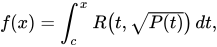
where R is a rational function of its two arguments, P is a polynomial of degree 3 or 4 with no repeated roots, and c is a constant.
In general, integrals in this form cannot be expressed in terms of elementary functions. Exceptions to this general rule are when P has repeated roots, when R(x, y) contains no odd powers of y, and when the integral is pseudo-elliptic. However, with the appropriate reduction formula, every elliptic integral can be brought into a form that involves integrals over rational functions and the three Legendre canonical forms, also known as the elliptic integrals of the first, second and third kind.
Besides the Legendre form given below, the elliptic integrals may also be expressed in Carlson symmetric form. Additional insight into the theory of the elliptic integral may be gained through the study of the Schwarz–Christoffel mapping. Historically, elliptic functions were discovered as inverse functions of elliptic integrals.
Argument notation
[edit]Incomplete elliptic integrals are functions of two arguments; complete elliptic integrals are functions of a single argument. These arguments are expressed in a variety of different but equivalent ways as they give the same elliptic integral. Most texts adhere to a canonical naming scheme, using the following naming conventions.
For expressing one argument:
- α, the modular angle
- k = sin α, the elliptic modulus or eccentricity
- m = k2 = sin2 α, the parameter
Each of the above three quantities is completely determined by any of the others (given that they are non-negative). Thus, they can be used interchangeably.
The other argument can likewise be expressed as φ, the amplitude, or as x or u, where x = sin φ = sn u and sn is one of the Jacobian elliptic functions.
Specifying the value of any one of these quantities determines the others. Note that u also depends on m. Some additional relationships involving u include

The latter is sometimes called the delta amplitude and written as Δ(φ) = dn u. Sometimes the literature also refers to the complementary parameter, the complementary modulus, or the complementary modular angle. These are further defined in the article on quarter periods.
In this notation, the use of a vertical bar as delimiter indicates that the argument following it is the "parameter" (as defined above), while the backslash indicates that it is the modular angle. The use of a semicolon implies that the argument preceding it is the sine of the amplitude: This potentially confusing use of different argument delimiters is traditional in elliptic integrals and much of the notation is compatible with that used in the reference book by Abramowitz and Stegun and that used in the integral tables by Gradshteyn and Ryzhik.

There are still other conventions for the notation of elliptic integrals employed in the literature. The notation with interchanged arguments, F(k, φ), is often encountered; and similarly E(k, φ) for the integral of the second kind. Abramowitz and Stegun substitute the integral of the first kind, F(φ, k), for the argument φ in their definition of the integrals of the second and third kinds, unless this argument is followed by a vertical bar: i.e. E(F(φ, k) | k2) for E(φ | k2). Moreover, their complete integrals employ the parameter k2 as argument in place of the modulus k, i.e. K(k2) rather than K(k). And the integral of the third kind defined by Gradshteyn and Ryzhik, Π(φ, n, k), puts the amplitude φ first and not the "characteristic" n.
Thus one must be careful with the notation when using these functions, because various reputable references and software packages use different conventions in the definitions of the elliptic functions. For example, Wolfram's Mathematica software and Wolfram Alpha define the complete elliptic integral of the first kind in terms of the parameter m, instead of the elliptic modulus k.
Incomplete elliptic integral of the first kind
[edit]The incomplete elliptic integral of the first kind F is defined as

This is Legendre's trigonometric form of the elliptic integral; substituting t = sin θ and x = sin φ, one obtains Jacobi's algebraic form:

Equivalently, in terms of the amplitude and modular angle one has:

With x = sn(u, k) one has: demonstrating that this Jacobian elliptic function is a simple inverse of the incomplete elliptic integral of the first kind.

The incomplete elliptic integral of the first kind has following addition theorem[citation needed]:
![{\displaystyle F{\bigl [}\arctan(x),k{\bigr ]}+F{\bigl [}\arctan(y),k{\bigr ]}=F\left[\arctan \left({\frac {x{\sqrt {k'^{2}y^{2}+1}}}{\sqrt {y^{2}+1}}}\right)+\arctan \left({\frac {y{\sqrt {k'^{2}x^{2}+1}}}{\sqrt {x^{2}+1}}}\right),k\right]}](https://wikimedia.org/api/rest_v1/media/math/render/svg/57910fd4c508794e391acf88c5a0773167da8c3a)
The elliptic modulus can be transformed that way:
![{\displaystyle F{\bigl [}\arcsin(x),k{\bigr ]}={\frac {2}{1+{\sqrt {1-k^{2}}}}}F\left[\arcsin \left({\frac {\left(1+{\sqrt {1-k^{2}}}\right)x}{1+{\sqrt {1-k^{2}x^{2}}}}}\right),{\frac {1-{\sqrt {1-k^{2}}}}{1+{\sqrt {1-k^{2}}}}}\right]}](https://wikimedia.org/api/rest_v1/media/math/render/svg/76eea8fbafa5746e507a2b9aa62ba30683aa47ad)
Incomplete elliptic integral of the second kind
[edit]The incomplete elliptic integral of the second kind E in Legendre's trigonometric form is

Substituting t = sin θ and x = sin φ, one obtains Jacobi's algebraic form:

Equivalently, in terms of the amplitude and modular angle:

Relations with the Jacobi elliptic functions include
![{\displaystyle {\begin{aligned}E{\left(\operatorname {sn} (u;k);k\right)}=\int _{0}^{u}\operatorname {dn} ^{2}(w;k)\,dw&=u-k^{2}\int _{0}^{u}\operatorname {sn} ^{2}(w;k)\,dw\\[1ex]&=\left(1-k^{2}\right)u+k^{2}\int _{0}^{u}\operatorname {cn} ^{2}(w;k)\,dw.\end{aligned}}}](https://wikimedia.org/api/rest_v1/media/math/render/svg/3daa5ea5ba73b833fb145588e70b71f71415c222)
The meridian arc length from the equator to latitude φ is written in terms of E: where a is the semi-major axis, and e is the eccentricity.

The incomplete elliptic integral of the second kind has following addition theorem[citation needed]:
![{\displaystyle {\begin{aligned}&E{\left[\arctan(x),k\right]}+E{\left[\arctan(y),k\right]}\\[.5ex]&\quad =E{\left[\arctan \left({\frac {x{\sqrt {k'^{2}y^{2}+1}}}{\sqrt {y^{2}+1}}}\right)+\arctan \left({\frac {y{\sqrt {k'^{2}x^{2}+1}}}{\sqrt {x^{2}+1}}}\right),k\right]}\\[1ex]&\qquad +{\frac {k^{2}xy}{k'^{2}x^{2}y^{2}+x^{2}+y^{2}+1}}\left({\frac {x{\sqrt {k'^{2}y^{2}+1}}}{\sqrt {y^{2}+1}}}+{\frac {y{\sqrt {k'^{2}x^{2}+1}}}{\sqrt {x^{2}+1}}}\right)\end{aligned}}}](https://wikimedia.org/api/rest_v1/media/math/render/svg/9c4623434407e9ffa9f529ff9092a8e2a951a5a5)
The elliptic modulus can be transformed that way:
![{\displaystyle {\begin{aligned}E{\left[\arcsin(x),k\right]}&=\left(1+{\sqrt {1-k^{2}}}\right)E{\left[\arcsin \left({\frac {\left(1+{\sqrt {1-k^{2}}}\right)x}{1+{\sqrt {1-k^{2}x^{2}}}}}\right),{\frac {1-{\sqrt {1-k^{2}}}}{1+{\sqrt {1-k^{2}}}}}\right]}\\[.5ex]&\quad -{\sqrt {1-k^{2}}}F{\left[\arcsin(x),k\right]}+{\frac {k^{2}x{\sqrt {1-x^{2}}}}{1+{\sqrt {1-k^{2}x^{2}}}}}\end{aligned}}}](https://wikimedia.org/api/rest_v1/media/math/render/svg/5ab1e825380f6de03abc6d12a96c936d580b1598)
Incomplete elliptic integral of the third kind
[edit]The incomplete elliptic integral of the third kind Π is

or

The number n is called the characteristic and can take on any value, independently of the other arguments. Note though that the value Π(1; π/2 | m) is infinite, for any m.
A relation with the Jacobian elliptic functions is

The meridian arc length from the equator to latitude φ is also related to a special case of Π:

Complete elliptic integral of the first kind
[edit]
Elliptic Integrals are said to be 'complete' when the amplitude φ = π/2 and therefore x = 1. The complete elliptic integral of the first kind K may thus be defined as or more compactly in terms of the incomplete integral of the first kind as


It can be expressed as a power series

where Pn is the Legendre polynomials, which is equivalent to

where n!! denotes the double factorial. In terms of the Gauss hypergeometric function, the complete elliptic integral of the first kind can be expressed as

The complete elliptic integral of the first kind is sometimes called the quarter period. It can be computed very efficiently in terms of the arithmetic–geometric mean:[1]
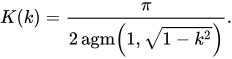
Therefore, the modulus can be transformed as:
![{\displaystyle {\begin{aligned}K(k)&={\frac {\pi }{2\operatorname {agm} \left(1,{\sqrt {1-k^{2}}}\right)}}\\[4pt]&={\frac {\pi }{2\operatorname {agm} \left({\frac {1}{2}}+{\frac {\sqrt {1-k^{2}}}{2}},{\sqrt[{4}]{1-k^{2}}}\right)}}\\[4pt]&={\frac {\pi }{\left(1+{\sqrt {1-k^{2}}}\right)\operatorname {agm} \left(1,{\frac {2{\sqrt[{4}]{1-k^{2}}}}{\left(1+{\sqrt {1-k^{2}}}\right)}}\right)}}\\[4pt]&={\frac {2}{1+{\sqrt {1-k^{2}}}}}K\left({\frac {1-{\sqrt {1-k^{2}}}}{1+{\sqrt {1-k^{2}}}}}\right)\end{aligned}}}](https://wikimedia.org/api/rest_v1/media/math/render/svg/6746059c2ef65a4af7d2856a18b5c5ebe7d179fb)
This expression is valid for all and 0 ≤ k ≤ 1:

![{\displaystyle K(k)=n\left[\sum _{a=1}^{n}\operatorname {dn} \left({\frac {2a}{n}}K(k);k\right)\right]^{-1}K\left[k^{n}\prod _{a=1}^{n}\operatorname {sn} \left({\frac {2a-1}{n}}K(k);k\right)^{2}\right]}](https://wikimedia.org/api/rest_v1/media/math/render/svg/69e4dd3df58277155b3c0a3a472621affaaedad5)
Relation to the gamma function
[edit]If k2 = λ(i√r) and (where λ is the modular lambda function), then K(k) is expressible in closed form in terms of the gamma function.[2] For example, r = 2, r = 3 and r = 7 give, respectively,[3]

![{\displaystyle K\left({\sqrt {2}}-1\right)={\frac {\Gamma \left({\frac {1}{8}}\right)\Gamma \left({\frac {3}{8}}\right){\sqrt {{\sqrt {2}}+1}}}{8{\sqrt[{4}]{2}}{\sqrt {\pi }}}},}](https://wikimedia.org/api/rest_v1/media/math/render/svg/7af68e2bb757bf83cb31b8c621daba7d08d25233)
and
![{\displaystyle K\left({\frac {{\sqrt {3}}-1}{2{\sqrt {2}}}}\right)={\frac {1}{8\pi }}{\sqrt[{4}]{3}}\,{\sqrt[{3}]{4}}\,\Gamma {\biggl (}{\frac {1}{3}}{\biggr )}^{3}}](https://wikimedia.org/api/rest_v1/media/math/render/svg/91fa028e9c294b1850c7a3ed45260a6ecfcf0cee)
and
![{\displaystyle K\left({\frac {3-{\sqrt {7}}}{4{\sqrt {2}}}}\right)={\frac {\Gamma \left({\frac {1}{7}}\right)\Gamma \left({\frac {2}{7}}\right)\Gamma \left({\frac {4}{7}}\right)}{4{\sqrt[{4}]{7}}\pi }}.}](https://wikimedia.org/api/rest_v1/media/math/render/svg/71967f390fee21bad3fb4f6a4422fb095cd6c06d)
More generally, the condition that be in an imaginary quadratic field[note 1] is sufficient.[4][5] For instance, if k = e5πi/6, then iK′/K = e2πi/3 and[6]
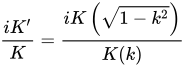
![{\displaystyle K\left(e^{5\pi i/6}\right)={\frac {e^{-\pi i/12}\Gamma ^{3}\left({\frac {1}{3}}\right){\sqrt[{4}]{3}}}{4{\sqrt[{3}]{2}}\pi }}.}](https://wikimedia.org/api/rest_v1/media/math/render/svg/af9aeeb4847d98060f6d067a35f0d07b04e7f308)
Asymptotic expressions
[edit]This approximation has a relative precision better than 3×10⁻⁴ for k < 1/2. Keeping only the first two terms is correct to 0.01 precision for k < 1/2.[citation needed]

Differential equation
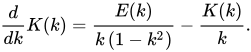
[edit]The differential equation for the elliptic integral of the first kind is

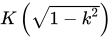
A second solution to this equation is . This solution satisfies the relation
Continued fraction
[edit]A continued fraction expansion is:[7] where the nome is in its definition.
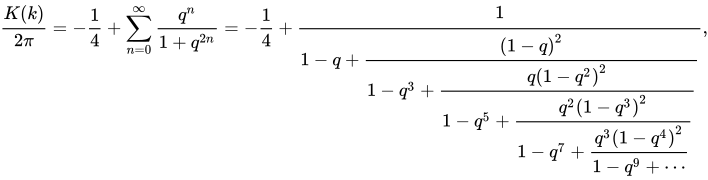
![{\displaystyle q=q(k)=\exp[-\pi K'(k)/K(k)]}](https://wikimedia.org/api/rest_v1/media/math/render/svg/eb86726110efea04f613a63fbdb98f397fa30d15)
Inverting the period ratio
[edit]Here, we use the complete elliptic integral of the first kind with the parameter instead, because the squaring function introduces problems when inverting in the complex plane. So let

![{\displaystyle K[m]=\int _{0}^{\pi /2}{\dfrac {d\theta }{\sqrt {1-m\sin ^{2}\theta }}}}](https://wikimedia.org/api/rest_v1/media/math/render/svg/c3007fef4e342b267f123e7b3e8a9c93f119d8a5)
and let


be the theta functions.
The equation
![{\displaystyle \tau =i{\frac {K[1-m]}{K[m]}}}](https://wikimedia.org/api/rest_v1/media/math/render/svg/e80a5226937cb73c0699926d4cfa3e10d4aca09d)
can then be solved (provided that a solution exists) by

which is in fact the modular lambda function.
For the purposes of computation, the error analysis is given by[8]


where and .


Also
![{\displaystyle K[m]={\frac {\pi }{2}}\theta _{3}(\tau )^{2},\quad \tau =i{\frac {K[1-m]}{K[m]}}}](https://wikimedia.org/api/rest_v1/media/math/render/svg/ee3b2fe5e7899ee67a5c9f8d6364a9c7cb92b9d2)
where .

Complete elliptic integral of the second kind
[edit]
The complete elliptic integral of the second kind E is defined as

or more compactly in terms of the incomplete integral of the second kind E(φ,k) as

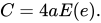
For an ellipse with semi-major axis a and semi-minor axis b and eccentricity e = √1 − b2/a2, the complete elliptic integral of the second kind E(e) is equal to one quarter of the circumference C of the ellipse measured in units of the semi-major axis a. In other words:
The complete elliptic integral of the second kind can be expressed as a power series[9]
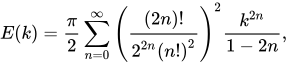
which is equivalent to

In terms of the Gauss hypergeometric function, the complete elliptic integral of the second kind can be expressed as

The modulus can be transformed that way:

Computation
[edit]Like the integral of the first kind, the complete elliptic integral of the second kind can be computed very efficiently using the arithmetic–geometric mean.[1]
Define sequences an and gn, where a0 = 1, g0 = √1 − k2 = k′ and the recurrence relations an + 1 = an + gn/2, gn + 1 = √an gn hold. Furthermore, define
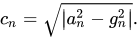
By definition,

Also

Then
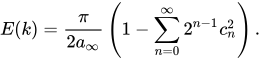
In practice, the arithmetic-geometric mean would simply be computed up to some limit. This formula converges quadratically for all |k| ≤ 1. To speed up computation further, the relation cn + 1 = cn2/4an + 1 can be used.
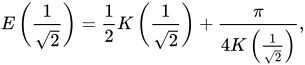
Furthermore, if k2 = λ(i√r) and (where λ is the modular lambda function), then E(k) is expressible in closed form in terms of and hence can be computed without the need for the infinite summation term. For example, r = 1, r = 3 and r = 7 give, respectively,[10]

and

and

Derivative and differential equation
[edit]
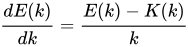

A second solution to this equation is E(√1 − k2) − K(√1 − k2).
Complete elliptic integral of the third kind
[edit]
The complete elliptic integral of the third kind Π can be defined as

Note that sometimes the elliptic integral of the third kind is defined with an inverse sign for the characteristic n,

Just like the complete elliptic integrals of the first and second kind, the complete elliptic integral of the third kind can be computed very efficiently using the arithmetic-geometric mean.[1]
Partial derivatives
[edit]
![{\displaystyle {\begin{aligned}{\frac {\partial \Pi (n,k)}{\partial n}}&={\frac {1}{2\left(k^{2}-n\right)(n-1)}}\left(E(k)+{\frac {1}{n}}\left(k^{2}-n\right)K(k)+{\frac {1}{n}}\left(n^{2}-k^{2}\right)\Pi (n,k)\right)\\[8pt]{\frac {\partial \Pi (n,k)}{\partial k}}&={\frac {k}{n-k^{2}}}\left({\frac {E(k)}{k^{2}-1}}+\Pi (n,k)\right)\end{aligned}}}](https://wikimedia.org/api/rest_v1/media/math/render/svg/9ebce786ea35739a3664eb489c14c514a1c4d602)
Jacobi zeta function
[edit]In 1829, Jacobi defined the Jacobi zeta function: It is periodic in with minimal period . It is related to the Jacobi zn function by . In the literature (e.g. Whittaker and Watson (1927)), sometimes means Wikipedia's . Some authors (e.g. King (1924)) use for both Wikipedia's and .






Legendre's relation
[edit]The Legendre's relation or Legendre Identity shows the relation of the integrals K and E of an elliptic modulus and its anti-related counterpart[11][12] in an integral equation of second degree:
For two modules that are Pythagorean counterparts to each other, this relation is valid:

For example:

And for two modules that are tangential counterparts to each other, the following relationship is valid:

For example:

The Legendre's relation for tangential modular counterparts results directly from the Legendre's identity for Pythagorean modular counterparts by using the Landen modular transformation on the Pythagorean counter modulus.
Special identity for the lemniscatic case
[edit]For the lemniscatic case, the elliptic modulus or specific eccentricity ε is equal to half the square root of two. Legendre's identity for the lemniscatic case can be proved as follows:
According to the Chain rule these derivatives hold:
![{\displaystyle {\frac {\mathrm {d} }{\mathrm {d} y}}\,K{\bigl (}{\frac {1}{2}}{\sqrt {2}}{\bigr )}-F{\biggl [}\arccos(xy);{\frac {1}{2}}{\sqrt {2}}{\biggr ]}={\frac {{\sqrt {2}}\,x}{\sqrt {1-x^{4}y^{4}}}}}](https://wikimedia.org/api/rest_v1/media/math/render/svg/7dc1718190eb8439c5553637893ee9656401692e)
![{\displaystyle {\frac {\mathrm {d} }{\mathrm {d} y}}\,2E{\bigl (}{\frac {1}{2}}{\sqrt {2}}{\bigr )}-K{\bigl (}{\frac {1}{2}}{\sqrt {2}}{\bigr )}-2E{\biggl [}\arccos(xy);{\frac {1}{2}}{\sqrt {2}}{\biggr ]}+F{\biggl [}\arccos(xy);{\frac {1}{2}}{\sqrt {2}}{\biggr ]}={\frac {{\sqrt {2}}\,x^{3}y^{2}}{\sqrt {1-x^{4}y^{4}}}}}](https://wikimedia.org/api/rest_v1/media/math/render/svg/51fd6c63925cf33e09dd212d2f2855ee54c35a9e)
By using the Fundamental theorem of calculus these formulas can be generated:
![{\displaystyle K{\bigl (}{\frac {1}{2}}{\sqrt {2}}{\bigr )}-F{\biggl [}\arccos(x);{\frac {1}{2}}{\sqrt {2}}{\biggr ]}=\int _{0}^{1}{\frac {{\sqrt {2}}\,x}{\sqrt {1-x^{4}y^{4}}}}\,\mathrm {d} y}](https://wikimedia.org/api/rest_v1/media/math/render/svg/58282761c03c55c3f20388ee7bf290e4dbc1df6a)
![{\displaystyle 2E{\bigl (}{\frac {1}{2}}{\sqrt {2}}{\bigr )}-K{\bigl (}{\frac {1}{2}}{\sqrt {2}}{\bigr )}-2E{\biggl [}\arccos(x);{\frac {1}{2}}{\sqrt {2}}{\biggr ]}+F{\biggl [}\arccos(x);{\frac {1}{2}}{\sqrt {2}}{\biggr ]}=\int _{0}^{1}{\frac {{\sqrt {2}}\,x^{3}y^{2}}{\sqrt {1-x^{4}y^{4}}}}\,\mathrm {d} y}](https://wikimedia.org/api/rest_v1/media/math/render/svg/199cf8df44d0d8a8724c407a1bc765265fa06832)
The Linear combination of the two now mentioned integrals leads to the following formula:
![{\displaystyle {\frac {\sqrt {2}}{\sqrt {1-x^{4}}}}{\biggl \{}2E{\bigl (}{\frac {1}{2}}{\sqrt {2}}{\bigr )}-K{\bigl (}{\frac {1}{2}}{\sqrt {2}}{\bigr )}-2E{\biggl [}\arccos(x);{\frac {1}{2}}{\sqrt {2}}{\biggr ]}+F{\biggl [}\arccos(x);{\frac {1}{2}}{\sqrt {2}}{\biggr ]}{\biggr \}}\,+}](https://wikimedia.org/api/rest_v1/media/math/render/svg/d2728dee1248dd6d671e14e2a97c8ba1ea1f9dc7)
![{\displaystyle +\,{\frac {{\sqrt {2}}\,x^{2}}{\sqrt {1-x^{4}}}}{\biggl \{}K{\bigl (}{\frac {1}{2}}{\sqrt {2}}{\bigr )}-F{\biggl [}\arccos(x);{\frac {1}{2}}{\sqrt {2}}{\biggr ]}{\biggr \}}=\int _{0}^{1}{\frac {2\,x^{3}(y^{2}+1)}{\sqrt {(1-x^{4})(1-x^{4}\,y^{4})}}}\,\mathrm {d} y}](https://wikimedia.org/api/rest_v1/media/math/render/svg/b57d166320807a046a01e07b470de52bfd40a80e)
By forming the original antiderivative related to x from the function now shown using the Product rule this formula results:
![{\displaystyle {\biggl \{}K{\bigl (}{\frac {1}{2}}{\sqrt {2}}{\bigr )}-F{\biggl [}\arccos(x);{\frac {1}{2}}{\sqrt {2}}{\biggr ]}{\biggr \}}{\biggl \{}2E{\bigl (}{\frac {1}{2}}{\sqrt {2}}{\bigr )}-K{\bigl (}{\frac {1}{2}}{\sqrt {2}}{\bigr )}-2E{\biggl [}\arccos(x);{\frac {1}{2}}{\sqrt {2}}{\biggr ]}+F{\biggl [}\arccos(x);{\frac {1}{2}}{\sqrt {2}}{\biggr ]}{\biggr \}}=}](https://wikimedia.org/api/rest_v1/media/math/render/svg/15e9f11c1f6b542a1f472fb7b974897d33203df1)
![{\displaystyle =\int _{0}^{1}{\frac {1}{y^{2}}}(y^{2}+1){\biggl [}{\text{artanh}}(y^{2})-{\text{artanh}}{\bigl (}{\frac {{\sqrt {1-x^{4}}}\,y^{2}}{\sqrt {1-x^{4}y^{4}}}}{\bigr )}{\biggr ]}\mathrm {d} y}](https://wikimedia.org/api/rest_v1/media/math/render/svg/b2503c8ea3948bd57fb32a6a33e02c60afcac539)
If the value is inserted in this integral identity, then the following identity emerges:

![{\displaystyle K{\bigl (}{\frac {1}{2}}{\sqrt {2}}{\bigr )}{\biggl [}2\,E{\bigl (}{\frac {1}{2}}{\sqrt {2}}{\bigr )}-K{\bigl (}{\frac {1}{2}}{\sqrt {2}}{\bigr )}{\biggr ]}=\int _{0}^{1}{\frac {1}{y^{2}}}(y^{2}+1)\,{\text{artanh}}(y^{2})\,\mathrm {d} y=}](https://wikimedia.org/api/rest_v1/media/math/render/svg/bb6222e15184d9633c7d6c2406698e6e018464ee)
![{\displaystyle ={\biggl [}2\arctan(y)-{\frac {1}{y}}(1-y^{2})\,{\text{artanh}}(y^{2}){\biggr ]}_{y=0}^{y=1}=2\arctan(1)={\frac {\pi }{2}}}](https://wikimedia.org/api/rest_v1/media/math/render/svg/ec66a7530dc2aacf368477e7fe3ee49ddc4c3273)
This is how this lemniscatic excerpt from Legendre's identity appears:

Generalization for the overall case
[edit]Now the modular general case[13][14] is worked out. For this purpose, the derivatives of the complete elliptic integrals are derived after the modulus and then they are combined. And then the Legendre's identity balance is determined.

Because the derivative of the circle function is the negative product of the identical mapping function and the reciprocal of the circle function:
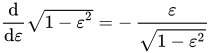
These are the derivatives of K and E shown in this article in the sections above:
![{\displaystyle {\frac {\mathrm {d} }{\mathrm {d} \varepsilon }}K(\varepsilon )={\frac {1}{\varepsilon (1-\varepsilon ^{2})}}{\bigl [}E(\varepsilon )-(1-\varepsilon ^{2})K(\varepsilon ){\bigr ]}}](https://wikimedia.org/api/rest_v1/media/math/render/svg/a8257c714bf0c36a8da6b69b079fb6aa68ca8779)
![{\displaystyle {\frac {\mathrm {d} }{\mathrm {d} \varepsilon }}E(\varepsilon )=-\,{\frac {1}{\varepsilon }}{\bigl [}K(\varepsilon )-E(\varepsilon ){\bigr ]}}](https://wikimedia.org/api/rest_v1/media/math/render/svg/4a9f0f2fa512b0426ff239625f6651b4cd519591)
In combination with the derivative of the circle function these derivatives are valid then:
![{\displaystyle {\frac {\mathrm {d} }{\mathrm {d} \varepsilon }}K({\sqrt {1-\varepsilon ^{2}}})={\frac {1}{\varepsilon (1-\varepsilon ^{2})}}{\bigl [}\varepsilon ^{2}K({\sqrt {1-\varepsilon ^{2}}})-E({\sqrt {1-\varepsilon ^{2}}}){\bigr ]}}](https://wikimedia.org/api/rest_v1/media/math/render/svg/bb0a0cfe27981a29e18422cdd2fabf9f4fe241ee)
![{\displaystyle {\frac {\mathrm {d} }{\mathrm {d} \varepsilon }}E({\sqrt {1-\varepsilon ^{2}}})={\frac {\varepsilon }{1-\varepsilon ^{2}}}{\bigl [}K({\sqrt {1-\varepsilon ^{2}}})-E({\sqrt {1-\varepsilon ^{2}}}){\bigr ]}}](https://wikimedia.org/api/rest_v1/media/math/render/svg/165f349634d534b3da323035a60dd50f249e26c1)
Legendre's identity includes products of any two complete elliptic integrals. For the derivation of the function side from the equation scale of Legendre's identity, the Product rule is now applied in the following:
![{\displaystyle {\frac {\mathrm {d} }{\mathrm {d} \varepsilon }}K(\varepsilon )E({\sqrt {1-\varepsilon ^{2}}})={\frac {1}{\varepsilon (1-\varepsilon ^{2})}}{\bigl [}E(\varepsilon )E({\sqrt {1-\varepsilon ^{2}}})-K(\varepsilon )E({\sqrt {1-\varepsilon ^{2}}})+\varepsilon ^{2}K(\varepsilon )K({\sqrt {1-\varepsilon ^{2}}}){\bigr ]}}](https://wikimedia.org/api/rest_v1/media/math/render/svg/f346b9a656f98160dcbf47164685c470bf227ca1)
![{\displaystyle {\frac {\mathrm {d} }{\mathrm {d} \varepsilon }}E(\varepsilon )K({\sqrt {1-\varepsilon ^{2}}})={\frac {1}{\varepsilon (1-\varepsilon ^{2})}}{\bigl [}-E(\varepsilon )E({\sqrt {1-\varepsilon ^{2}}})+E(\varepsilon )K({\sqrt {1-\varepsilon ^{2}}})-(1-\varepsilon ^{2})K(\varepsilon )K({\sqrt {1-\varepsilon ^{2}}}){\bigr ]}}](https://wikimedia.org/api/rest_v1/media/math/render/svg/442ae2b56db1b68bee1c2b44535a248527fc2e32)
![{\displaystyle {\frac {\mathrm {d} }{\mathrm {d} \varepsilon }}K(\varepsilon )K({\sqrt {1-\varepsilon ^{2}}})={\frac {1}{\varepsilon (1-\varepsilon ^{2})}}{\bigl [}E(\varepsilon )K({\sqrt {1-\varepsilon ^{2}}})-K(\varepsilon )E({\sqrt {1-\varepsilon ^{2}}})-(1-2\varepsilon ^{2})K(\varepsilon )K({\sqrt {1-\varepsilon ^{2}}}){\bigr ]}}](https://wikimedia.org/api/rest_v1/media/math/render/svg/0981cb098ac4b82cb503bffa8964b0d92030ae8d)
Of these three equations, adding the top two equations and subtracting the bottom equation gives this result:
![{\displaystyle {\frac {\mathrm {d} }{\mathrm {d} \varepsilon }}{\bigl [}K(\varepsilon )E({\sqrt {1-\varepsilon ^{2}}})+E(\varepsilon )K({\sqrt {1-\varepsilon ^{2}}})-K(\varepsilon )K({\sqrt {1-\varepsilon ^{2}}}){\bigr ]}=0}](https://wikimedia.org/api/rest_v1/media/math/render/svg/19a6abc97b33945523271bd18bd396c52280c64a)
In relation to the the equation balance constantly gives the value zero.
The previously determined result shall be combined with the Legendre equation to the modulus that is worked out in the section before:

The combination of the last two formulas gives the following result:

Because if the derivative of a continuous function constantly takes the value zero, then the concerned function is a constant function. This means that this function results in the same function value for each abscissa value and the associated function graph is therefore a horizontal straight line.
See also
[edit]
References
[edit]Notes
[edit]- ^ K can be analytically extended to the complex plane.
References
[edit]- ^ a b c Carlson 2010, 19.8.
- ^ Borwein, Jonathan M.; Borwein, Peter B. (1987). Pi and the AGM: A Study in Analytic Number Theory and Computational Complexity (First ed.). Wiley-Interscience. ISBN 0-471-83138-7. p. 296
- ^ Borwein, Jonathan M.; Borwein, Peter B. (1987). Pi and the AGM: A Study in Analytic Number Theory and Computational Complexity (First ed.). Wiley-Interscience. ISBN 0-471-83138-7. p. 298
- ^ Chowla, S.; Selberg, A. (1949). "On Epstein's Zeta Function (I)". Proceedings of the National Academy of Sciences. 35 (7): 373. Bibcode:1949PNAS...35..371C. doi:10.1073/PNAS.35.7.371. PMC 1063041. PMID 16588908. S2CID 45071481.
- ^ Chowla, S.; Selberg, A. (1967). "On Epstein's Zeta-Function". Journal für die Reine und Angewandte Mathematik. 227: 86–110.
- ^ "Legendre elliptic integrals (Entry 175b7a)".
- ^ N.Bagis,L.Glasser.(2015)"Evaluations of a Continued fraction of Ramanujan". Rend.Sem.Mat.Univ.Padova, Vol.133 pp 1-10
- ^ "Approximations of Jacobi theta functions". The Mathematical Functions Grimoire. Fredrik Johansson. Retrieved August 29, 2024.
- ^ "Complete elliptic integral of the second kind: Series representations (Formula 08.01.06.0002)".
- ^ Borwein, Jonathan M.; Borwein, Peter B. (1987). Pi and the AGM: A Study in Analytic Number Theory and Computational Complexity (First ed.). Wiley-Interscience. ISBN 0-471-83138-7. p. 26, 161
- ^ "Legendre-Relation" (in German). Retrieved 2022-11-29.
- ^ "Legendre Relation". Retrieved 2022-11-29.
- ^ "integration - Proving Legendres Relation for elliptic curves". Retrieved 2023-02-10.
- ^ Internet Archive (1991), Paul Halmos celebrating 50 years of mathematics, New York : Springer-Verlag, ISBN 0-387-97509-8, retrieved 2023-02-10
Sources
[edit]- Abramowitz, Milton; Stegun, Irene Ann, eds. (1983) [June 1964]. "Chapter 17". Handbook of Mathematical Functions with Formulas, Graphs, and Mathematical Tables. Applied Mathematics Series. Vol. 55 (Ninth reprint with additional corrections of tenth original printing with corrections (December 1972); first ed.). Washington D.C.; New York: United States Department of Commerce, National Bureau of Standards; Dover Publications. p. 587. ISBN 978-0-486-61272-0. LCCN 64-60036. MR 0167642. LCCN 65-12253.
- Byrd, P. F.; Friedman, M.D. (1971). Handbook of Elliptic Integrals for Engineers and Scientists (2nd ed.). New York: Springer-Verlag. ISBN 0-387-05318-2.
- Carlson, B. C. (1995). "Numerical Computation of Real or Complex Elliptic Integrals". Numerical Algorithms. 10 (1): 13–26. arXiv:math/9409227. Bibcode:1995NuAlg..10...13C. doi:10.1007/BF02198293. S2CID 11580137.
- Carlson, B. C. (2010), "Elliptic integral", in Olver, Frank W. J.; Lozier, Daniel M.; Boisvert, Ronald F.; Clark, Charles W. (eds.), NIST Handbook of Mathematical Functions, Cambridge University Press, ISBN 978-0-521-19225-5, MR 2723248.
- Erdélyi, Arthur; Magnus, Wilhelm; Oberhettinger, Fritz; Tricomi, Francesco G. (1953). Higher transcendental functions. Vol II (PDF). McGraw-Hill Book Company, Inc., New York-Toronto-London. MR 0058756. Archived from the original (PDF) on 2011-07-14. Retrieved 2016-07-24.
- Gradshteyn, Izrail Solomonovich; Ryzhik, Iosif Moiseevich; Geronimus, Yuri Veniaminovich; Tseytlin, Michail Yulyevich; Jeffrey, Alan (2015) [October 2014]. "8.1.". In Zwillinger, Daniel; Moll, Victor Hugo (eds.). Table of Integrals, Series, and Products. Translated by Scripta Technica, Inc. (8 ed.). Academic Press, Inc. ISBN 978-0-12-384933-5. LCCN 2014010276.
- Greenhill, Alfred George (1892). The applications of elliptic functions. New York: Macmillan.
- Hancock, Harris (1910). Lectures on the Theory of Elliptic Functions. New York: J. Wiley & sons.
- King, Louis V. (1924). On The Direct Numerical Calculation Of Elliptic Functions And Integrals. Cambridge University Press.
- Press, W. H.; Teukolsky, S. A.; Vetterling, W. T.; Flannery, B. P. (2007), "Section 6.12. Elliptic Integrals and Jacobian Elliptic Functions", Numerical Recipes: The Art of Scientific Computing (3rd ed.), New York: Cambridge University Press, ISBN 978-0-521-88068-8, archived from the original on 2011-08-11, retrieved 2011-08-09
External links
[edit]
- "Elliptic integral", Encyclopedia of Mathematics, EMS Press, 2001 [1994]
- Eric W. Weisstein, "Elliptic Integral" (Mathworld)
- Matlab code for elliptic integrals evaluation by elliptic project
- Rational Approximations for Complete Elliptic Integrals (Exstrom Laboratories)
- A Brief History of Elliptic Integral Addition Theorems
| International | |
|---|---|
| Other | |

Elliptic integral
View on GrokipediaIntroduction and Fundamentals
Definition and Motivation
Elliptic integrals originate from classical problems in geometry and mechanics, particularly the computation of arc lengths for curves such as ellipses and lemniscates, as well as the period of oscillation for a simple pendulum. These integrals arise when attempting to find the exact length of an elliptical arc or the time for a pendulum to swing through large angles, where the resulting expressions cannot be simplified using basic algebraic operations or standard transcendental functions. In the 17th and 18th centuries, mathematicians encountered these forms while addressing practical challenges, such as determining the perimeter of an ellipse, which motivated the development of new analytical tools beyond elementary integration techniques.[8][9][10] The general form of an elliptic integral is given by where is a rational function and is a cubic or quartic polynomial with no repeated roots. This structure captures the essential feature of these integrals: the presence of a square root of a polynomial of degree three or four in the integrand, which prevents reduction to elementary antiderivatives. Equivalently, it can be expressed as where is cubic or quartic with simple zeros, and is rational in and with at least one odd power of .[11][12] Unlike integrals that yield expressions in terms of polynomials, exponentials, logarithms, or trigonometric functions—known as elementary functions—elliptic integrals require the definition of special functions to represent their values, as they are non-elementary in general. This distinction became evident through 19th-century proofs showing that such integrals cannot be expressed using finite combinations of elementary operations, necessitating the introduction of elliptic functions as inverses to parametrize solutions. The motivation for studying them thus lies in their fundamental role in solving differential equations and geometric problems that elementary methods fail to address.[11][10]Historical Development
The study of elliptic integrals began in the 17th century amid efforts to compute arc lengths of non-circular curves, particularly ellipses. In 1655–1656, John Wallis provided the first systematic investigation in his Arithmetica Infinitorum, deriving an infinite series expansion for the arc length of an ellipse.[8] Earlier, Pierre de Fermat had issued challenges on curve rectification, such as finding lengths of spirals and other transcendental curves, which indirectly spurred interest in these geometric problems.[13] Leonhard Euler advanced the field in the 1760s by relating elliptic integrals to his newly developed beta and gamma functions, enabling evaluations of specific cases, and by reducing diverse integral forms to more standardized expressions through addition theorems.[14] Adrien-Marie Legendre then systematized the theory between 1786 and 1811, starting with his Mémoire sur les intégrations par arcs d'ellipse (1786), where he analyzed integrations involving elliptic arcs, followed by a second memoir in 1786 and extensions in later works that defined complete elliptic integrals in a unified framework.[15] The 19th century saw transformative progress through connections to elliptic functions. Niels Henrik Abel, in 1827, proved the addition theorem for elliptic integrals of the first kind, revealing their invertibility to yield doubly periodic functions.[16] Carl Gustav Jacob Jacobi independently developed this inversion in his Fundamenta Nova Theoriae Functionum Ellipticarum (1829), introducing the Jacobi elliptic functions and exploring their properties extensively.[17] Karl Weierstrass further refined the theory in the 1850s and 1860s, formulating elliptic functions via the Weierstrass ℘-function and its associates, which established rigorous foundations linking to modular forms and complex analysis.[18] In the 20th century, emphasis shifted to computational aspects and practical applications in physics and engineering. Paul F. Byrd and Morris D. Friedman's Handbook of Elliptic Integrals for Engineers and Physicists (1954) compiled extensive tables and reduction formulas for numerical evaluation.[19] This was followed by the comprehensive treatment in Milton Abramowitz and Irene A. Stegun's Handbook of Mathematical Functions (1964), published by the National Bureau of Standards (now NIST), which integrated elliptic integrals into broader special function theory with algorithms suited for mid-century computing needs.[20]Notation and Parameters
Argument Conventions
In elliptic integrals, the modulus is a fundamental parameter, typically restricted to real values satisfying to ensure the integrals converge and remain real-valued for principal branches.[21] The complementary modulus is defined as , providing a symmetric counterpart useful in transformations and complementary integrals.[21] Additionally, the parameter is commonly employed in computational contexts and historical handbooks, offering a squared form that simplifies certain algebraic manipulations. For incomplete elliptic integrals, the amplitude serves as the upper limit of integration, representing a real or complex angle, while the argument parameterizes the integrand's trigonometric component.[21] This substitution aligns the integral with arc length problems on ellipses, where corresponds to the eccentric anomaly. Standard notations distinguish between forms introduced by Legendre and those refined by Jacobi. Legendre's notation for incomplete integrals uses , , and for the first, second, and third kinds, respectively, with the parameter in the third kind.[22] Jacobi's notation modifies this by introducing a vertical bar to separate the amplitude from the modulus: , , and , where , enhancing clarity in expressions involving elliptic functions.[22] These notations transitioned from Legendre's comma-separated arguments in his 18th-century treatises to the modern bar convention popularized by Jacobi in the 19th century, standardizing usage in analytic number theory and physics.[22] Conventions for arguments extend to complex domains, where , , and may be complex, with principal branches defined via phase restrictions such as .[21] Branch cuts are typically placed along for the modulus to avoid singularities in the square roots, ensuring analytic continuation while preserving the principal value for real arguments in the unit disk.[21] Square roots throughout adopt the principal branch with non-negative real part, facilitating consistent evaluation in software libraries and theoretical derivations.[21]Modular Transformations
Modular transformations refer to a class of symmetries and parameter substitutions for the modulus (or equivalently the parameter ) in elliptic integrals that relate the value of an integral with modulus to one with a transformed modulus, often facilitating numerical computation or revealing structural properties.[23] These transformations preserve the elliptic nature of the functions and are rooted in the historical work of mathematicians like John Landen and Carl Friedrich Gauss.[23] The complementary modulus is defined as , providing a fundamental relation that connects elliptic integrals with to those with .[21] A key connection formula arises in the addition theorems, where for the incomplete elliptic integral of the first kind, , with .[24] This relation explicitly incorporates the complementary modulus and links the amplitude to a transformed angle , enabling the expression of the integral in terms of complementary quantities. Similar relations hold for the second and third kinds: and , where and depend on .[24] These formulas highlight how the complementary modulus facilitates decomposition and symmetry in the integrals.[24] The Landen transformation, discovered by John Landen in the 18th century, provides quadratic transformations that relate elliptic integrals with modulus to those with a derived modulus .[23] For the descending Landen transformation, the angle transforms as , yielding relations such as and for complete integrals, , .[23] The ascending Landen transformation reverses this, mapping to a larger modulus with , giving [23] These transformations are particularly useful for accelerating convergence in series expansions or iterative methods like the arithmetic-geometric mean.[23] Gauss's transformation, developed by Carl Friedrich Gauss, offers a variant of the descending quadratic transformation with the same modulus shift but a different angle adjustment: , where .[23] The relations are [23] This form is equivalent to the descending Landen in many applications but provides an alternative for numerical stability, especially in reducing the modulus for computation.[23] Gauss extensively used these in his work on the arithmetic-geometric mean, linking them to evaluations of complete integrals.[23] The imaginary modulus transformation extends these symmetries to complex moduli, relating an integral with imaginary modulus (where is real, ) to one with real modulus and complementary .[25] Specifically, where . For the second kind, and for the third kind, with .[25] This transformation, equivalent to substituting in certain conventions, allows evaluation of integrals outside the real modulus range by reducing to real cases.[25] Periodicity in modular transformations emerges through the elliptic modular functions, which invert the complete elliptic integrals. The ratio serves as a modular parameter in the upper half-plane, and the elliptic modular lambda function satisfies transformation laws under the modular group SL(2, ).[26] For a matrix SL(2, ), up to transformations like , , or , ensuring invariance under the group action.[26] This periodicity reflects the doubly periodic nature of elliptic functions, with the complete integrals and defining the periods, and the modular functions providing the inverse mapping from to .[26] Such relations underscore the deep connection between elliptic integrals and modular forms, with applications in number theory and complex analysis.[26]Incomplete Elliptic Integrals
Of the First Kind
The incomplete elliptic integral of the first kind, denoted , provides the foundational form for elliptic integrals of this type and is defined for and as An equivalent representation substitutes , yielding This function appears in problems involving arc lengths of ellipses and periods of pendulums with large amplitudes.[21]Of the Second Kind
The incomplete elliptic integral of the second kind, denoted , is defined for and as An equivalent representation substitutes , yielding This function arises in applications such as the arc length of an ellipse.[21]Of the Third Kind
The incomplete elliptic integral of the third kind, denoted , is defined for , , and suitable to ensure convergence as An equivalent representation substitutes , yielding This function appears in more complex scenarios, such as perturbations in orbital mechanics.[21]Complete Elliptic Integrals
Of the First Kind
The complete elliptic integral of the first kind, denoted , is defined for as and plays a central role in the theory of elliptic functions, where it determines the quarter-periods, as well as in the convergence of the arithmetic-geometric mean iteration for numerical evaluation.[21][23] It admits a representation in terms of the Gauss hypergeometric function, K(k) = \frac{\pi}{2} \, _2F_1\left( \frac{1}{2}, \frac{1}{2}; 1; k^2 \right), which connects it to broader classes of special functions.[25] Additionally, possesses an integral form that extends the beta function , recovering and thus when .[25] The Landen transformation further relates to at a transformed modulus , via , enabling efficient recursive computations.[23] As the modulus , with complementary modulus , exhibits a logarithmic singularity, This behavior reflects the increasing "flatness" of the integrand near the endpoint, making diverge slowly.[27] The function satisfies the second-order linear differential equation derived from its hypergeometric structure and verifiable by direct differentiation of the integral definition.[28] This equation, along with its hypergeometric form where and , underscores its classification within Gauss's hypergeometric differential equation.[29]Of the Second Kind
The complete elliptic integral of the second kind, denoted , is defined for as where is the elliptic modulus. This function also admits a representation in terms of the Gauss hypergeometric function: E(k) = \frac{\pi}{2} \, _2F_1\left(-\frac{1}{2}, \frac{1}{2}; 1; k^2\right). It arises prominently in applications such as the exact perimeter of an ellipse with semi-major axis and eccentricity , given by , and in orbital mechanics for computing arc lengths in elliptic trajectories.[20] The derivative of with respect to the modulus relates it to the complete elliptic integral of the first kind : For small values of , an asymptotic series expansion provides a useful approximation: This expansion follows directly from the hypergeometric series, highlighting how approaches as , corresponding to the circular limit where the integral simplifies to the quarter-circumference. Numerical evaluation of benefits from the arithmetic-geometric mean (AGM) iteration, a highly efficient method due to its quadratic convergence. Start with , , and iterate , . Then, This formula, derived from quadratic transformations, allows precise computation with few iterations, distinguishing from by incorporating a corrective sum that reflects its role in length computations rather than periods. For , , underscoring the geometric interpretation of as an averaged arc length element.Of the Third Kind
The complete elliptic integral of the third kind, denoted , arises in applications involving weighted contributions, such as certain gravitational or electromagnetic potentials where an additional linear parameter modifies the integrand. It is defined as where is the elliptic modulus with , and is the characteristic parameter with to ensure the integrand is positive.[30] This form extends the integrals of the first and second kinds by incorporating the factor in the denominator, allowing for non-uniform weighting in the integration. Differentiating the defining integral with respect to the characteristic yields the partial derivative which follows directly from interchanging differentiation and integration under the standard conditions for convergence. This relation highlights the integral's sensitivity to the parameter and is useful in deriving further identities or approximations.Properties and Identities
Differential Equations
The complete elliptic integrals of the first and second kind satisfy second-order linear differential equations in the elliptic modulus . These equations arise from the hypergeometric representation of the integrals and highlight their analytic structure as special functions. The complete elliptic integral of the first kind satisfies which is obtained by transforming the Gauss hypergeometric differential equation with parameters , , and , since K(k) = \frac{\pi}{2} \, _2F_1(1/2, 1/2; 1; k^2). Similarly, the complete elliptic integral of the second kind satisfies derived analogously from the hypergeometric differential equation with parameters , , , and , as E(k) = \frac{\pi}{2} \, _2F_1(-1/2, 1/2; 1; k^2). For incomplete elliptic integrals, the differential equation in the modulus for fixed amplitude takes a hypergeometric form when , reducing to the complete cases above; in general, satisfies the inhomogeneous linear second-order equation reflecting the parameter dependence. Elliptic integrals are also linked to the Lamé equation, a second-order linear Sturm-Liouville equation where is the Jacobi elliptic sine, the inverse of via . This equation emerges in quantum mechanics, notably in the quantum Euler top, where solutions involve elliptic functions built from elliptic integrals.Legendre's Relation
Legendre's relation provides an exact identity linking the complete elliptic integrals of the first kind and second kind with their complementary counterparts and , where the complementary modulus is defined as . The relation states that This identity, first established by Adrien-Marie Legendre in his comprehensive work on elliptic functions, holds for and is fundamental in verifying numerical computations and deriving further properties of elliptic integrals. A proof of the relation can be sketched using integration by parts on the integral representations. Start with the definitions and . By differentiating with respect to under the integral sign and applying integration by parts, one obtains terms that combine to yield the left-hand side of the identity after substitution and simplification, equaling from the limiting case as . Alternatively, the relation follows from identities involving the beta function, as the elliptic integrals admit representations in terms of the incomplete beta function, leading to the desired equality through known transformation formulas. In the special lemniscatic case where (so ), the relation simplifies to , and the value of is given explicitly by with following from the relation. This case arises in the rectification of the lemniscate of Bernoulli and connects elliptic integrals to the gamma function via the hypergeometric representation , evaluated at . The relation extends to the complete elliptic integrals of the third kind through differentiation with respect to the characteristic parameter . Specifically, differentiating the core identity with respect to a parameter that introduces the third-kind form yields analogous relations, such as connections between , , and the first- and second-kind integrals, often expressed using symmetric elliptic integrals like . These generalizations preserve the structural form and are useful in applications requiring parameter variations.[31]Asymptotic Approximations
Asymptotic approximations for complete elliptic integrals are essential for numerical evaluation in limiting cases, particularly when the modulus approaches 0 or 1, where direct integration becomes inefficient. These expansions provide series representations that converge rapidly in their respective regimes, facilitating high-precision computations without evaluating the full integral.[27] For the complete elliptic integral of the first kind as , where approaches 0, the leading behavior is logarithmic due to the singularity at : This asymptotic series, derived from the hypergeometric representation, converges for and captures the divergent nature of as the modulus nears unity. A more complete expansion involves a sum over Pochhammer symbols: with and , ensuring the leading term matches . Similarly, for the complete elliptic integral of the second kind as , the function approaches 1 with a correction involving : The full series is which remains bounded and provides accurate approximations near the singularity. These expansions are particularly useful in physical applications where is close to 1, such as in pendulum dynamics or electrostatics.[27] In the opposite limit, as , both and admit power series expansions around , reflecting their hypergeometric origins. For , valid for , with the full series . This Taylor series converges slowly for moderate but excels for small moduli, as in approximations for weakly eccentric orbits. For , with the series . At , both reduce to , corresponding to circular cases in geometric interpretations.[32] To bridge these limits and achieve uniform approximations over the full range , rational and polynomial methods such as Padé approximants and Chebyshev expansions are employed. Padé approximants, which match the Taylor series at to higher order than Taylor polynomials, yield rational functions with maximal errors below for degrees up to (13,13); for instance, approximations derived from the integrand's square root provide explicit rational forms for and .[33] Chebyshev polynomial expansions, minimizing uniform error on after variable substitution, offer coefficients for and with errors as low as for degree-20 approximants, making them suitable for software implementations.[34] These techniques prioritize accuracy across the domain, avoiding divergence issues in endpoint asymptotics.90032-0)Related Functions and Applications
Jacobi Zeta Function
The Jacobi zeta function, denoted , is defined in terms of Legendre's incomplete elliptic integrals as where is the incomplete elliptic integral of the first kind, is the incomplete elliptic integral of the second kind, , and .[35][36] This definition arises from the work of C. G. J. Jacobi in the early 19th century on inverting elliptic integrals to form elliptic functions.[37] Equivalently, in terms of the elliptic amplitude , the function takes the form , where is Jacobi's epsilon function given by .[36] An explicit integral representation follows directly from differentiation: This form highlights its connection to the difference between the integrands of the second and first kinds, scaled appropriately.[21] At the quarter-period, , reflecting the normalization by the complete integrals.[35] The Jacobi zeta function exhibits periodicity with period in the -argument: .[36] It also satisfies a half-period shift: .[36] A Fourier series expansion provides an alternative representation for computational purposes: where involves hypergeometric functions derived from series expansions of the underlying elliptic integrals.[38] The function relates to the Weierstrass zeta function through standard equivalences in elliptic function theory, where transformations between Jacobi and Weierstrass forms preserve modular invariance under the action of the modular group SL(2, ℤ).[39] Specifically, expressions involving Jacobi zeta can be mapped to Weierstrass zeta via theta function identities, facilitating interchanges in modular form applications.[40]Geometric and Physical Applications
Elliptic integrals find prominent applications in geometry, particularly in computing exact arc lengths of curves that cannot be expressed in elementary functions. The perimeter of an ellipse with semimajor axis and semiminor axis is given by , where is the eccentricity and is the complete elliptic integral of the second kind.[41] This formula arises from parametrizing the ellipse as , and integrating the arc length element, yielding an elliptic integral that accounts for the curve's deviation from a circle. Similarly, the lemniscate constant , which represents the arc length of one loop of the lemniscate of Bernoulli from the origin to its node, is expressed as , where is the gamma function; this integral is a special case of the complete elliptic integral of the first kind evaluated at modulus .[42][43] In classical mechanics, elliptic integrals describe the dynamics of oscillatory systems with nonlinear restoring forces. For a simple pendulum of length and maximum angular displacement , the period is , where is gravitational acceleration, , and is the complete elliptic integral of the first kind; this exact expression corrects the small-angle approximation for large amplitudes.[2] In orbital mechanics, elliptic integrals appear in the Kepler problem for bound elliptical orbits, where they facilitate the computation of time-of-flight between orbital elements such as true anomaly or eccentric anomaly, particularly in integral solutions to Kepler's equation that express mean anomaly as a contour integral reducible to elliptic forms.[44] Modern applications extend elliptic integrals to computational number theory and theoretical physics. Carl Friedrich Gauss developed the arithmetic-geometric mean (AGM) iteration, which evaluates the complete elliptic integral of the first kind via the relation , enabling efficient approximations for , particularly for special values like connected to the lemniscate constant, and supporting rapid high-precision computations historically and in numerical algorithms today.[45] In random matrix theory, elliptic integrals arise in the exact evaluation of spectral densities for sums of Hermitian random matrices, such as in models of the Potts model on random planar maps, where moments of the eigenvalue distribution involve complete elliptic integrals of the first and second kinds to capture phase transitions and universality classes.[46] In string theory, elliptic integrals parameterize integrals over moduli spaces of Riemann surfaces, notably in Feynman integral computations for scattering amplitudes on elliptic curves and K3 surfaces, linking non-perturbative effects to modular forms and mirror symmetry in Calabi-Yau compactifications.[47][48] Numerical libraries implement elliptic integrals for solving differential equations and simulations in these fields. SciPy'sscipy.special module provides functions like ellipk(m) for the complete elliptic integral of the first kind and ellipe(m) for the second kind, alongside incomplete and symmetric variants, enabling applications in pendulum dynamics and orbital propagation via vectorized computations.[49] Mathematica offers comprehensive support through functions such as EllipticK[m], EllipticE[φ, m], and EllipticPi[n, φ, m], with arbitrary-precision evaluation for complex parameters, facilitating exact solutions in geometric and physical modeling.[50]