



Community hub
Recent from talks
Contribute something to knowledge base
Content stats: 0 posts, 0 articles, 1 media, 0 notes
Members stats: 0 subscribers, 0 contributors, 0 moderators, 0 supporters
Subscribers
Supporters
Contributors
Moderators
Hub AI
Hip replacement AI simulator
(@Hip replacement_simulator)
Hub AI
Hip replacement AI simulator
(@Hip replacement_simulator)
Hip replacement
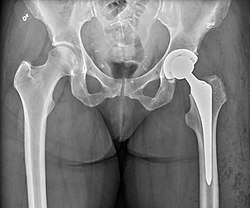
Hip replacement is a surgical procedure in which the hip joint is replaced by a prosthetic implant, that is, a hip prosthesis. Hip replacement surgery can be performed as a total replacement or a hemi/semi(half) replacement. Such joint replacement orthopaedic surgery is generally conducted to relieve arthritis pain or in some hip fractures. A total hip replacement (total hip arthroplasty) consists of replacing both the acetabulum and the femoral head while hemiarthroplasty generally only replaces the femoral head. Hip replacement is one of the most common orthopaedic operations. Patient satisfaction varies widely between different techniques and implants. Approximately 58% of total hip replacements are estimated to last 25 years. The average cost of a total hip replacement in 2012 was $40,364 in the United States (about €37,300 euros), and in the range of €7,117 to €11,091 in most European countries.
Total hip replacement is most commonly used to treat joint failure caused by osteoarthritis. Other indications include rheumatoid arthritis, avascular necrosis, traumatic arthritis, protrusio acetabuli, certain hip fractures, benign and malignant bone tumors, arthritis associated with Paget's disease, ankylosing spondylitis and juvenile rheumatoid arthritis. The aims of the procedure are pain relief and improvement in hip function. Hip replacement is usually considered only after other therapies, such as physical therapy and pain medications, have failed.
Hip replacement provides significantly better results than exercise training in terms of reducing pain 6 months afterwards. It is possible to play high-level sport after hip resurfacing, or even play professional tennis (Andy Murray) or baseball (Bo Jackson). People who have had hip replacements generally have reduced death rates than the matched population for 10 years after surgery, but rates then increase from 11 years onwards. For this reason it is sometimes argued that the age group 65-80 is the best time to consider having a hip replacement if activity is being severely curtailed by hip pain. Hip resurfacing is a less invasive type of hip replacement that may be more suitable for younger patients.
Risks and complications in hip replacement are similar to those associated with all joint replacements. They can include infection, dislocation, limb length inequality, loosening, impingement, osteolysis, metal sensitivity, nerve palsy, chronic pain and death. Weight loss surgery before a hip replacement does not appear to change outcomes.
Edema appears around the hip in the hours or days following the surgery. This swelling is typically at its maximum 7 days after the operation, then decreases and disappears over the course of weeks. Only 5% of patients still have swelling 6 months after the operation.
Dislocation (the ball coming out of the socket) is one of the most common complications. Hip prosthesis dislocation mostly occurs in the first three months after insertion, mainly because of incomplete scar formation and relaxed soft tissues. The chance of this is diminished if less tissue is cut, if the cut tissue is repaired and if large diameter head balls are used. Surgeons who perform more operations tend to have fewer dislocations. Important factors which are related to dislocation are: component positioning, preservation of the gluteal muscles and restoration of leg length and femoral offset. Keeping the leg out of certain positions during the first few months after surgery further reduces risk.[medical citation needed]
Dislocations occurring between three months and five years after insertion usually occur due to malposition of the components, or dysfunction of nearby muscles. Risk factors of late dislocation (after five years) mainly include:
Infection is one of the most common causes for revision of a total hip replacement. A 2009 study found that the incidence of infection in primary hip replacement was 1% or less in the United States. Risk factors for infection include obesity, diabetes, smoking, immunosuppressive medications or diseases, history of infection and previous hip surgery.
Hip replacement
Hip replacement is a surgical procedure in which the hip joint is replaced by a prosthetic implant, that is, a hip prosthesis. Hip replacement surgery can be performed as a total replacement or a hemi/semi(half) replacement. Such joint replacement orthopaedic surgery is generally conducted to relieve arthritis pain or in some hip fractures. A total hip replacement (total hip arthroplasty) consists of replacing both the acetabulum and the femoral head while hemiarthroplasty generally only replaces the femoral head. Hip replacement is one of the most common orthopaedic operations. Patient satisfaction varies widely between different techniques and implants. Approximately 58% of total hip replacements are estimated to last 25 years. The average cost of a total hip replacement in 2012 was $40,364 in the United States (about €37,300 euros), and in the range of €7,117 to €11,091 in most European countries.
Total hip replacement is most commonly used to treat joint failure caused by osteoarthritis. Other indications include rheumatoid arthritis, avascular necrosis, traumatic arthritis, protrusio acetabuli, certain hip fractures, benign and malignant bone tumors, arthritis associated with Paget's disease, ankylosing spondylitis and juvenile rheumatoid arthritis. The aims of the procedure are pain relief and improvement in hip function. Hip replacement is usually considered only after other therapies, such as physical therapy and pain medications, have failed.
Hip replacement provides significantly better results than exercise training in terms of reducing pain 6 months afterwards. It is possible to play high-level sport after hip resurfacing, or even play professional tennis (Andy Murray) or baseball (Bo Jackson). People who have had hip replacements generally have reduced death rates than the matched population for 10 years after surgery, but rates then increase from 11 years onwards. For this reason it is sometimes argued that the age group 65-80 is the best time to consider having a hip replacement if activity is being severely curtailed by hip pain. Hip resurfacing is a less invasive type of hip replacement that may be more suitable for younger patients.
Risks and complications in hip replacement are similar to those associated with all joint replacements. They can include infection, dislocation, limb length inequality, loosening, impingement, osteolysis, metal sensitivity, nerve palsy, chronic pain and death. Weight loss surgery before a hip replacement does not appear to change outcomes.
Edema appears around the hip in the hours or days following the surgery. This swelling is typically at its maximum 7 days after the operation, then decreases and disappears over the course of weeks. Only 5% of patients still have swelling 6 months after the operation.
Dislocation (the ball coming out of the socket) is one of the most common complications. Hip prosthesis dislocation mostly occurs in the first three months after insertion, mainly because of incomplete scar formation and relaxed soft tissues. The chance of this is diminished if less tissue is cut, if the cut tissue is repaired and if large diameter head balls are used. Surgeons who perform more operations tend to have fewer dislocations. Important factors which are related to dislocation are: component positioning, preservation of the gluteal muscles and restoration of leg length and femoral offset. Keeping the leg out of certain positions during the first few months after surgery further reduces risk.[medical citation needed]
Dislocations occurring between three months and five years after insertion usually occur due to malposition of the components, or dysfunction of nearby muscles. Risk factors of late dislocation (after five years) mainly include:
Infection is one of the most common causes for revision of a total hip replacement. A 2009 study found that the incidence of infection in primary hip replacement was 1% or less in the United States. Risk factors for infection include obesity, diabetes, smoking, immunosuppressive medications or diseases, history of infection and previous hip surgery.
Recent media
Recent media