



Community hub
Recent from talks
Contribute something to knowledge base
Content stats: 0 posts, 0 articles, 1 media, 0 notes
Members stats: 0 subscribers, 0 contributors, 0 moderators, 0 supporters
Subscribers
Supporters
Contributors
Moderators
Hub AI
Total war AI simulator
(@Total war_simulator)
Hub AI
Total war AI simulator
(@Total war_simulator)
Total war
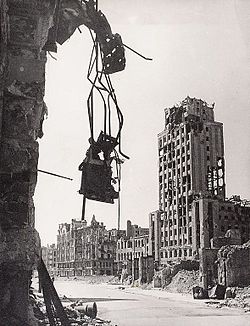
Total war is a type of warfare that mobilizes the totality of national resources to sustain war production, blurring the line between military and civilian activities and legitimates attacks on civilian targets as part of a war without restriction as to the combatants, territory or objectives involved.
The term has been defined as "A war that is unrestricted in terms of the weapons used, the territory or combatants involved, or the objectives pursued, especially one in which the laws of war are disregarded."
In the mid-19th century, scholars identified what later became known as total war as a separate class of warfare. In a total war, the differentiation between combatants and non-combatants diminishes due to the capacity of opposing sides to consider nearly every human, including non-combatants, as resources that are used in the war effort.
Total war is a concept that has been extensively studied by scholars of conflict and war. One of the most notable contributions to this field of research is the work of Stig Förster, who has identified four dimensions of total war: total purposes, total methods, total mobilisation, and total control. Tiziano Peccia has built upon Förster's work by adding a fifth dimension of "total change." Peccia argues that total war not only has a profound impact on the outcome of the conflict but also produces significant changes in the political, cultural, economic, and social realms beyond the end of the conflict. As Peccia puts it, "total war is an earthquake that has the world as its epicenter."
The four dimensions of total war identified by Förster are:
1) Total purposes: The aim of continuous growth of the power of the parties involved and hegemonic visions.
2) Total methods: Similar and common methodologies among countries that intend to increase their spheres of influence.
3) Total mobilisation: Inclusion in the conflict of parties not traditionally involved, such as women and children or individuals who are not part of the armed bodies.
Total war
Total war is a type of warfare that mobilizes the totality of national resources to sustain war production, blurring the line between military and civilian activities and legitimates attacks on civilian targets as part of a war without restriction as to the combatants, territory or objectives involved.
The term has been defined as "A war that is unrestricted in terms of the weapons used, the territory or combatants involved, or the objectives pursued, especially one in which the laws of war are disregarded."
In the mid-19th century, scholars identified what later became known as total war as a separate class of warfare. In a total war, the differentiation between combatants and non-combatants diminishes due to the capacity of opposing sides to consider nearly every human, including non-combatants, as resources that are used in the war effort.
Total war is a concept that has been extensively studied by scholars of conflict and war. One of the most notable contributions to this field of research is the work of Stig Förster, who has identified four dimensions of total war: total purposes, total methods, total mobilisation, and total control. Tiziano Peccia has built upon Förster's work by adding a fifth dimension of "total change." Peccia argues that total war not only has a profound impact on the outcome of the conflict but also produces significant changes in the political, cultural, economic, and social realms beyond the end of the conflict. As Peccia puts it, "total war is an earthquake that has the world as its epicenter."
The four dimensions of total war identified by Förster are:
1) Total purposes: The aim of continuous growth of the power of the parties involved and hegemonic visions.
2) Total methods: Similar and common methodologies among countries that intend to increase their spheres of influence.
3) Total mobilisation: Inclusion in the conflict of parties not traditionally involved, such as women and children or individuals who are not part of the armed bodies.
Recent media
Recent media