

Recent from talks
Trabecula
Knowledge base stats:
Talk channels stats:
Members stats:
Trabecula
A trabecula (pl.: trabeculae, from Latin for 'small beam') is a small, often microscopic, tissue element in the form of a small beam, strut or rod that supports or anchors a framework of parts within a body or organ. A trabecula generally has a mechanical function, and is usually composed of dense collagenous tissue (such as the trabecula of the spleen). It can be composed of other material such as muscle and bone. In the heart, muscles form trabeculae carneae and septomarginal trabeculae, and the left atrial appendage has a tubular trabeculated structure.
Cancellous bone is formed from groupings of trabeculated bone tissue. In cross section, trabeculae of a cancellous bone can look like septa, but in three dimensions they are topologically distinct, with trabeculae being roughly rod or pillar-shaped and septa being sheet-like.
When crossing fluid-filled spaces, trabeculae may offer the function of resisting tension (as in the penis, see for example trabeculae of corpora cavernosa and trabeculae of corpus spongiosum) or providing a cell filter (as in the trabecular meshwork of the eye).
Trabecular bone, also called cancellous bone, is porous bone composed of trabeculated bone tissue. It can be found at the ends of long bones like the femur, where the bone is actually not solid but is full of holes connected by thin rods and plates of bone tissue. The holes (the volume not directly occupied by bone trabecula) is the intertrabecular space, and is occupied by red bone marrow, where all the blood cells are made, as well as fibrous tissue. Even though trabecular bone contains a lot of intertrabecular space, its spatial complexity contributes the maximal strength with minimum mass. It is noted that the form and structure of trabecular bone are organized to optimally resist loads imposed by functional activities, like jumping, running and squatting. And according to Wolff's law, proposed in 1892, the external shape and internal architecture of bone are determined by external stresses acting on it. The internal structure of the trabecular bone firstly undergoes adaptive changes along stress direction and then the external shape of cortical bone undergoes secondary changes. Finally bone structure becomes thicker and denser to resist external loading.
Because of the increased occurrence of total joint replacement and its impact on bone remodeling, understanding the stress-related and adaptive process of trabecular bone has become a central concern for bone physiologists. To understand the role of trabecular bone in age-related bone structure and in the design for bone-implant systems, it is important to study the mechanical properties of trabecular bone as a function of variables such as anatomic site, bone density, and age related issues. Mechanical factors including modulus, uniaxial strength, and fatigue properties must be taken into account.
Typically, the porosity percent of trabecular bone is in the range 75–95% and the density ranges from 0.2 to 0.8 g/cm3. It is noted that the porosity can reduce the strength of the bone, but also reduce its weight. The porosity and the manner that porosity is structured affect the strength of material. Thus, the micro structure of trabecular bone is typically oriented and ''grain'' of porosity is aligned in a direction at which mechanical stiffness and strength are greatest. Because of the microstructural directionality, the mechanical properties of trabecular bone are highly anisotropic. The range of Young's modulus for trabecular bone is 800 to 14,000 MPa and the strength of failure is 1 to 100 MPa.
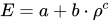
As mentioned above, the mechanical properties of trabecular bone are very sensitive to apparent density. The relationship between modulus of trabecular bone and its apparent density was demonstrated by Carter and Hayes in 1976. The resulting equation states:
Hub AI
Trabecula AI simulator
(@Trabecula_simulator)
Trabecula
A trabecula (pl.: trabeculae, from Latin for 'small beam') is a small, often microscopic, tissue element in the form of a small beam, strut or rod that supports or anchors a framework of parts within a body or organ. A trabecula generally has a mechanical function, and is usually composed of dense collagenous tissue (such as the trabecula of the spleen). It can be composed of other material such as muscle and bone. In the heart, muscles form trabeculae carneae and septomarginal trabeculae, and the left atrial appendage has a tubular trabeculated structure.
Cancellous bone is formed from groupings of trabeculated bone tissue. In cross section, trabeculae of a cancellous bone can look like septa, but in three dimensions they are topologically distinct, with trabeculae being roughly rod or pillar-shaped and septa being sheet-like.
When crossing fluid-filled spaces, trabeculae may offer the function of resisting tension (as in the penis, see for example trabeculae of corpora cavernosa and trabeculae of corpus spongiosum) or providing a cell filter (as in the trabecular meshwork of the eye).
Trabecular bone, also called cancellous bone, is porous bone composed of trabeculated bone tissue. It can be found at the ends of long bones like the femur, where the bone is actually not solid but is full of holes connected by thin rods and plates of bone tissue. The holes (the volume not directly occupied by bone trabecula) is the intertrabecular space, and is occupied by red bone marrow, where all the blood cells are made, as well as fibrous tissue. Even though trabecular bone contains a lot of intertrabecular space, its spatial complexity contributes the maximal strength with minimum mass. It is noted that the form and structure of trabecular bone are organized to optimally resist loads imposed by functional activities, like jumping, running and squatting. And according to Wolff's law, proposed in 1892, the external shape and internal architecture of bone are determined by external stresses acting on it. The internal structure of the trabecular bone firstly undergoes adaptive changes along stress direction and then the external shape of cortical bone undergoes secondary changes. Finally bone structure becomes thicker and denser to resist external loading.
Because of the increased occurrence of total joint replacement and its impact on bone remodeling, understanding the stress-related and adaptive process of trabecular bone has become a central concern for bone physiologists. To understand the role of trabecular bone in age-related bone structure and in the design for bone-implant systems, it is important to study the mechanical properties of trabecular bone as a function of variables such as anatomic site, bone density, and age related issues. Mechanical factors including modulus, uniaxial strength, and fatigue properties must be taken into account.
Typically, the porosity percent of trabecular bone is in the range 75–95% and the density ranges from 0.2 to 0.8 g/cm3. It is noted that the porosity can reduce the strength of the bone, but also reduce its weight. The porosity and the manner that porosity is structured affect the strength of material. Thus, the micro structure of trabecular bone is typically oriented and ''grain'' of porosity is aligned in a direction at which mechanical stiffness and strength are greatest. Because of the microstructural directionality, the mechanical properties of trabecular bone are highly anisotropic. The range of Young's modulus for trabecular bone is 800 to 14,000 MPa and the strength of failure is 1 to 100 MPa.
As mentioned above, the mechanical properties of trabecular bone are very sensitive to apparent density. The relationship between modulus of trabecular bone and its apparent density was demonstrated by Carter and Hayes in 1976. The resulting equation states:
Recent media