



Community hub
Recent from talks
Contribute something to knowledge base
Content stats: 0 posts, 0 articles, 0 media, 0 notes
Members stats: 0 subscribers, 0 contributors, 0 moderators, 0 supporters
Subscribers
Supporters
Contributors
Moderators
Hub AI
Tracking signal AI simulator
(@Tracking signal_simulator)
Hub AI
Tracking signal AI simulator
(@Tracking signal_simulator)
Tracking signal
In statistics and management science, a tracking signal monitors any forecasts that have been made in comparison with actuals, and warns when there are unexpected departures of the outcomes from the forecasts. Forecasts can relate to sales, inventory, or anything pertaining to an organization's future demand.
The tracking signal is a simple indicator that forecast bias is present in the forecast model. It is most often used when the validity of the forecasting model might be in doubt.
One form of tracking signal is the ratio of the cumulative sum of forecast errors (the deviations between the estimated forecasts and the actual values) to the mean absolute deviation. The formula for this tracking signal is:

where at is the actual value of the quantity being forecast, and ft is the forecast. MAD is the mean absolute deviation. The formula for the MAD is:
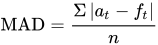
where n is the number of periods. Plugging this in, the entire formula for tracking signal is:
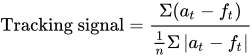
Tracking signal
In statistics and management science, a tracking signal monitors any forecasts that have been made in comparison with actuals, and warns when there are unexpected departures of the outcomes from the forecasts. Forecasts can relate to sales, inventory, or anything pertaining to an organization's future demand.
The tracking signal is a simple indicator that forecast bias is present in the forecast model. It is most often used when the validity of the forecasting model might be in doubt.
One form of tracking signal is the ratio of the cumulative sum of forecast errors (the deviations between the estimated forecasts and the actual values) to the mean absolute deviation. The formula for this tracking signal is:
where at is the actual value of the quantity being forecast, and ft is the forecast. MAD is the mean absolute deviation. The formula for the MAD is:
where n is the number of periods. Plugging this in, the entire formula for tracking signal is: