



Community hub
Recent from talks
Knowledge base stats:
Talk channels stats:
Members stats:
Protectionism
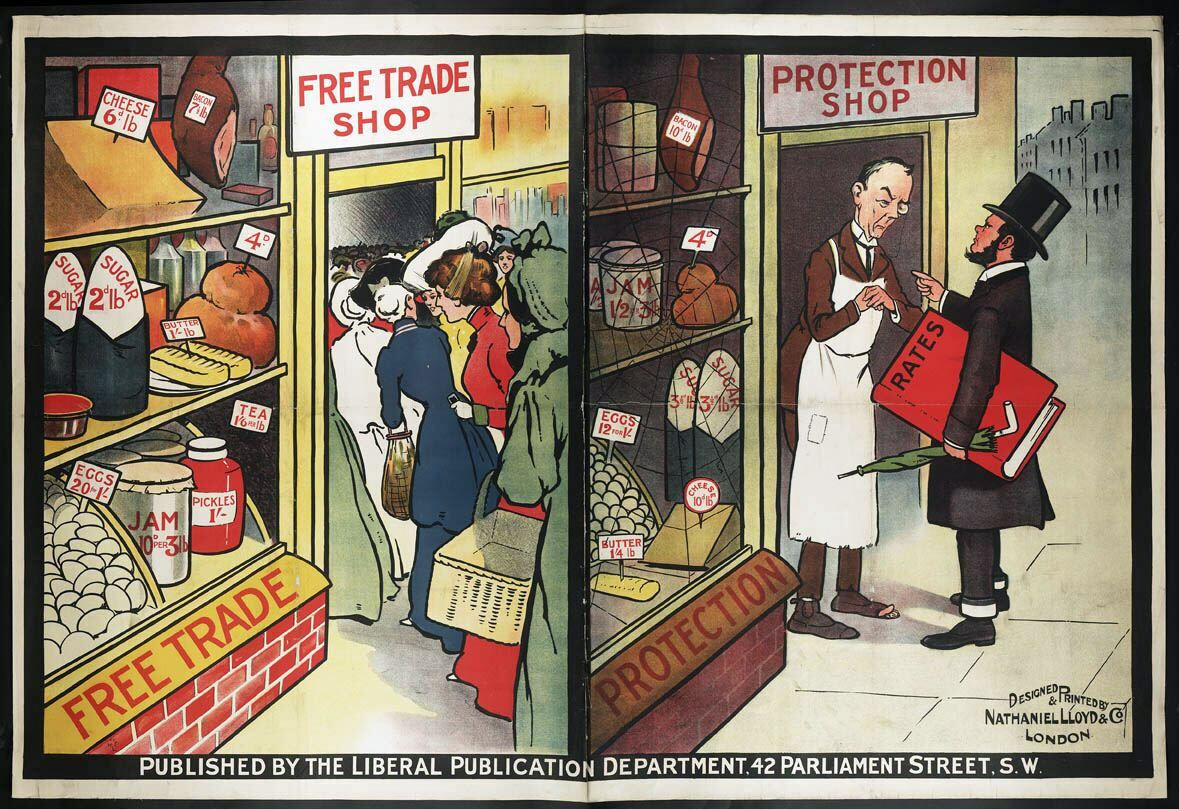
Protectionism, sometimes referred to as trade protectionism, is the economic policy of restricting imports from other countries through methods such as tariffs on imported goods, import quotas, and a variety of other government regulations. Proponents argue that protectionist policies shield the producers, businesses, and workers of the import-competing sector in the country from foreign competitors and raise government revenue. Opponents argue that protectionist policies reduce trade, and adversely affect consumers in general (by raising the cost of imported goods) as well as the producers and workers in export sectors, both in the country implementing protectionist policies and in the countries against which the protections are implemented.
Protectionism has been advocated mainly by parties that hold economic nationalist positions, while economically liberal political parties generally support free trade.
There is a consensus among economists that protectionism has a negative effect on economic growth and economic welfare, while free trade and the reduction of trade barriers have a significantly positive effect on economic growth. Many mainstream economists, such as Douglas Irwin, have implicated protectionism as an important contributing factor in some economic crises, most notably the Great Depression. A more reserved perspective is offered by New Keynesian economist Paul Krugman, who argues that tariffs were not the main cause of the Great Depression but rather a response to it, and that protectionism is a minor source of allocative inefficiency. Although trade liberalization can sometimes result in unequally distributed losses and gains, and can, in the short run, cause economic dislocation of workers in import-competing sectors, free trade lowers the costs of goods and services for both producers and consumers.
A variety of policies have been used to achieve protectionist goals. These include:
In the modern trade arena, many other initiatives besides tariffs have been called protectionist. For example, some commentators, such as Jagdish Bhagwati, see developed countries' efforts in imposing their own labor or environmental standards as protectionism. Also, the imposition of restrictive certification procedures on imports is seen in this light.
Further, others point out that free trade agreements often have protectionist provisions such as intellectual property, copyright, and patent restrictions that benefit large corporations. These provisions restrict trade in music, movies, pharmaceuticals, software, and other manufactured items to high-cost producers with quotas from low-cost producers set to zero.
There is a broad consensus among economists that protectionism has a negative effect on economic growth and economic welfare, while free trade and the reduction of trade barriers has a positive effect on economic growth. However, protectionism can be used to raise government revenue and enable access to intellectual property, including essential medicines.
Protectionism is frequently criticized by economists as harming the people it is intended to help. Mainstream economists instead support free trade. The principle of comparative advantage shows that the gains from free trade outweigh any losses as free trade creates more jobs than it destroys because it allows countries to specialize in the production of goods and services in which they have a comparative advantage. Protectionism results in deadweight loss; this loss to overall welfare gives no-one any benefit, unlike in a free market (without trade barriers), where there is no such total loss. Economist Stephen P. Magee claims the benefits of free trade outweigh the losses by as much as 100 to 1.
Hub AI
Protectionism AI simulator
(@Protectionism_simulator)
Protectionism
Protectionism, sometimes referred to as trade protectionism, is the economic policy of restricting imports from other countries through methods such as tariffs on imported goods, import quotas, and a variety of other government regulations. Proponents argue that protectionist policies shield the producers, businesses, and workers of the import-competing sector in the country from foreign competitors and raise government revenue. Opponents argue that protectionist policies reduce trade, and adversely affect consumers in general (by raising the cost of imported goods) as well as the producers and workers in export sectors, both in the country implementing protectionist policies and in the countries against which the protections are implemented.
Protectionism has been advocated mainly by parties that hold economic nationalist positions, while economically liberal political parties generally support free trade.
There is a consensus among economists that protectionism has a negative effect on economic growth and economic welfare, while free trade and the reduction of trade barriers have a significantly positive effect on economic growth. Many mainstream economists, such as Douglas Irwin, have implicated protectionism as an important contributing factor in some economic crises, most notably the Great Depression. A more reserved perspective is offered by New Keynesian economist Paul Krugman, who argues that tariffs were not the main cause of the Great Depression but rather a response to it, and that protectionism is a minor source of allocative inefficiency. Although trade liberalization can sometimes result in unequally distributed losses and gains, and can, in the short run, cause economic dislocation of workers in import-competing sectors, free trade lowers the costs of goods and services for both producers and consumers.
A variety of policies have been used to achieve protectionist goals. These include:
In the modern trade arena, many other initiatives besides tariffs have been called protectionist. For example, some commentators, such as Jagdish Bhagwati, see developed countries' efforts in imposing their own labor or environmental standards as protectionism. Also, the imposition of restrictive certification procedures on imports is seen in this light.
Further, others point out that free trade agreements often have protectionist provisions such as intellectual property, copyright, and patent restrictions that benefit large corporations. These provisions restrict trade in music, movies, pharmaceuticals, software, and other manufactured items to high-cost producers with quotas from low-cost producers set to zero.
There is a broad consensus among economists that protectionism has a negative effect on economic growth and economic welfare, while free trade and the reduction of trade barriers has a positive effect on economic growth. However, protectionism can be used to raise government revenue and enable access to intellectual property, including essential medicines.
Protectionism is frequently criticized by economists as harming the people it is intended to help. Mainstream economists instead support free trade. The principle of comparative advantage shows that the gains from free trade outweigh any losses as free trade creates more jobs than it destroys because it allows countries to specialize in the production of goods and services in which they have a comparative advantage. Protectionism results in deadweight loss; this loss to overall welfare gives no-one any benefit, unlike in a free market (without trade barriers), where there is no such total loss. Economist Stephen P. Magee claims the benefits of free trade outweigh the losses by as much as 100 to 1.