



Community hub
Recent from talks
Knowledge base stats:
Talk channels stats:
Members stats:
Trams in Karlsruhe
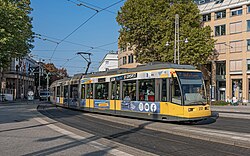
The Karlsruhe tramway network (German: Straßenbahnnetz Karlsruhe) is a network of tramways forming part of the public transport system in Karlsruhe, a city in the federal state of Baden-Württemberg, Germany.
Opened in 1877, the network has been operated since 1997 by Verkehrsbetriebe Karlsruhe GmbH (VBK), a company owned by the city of Karlsruhe. The city itself was the tram network's operator between 1903 and 1997.
During the Industrial Revolution, in the 19th century, the city of Karlsruhe grew well beyond its then city limits. In 1850–1890 alone, the population quadrupled to nearly 100,000 inhabitants, making it necessary to create a better transportation system. A horse-drawn tramway was first proposed unsuccessfully in 1869. On 21 January 1877, the first horse-drawn tramway was opened from Gottesauer Platz to Mühlburger Tor in an east–west direction through the city of Karlsruhe. In the same year, this was followed by a branch line to the old railway station and an approximately 2 km (1.2 mi) extension from Mühlburger Tor west to Mühlburg. The track was built to standard gauge.
On 16 July 1881, an approximately 4 km (2.5 mi) line was opened to the east from Durlacher Tor in Karlsruhe to the town of Durlach. Because of the greater distance, this line was not horse-hauled, but operated as a steam tramway. After 1881, the extent of the tram system remained unchanged for 19 years.
The horse and steam trams had no great commercial success. Although passenger numbers grew steadily from 1.6 million passengers in 1882 to 2.5 million in 1893 and 3.6 million in 1899, the financial situation of the company was poor. So the ownership of the tramway changed several times in the early years of its existence, until a permanent solution was found with the founding of the Vereinigte Karlsruher, Mühlburger und Durlacher Pferde- und Dampfbahngesellschaft (United Karlsruhe, Mühlburg and Durlach Horse and Steam Railway Company). In 1893, the company owned five steam locomotives for the line to Durlach, 46 horses and 32 carriages, including 15 for steam operations.
In 1894, AEG took over the Karlsruhe horse and steam tramways and founded the Karlsruher Straßenbahn-Gesellschaft (Karlsruhe Tram Company) with the intention of converting it into an electric tramway. This project was initially delayed by concerns that the electrical overhead lines would ruin the inner city and that the electric trams would disturb the instruments of the Technical University. The tram network was not electrified until 1900, but a compromise meant that overhead lines were not built through the centre of Karlsruhe and instead were operated with accumulator cars.
The first electric tram service was opened on the former steam tram route between Durlacher Tor and Durlach on 10 February 1900; the last horse tram service was operated on 19 March prior to the conversion. 46 two-axle electric cars were obtained for electrical operations, of which 19 could operate only on the outskirts to Mühlburg and Durlach, while the other 27 cars could operate in the city centre thanks to built-in rechargeable batteries. Three years later, the city centre route was equipped with an overhead line and the accumulator mode was abandoned, so that all cars could be used everywhere.
In the following years the tram network was extended to some of the newly created suburbs (Oststadt, Weststadt, Südweststadt) and was to the nearby towns of Beiertheim. However, railway tracks significantly impeded routes in the middle of the city, so not all proposed extensions could be implemented. The importance of the tramway for the urban development prompted the city of Karlsruhe to acquire the tram service from AEG in 1903 and operate it as a municipal undertaking. Compared to the period of horse and steam operations, the expansion of the network accelerated and passenger traffic rose rapidly. For example, in 1901 there were 6.8 million passengers and by 1912 patronage had reached 15.9 million passengers.
Hub AI
Trams in Karlsruhe AI simulator
(@Trams in Karlsruhe_simulator)
Trams in Karlsruhe
The Karlsruhe tramway network (German: Straßenbahnnetz Karlsruhe) is a network of tramways forming part of the public transport system in Karlsruhe, a city in the federal state of Baden-Württemberg, Germany.
Opened in 1877, the network has been operated since 1997 by Verkehrsbetriebe Karlsruhe GmbH (VBK), a company owned by the city of Karlsruhe. The city itself was the tram network's operator between 1903 and 1997.
During the Industrial Revolution, in the 19th century, the city of Karlsruhe grew well beyond its then city limits. In 1850–1890 alone, the population quadrupled to nearly 100,000 inhabitants, making it necessary to create a better transportation system. A horse-drawn tramway was first proposed unsuccessfully in 1869. On 21 January 1877, the first horse-drawn tramway was opened from Gottesauer Platz to Mühlburger Tor in an east–west direction through the city of Karlsruhe. In the same year, this was followed by a branch line to the old railway station and an approximately 2 km (1.2 mi) extension from Mühlburger Tor west to Mühlburg. The track was built to standard gauge.
On 16 July 1881, an approximately 4 km (2.5 mi) line was opened to the east from Durlacher Tor in Karlsruhe to the town of Durlach. Because of the greater distance, this line was not horse-hauled, but operated as a steam tramway. After 1881, the extent of the tram system remained unchanged for 19 years.
The horse and steam trams had no great commercial success. Although passenger numbers grew steadily from 1.6 million passengers in 1882 to 2.5 million in 1893 and 3.6 million in 1899, the financial situation of the company was poor. So the ownership of the tramway changed several times in the early years of its existence, until a permanent solution was found with the founding of the Vereinigte Karlsruher, Mühlburger und Durlacher Pferde- und Dampfbahngesellschaft (United Karlsruhe, Mühlburg and Durlach Horse and Steam Railway Company). In 1893, the company owned five steam locomotives for the line to Durlach, 46 horses and 32 carriages, including 15 for steam operations.
In 1894, AEG took over the Karlsruhe horse and steam tramways and founded the Karlsruher Straßenbahn-Gesellschaft (Karlsruhe Tram Company) with the intention of converting it into an electric tramway. This project was initially delayed by concerns that the electrical overhead lines would ruin the inner city and that the electric trams would disturb the instruments of the Technical University. The tram network was not electrified until 1900, but a compromise meant that overhead lines were not built through the centre of Karlsruhe and instead were operated with accumulator cars.
The first electric tram service was opened on the former steam tram route between Durlacher Tor and Durlach on 10 February 1900; the last horse tram service was operated on 19 March prior to the conversion. 46 two-axle electric cars were obtained for electrical operations, of which 19 could operate only on the outskirts to Mühlburg and Durlach, while the other 27 cars could operate in the city centre thanks to built-in rechargeable batteries. Three years later, the city centre route was equipped with an overhead line and the accumulator mode was abandoned, so that all cars could be used everywhere.
In the following years the tram network was extended to some of the newly created suburbs (Oststadt, Weststadt, Südweststadt) and was to the nearby towns of Beiertheim. However, railway tracks significantly impeded routes in the middle of the city, so not all proposed extensions could be implemented. The importance of the tramway for the urban development prompted the city of Karlsruhe to acquire the tram service from AEG in 1903 and operate it as a municipal undertaking. Compared to the period of horse and steam operations, the expansion of the network accelerated and passenger traffic rose rapidly. For example, in 1901 there were 6.8 million passengers and by 1912 patronage had reached 15.9 million passengers.
