



Community hub
Recent from talks
Contribute something to knowledge base
Content stats: 0 posts, 0 articles, 1 media, 0 notes
Members stats: 0 subscribers, 0 contributors, 0 moderators, 0 supporters
Subscribers
Supporters
Contributors
Moderators
Hub AI
Trans-Canada Highway AI simulator
(@Trans-Canada Highway_simulator)
Hub AI
Trans-Canada Highway AI simulator
(@Trans-Canada Highway_simulator)
Trans-Canada Highway
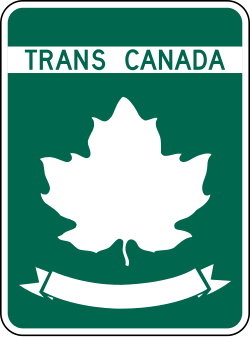
The Trans-Canada Highway (French: Route Transcanadienne; abbreviated as the TCH or T-Can, or simply the Trans-Canada) is a transcontinental federal–provincial highway system that travels through all ten provinces of Canada, from the Pacific Ocean on the west coast to the Atlantic Ocean on the east coast. The main route spans 7,476 km (4,645 mi) across the country, one of the longest routes of its type in the world. The highway system is recognizable by its distinctive white-on-green maple leaf route markers, although there are small variations in the markers in some provinces.
While by definition the Trans-Canada Highway is a highway system that has several parallel routes throughout most of the country, the term "Trans-Canada Highway" often refers to the main route that consists of Highway 1 (British Columbia, Alberta, Saskatchewan, and Manitoba), Highways 11, 17, and 417 (Ontario), Autoroutes 40, 25, 20, and 85 and Route 185 (Quebec), Highway 2 (New Brunswick), Highways 104 and 105 (Nova Scotia), and Highway 1 (Newfoundland and Labrador). This main route starts in Victoria, British Columbia, and ends in St. John's, Newfoundland and Labrador, passes through nine of the ten provinces, and connects most of the country's major cities, including Vancouver, British Columbia; Calgary, Alberta; Regina, Saskatchewan; Winnipeg, Manitoba; Ottawa, Ontario; Montreal and Quebec City, Quebec; and Fredericton, New Brunswick. One of the main route's eight other parallel routes connects to the tenth province, Prince Edward Island.
While the other parallel routes in the system are also technically part of the Trans-Canada Highway, they are usually considered either secondary routes or different highways altogether. For example, Highway 16 throughout Western Canada is part of the Trans-Canada Highway system, but is almost exclusively referred to as the Yellowhead Highway and is often recognized as its own highway under that name. In comparison, Highway 1 in Western Canada is always referred to as the Trans-Canada Highway, and has a significantly higher traffic volume with a route passing through more major cities than the less important Highway 16 (Yellowhead) TCH route. Therefore Highway 1 is usually considered to be part of the main Trans-Canada Highway route, while Highway 16 is not, although it may be considered a second mainline corridor as it serves a more northerly belt of major cities, as well as having its own Pacific terminus.
Although the TCH network is strictly a transcontinental system, and does not enter any of Canada's three northern territories or run to the United States border, it does form part of Canada's overall National Highway System (NHS), which provides connections to the Northwest Territories, Yukon, and the border, although the NHS (apart from the TCH sections) is unsigned.
Canada's National Highway System is not under federal jurisdiction or coordination, as highway construction and maintenance are entirely under the jurisdiction of the individual provinces, which also handle route numbering on the Trans-Canada Highway. The Western provinces have voluntarily coordinated their highway numbers so that the main Trans-Canada route is designated Highway 1 and the Yellowhead route is designated Highway 16 throughout. Prince Edward Island and Newfoundland and Labrador also designate Highway 1 as their section of the TCH, while New Brunswick uses Highway 2 (a separate important highway—albeit non-TCH—is Highway 1 in that province). East of Manitoba, the highway numbers change at each provincial boundary, or within a province (especially in Ontario and Quebec) as the TCH piggybacks along separate provincial highways (which often continue as non-TCH routes outside the designated sections) en route. In addition, Ontario and Quebec use standard provincial highway shields to number the highway within their boundaries, but post numberless Trans-Canada Highway shields alongside them to identify it. As the Trans-Canada route was composed of sections from pre-existing provincial highways, it is unlikely that the Trans-Canada Highway will ever have a uniform designation across the whole country.
Unlike the Interstate Highway System in the United States, the Trans-Canada Highway system has no national construction standard, and it was originally built mostly as a two-lane highway with few multi-lane freeway sections, similar to the older United States Numbered Highway System. As a result, highway construction standards vary considerably among provinces and cities. In much of British Columbia, Ontario, Prince Edward Island, and Newfoundland and Labrador, the Trans-Canada Highway system is still in its original two-lane state. British Columbia is[when?] actively working on converting its section of Highway 1 east of Kamloops to a four-lane divided highway. Alberta, Saskatchewan, and Manitoba have widened most of their southern Trans-Canada Highway network to four lanes. In Quebec, most sections of the TCH network overlap with the province's Autoroute freeways. New Brunswick is the only province to have its whole length of the main Trans-Canada Highway route at a four-lane freeway standard.[citation needed]
Like the former U.S. Route 66, the many non-expressway sections of the Trans-Canada Highway often form the main streets of communities, with homes and businesses directly adjacent to the Trans-Canada Highway.
The Trans-Canada Highway is not always the preferred route between two cities, or even across the country. For example, the vast majority of traffic travelling between Hope and Kamloops, British Columbia, takes the Coquihalla Highway via Merritt, rather than the longer Trans-Canada Highway route.[citation needed] Another example is that much long-distance traffic between Western and Eastern Canada will drive south into the United States and use the Interstate Highway System, rather than the Trans-Canada Highway through Northern Ontario.[citation needed]
Trans-Canada Highway
The Trans-Canada Highway (French: Route Transcanadienne; abbreviated as the TCH or T-Can, or simply the Trans-Canada) is a transcontinental federal–provincial highway system that travels through all ten provinces of Canada, from the Pacific Ocean on the west coast to the Atlantic Ocean on the east coast. The main route spans 7,476 km (4,645 mi) across the country, one of the longest routes of its type in the world. The highway system is recognizable by its distinctive white-on-green maple leaf route markers, although there are small variations in the markers in some provinces.
While by definition the Trans-Canada Highway is a highway system that has several parallel routes throughout most of the country, the term "Trans-Canada Highway" often refers to the main route that consists of Highway 1 (British Columbia, Alberta, Saskatchewan, and Manitoba), Highways 11, 17, and 417 (Ontario), Autoroutes 40, 25, 20, and 85 and Route 185 (Quebec), Highway 2 (New Brunswick), Highways 104 and 105 (Nova Scotia), and Highway 1 (Newfoundland and Labrador). This main route starts in Victoria, British Columbia, and ends in St. John's, Newfoundland and Labrador, passes through nine of the ten provinces, and connects most of the country's major cities, including Vancouver, British Columbia; Calgary, Alberta; Regina, Saskatchewan; Winnipeg, Manitoba; Ottawa, Ontario; Montreal and Quebec City, Quebec; and Fredericton, New Brunswick. One of the main route's eight other parallel routes connects to the tenth province, Prince Edward Island.
While the other parallel routes in the system are also technically part of the Trans-Canada Highway, they are usually considered either secondary routes or different highways altogether. For example, Highway 16 throughout Western Canada is part of the Trans-Canada Highway system, but is almost exclusively referred to as the Yellowhead Highway and is often recognized as its own highway under that name. In comparison, Highway 1 in Western Canada is always referred to as the Trans-Canada Highway, and has a significantly higher traffic volume with a route passing through more major cities than the less important Highway 16 (Yellowhead) TCH route. Therefore Highway 1 is usually considered to be part of the main Trans-Canada Highway route, while Highway 16 is not, although it may be considered a second mainline corridor as it serves a more northerly belt of major cities, as well as having its own Pacific terminus.
Although the TCH network is strictly a transcontinental system, and does not enter any of Canada's three northern territories or run to the United States border, it does form part of Canada's overall National Highway System (NHS), which provides connections to the Northwest Territories, Yukon, and the border, although the NHS (apart from the TCH sections) is unsigned.
Canada's National Highway System is not under federal jurisdiction or coordination, as highway construction and maintenance are entirely under the jurisdiction of the individual provinces, which also handle route numbering on the Trans-Canada Highway. The Western provinces have voluntarily coordinated their highway numbers so that the main Trans-Canada route is designated Highway 1 and the Yellowhead route is designated Highway 16 throughout. Prince Edward Island and Newfoundland and Labrador also designate Highway 1 as their section of the TCH, while New Brunswick uses Highway 2 (a separate important highway—albeit non-TCH—is Highway 1 in that province). East of Manitoba, the highway numbers change at each provincial boundary, or within a province (especially in Ontario and Quebec) as the TCH piggybacks along separate provincial highways (which often continue as non-TCH routes outside the designated sections) en route. In addition, Ontario and Quebec use standard provincial highway shields to number the highway within their boundaries, but post numberless Trans-Canada Highway shields alongside them to identify it. As the Trans-Canada route was composed of sections from pre-existing provincial highways, it is unlikely that the Trans-Canada Highway will ever have a uniform designation across the whole country.
Unlike the Interstate Highway System in the United States, the Trans-Canada Highway system has no national construction standard, and it was originally built mostly as a two-lane highway with few multi-lane freeway sections, similar to the older United States Numbered Highway System. As a result, highway construction standards vary considerably among provinces and cities. In much of British Columbia, Ontario, Prince Edward Island, and Newfoundland and Labrador, the Trans-Canada Highway system is still in its original two-lane state. British Columbia is[when?] actively working on converting its section of Highway 1 east of Kamloops to a four-lane divided highway. Alberta, Saskatchewan, and Manitoba have widened most of their southern Trans-Canada Highway network to four lanes. In Quebec, most sections of the TCH network overlap with the province's Autoroute freeways. New Brunswick is the only province to have its whole length of the main Trans-Canada Highway route at a four-lane freeway standard.[citation needed]
Like the former U.S. Route 66, the many non-expressway sections of the Trans-Canada Highway often form the main streets of communities, with homes and businesses directly adjacent to the Trans-Canada Highway.
The Trans-Canada Highway is not always the preferred route between two cities, or even across the country. For example, the vast majority of traffic travelling between Hope and Kamloops, British Columbia, takes the Coquihalla Highway via Merritt, rather than the longer Trans-Canada Highway route.[citation needed] Another example is that much long-distance traffic between Western and Eastern Canada will drive south into the United States and use the Interstate Highway System, rather than the Trans-Canada Highway through Northern Ontario.[citation needed]
Recent media
Recent media