


Community hub
Recent from talks
Contribute something to knowledge base
Content stats: 0 posts, 0 articles, 1 media, 0 notes
Members stats: 0 subscribers, 0 contributors, 0 moderators, 0 supporters
Subscribers
Supporters
Contributors
Moderators
Hub AI
TransCanada pipeline AI simulator
(@TransCanada pipeline_simulator)
Hub AI
TransCanada pipeline AI simulator
(@TransCanada pipeline_simulator)
TransCanada pipeline
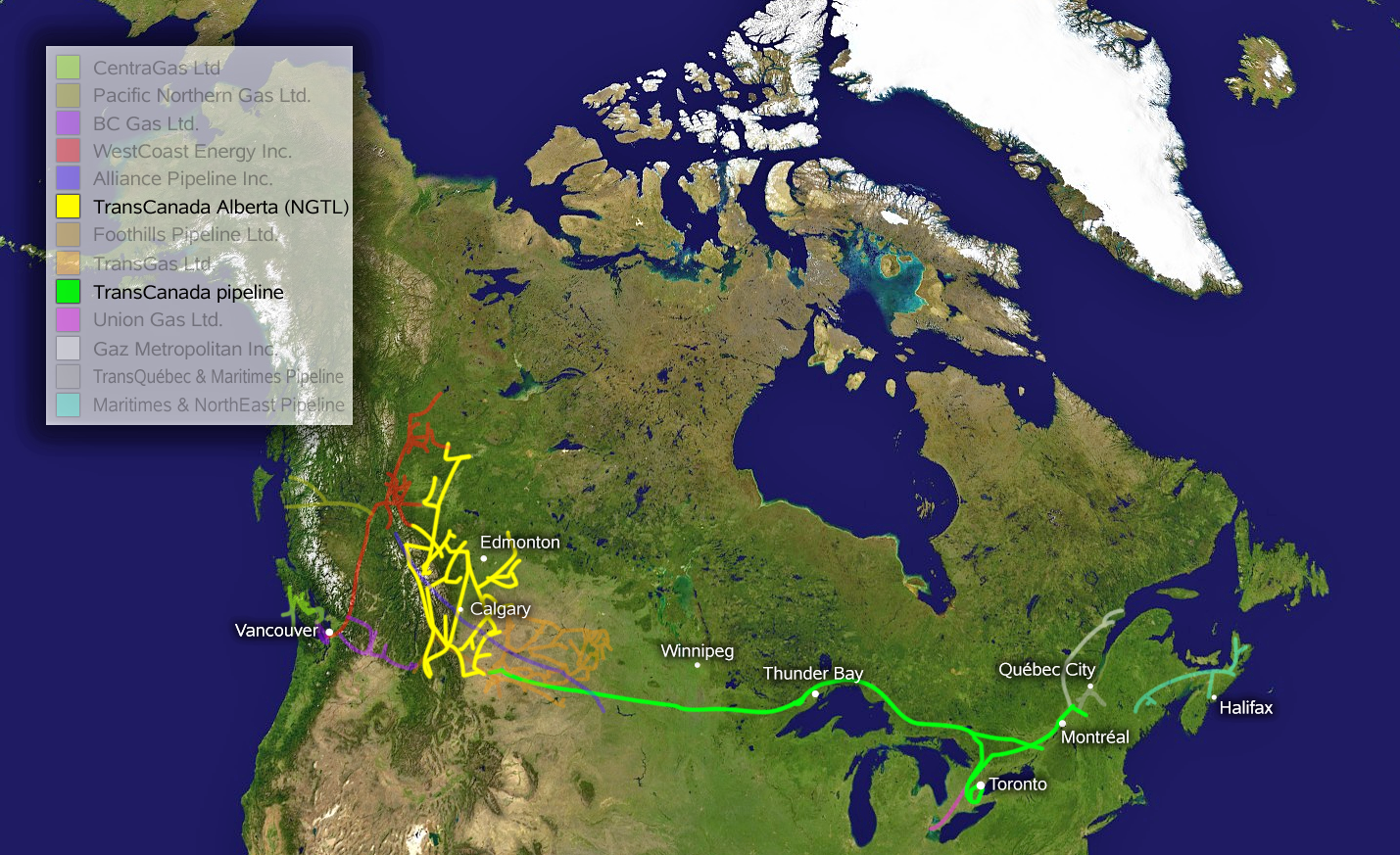
The TransCanada pipeline is a system of natural gas pipelines, up to 48 inches (1.2 m) in diameter, that carries gas through Alberta, Saskatchewan, Manitoba, Ontario and Quebec. It is maintained by TransCanada PipeLines, LP. It is the longest pipeline in Canada.
Canada's population was booming during the 1950s, and energy shortages were becoming problematic. Canadian company TransCanada PipeLines Limited was incorporated in 1951 to undertake the construction of a natural gas pipeline across Canada. The financing of the project was split 50–50 between American and Canadian interests.
Two applicants originally expressed interest in moving gas east: Canadian Delhi Oil Company (now called TCPL) proposed moving gas to the major cities of eastern Canada by an all-Canadian route, while Western Pipelines wanted to stop at Winnipeg with a branch line south to sell into the mid-western United States. In 1954 C. D. Howe, a member of the Cabinet of Canada of a Liberal Government, forced the two companies to merge, with the all-Canadian route preferred over its more economical but American-routed competitor. This imposed solution reflected problems encountered with the construction of the Interprovincial oil pipeline. Despite the speed of its construction, the earlier line caused angry debate in Parliament, with the Opposition arguing that Canadian centres deserved consideration before American customers and that "the main pipeline carrying Canadian oil should be laid in Canadian soil". By constructing its natural gas mainline along an entirely Canadian route, TCPL accommodated nationalist sentiments, solving a political problem for the federal government.
The regulatory process for TCPL proved long and arduous. After rejecting proposals twice, Alberta finally granted its permission to export gas from the province in 1953. At first, the province waited for explorers to prove gas reserves sufficient for its thirty-year needs, intending to only allow exports in excess of those needs. After clearing this hurdle, the federal government virtually compelled TCPL into a merger with Western pipelines. When this reorganized TCPL went before the Federal Power Commission for permission to sell gas into the United States, the Americans greeted it coolly. The FPC proved skeptical of the project's financing and unimpressed with Alberta's reserves.
The 1,090-kilometre section crossing the Canadian Shield was the most difficult leg of the pipeline. Believing construction costs could make the line uneconomic, private sector sponsors refused to finance this portion of the line. Since the federal government wanted the line laid for nationalistic reasons, the reigning Liberals put a bill before Parliament to create a crown corporation to build and own the Canadian Shield portion of the line, leasing it back to TCPL.
The Louis St. Laurent government aggressively restricted debate on this bill to get construction underway by June 1956, knowing that delays beyond that month would postpone the entire project a year. The use of closure created a Parliamentary scandal. Known as the Pipeline Debate, this parliamentary episode contributed to the government's defeat at the polls in 1957, ending many years of Liberal rule, and bringing in a government under Prime Minister John Diefenbaker.
The bill was passed and construction of the TransCanada pipeline began.
A stock trading scandal surrounding Northern Ontario Natural Gas, the contractor for the Northern Ontario leg of the pipeline, also implicated Sudbury mayor Leo Landreville and Ontario provincial cabinet ministers Philip Kelly, William Griesinger and Clare Mapledoram between 1955 and 1958.
TransCanada pipeline
The TransCanada pipeline is a system of natural gas pipelines, up to 48 inches (1.2 m) in diameter, that carries gas through Alberta, Saskatchewan, Manitoba, Ontario and Quebec. It is maintained by TransCanada PipeLines, LP. It is the longest pipeline in Canada.
Canada's population was booming during the 1950s, and energy shortages were becoming problematic. Canadian company TransCanada PipeLines Limited was incorporated in 1951 to undertake the construction of a natural gas pipeline across Canada. The financing of the project was split 50–50 between American and Canadian interests.
Two applicants originally expressed interest in moving gas east: Canadian Delhi Oil Company (now called TCPL) proposed moving gas to the major cities of eastern Canada by an all-Canadian route, while Western Pipelines wanted to stop at Winnipeg with a branch line south to sell into the mid-western United States. In 1954 C. D. Howe, a member of the Cabinet of Canada of a Liberal Government, forced the two companies to merge, with the all-Canadian route preferred over its more economical but American-routed competitor. This imposed solution reflected problems encountered with the construction of the Interprovincial oil pipeline. Despite the speed of its construction, the earlier line caused angry debate in Parliament, with the Opposition arguing that Canadian centres deserved consideration before American customers and that "the main pipeline carrying Canadian oil should be laid in Canadian soil". By constructing its natural gas mainline along an entirely Canadian route, TCPL accommodated nationalist sentiments, solving a political problem for the federal government.
The regulatory process for TCPL proved long and arduous. After rejecting proposals twice, Alberta finally granted its permission to export gas from the province in 1953. At first, the province waited for explorers to prove gas reserves sufficient for its thirty-year needs, intending to only allow exports in excess of those needs. After clearing this hurdle, the federal government virtually compelled TCPL into a merger with Western pipelines. When this reorganized TCPL went before the Federal Power Commission for permission to sell gas into the United States, the Americans greeted it coolly. The FPC proved skeptical of the project's financing and unimpressed with Alberta's reserves.
The 1,090-kilometre section crossing the Canadian Shield was the most difficult leg of the pipeline. Believing construction costs could make the line uneconomic, private sector sponsors refused to finance this portion of the line. Since the federal government wanted the line laid for nationalistic reasons, the reigning Liberals put a bill before Parliament to create a crown corporation to build and own the Canadian Shield portion of the line, leasing it back to TCPL.
The Louis St. Laurent government aggressively restricted debate on this bill to get construction underway by June 1956, knowing that delays beyond that month would postpone the entire project a year. The use of closure created a Parliamentary scandal. Known as the Pipeline Debate, this parliamentary episode contributed to the government's defeat at the polls in 1957, ending many years of Liberal rule, and bringing in a government under Prime Minister John Diefenbaker.
The bill was passed and construction of the TransCanada pipeline began.
A stock trading scandal surrounding Northern Ontario Natural Gas, the contractor for the Northern Ontario leg of the pipeline, also implicated Sudbury mayor Leo Landreville and Ontario provincial cabinet ministers Philip Kelly, William Griesinger and Clare Mapledoram between 1955 and 1958.
Recent media
Recent media