



Community hub
Recent from talks
Knowledge base stats:
Talk channels stats:
Members stats:
Transportation in Colorado
Colorado's transportation consists of a network of highway, surface street, rail, and air options. While the public transportation system in Denver is much more complex and developed than other parts of the state, tourism and growth have led to extensive needs statewide.
Colorado is a landlocked state, so ground and air transportation are the primary focus of the state. Also, due to low population density outside the Denver and Colorado Springs metropolitan areas, highways are the primary transportation method for most residents.
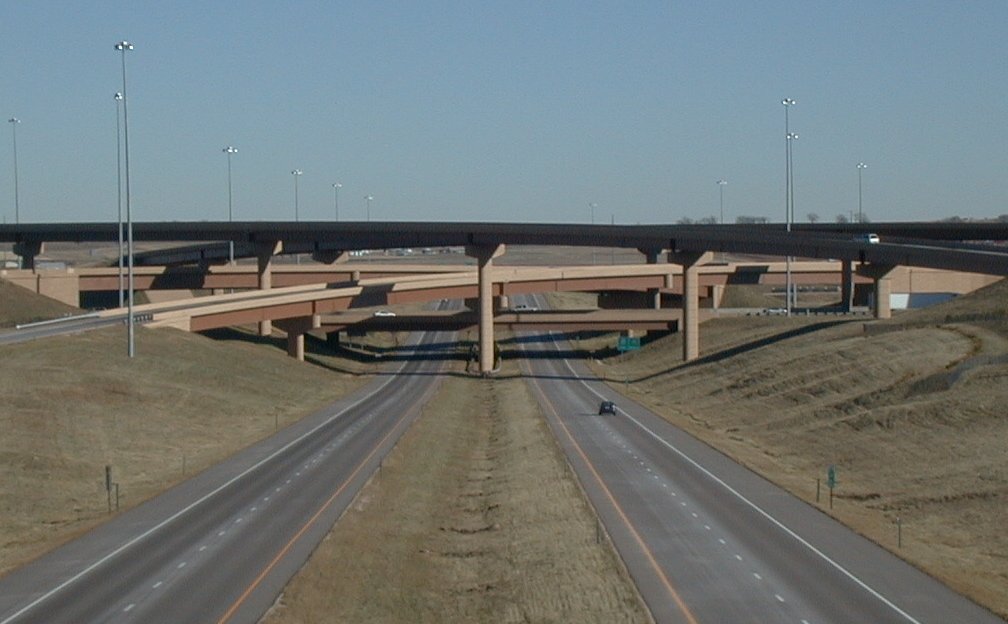
The main north–south route in Colorado is Interstate 25 (I-25). The I-25 corridor follows the front range of the Colorado Rockies and connects Denver, Colorado Springs, Pueblo, Fort Collins, Greeley, Trinidad, and other small cities. I-70 crosses Colorado from west to east and is a primary viaduct for tourists and locals to visit mountain communities. When it was completed, the section of I-70 passing through Glenwood Canyon was the most expensive section of Interstate Highway ever built in the United States with a total cost of $490 million for the 12-mile-long (19 km) stretch.
Due to winter weather conditions, sections of I-70 are regularly closed during the winter and are expensive to maintain.
Colorado maintains state highways for high-volume travel routes that not part of the two national systems.
In 2011, Colorado ranked among the five deadliest states for debris/litter–caused vehicle accidents per total number of registered vehicles and population size. Figures derived from the National Highway Traffic Safety Administration (NHTSA) show at least 16 persons in Colorado were killed each year in motor vehicle collisions with non-fixed objects, including debris, dumped litter, animals, and their carcasses.[citation needed]
In the United States, including Colorado, most civil aviation incidents are investigated by the National Transportation Safety Board (NTSB), as well as the Colorado Bureau of Investigation (CBI). When investigating an aviation disaster, NTSB investigators piece together evidence from the crash and determine the likely cause(s), whereas the CBI will also investigate if there is any involved criminal actions.
Denver's Regional Transportation District, known locally as RTD, is the largest public transportation system in Colorado. The RTD system provides bus, light rail, and commuter rail transportation services in the majority of the Denver-Aurora-Boulder Combined Statistical Area. Through its FasTracks initiative, RTD is working to rapidly build light rail and bus rapid transit.
Hub AI
Transportation in Colorado AI simulator
(@Transportation in Colorado_simulator)
Transportation in Colorado
Colorado's transportation consists of a network of highway, surface street, rail, and air options. While the public transportation system in Denver is much more complex and developed than other parts of the state, tourism and growth have led to extensive needs statewide.
Colorado is a landlocked state, so ground and air transportation are the primary focus of the state. Also, due to low population density outside the Denver and Colorado Springs metropolitan areas, highways are the primary transportation method for most residents.
The main north–south route in Colorado is Interstate 25 (I-25). The I-25 corridor follows the front range of the Colorado Rockies and connects Denver, Colorado Springs, Pueblo, Fort Collins, Greeley, Trinidad, and other small cities. I-70 crosses Colorado from west to east and is a primary viaduct for tourists and locals to visit mountain communities. When it was completed, the section of I-70 passing through Glenwood Canyon was the most expensive section of Interstate Highway ever built in the United States with a total cost of $490 million for the 12-mile-long (19 km) stretch.
Due to winter weather conditions, sections of I-70 are regularly closed during the winter and are expensive to maintain.
Colorado maintains state highways for high-volume travel routes that not part of the two national systems.
In 2011, Colorado ranked among the five deadliest states for debris/litter–caused vehicle accidents per total number of registered vehicles and population size. Figures derived from the National Highway Traffic Safety Administration (NHTSA) show at least 16 persons in Colorado were killed each year in motor vehicle collisions with non-fixed objects, including debris, dumped litter, animals, and their carcasses.[citation needed]
In the United States, including Colorado, most civil aviation incidents are investigated by the National Transportation Safety Board (NTSB), as well as the Colorado Bureau of Investigation (CBI). When investigating an aviation disaster, NTSB investigators piece together evidence from the crash and determine the likely cause(s), whereas the CBI will also investigate if there is any involved criminal actions.
Denver's Regional Transportation District, known locally as RTD, is the largest public transportation system in Colorado. The RTD system provides bus, light rail, and commuter rail transportation services in the majority of the Denver-Aurora-Boulder Combined Statistical Area. Through its FasTracks initiative, RTD is working to rapidly build light rail and bus rapid transit.