Hubbry Logo
logo
Trapdoor function
Community hub

Trapdoor function

logo
0 subscribers
Read side by side
from Wikipedia
The idea of trapdoor function. A trapdoor function f with its trapdoor t can be generated by an algorithm Gen. f can be efficiently computed, i.e., in probabilistic polynomial time. However, the computation of the inverse of f is generally hard, unless the trapdoor t is given.[1]

In theoretical computer science and cryptography, a trapdoor function is a function that is easy to compute in one direction, yet difficult to compute in the opposite direction (finding its inverse) without special information, called the "trapdoor". Trapdoor functions are a special case of one-way functions and are widely used in public-key cryptography.[2]

In mathematical terms, if f is a trapdoor function, then there exists some secret information t, such that given f(x) and t, it is easy to compute x. Consider a padlock and its key. It is trivial to change the padlock from open to closed without using the key, by pushing the shackle into the lock mechanism. Opening the padlock easily, however, requires the key to be used. Here the key t is the trapdoor and the padlock is the trapdoor function.

An example of a simple mathematical trapdoor is "6895601 is the product of two prime numbers. What are those numbers?" A typical "brute-force" solution would be to try dividing 6895601 by many prime numbers until finding the answer. However, if one is told that 1931 is one of the numbers, one can find the answer by entering "6895601 ÷ 1931" into any calculator. This example is not a sturdy trapdoor function – modern computers can guess all of the possible answers within a second – but this sample problem could be improved by using the product of two much larger primes.

Trapdoor functions came to prominence in cryptography in the mid-1970s with the publication of asymmetric (or public-key) encryption techniques by Diffie, Hellman, and Merkle. Indeed, Diffie & Hellman (1976) coined the term. Several function classes had been proposed, and it soon became obvious that trapdoor functions are harder to find than was initially thought. For example, an early suggestion was to use schemes based on the subset sum problem. This turned out rather quickly to be unsuitable.

As of 2004, the best known trapdoor function (family) candidates are the RSA and Rabin families of functions. Both are written as exponentiation modulo a composite number, and both are related to the problem of prime factorization.

Functions related to the hardness of the discrete logarithm problem (either modulo a prime or in a group defined over an elliptic curve) are not known to be trapdoor functions, because there is no known "trapdoor" information about the group that enables the efficient computation of discrete logarithms.

A trapdoor in cryptography has the very specific aforementioned meaning and is not to be confused with a backdoor (these are frequently used interchangeably, which is incorrect). A backdoor is a deliberate mechanism that is added to a cryptographic algorithm (e.g., a key pair generation algorithm, digital signing algorithm, etc.) or operating system, for example, that permits one or more unauthorized parties to bypass or subvert the security of the system in some fashion.

Definition

[edit]

A trapdoor function is a collection of one-way functions { fk : DkRk } (kK), in which all of K, Dk, Rk are subsets of binary strings {0, 1}*, satisfying the following conditions:

  • There exists a probabilistic polynomial time (PPT) sampling algorithm Gen s.t. Gen(1n) = (k, tk) with kK ∩ {0, 1}n and tk ∈ {0, 1}* satisfies | tk | < p (n), in which p is some polynomial. Each tk is called the trapdoor corresponding to k. Each trapdoor can be efficiently sampled.
  • Given input k, there also exists a PPT algorithm that outputs xDk. That is, each Dk can be efficiently sampled.
  • For any kK, there exists a PPT algorithm that correctly computes fk.
  • For any kK, there exists a PPT algorithm A s.t. for any xDk, let y = A ( k, fk(x), tk ), and then we have fk(y) = fk(x). That is, given trapdoor, it is easy to invert.
  • For any kK, without trapdoor tk, for any PPT algorithm, the probability to correctly invert fk (i.e., given fk(x), find a pre-image x' such that fk(x' ) = fk(x)) is negligible.[3][4][5]

If each function in the collection above is a one-way permutation, then the collection is also called a trapdoor permutation.[6]

Examples

[edit]

In the following two examples, we always assume that it is difficult to factorize a large composite number (see Integer factorization).

RSA assumption

[edit]

In this example, the inverse of modulo (Euler's totient function of ) is the trapdoor:

If the factorization of is known, then can be computed. With this the inverse of can be computed , and then given , we can find . Its hardness follows from the RSA assumption.[7]


Rabin's quadratic residue assumption

[edit]

Let be a large composite number such that , where and are large primes such that , and kept confidential to the adversary. The problem is to compute given such that . The trapdoor is the factorization of . With the trapdoor, the solutions of z can be given as , where . See Chinese remainder theorem for more details. Note that given primes and , we can find and . Here the conditions and guarantee that the solutions and can be well defined.[8]

See also

[edit]

Notes

[edit]

References

[edit]
Revisions and contributorsEdit on WikipediaRead on Wikipedia
from Grokipedia
In cryptography, a trapdoor function, also known as a trapdoor one-way function, is a special type of one-way function that is easy to compute in the forward direction but computationally infeasible to invert (i.e., to find the preimage) without knowledge of a secret piece of information called the trapdoor.[1] This trapdoor allows efficient inversion once revealed, but remains hidden in public applications, enabling secure operations like encryption and digital signatures.[2] Unlike standard one-way functions, trapdoor variants are not truly irreversible; they merely appear so to unauthorized parties due to the computational hardness of discovering the trapdoor without additional hints.[1] The concept of trapdoor functions was introduced by Whitfield Diffie and Martin Hellman in their seminal 1976 paper "New Directions in Cryptography," where they proposed them as a foundational primitive for public-key cryptosystems.[1] These systems address the key distribution problem in symmetric cryptography by allowing anyone to encrypt messages using a publicly available key, while only the trapdoor holder can decrypt them efficiently.[1] A prominent example is the RSA trapdoor permutation, developed by Ronald Rivest, Adi Shamir, and Leonard Adleman in 1978, which relies on the hardness of integer factorization: the function computes $ M^e \mod n $ for public exponents $ e $ and modulus $ n = pq $ (product of large primes $ p $ and $ q $), with inversion via the private exponent $ d $ such that $ ed \equiv 1 \mod \phi(n) $, where $ \phi $ is Euler's totient function and the trapdoor is knowledge of $ p $ and $ q $.[2] This construction underpins widely used protocols like HTTPS for secure web communication. Trapdoor functions have since become central to modern cryptography, supporting public-key encryption and digital signatures, though their security often depends on unproven assumptions like the difficulty of certain mathematical problems. Ongoing research continues to explore constructions based on diverse hardness assumptions, such as lattice problems, to enhance resilience against quantum computing threats.[3]

Fundamentals

Definition

A trapdoor function is a special type of cryptographic primitive consisting of a family of functions that are easy to evaluate in the forward direction but computationally difficult to invert without specific secret information known as the trapdoor.[1] With access to the trapdoor, however, inversion becomes efficient, allowing recovery of the preimage in polynomial time.[4] This asymmetry makes trapdoor functions foundational for public-key cryptography, where the forward function can be performed publicly while inversion remains private to the holder of the trapdoor.[1] Formally, a trapdoor function family $ F = {F_k}_{k \in \mathbb{N}} $ is defined by a probabilistic polynomial-time (PPT) generation algorithm $ F $-Gen that, on input security parameter $ 1^k $, outputs a function description $ f $ (including public parameters) and trapdoor information $ tp $, where $ f $ is sampled from the distribution $ F_k $ over functions with domain $ \text{Dom}(f) $ and range $ \text{Range}(f) $.[4] There exists a PPT evaluation algorithm $ F $-Eval such that for any $ x \in \text{Dom}(f) $, $ F Eval-Eval (f, x) = f(x) $ runs in polynomial time.[4] Inversion without the trapdoor is hard: for any PPT inverter $ I $, the probability that $ I(f, f(x)) \in f^{-1}(f(x)) $ is negligible in $ k $.[4] In contrast, with the trapdoor, a PPT inversion algorithm $ F $-Inv satisfies $ F Inv-Inv (f, y, tp) \in f^{-1}(y) $ with probability 1 for all $ y \in \text{Range}(f) $.[4] Unlike plain one-way functions, which lack any mechanism for efficient inversion and are presumed hard to reverse even for the creator, trapdoor functions incorporate this secret trapdoor to enable controlled reversibility.[1] Intuitively, a trapdoor function resembles a padlock that is straightforward to lock (forward computation) but exceedingly difficult to unlock without the key (trapdoor information), which allows easy opening when possessed.[1]

Properties

Trapdoor functions are characterized by their one-wayness, a core property ensuring that computing the function forward is efficient, while inverting it to recover a preimage is computationally infeasible without the trapdoor. Formally, for a trapdoor function family parameterized by a security parameter kk, the success probability of any probabilistic polynomial-time adversary in inverting fk(x)f_k(x) to recover a preimage, where kk is the public key and xx is chosen uniformly at random from the domain, satisfies
Pr[A(fk(x),k)fk1(fk(x))]negl(k), \Pr[\mathcal{A}(f_k(x), k) \in f_k^{-1}(f_k(x))] \leq \mathsf{negl}(k),
where negl(k)\mathsf{negl}(k) is a negligible function, meaning it is smaller than 1/poly(k)1/\mathsf{poly}(k) for any polynomial poly\mathsf{poly}. This hardness holds under standard computational assumptions and is essential for the security of systems built upon trapdoor functions.[4] A key efficiency property is the presence of a trapdoor that enables rapid inversion. With access to the trapdoor tt (generated alongside the public description kk), there exists a deterministic polynomial-time algorithm Inv\mathsf{Inv} such that Inv(t,fk(x))fk1(fk(x))\mathsf{Inv}(t, f_k(x)) \in f_k^{-1}(f_k(x)) for all xx in the domain. This inversion must run in time polynomial in the input size, typically O(poly(k))O(\mathsf{poly}(k)), ensuring practical usability in cryptographic protocols while maintaining the one-wayness without tt. The trapdoor tt is kept secret, and its structure ensures that even partial knowledge of tt does not significantly reduce the inversion hardness; full trapdoor information is required for efficient computation, as partial details may only marginally improve success probabilities beyond negligible levels.[4] For broader cryptographic applicability, trapdoor functions must exhibit adaptability, often in the form of being permutations (bijective mappings) or length-expanding (output longer than input). Permutation-based trapdoor functions preserve invertibility uniquely, which is crucial for applications requiring exact recovery, while length-expanding variants allow encoding messages of varying sizes into ciphertexts without information loss. These properties ensure compatibility with schemes like public-key encryption, where the function must handle arbitrary inputs securely and efficiently.

Historical Context

Origins

The concept of trapdoor functions emerged in the mid-1970s as a pivotal innovation in cryptography, specifically within the framework of public-key systems. In their groundbreaking 1976 paper, "New Directions in Cryptography," Whitfield Diffie and Martin E. Hellman formally introduced the idea of trapdoor one-way functions as a core primitive for enabling secure communication without the need for prior exchange of secret keys.[1] This proposal addressed fundamental limitations in conventional symmetric encryption schemes, where key distribution over potentially insecure channels posed a significant vulnerability, often requiring physical meetings or trusted couriers.[1] Diffie and Hellman motivated trapdoor functions by envisioning a paradigm shift toward "public-key cryptosystems," where each user could generate a pair of keys: a public key for encryption and a private "trapdoor" key for decryption.[1] The trapdoor mechanism ensures that the function operates efficiently in the forward direction—mapping inputs to outputs with relative ease—but inverting it to recover the original input is computationally infeasible for unauthorized parties lacking the secret trapdoor information.[1] This asymmetry allows for broad dissemination of public keys while preserving privacy, thereby supporting applications like secure teleprocessing and digital signatures without compromising scalability.[1] The foundational ideas behind trapdoor functions built upon earlier explorations of one-way functions in theoretical computer science. In the early 1970s, Soviet researcher Leonid Levin developed concepts related to one-way functions through his work on universal search problems and average-case complexity, published in Russian journals and later recognized internationally through translation efforts.[5] Levin's contributions, such as those in his 1973 analysis of search complexities, provided a theoretical basis for functions that are hard to invert on average, influencing the cryptographic community's understanding of computational hardness, though Diffie and Hellman independently adapted these notions for practical public-key purposes without direct citation due to language and access barriers at the time.[5]

Key Developments

In 1978, Rivest, Shamir, and Adleman introduced the RSA trapdoor permutation, the first practical construction based on the difficulty of integer factorization, enabling public-key cryptosystems and digital signatures.[2] This marked a significant advancement by providing an efficient, trapdoor-enabled one-way function suitable for real-world deployment.[2] The following year, in 1979, Michael O. Rabin proposed a trapdoor function based on quadratic residues modulo a composite number, which offered provable security equivalent to the quadratic residuosity assumption and factorization hardness.[6] Rabin's construction addressed limitations in earlier permutations by allowing for multiple preimages while maintaining a clear trapdoor for efficient inversion.[6] During the 1980s, researchers explored knapsack-based trapdoor functions as an alternative to number-theoretic approaches, with Merkle and Hellman introducing the first such system in 1978, relying on the subset sum problem's hardness when the trapdoor is hidden.[7] However, this scheme was broken in 1984 by Lagarias and Odlyzko, who developed an efficient lattice-based attack on low-density instances, highlighting vulnerabilities in density assumptions and prompting refinements in knapsack designs.[8] In the post-1990s era, the field shifted toward provable security models, emphasizing reductions to well-defined computational assumptions; this included formalizing trapdoor mechanisms in code-based cryptography, such as McEliece's 1978 system, where decoding errors serve as the trapdoor but were rigorously analyzed for security in subsequent works.[9] Lattice-based trapdoors also emerged prominently, with constructions like those of Micciancio and Peikert providing efficient short bases for inversion while basing security on worst-case lattice problems.[10] By the 2000s, concerns over quantum computing threats intensified, as Shor's 1994 algorithm demonstrated that classical trapdoor functions like RSA could be efficiently broken on a quantum computer by factoring large integers in polynomial time, spurring research into quantum-resistant trapdoor alternatives.[11] This led to significant advancements, including the U.S. National Institute of Standards and Technology (NIST) standardizing post-quantum cryptographic algorithms in August 2024, such as the lattice-based CRYSTALS-Kyber, which incorporates trapdoor mechanisms for key encapsulation to ensure long-term security against quantum attacks.[3]

Examples

RSA Trapdoor Permutation

The RSA trapdoor permutation is a foundational example of a trapdoor function constructed using modular exponentiation in the multiplicative group modulo a composite number. It operates on elements of Zn\mathbb{Z}_n^*, where n=pqn = pq is the product of two large distinct primes pp and qq, ensuring it is a bijection on this domain. The public key consists of the modulus nn and an encryption exponent ee such that 1<e<ϕ(n)1 < e < \phi(n) and gcd(e,ϕ(n))=1\gcd(e, \phi(n)) = 1, where ϕ(n)=(p1)(q1)\phi(n) = (p-1)(q-1) is Euler's totient function. The trapdoor, kept secret, comprises the prime factors pp and qq, which allow computation of the decryption exponent d=e1modϕ(n)d = e^{-1} \mod \phi(n).[2] The forward direction of the permutation is defined as f(x)=xemodnf(x) = x^e \mod n for xZnx \in \mathbb{Z}_n^*, which is efficiently computable using fast exponentiation algorithms. The inverse is then f1(y)=ydmodnf^{-1}(y) = y^d \mod n, recovering xx from the output yy. In the context of encryption, a message mm is transformed to ciphertext c=memodnc = m^e \mod n, and decryption yields m=cdmodnm = c^d \mod n, leveraging the fact that ed1modϕ(n)ed \equiv 1 \mod \phi(n) by Euler's theorem. This construction ensures the function is a permutation because ee is coprime to ϕ(n)\phi(n), making exponentiation bijective in Zn\mathbb{Z}_n^*.[2] The trapdoor's role is pivotal: given pp and qq, one can compute ϕ(n)\phi(n) and thus dd, enabling efficient inversion. Without the factors, however, inverting the function—specifically, extracting ee-th roots modulo nn—is computationally infeasible, as it is believed to be equivalent in difficulty to factoring nn. This equivalence holds under the RSA assumption, which posits that for randomly chosen p,q,ep, q, e, and xx, computing xx from y=xemodny = x^e \mod n without the trapdoor is hard for sufficiently large nn.[12] The security of the RSA trapdoor permutation fundamentally relies on the hardness of the integer factorization problem for semiprimes nn, as no subexponential-time algorithm is known to compute ee-th roots modulo such composites without the factorization. Seminal analyses confirm that advances in factoring, such as the general number field sieve, directly impact RSA's viability, but the problem remains intractable for large parameters.[12] In practice, as of 2025, RSA implementations use moduli nn of at least 2048 bits to achieve a security level of approximately 112 bits, sufficient for protecting data through 2030 according to NIST guidelines; longer-term applications may require 3072-bit or larger keys for 128-bit security. These parameter choices balance computational efficiency with resistance to known attacks, with key generation involving probabilistic primality testing for pp and qq.[13]

Rabin Trapdoor Function

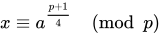
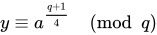
The Rabin trapdoor function is constructed using a Blum integer n=pqn = pq, where pp and qq are distinct large primes both congruent to 3 modulo 4. The public parameter is nn, while the trapdoor information consists of the prime factors pp and qq. The forward computation is defined as f(x)=x2modnf(x) = x^2 \mod n for x{0,1,,n1}x \in \{0, 1, \dots, n-1\}, which is easy to evaluate but difficult to invert without knowledge of the factors. With the trapdoor, inversion is achieved efficiently using the Chinese Remainder Theorem (CRT) by first computing square roots modulo pp and modulo qq, then combining them to obtain the four possible preimages modulo nn.[14][6] The inversion algorithm proceeds as follows. Given ciphertext y=f(x)modny = f(x) \mod n, compute the square roots modulo pp: let r=y(p+1)/4modpr = y^{(p+1)/4} \mod p, so the roots are ±rmodp\pm r \mod p (verifiable since r2ymodpr^2 \equiv y \mod p). Similarly, compute s=y(q+1)/4modqs = y^{(q+1)/4} \mod q, yielding roots ±smodq\pm s \mod q. These four combinations—(r,s)(r, s), (r,s)(r, -s), (r,s)(-r, s), and (r,s)(-r, -s)—are then lifted to modulo nn via the CRT. Specifically, solve for each pair (amodp,bmodq)(a \mod p, b \mod q) to find the unique zmodnz \mod n satisfying the system, producing the four roots ±z1,±z2modn\pm z_1, \pm z_2 \mod n. This process runs in expected time O((logp)3)O((\log p)^3) bit operations. To disambiguate and recover the unique plaintext from the four candidates, the message is encoded with redundancy, such as appending fixed bits or checksums, allowing selection of the valid root (e.g., the one matching the redundancy pattern).[15][14] The security of the Rabin trapdoor function relies on the computational difficulty of extracting square roots modulo nn without the factors, which is provably equivalent to the problem of integer factorization. In particular, an efficient inverter would allow factoring nn by repeatedly applying it to random quadratic residues, and conversely, the trapdoor enables inversion. This equivalence holds unconditionally, providing stronger security guarantees than some alternatives. Compared to the RSA trapdoor permutation, the Rabin function is simpler in structure but produces multiple preimages, necessitating padding schemes to ensure unique decryption.[6][14]

Applications

Public-Key Encryption

Trapdoor functions form the foundation of public-key encryption schemes by enabling asymmetric cryptography, where the public key corresponds to a one-way function fkf_k that is computationally easy to evaluate for encryption but hard to invert without the private trapdoor information. In this mechanism, a sender encrypts a plaintext message mm by computing the ciphertext c=fk(m)c = f_k(m), which can be sent openly since inverting fkf_k to recover mm is infeasible without the trapdoor. The receiver, possessing the trapdoor, efficiently inverts the function to decrypt cc, thereby ensuring message confidentiality without the need for prior shared secret keys. This approach underpins the security of systems where parties may not have established symmetric keys in advance.[4] A prominent example is the RSA-OAEP scheme, which leverages the RSA trapdoor permutation to achieve semantic security. In RSA-OAEP, the message is padded using Optimal Asymmetric Encryption Padding (OAEP), incorporating random bits and hash functions to produce a padded input that is then encrypted via the RSA function. This padding ensures the scheme is secure against chosen-plaintext attacks (IND-CPA) in the random oracle model, assuming the underlying RSA trapdoor permutation is one-way. Furthermore, enhancements like plaintext awareness extend security to chosen-ciphertext attacks (IND-CCA), preventing adversaries from exploiting malformed ciphertexts to learn about plaintexts.[16] The Rabin encryption scheme similarly employs the Rabin trapdoor function, based on quadratic residuosity modulo a composite, for public-key encryption. Encryption involves squaring the message (with added redundancy) modulo the public modulus n=pqn = pq, yielding a ciphertext from which the receiver computes the four possible square roots using the trapdoor (factors pp and qq). Redundancy, such as fixed padding or message hashing, is incorporated to disambiguate the correct plaintext among the multiple decryption candidates, ensuring unique recovery while maintaining semantic security under the factorization assumption. Recent constructions, like redundancy-free variants, further refine this by using extractable properties of the trapdoor to achieve IND-CCA security without explicit padding. The polynomial-time computability of trapdoor functions makes them suitable for practical deployment in real-world protocols. For instance, in the Transport Layer Security (TLS) protocol as of 2025, RSA-based schemes are used for digital signatures in server authentication, while key exchange relies on Diffie-Hellman variants; these support session establishment in hybrid modes for bulk data encryption with symmetric ciphers, providing efficiency compared to pure symmetric alternatives.[17] Despite these strengths, trapdoor-based encryption schemes are vulnerable to chosen-ciphertext attacks without appropriate padding or modes, as attackers can query decryptions of adaptively chosen ciphertexts to infer information about target messages. Proper constructions like OAEP mitigate this by binding randomness and structure to prevent such exploitation, but naive implementations remain insecure.[18]

Digital Signatures

Trapdoor functions form the basis of many digital signature schemes by enabling efficient signing with the private trapdoor while allowing public verification using the forward function. In such schemes, the signer computes a signature by inverting the trapdoor function fkf_k on a hash of the message, producing s=fk1(hash(m))s = f_k^{-1}(\text{hash}(m)), where kk is the public key and the trapdoor information enables the inversion. Verification then checks if fk(s)=hash(m)f_k(s) = \text{hash}(m), confirming the signature without revealing the trapdoor. This construction ensures that forging a signature requires inverting the one-way function without the trapdoor, which is computationally infeasible under the assumed hardness of the underlying problem.[19] The RSA Probabilistic Signature Scheme (RSA-PSS) exemplifies this approach using the RSA trapdoor permutation. In RSA-PSS, signing involves probabilistic padding of the hashed message to enhance security against existential unforgeability under chosen-message attacks (EUF-CMA). The padded hash is then inverted using the private exponent dd, yielding the signature. This padding scheme, which includes random salt and masking functions, provides provable security reductions to the RSA assumption, making it resistant to forgery even under adaptive adversaries. RSA-PSS is widely adopted due to its balance of efficiency and strong security guarantees.[20] Rabin-based signature schemes also leverage trapdoor functions, particularly the Rabin permutation f(x)=x2modNf(x) = x^2 \mod N where N=pqN = pq. In Rabin's original scheme, the signer inverts the function on a padded hash of the message using the factorization of NN as the trapdoor, producing one of four possible square roots and including redundancy to select the correct one during verification. However, these schemes suffer from ambiguity in root selection, leading to multiple valid signatures per message, which complicates uniqueness and has limited their practical use compared to RSA variants. Modern adaptations address some issues but remain less common.[6] The U.S. Federal Information Processing Standard (FIPS) 186-5, published in 2023, specifies RSA signatures with PSS as an approved method for generating and verifying digital signatures, requiring key sizes of at least 2048 bits for security levels of 112 bits or higher. This standard mandates the use of trapdoor-based algorithms like RSA for applications requiring non-repudiation and integrity in federal systems.[21] Without proper hashing and padding, plain trapdoor-based signatures like textbook RSA are vulnerable to existential forgery, where an adversary can generate a valid signature for some arbitrary message by selecting a random value ss and computing m=fk(s)m = f_k(s), as no specific message structure prevents this. Hashing binds the signature to intended messages, mitigating such attacks by ensuring the input to the trapdoor function is unpredictable without message knowledge.[22]

One-Way Functions

In cryptography, one-way functions form a foundational concept, representing functions that are computationally efficient to evaluate in the forward direction but extremely difficult to invert on average, without any special knowledge. Formally, a function f:{0,1}{0,1}f: \{0,1\}^* \to \{0,1\}^* is one-way if it is computable in polynomial time, and for every probabilistic polynomial-time adversary AA, the probability Pr[A(f(X),1X)f1(f(X))]\Pr[A(f(X), 1^{|X|}) \in f^{-1}(f(X))] is negligible, where XX is chosen uniformly at random from its domain and f1(y)f^{-1}(y) denotes the set of preimages of yy. This definition captures the intuitive notion that, for a randomly selected input, finding any valid preimage after seeing the output is infeasible for polynomial-time algorithms.[23] The existence of one-way functions remains an unresolved question in computational complexity theory, though it is a standard assumption underlying much of modern cryptography. If such functions exist, it implies that PNP\mathbf{P} \neq \mathbf{NP}, as the ability to solve NP-complete problems in polynomial time would allow efficient inversion of any purported one-way function. Conversely, P=NP\mathbf{P} = \mathbf{NP} would preclude the existence of one-way functions, rendering many cryptographic protocols insecure. This connection underscores the deep ties between cryptographic primitives and fundamental limits of computation, with ongoing research exploring weaker assumptions or derandomizations that might bridge the gap.[24] Prominent candidates for one-way functions include problems from number theory, such as integer factorization: given the product N=pqN = pq of two large primes pp and qq, computing NN is trivial, but recovering pp and qq is believed intractable for sufficiently large NN. Similarly, the discrete logarithm problem—finding xx such that gxy(modp)g^x \equiv y \pmod{p} for a prime pp, generator gg, and given yy—is easy to compute forward but hard to invert under standard cryptographic parameters. Practical approximations appear in cryptographic hash functions like SHA-256, which exhibit strong preimage resistance: given a 256-bit hash value, finding any input that produces it requires approximately 22562^{256} operations, making it effectively one-way for collision-free applications.[25][25][26] Trapdoor functions extend the one-way paradigm by incorporating a secret piece of information (the trapdoor) that enables efficient inversion, distinguishing them from plain one-way functions while building directly on their hardness properties.[27]

Security Assumptions

Trapdoor functions rely on specific computational hardness assumptions to ensure that inversion is infeasible without the trapdoor information. The RSA assumption posits that, given a modulus n=pqn = pq where pp and qq are large primes, a public exponent ee, and a ciphertext y=xemodny = x^e \mod n, there exists no probabilistic polynomial-time algorithm that can recover xx with non-negligible probability, assuming the trapdoor (the factorization of nn) is unknown. This assumption remains unproven in the sense that no full equivalence to a well-defined problem like factoring has been established, yet it underpins numerous cryptographic protocols due to its practical resilience.[28] The quadratic residuosity assumption complements this by stating that, for a composite modulus n=pqn = pq (with p,qp, q odd primes), it is computationally hard to determine whether a random element xZnx \in \mathbb{Z}_n^* is a quadratic residue modulo nn without knowledge of the factorization. This assumption serves as a foundation for trapdoor functions like those in the Goldwasser-Micali cryptosystem, where distinguishing residues enables secure probabilistic encryption. The factoring assumption, which asserts the difficulty of decomposing a large semiprime nn into its prime factors pp and qq using polynomial-time algorithms, forms the common basis for both RSA and Rabin trapdoor functions. Regarding provable security, the Rabin trapdoor function—based on modular squaring—admits a tight reduction: inverting it is computationally equivalent to factoring the modulus, providing a direct link to the factoring assumption. In contrast, the RSA trapdoor permutation lacks such a complete reduction; while partial results exist under stronger assumptions like the Phi-hiding hypothesis, full equivalence to factoring remains an open problem.[28] As of November 2025, these assumptions hold for properly sized keys (e.g., 2048-bit moduli in RSA), with no classical algorithms breaking them for such parameters despite ongoing advances in factoring techniques.[29] However, quantum computing poses a significant threat through Shor's algorithm, which can factor large integers in polynomial time on a sufficiently large fault-tolerant quantum computer, potentially rendering these trapdoor functions insecure in the post-quantum era. Current quantum hardware, even with recent optimizations lowering the qubit requirements to around one million noisy qubits for 2048-bit RSA, remains far from practical implementation.[30]

References

User Avatar
No comments yet.