



Community hub
Recent from talks
Knowledge base stats:
Talk channels stats:
Members stats:
Traveling wave reactor
A traveling-wave reactor (TWR) is a proposed type of nuclear fission reactor that can convert fertile material into usable fuel through nuclear transmutation, in tandem with the burnup of fissile material. TWRs differ from other kinds of fast-neutron and breeder reactors in their ability to use fuel efficiently without uranium enrichment or reprocessing, [dubious – discuss] instead directly using depleted uranium, natural uranium, thorium, spent fuel removed from light water reactors, or some combination of these materials. The concept is still in the development stage and no TWRs have ever been built.
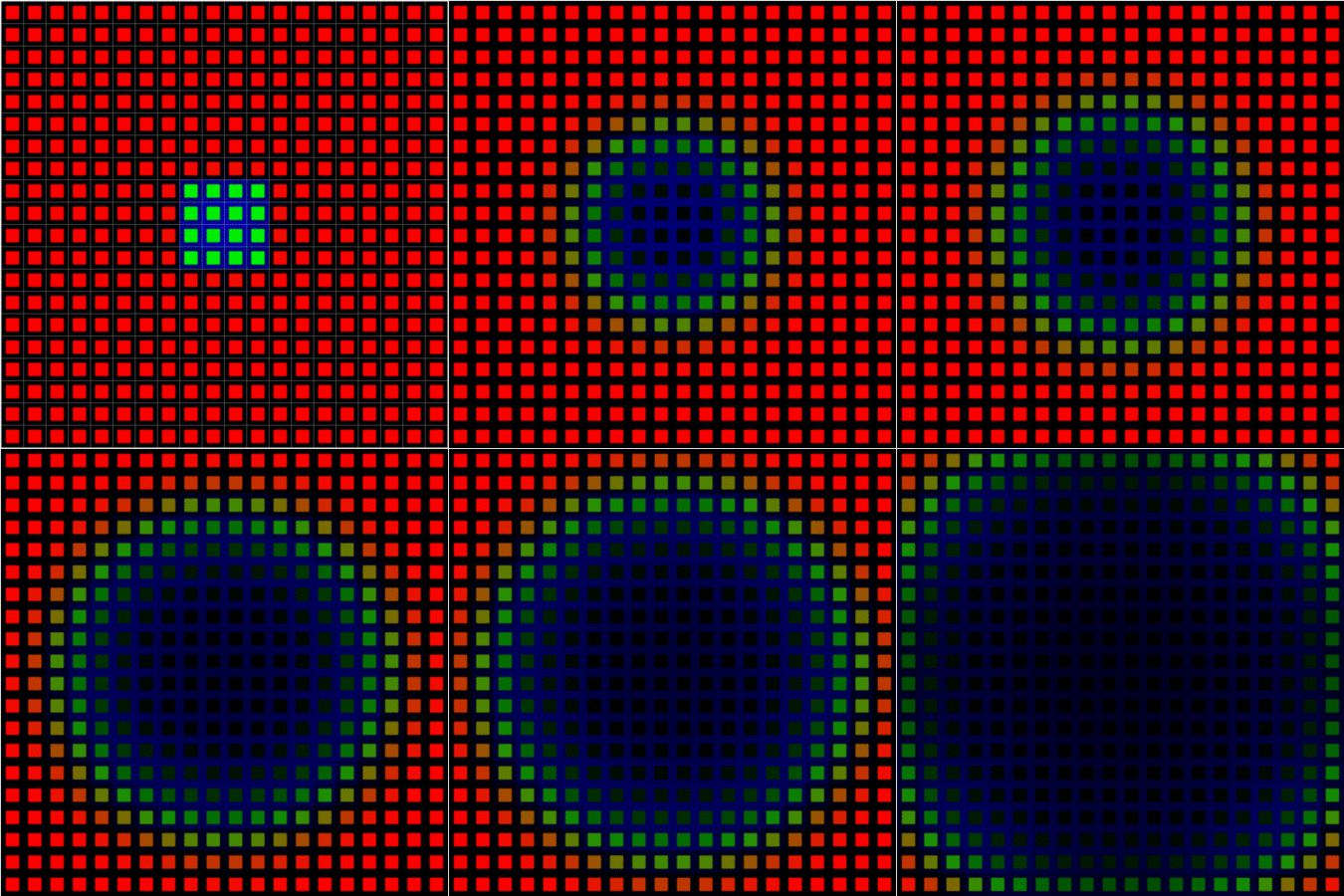
The name refers to the fact that fission remains confined to a boundary zone in the reactor core that slowly advances over time. TWRs could theoretically run self-sustained for decades without refueling or removing spent fuel.
Traveling-wave reactors were first proposed in the 1950s and have been studied intermittently. The concept of a reactor that could breed its own fuel inside the reactor core was initially proposed and studied in 1958 by Savely Moiseevich Feinberg, who called it a "breed-and-burn" reactor. Further research was published by multiple teams from the late 1970s to the early 2000s.
The TWR was discussed at the Innovative Nuclear Energy Systems (INES) symposiums in 2004, 2006 and 2010 in Japan where it was called "CANDLE" Reactor, an abbreviation for Constant Axial shape of Neutron flux, nuclides densities and power shape During Life of Energy production. In 2010 information on the case of micro-hetero-structures[definition needed] was published. In 2012 it was shown that fission waves are a form of bi-stable reaction diffusion phenomenon. It has also been shown that fission waves can be stable, unstable or undergo a Hopf birfurcation[definition needed] depending on thermal feedback.
Irradiation damage has been shown to be an obstacle to the use of conventional materials in wave reactors, but it has been shown that fuel enrichment can be used to reduce this problem.
No TWR has yet been constructed, but in 2006 Intellectual Ventures launched a spin-off named TerraPower to model and commercialize a working design of such a reactor, which later came to be called a "traveling-wave reactor". TerraPower has developed TWR designs for low- to medium- (300 MWe) as well as high-power (~1000 MWe) generation facilities. Bill Gates featured TerraPower in his 2010 TED talk.
In September 2015 TerraPower and China National Nuclear Corporation (CNNC) signed a memorandum of understanding to jointly develop a TWR. TerraPower planned to build a 600 MWe demonstration Plant, the TWR-P, by 2018 to 2022 followed by larger commercial plants of 1150 MWe in the late 2020s. However, in January 2019 it was announced that the project had been abandoned due to technology transfer limitations placed by the Trump administration.
Papers and presentations on TerraPower's TWR describe a pool-type reactor cooled by liquid sodium. The reactor is fueled primarily by depleted uranium-238 "fertile fuel", but requires a small amount of enriched uranium-235 or other "fissile fuel" to initiate fission. Some of the fast-spectrum neutrons produced by fission are absorbed by neutron capture in adjacent fertile fuel (i.e. the non-fissile depleted uranium), which is "bred" into plutonium by the nuclear reaction:
Hub AI
Traveling wave reactor AI simulator
(@Traveling wave reactor_simulator)
Traveling wave reactor
A traveling-wave reactor (TWR) is a proposed type of nuclear fission reactor that can convert fertile material into usable fuel through nuclear transmutation, in tandem with the burnup of fissile material. TWRs differ from other kinds of fast-neutron and breeder reactors in their ability to use fuel efficiently without uranium enrichment or reprocessing, [dubious – discuss] instead directly using depleted uranium, natural uranium, thorium, spent fuel removed from light water reactors, or some combination of these materials. The concept is still in the development stage and no TWRs have ever been built.
The name refers to the fact that fission remains confined to a boundary zone in the reactor core that slowly advances over time. TWRs could theoretically run self-sustained for decades without refueling or removing spent fuel.
Traveling-wave reactors were first proposed in the 1950s and have been studied intermittently. The concept of a reactor that could breed its own fuel inside the reactor core was initially proposed and studied in 1958 by Savely Moiseevich Feinberg, who called it a "breed-and-burn" reactor. Further research was published by multiple teams from the late 1970s to the early 2000s.
The TWR was discussed at the Innovative Nuclear Energy Systems (INES) symposiums in 2004, 2006 and 2010 in Japan where it was called "CANDLE" Reactor, an abbreviation for Constant Axial shape of Neutron flux, nuclides densities and power shape During Life of Energy production. In 2010 information on the case of micro-hetero-structures[definition needed] was published. In 2012 it was shown that fission waves are a form of bi-stable reaction diffusion phenomenon. It has also been shown that fission waves can be stable, unstable or undergo a Hopf birfurcation[definition needed] depending on thermal feedback.
Irradiation damage has been shown to be an obstacle to the use of conventional materials in wave reactors, but it has been shown that fuel enrichment can be used to reduce this problem.
No TWR has yet been constructed, but in 2006 Intellectual Ventures launched a spin-off named TerraPower to model and commercialize a working design of such a reactor, which later came to be called a "traveling-wave reactor". TerraPower has developed TWR designs for low- to medium- (300 MWe) as well as high-power (~1000 MWe) generation facilities. Bill Gates featured TerraPower in his 2010 TED talk.
In September 2015 TerraPower and China National Nuclear Corporation (CNNC) signed a memorandum of understanding to jointly develop a TWR. TerraPower planned to build a 600 MWe demonstration Plant, the TWR-P, by 2018 to 2022 followed by larger commercial plants of 1150 MWe in the late 2020s. However, in January 2019 it was announced that the project had been abandoned due to technology transfer limitations placed by the Trump administration.
Papers and presentations on TerraPower's TWR describe a pool-type reactor cooled by liquid sodium. The reactor is fueled primarily by depleted uranium-238 "fertile fuel", but requires a small amount of enriched uranium-235 or other "fissile fuel" to initiate fission. Some of the fast-spectrum neutrons produced by fission are absorbed by neutron capture in adjacent fertile fuel (i.e. the non-fissile depleted uranium), which is "bred" into plutonium by the nuclear reaction: