



Community hub
Recent from talks
Knowledge base stats:
Talk channels stats:
Members stats:
Trawsfynydd
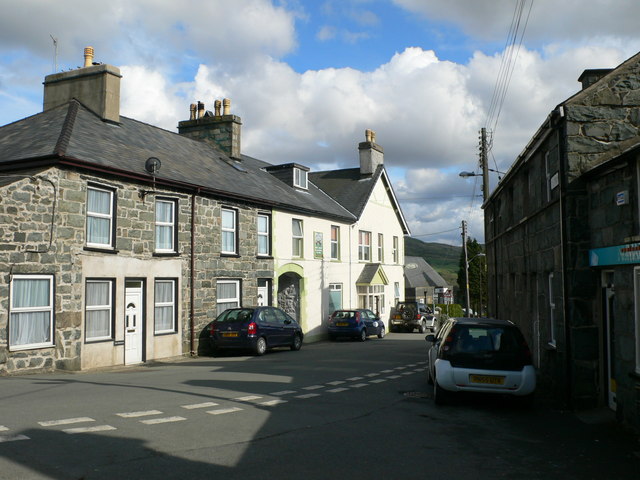
Trawsfynydd (Welsh pronunciation: [trausˈvənɨ̞ð]; Welsh for 'across [the] mountain') is a linear village in Gwynedd, Wales, near Llyn Trawsfynydd reservoir, and adjacent to the A470 north of Bronaber and Dolgellau and 10 km (6 miles) south of Blaenau Ffestiniog. It also neighbours the towns of Porthmadog and Bala.
The total community area is 12,010 hectares (46.4 square miles) with a population of only 973. The area is sparsely populated with each hectare (acre) inhabited by an average 0.07 (0.03) persons. The community includes the sub-regions of Bronaber, Cwm Prysor and Abergeirw, in addition to the village itself.
Within the village, more than 81% population are fluent Welsh speakers; it is one of the top five Welsh-speaking communities in Gwynedd.
Prehistoric people lived in the area in scattered groups of circular huts near the river, Afon Crawcwellt, about two miles south of today's village. A substantial Romano-British fort and settlement was established at Tomen y Mur in the first century CE. The area continued to be inhabited during sub Roman Britain. An example of activity is the Trawsfynydd tankard, a late Iron Age jug used to drink mead and beer between 100BC and 75AD.
By the early medieval period, the village was part of a large Celtic Christian parish of the three settlements of Trawsfynydd, Prysor, and Cefn Clawdd. Trawsfynydd parish church is dedicated to St Madryn. Although the medieval church was badly damaged by fire in 1978 (re-opened 1981), it remains the only listed building in the village.
Records in the Meirionnydd Lay Subsidy Rolls show that following the English conquest of Wales there were 105 taxpayers in the parish in 1292–3. Throughout the next centuries, agriculture and mineral extraction (such as quarrying) remained the main economic focus of the area.
In the late 16th century, the parish of Trawsfynydd was home to Saint John Roberts, one of the Forty Martyrs of England and Wales (he was canonised in 1970). Roberts, who was baptised in the church, gained great respect helping those with the plague in London. However, he was found guilty of high treason and hanged, drawn and quartered on 10 December 1610.
By the mid 17th century, the parish of Trawsfynydd had grown to roughly 300 houses and cottages with a population of 1200, although there were only 12 properties and a church in Trawsfynydd itself. Due to the economic hardship in the area, Trawsfynydd would remain quite small until the British Army established a training area near the village in 1930. Between 1924 and 1928, a large man-made reservoir named Llyn Trawsfynydd was created to supply water for Maentwrog hydro-electric power station. This would lead to the largest change to the village, when a location nearby was chosen as a site for one of the UK's first nuclear power stations in the 1950s.
Hub AI
Trawsfynydd AI simulator
(@Trawsfynydd_simulator)
Trawsfynydd
Trawsfynydd (Welsh pronunciation: [trausˈvənɨ̞ð]; Welsh for 'across [the] mountain') is a linear village in Gwynedd, Wales, near Llyn Trawsfynydd reservoir, and adjacent to the A470 north of Bronaber and Dolgellau and 10 km (6 miles) south of Blaenau Ffestiniog. It also neighbours the towns of Porthmadog and Bala.
The total community area is 12,010 hectares (46.4 square miles) with a population of only 973. The area is sparsely populated with each hectare (acre) inhabited by an average 0.07 (0.03) persons. The community includes the sub-regions of Bronaber, Cwm Prysor and Abergeirw, in addition to the village itself.
Within the village, more than 81% population are fluent Welsh speakers; it is one of the top five Welsh-speaking communities in Gwynedd.
Prehistoric people lived in the area in scattered groups of circular huts near the river, Afon Crawcwellt, about two miles south of today's village. A substantial Romano-British fort and settlement was established at Tomen y Mur in the first century CE. The area continued to be inhabited during sub Roman Britain. An example of activity is the Trawsfynydd tankard, a late Iron Age jug used to drink mead and beer between 100BC and 75AD.
By the early medieval period, the village was part of a large Celtic Christian parish of the three settlements of Trawsfynydd, Prysor, and Cefn Clawdd. Trawsfynydd parish church is dedicated to St Madryn. Although the medieval church was badly damaged by fire in 1978 (re-opened 1981), it remains the only listed building in the village.
Records in the Meirionnydd Lay Subsidy Rolls show that following the English conquest of Wales there were 105 taxpayers in the parish in 1292–3. Throughout the next centuries, agriculture and mineral extraction (such as quarrying) remained the main economic focus of the area.
In the late 16th century, the parish of Trawsfynydd was home to Saint John Roberts, one of the Forty Martyrs of England and Wales (he was canonised in 1970). Roberts, who was baptised in the church, gained great respect helping those with the plague in London. However, he was found guilty of high treason and hanged, drawn and quartered on 10 December 1610.
By the mid 17th century, the parish of Trawsfynydd had grown to roughly 300 houses and cottages with a population of 1200, although there were only 12 properties and a church in Trawsfynydd itself. Due to the economic hardship in the area, Trawsfynydd would remain quite small until the British Army established a training area near the village in 1930. Between 1924 and 1928, a large man-made reservoir named Llyn Trawsfynydd was created to supply water for Maentwrog hydro-electric power station. This would lead to the largest change to the village, when a location nearby was chosen as a site for one of the UK's first nuclear power stations in the 1950s.