


Community hub
Recent from talks
Contribute something
Nothing was collected or created yet.
Hipparchia statilinus
View on Wikipedia
| Hipparchia statilinus | |
|---|---|

| |
| Hipparchia statilinus. Male, side view | |
Scientific classification 
| |
| Kingdom: | Animalia |
| Phylum: | Arthropoda |
| Class: | Insecta |
| Order: | Lepidoptera |
| Family: | Nymphalidae |
| Genus: | Hipparchia |
| Species: | H. statilinus
|
| Binomial name | |
| Hipparchia statilinus | |

| |
| Hipparchia statilinus distribution | |
| Synonyms | |
| |

Hipparchia statilinus, the tree grayling, is a butterfly of the family Nymphalidae.
Subspecies
[edit]Subspecies include:[3][4]
Distribution
[edit]The species can be found in Central Europe, Southern Europe, North Africa, Anatolia and the Caucasus.[1][4][5]
Habitat
[edit]This butterfly can be found in dry, rocky, grassy and bushy areas[1][6] at an elevation of 0–1,400 metres (0–4,593 ft) above sea level.[7]
Description
[edit]Hipparchia statilinus has a wingspan of 60–68 millimetres (2.4–2.7 in).[7] These butterflies are rather variable, especially in the shades of brown present on the wings and in the intensity of the white bands. Usually the basic color of the upperside of the wings is dull brown in the male, lighter or ocher in the female, with a fringe on the edges. Two blind or very discreetly pupillated black eyespots are present on the forewings, while the hindwings show a very small eyespot.
The underside is marbled with ocher and dusty white bands. On the underside of each forewing there are two black eyespots ringed in yellow, the upper one with a white central spot. Between the two black eyespots there are two white spots. On the underside of the hindwings there may be a black spot near the posterior and anal margin.[6] The caterpillars are greenish-beige with green-brownish longitudinal stripes.[8]
Biology
[edit]Hipparchia statilinus is a univoltine species. The larvae feed on various common grasses of the family Poaceae (Brachypodium phoenicoides, Brachypodium retusum, Bromus erectus, Bromus sterilis, Corynephorus canescens, Dactylis glomerata, Festuca ovina, Koeleria vallesiana, Lolium rigidum, Nardus stricta, Poa annua, Stipa gigantea, Stipa parviflora, Stipa pennata, Oryzopsis canadensis, Deschampsia cespitosa, Anisantha sterilis) and of family Cyperaceae (Carex species).[1][9][4] Adults fly from June to October,[7] and can be found resting on rocky ground with closed wings, warming up.[6]
Gallery
[edit]-
 Female
 -
 Female underside
 -
 Male
Male -
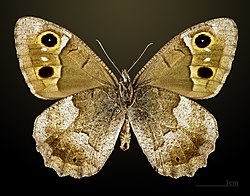 Male underside


References
[edit]- ^ a b c d Tennent, W.J. (2011). "Hipparchia statilinus". IUCN Red List of Threatened Species. 2011 e.T160360A5364211. doi:10.2305/IUCN.UK.2011-2.RLTS.T160360A5364211.en. Retrieved 20 November 2021.
- ^ Hufnagel, Johann Siegfried (1766). "Tabelle von den Tagevögeln der hiesigen Gegend, worauf denen Liebhabern der Insekten Beschaffenheit, Zeit, Ort und andere Umstände der Raupen und der daraus entstehenden Schmetterlinge bestimmt werden". Berlinisches Magazin. 2 (1): 84–85.
- ^ Biolib
- ^ a b c "Hipparchia Fabricius, 1807" at Markku Savela's Lepidoptera and Some Other Life Forms
- ^ Fauna europaea
- ^ a b c Rowlings, Matt. "Neohipparchia statilinus". euroButterflies. Retrieved 21 August 2016.
- ^ a b c Simon Coombes Captain's European Butterfly Guide Archived 2019-07-22 at the Wayback Machine
- ^ Kimmo Silvonen Larvae of North-European Lepidoptera Archived 2021-11-28 at the Wayback Machine
- ^ Encyclopedia of life
External links
[edit]

- "Hipparchia statilinus". Bestimmungshilfe des Lepiforum. Retrieved 21 August 2016.
- Paolo Mazzei, Daniel Morel, Raniero Panfili Moths and Butterflies of Europe and North Africa
- Matt Rowlings Euro Butterflies