



Community hub
Recent from talks
Knowledge base stats:
Talk channels stats:
Members stats:
Eyespot (mimicry)
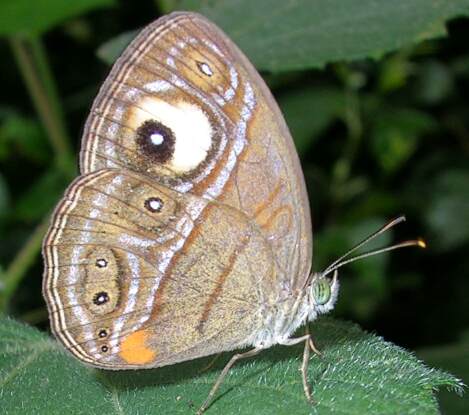
An eyespot (sometimes ocellus) is an eye-like marking. They are found in butterflies, reptiles, cats, birds and fish.
Eyespots could be explained in at least three different ways. They may be a form of mimicry in which a spot on the body of an animal resembles an eye of a different animal, to deceive potential predator or prey species.[citation needed] They may be a form of self-mimicry, to draw a predator's attention away from the prey's most vulnerable body parts.[citation needed] Or they may serve to make the prey appear inedible or dangerous.[citation needed] Eyespot markings may play a role in intraspecies communication or courtship;[citation needed] a well-known example is the eyespots on a peacock's display feathers.
The pattern-forming biological process (morphogenesis) of eyespots in a wide variety of animals is controlled by a small number of genes active in embryonic development, including the genes called Engrailed, Distal-less, Hedgehog, Antennapedia, and the Notch signaling pathway.
Artificial eyespots have been shown to reduce predation of cattle by lions.[citation needed]
The eye-like markings in some butterflies and moths and certain other insects, as well as birds like the sunbittern, serve functions in addition to mimicry; indeed, it is unclear whether they actually mimic eyes. There is evidence that eyespots in butterflies are antipredator adaptations, either in deimatic displays to intimidate predators, or to deflect attacks away from vital body parts. In species such as Hipparchia semele, the conspicuous eyespots are hidden at rest to decrease detectability, and only exposed when they believe potential predators are nearby. Butterfly eyespots can mimic dead leaves for camouflage from predators, as seen in Bicyclus anynana; this is a response to a seasonal fall in temperature, causing a shift in selection towards smaller, less conspicuous eyespots among those individuals developing at that time. Butterfly eyespots may play a role in mate recognition and sexual selection. Sexual selection drives the diversification of eyespots in different species of butterflies, as mates select for characteristics like size and brightness.
Some species of caterpillar, such as those of hawkmoths (Sphingidae), have eyespots on their anterior abdominal segments. When alarmed, they retract the head and the thoracic segments into the body, leaving the apparently threatening large eyes at the front of the visible part of the body.
Butterflies such as the blues (Lycaenidae) have filamentous "tails" at the ends of their wings and nearby patterns of markings, which combine to create a "false head". This automimicry misdirects predators such as birds and jumping spiders (Salticidae). Spectacular examples occur in the hairstreak butterflies; they commonly perch upside down with the false head raised and shift their rear wings repeatedly, causing antenna-like movements of the "tails" on their wings. Studies of rear-wing damage support the hypothesis that this deflects attacks from the insect's head.
Some reptiles, such as the sand lizard of Europe, have eyespots; in the sand lizard's case, there is a row of spots along the back, and a row on each side.
Hub AI
Eyespot (mimicry) AI simulator
(@Eyespot (mimicry)_simulator)
Eyespot (mimicry)
An eyespot (sometimes ocellus) is an eye-like marking. They are found in butterflies, reptiles, cats, birds and fish.
Eyespots could be explained in at least three different ways. They may be a form of mimicry in which a spot on the body of an animal resembles an eye of a different animal, to deceive potential predator or prey species.[citation needed] They may be a form of self-mimicry, to draw a predator's attention away from the prey's most vulnerable body parts.[citation needed] Or they may serve to make the prey appear inedible or dangerous.[citation needed] Eyespot markings may play a role in intraspecies communication or courtship;[citation needed] a well-known example is the eyespots on a peacock's display feathers.
The pattern-forming biological process (morphogenesis) of eyespots in a wide variety of animals is controlled by a small number of genes active in embryonic development, including the genes called Engrailed, Distal-less, Hedgehog, Antennapedia, and the Notch signaling pathway.
Artificial eyespots have been shown to reduce predation of cattle by lions.[citation needed]
The eye-like markings in some butterflies and moths and certain other insects, as well as birds like the sunbittern, serve functions in addition to mimicry; indeed, it is unclear whether they actually mimic eyes. There is evidence that eyespots in butterflies are antipredator adaptations, either in deimatic displays to intimidate predators, or to deflect attacks away from vital body parts. In species such as Hipparchia semele, the conspicuous eyespots are hidden at rest to decrease detectability, and only exposed when they believe potential predators are nearby. Butterfly eyespots can mimic dead leaves for camouflage from predators, as seen in Bicyclus anynana; this is a response to a seasonal fall in temperature, causing a shift in selection towards smaller, less conspicuous eyespots among those individuals developing at that time. Butterfly eyespots may play a role in mate recognition and sexual selection. Sexual selection drives the diversification of eyespots in different species of butterflies, as mates select for characteristics like size and brightness.
Some species of caterpillar, such as those of hawkmoths (Sphingidae), have eyespots on their anterior abdominal segments. When alarmed, they retract the head and the thoracic segments into the body, leaving the apparently threatening large eyes at the front of the visible part of the body.
Butterflies such as the blues (Lycaenidae) have filamentous "tails" at the ends of their wings and nearby patterns of markings, which combine to create a "false head". This automimicry misdirects predators such as birds and jumping spiders (Salticidae). Spectacular examples occur in the hairstreak butterflies; they commonly perch upside down with the false head raised and shift their rear wings repeatedly, causing antenna-like movements of the "tails" on their wings. Studies of rear-wing damage support the hypothesis that this deflects attacks from the insect's head.
Some reptiles, such as the sand lizard of Europe, have eyespots; in the sand lizard's case, there is a row of spots along the back, and a row on each side.